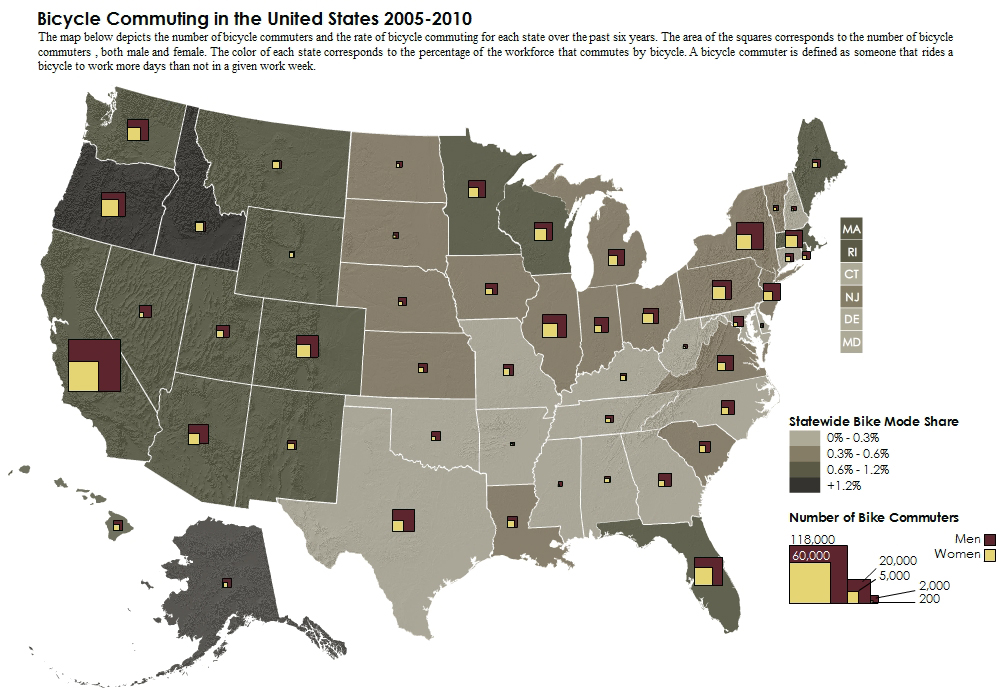
The American landscape changed dramatically in the twentieth century due to a steady increase of and reliance on automobiles. Public and private transportation needs were met with automotive solutions while the vast majority of government spending went towards construction and improvement of roadways. As a result, the nation’s main transportation system and built environments have become difficult to navigate by methods other than the automobile. This reality is highlighted by the fact that forty percent of all automobile trips in cities are less than two miles, a distance easily covered on a bicycle. While the American road network is world-class, it is steadily deteriorating and the funding to make much-needed improvements is dwindling. In addition to the lack of funding, automobile travel has been associated with a host of other issues including climate change and obesity. Bicycle transportation has received significant attention in recent years due to its potential to increase mobility, alleviate traffic congestion, reduce negative environmental impacts, increase energy independence, and combat public health issues. In a time when local, state, and national governments face daunting budget deficits, investments in bicycle transportation have become even more lucrative and cost-efficient. Hundreds of miles of bicycle infrastructure can be built for the same price as one mile of a four-lane urban highway. One hundred miles of bicycle infrastructure is enough to create a sea change of mobility for people living without access to cars or wanting to travel by other methods. Encouraging people to move away from the automobile cannot happen without having affordable, comprehensive, and safe alternatives in place. Studies have shown that communities making serious efforts to encourage bicycling have seen larger gains in bicycle commuting and safety than communities that don’t actively support bicycling. Additionally, some of these communities are seeing increased economic activity due to bicycle-related businesses and tourism. All of this shows that Americans are responsive to utilizing bicycle infrastructure once it becomes convenient and safe. Bicycle transportation is not the panacea for all transportation challenges, but if used in combination with other transportation solutions it will continue creating positive changes nationwide. Looking domestically and internationally, it is evident that reliance on automobiles (and their associated problems) can be reduced through increased bicycle infrastructure. However, none of the gains are possible without significant government investments. Data related to bicycle commuting and transportation is scattered among a variety of sources and accessing it can be non-intuitive. Additionally, the data itself is rather dense and number-heavy. Assembling the disparate data in one location and in a manner that is more easily digestible is important to informing policymakers and the public about these issues. My visualization attempts to accomplish those tasks. This series of five interactive graphics highlights the increases in bicycle commuting and safety correlated to increases in government spending. The take-home message is that increased government spending on bicycle infrastructure leads to more people commuting by bicycle and safer conditions for all bicyclists. From 2004 to 2009, the total number of bicycle commuters nearly doubled while total federal spending on bicycle infrastructure nearly tripled. Visual representations of data often allow the viewer to draw conclusions that may otherwise go unnoticed. For instance, comparing the bicycle-commuting map and the bicyclist fatality map, one can see that the highest rates of bicyclist fatalities occur in states with lower bicycle commuting rates. While someone may realize this from looking at the tabular data, it stands out much more readily when displayed graphically. While making this visualization, I was frustrated with the lack of bicycle-related data and the discrepancies that exist between that available data. While the American Community Survey data is the best estimate of bicycling levels, it only encompasses commuting and fails to include people who utilize bicycles for non-work-related travel. With more robust datasets, it would be easier to assess the state of bicycle transportation in America and make a stronger case for increased spending.
Bicycle Commuting Trends in the United States
A data visualization depicting bicycle commuting stats over the past few decades.
Updates

Leave feedback in the comments!
Log in or sign up for Devpost to join the conversation.