Inspiration
AI tools write convincing references that don't exist. In early 2026 GPTZero reported 100 hallucinated citations in accepted NeurIPS 2025 papers, all of which had passed peer review. A student faces the same risk with less margin: one invented source in a thesis can become an academic integrity case. Checking a long bibliography manually is time-consuming.
What it does
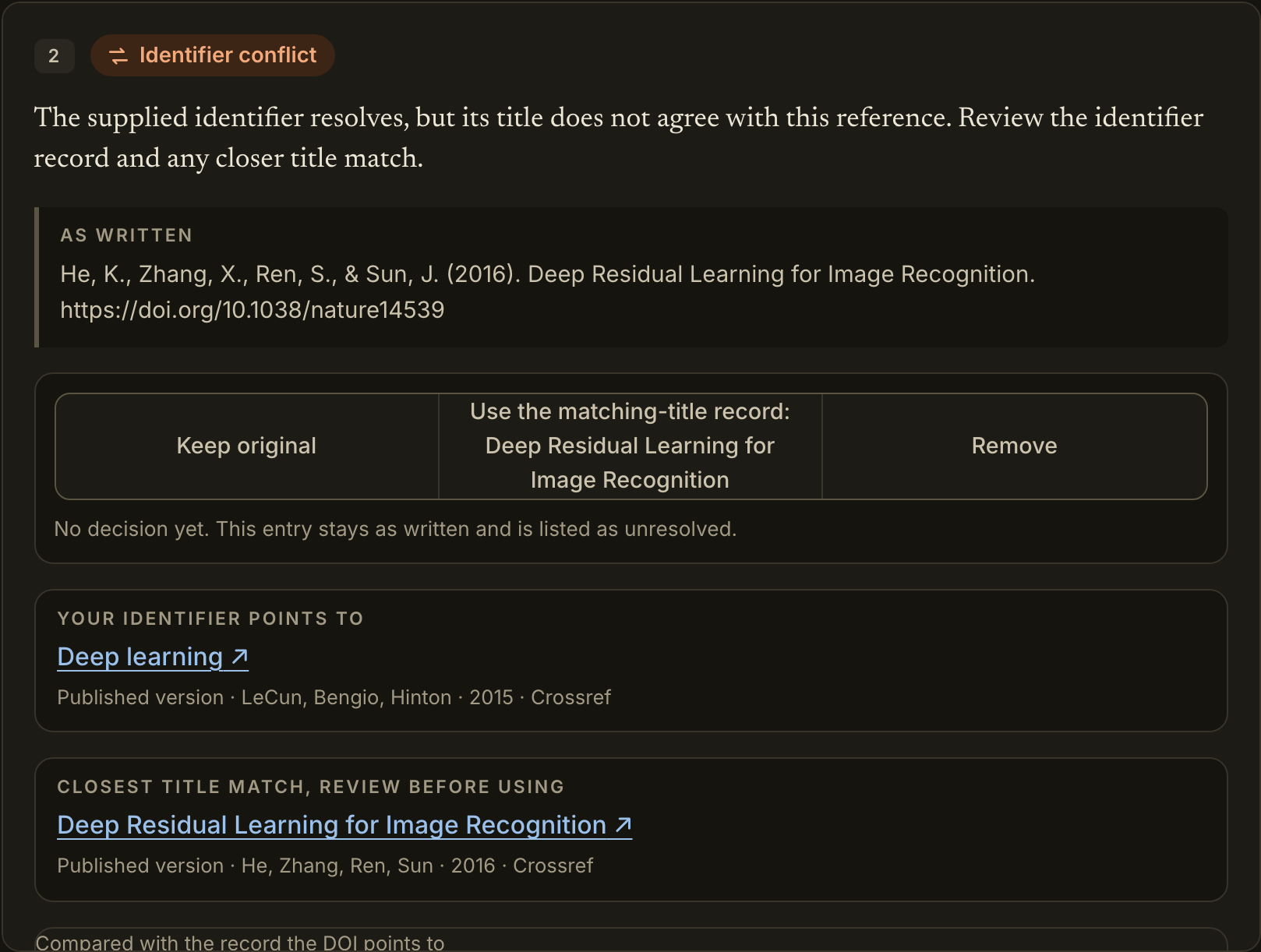
A DOI can work and still identify the wrong paper. Bibproof shows the mismatch and traces your chosen correction to the sentences that cite it.
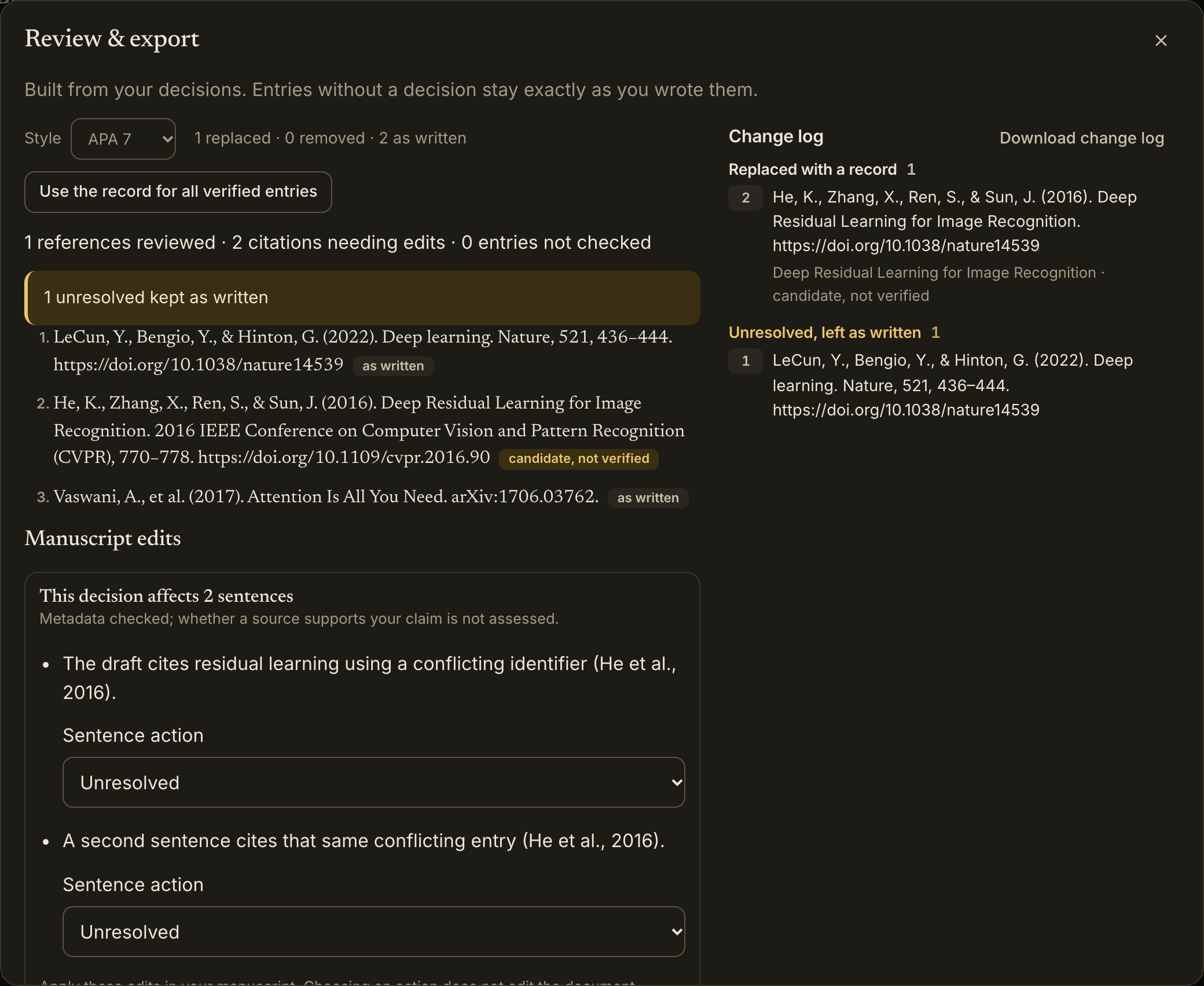
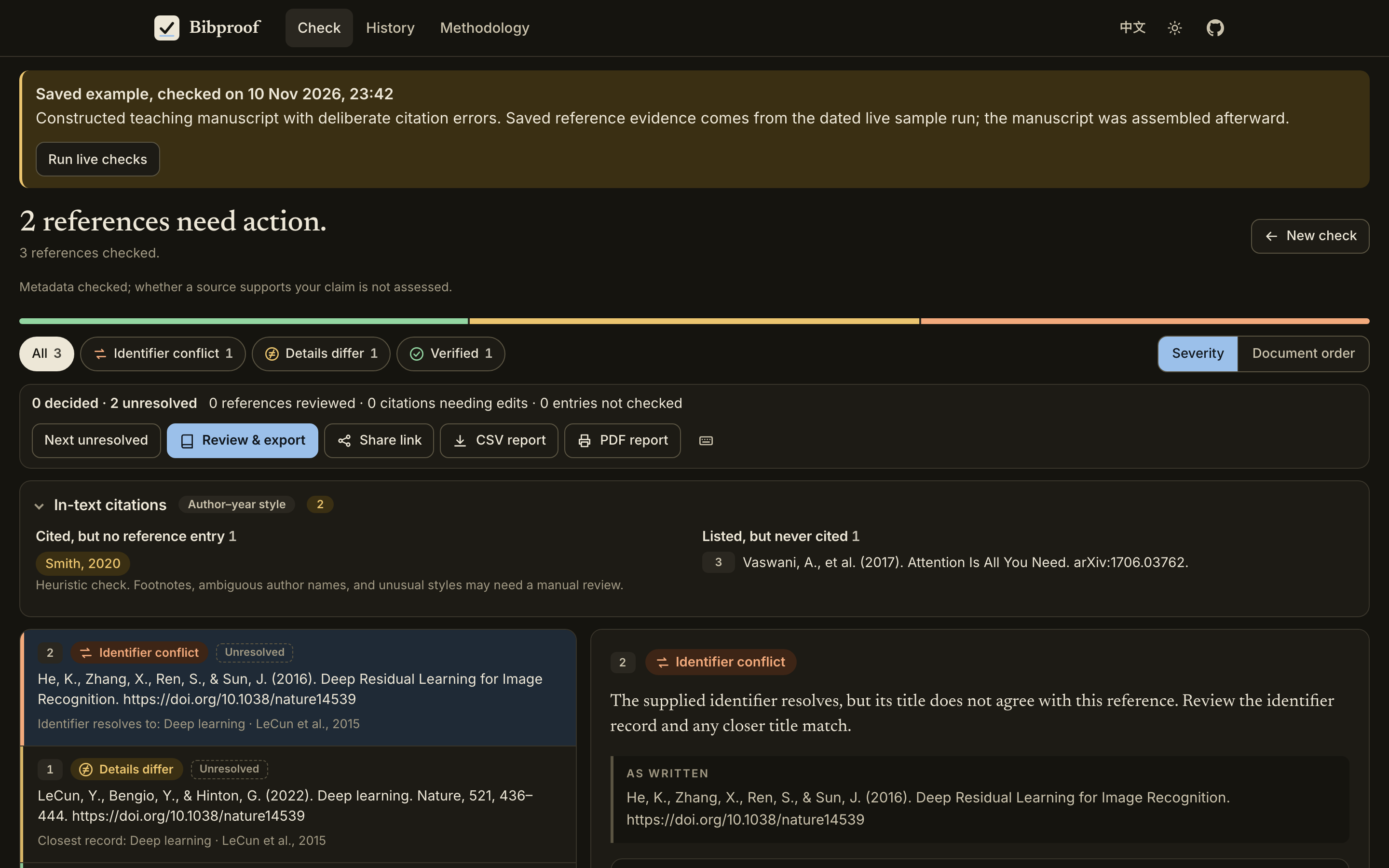
Try the complete workflow: open the live app → Try a paper → select the He et al. reference → Use the matching-title record → Review & export. The example opens from a dated saved live run; Run live checks queries the indexes again.
Paste a bibliography, drop in a paper (.docx, .pdf, .bib, .ris, .txt) or enter a DOI. Bibproof checks every reference against the scholarly record and gives one of six verdicts: Verified, Details differ, Identifier conflict, Retracted, No record found, or Could not check.
Every verdict shows its evidence: the matched record with a link, and a side-by-side of what you wrote against what the record says. It catches the fakes a quick search misses, such as a real title with the wrong authors, or a real DOI that belongs to another paper.
Then it helps you fix them. Problems come first, worst at the top, and you can work through them from the keyboard: keep the entry, use the record, pick a close real record as a candidate, or remove it. Build a bibliography from your review decisions, with a change log and a checklist of manuscript edits to apply yourself, in APA, MLA, Chicago, IEEE or Harvard. Unresolved entries remain clearly marked.
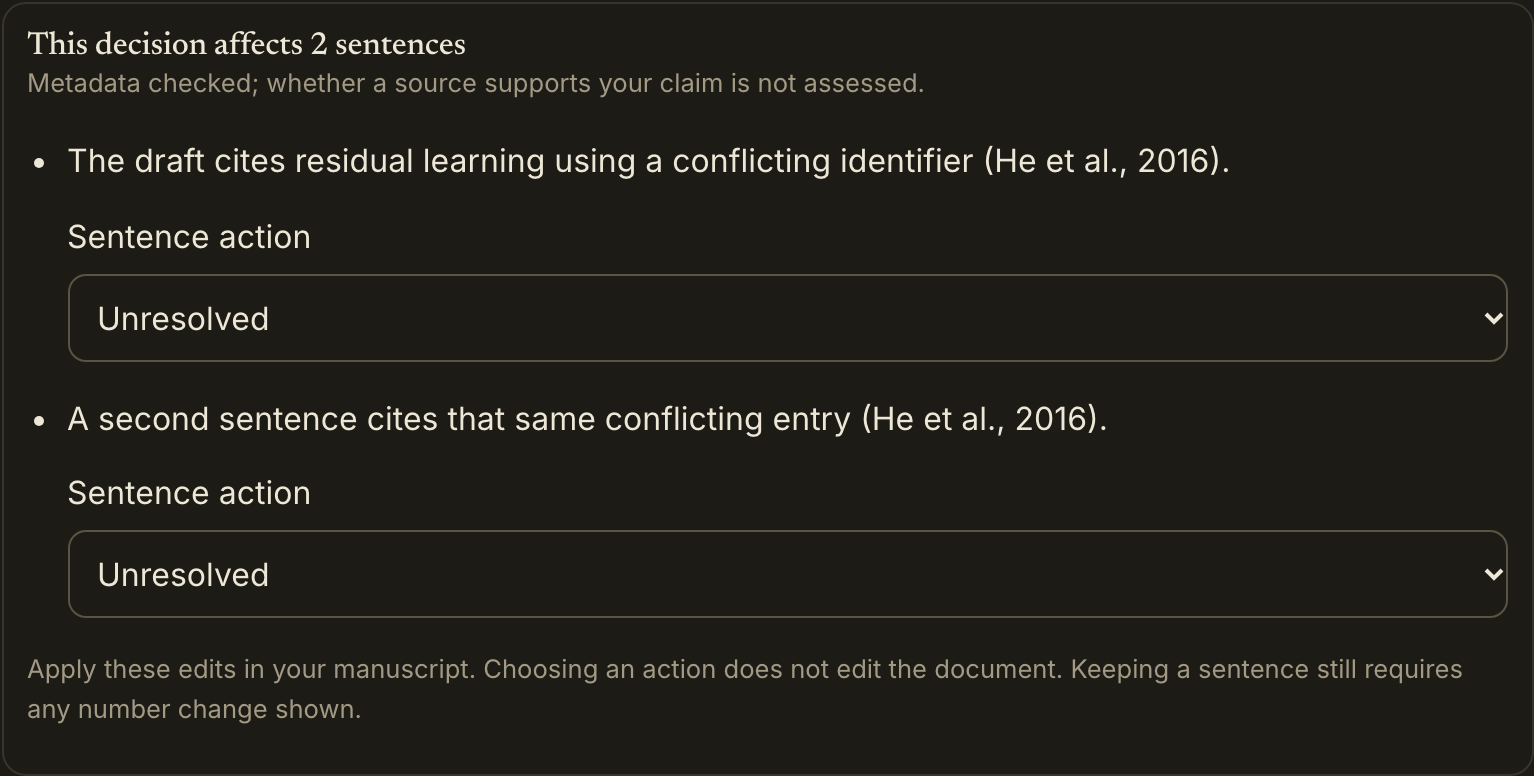
In a full paper it cross-checks in-text citations against the reference list both ways. When you remove or replace a source, it shows what that decision changes in your manuscript: "This decision affects 2 sentences", the citation numbers that moved ([3] → [2]) and author–year labels that need editing, as a checklist you can export with the corrected bibliography.
Documents are parsed locally. You review the extracted entries before checking; only the approved reference text is sent to public indexes. If an index has no record of a real source, you can attach what you found as user-reviewed evidence, kept separate from the automatic verdict.
For entries it cannot check, it never guesses. It gives direct search links to CNKI, Wanfang, Baidu Scholar and Google Scholar. The whole interface is available in English and Chinese.
There is no account and no Bibproof usage cap (public-index limits apply), and the retraction check is free. Past checks stay in your browser, and a result can be shared as a link whose data sits in the URL fragment, which browsers do not send to servers.
It is for students, researchers and anyone who has to stand behind a reference list.
Click Try a sample to see each failure type on real records, or Try a paper for the full-manuscript workflow. Both open instantly from a dated saved run, with a button to re-run the checks live.
Setup
None for judges: open the link and click Try a sample or Try a paper. To run it locally: npm ci, then npm run dev. It needs no accounts or keys.
How I built it
It is a static TypeScript and React app with no backend. The verification core is plain TypeScript, so the same code runs in the browser and in a Node evaluation harness.
- Extraction: pdf.js and mammoth.js read documents locally. PDF lines and columns are rebuilt from positioned text.
- Lookup: identifiers first, then Crossref, then OpenAlex, Europe PMC and Open Library, through per-host queues that respect each rate limit, with answers cached in IndexedDB.
- Scoring: candidates are compared with the raw reference text instead of a parsed guess, which makes it robust to citation style.
- Corrections: Citation.js and CSL styles.
Challenges
The hardest part was not catching fakes but avoiding false accusations. A first version looked perfect on references I generated from clean metadata. So I tested it on strings real authors typed, taken from reference lists deposited with Crossref. It wrongly called 3 of 57 genuine references fabricated, including entries in medical style with no title at all, and one whose author had misquoted a subtitle. I added a check on volume, first page and first author, and a rule that an entry with no stated title can never be called fabricated. False accusations on that set went to zero.
The first full held-out run then found one more: a preprint cited under a title that differs from its record, although every author and the year matched. That pattern now returns "Details differ". The rule came from that set, so I then froze the rules and drew 60 more real references. That batch produced one false accusation, a book chapter cited only by its book title. I left it as measured instead of tuning it away.
Adversarial testing exposed identity, extraction and manuscript-edit failures; reproduced cases became regression checks.
Evaluation
A false accusation below means a genuine reference that received "No record found".
- 240 formatting trials across 60 genuine works held out from tuning: 0 false accusations.
- 60 references as real authors typed them, drawn after the rules were frozen: 58 matched, 1 could not be checked, 1 false accusation.
- 60 synthetic fabrications: 59 flagged for review, including 15/15 invented papers, 15/15 chimeras and 15/15 wrong DOIs.
- GPTZero's published list of 100 hallucinated NeurIPS citations: 98 flagged, 0 marked verified, 2 could not be checked.
External benchmark. On a predeclared 400-entry sample from HALLMARK v1.2.4 test_public, frozen build a9b6fa1 achieved 87.1% detection, 35.1% false-positive rate and 83.3% F1, with 97.8% coverage. "Details differ" counts as a flag, so metadata warnings on genuine references count as false positives here; "Could not check" is an abstention excluded from these metrics. False warnings on author names, venues and preprint versions informed changes in 67abc39. A separate evaluation of the other 431 test entries, excluded from that error analysis, is in progress. Predictions and protocol are in the repository.
What I learned
"Not found" and "fake" are different claims, and a tool has to keep them apart. An index outage or a coverage gap is not evidence. Testing on my own synthetic data would have hidden the failures that matter most.
What's next
Reduce false warnings on genuine references and publish the completed external evaluation.
Limitations
Books, reports, web pages and non-Latin scripts have uneven coverage and often return "Could not check"; book chapters cited only by their book title can be missed. A missing record can still be real, so "No record found" tells you to check by hand. Bibproof checks that a source exists and is cited accurately, not that it supports the claim. The synthetic evaluation set comes from Crossref, the same index used for lookup. OpenAlex allows about 100 anonymous searches per network per day.
Contributions, prior work and AI disclosure
Solo project by Yi Yu. All project code was written during the event, in November 2026; nothing predates it. AI coding assistants (Claude Code and OpenAI Codex) wrote much of the code under my direction; I chose the product, set the evaluation design and reviewed the results.
Open-source components: React, Vite, pdf.js (Apache-2.0), mammoth.js (BSD-2-Clause), Citation.js (MIT), CSL styles (CC BY-SA 3.0), Inter and Newsreader fonts (OFL). Data: Crossref, DataCite, OpenAlex, Europe PMC, Open Library. The real-world test set is GPTZero's published NeurIPS 2025 list, and its labels are GPTZero's own.
Built With
- citation.js
- crossref
- datacite
- europe-pmc
- github
- mammoth.js
- open-library
- openalex
- pdf.js
- radix-ui
- react
- typescript
- vite
