-
-
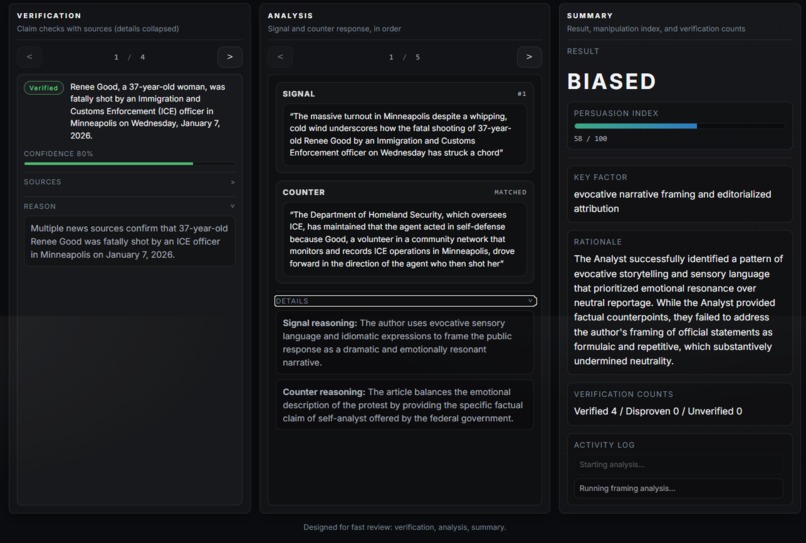
Output console
-
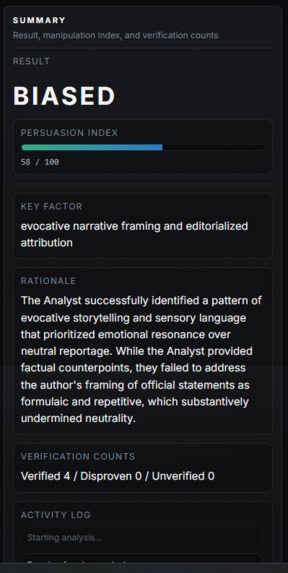
Analysis column
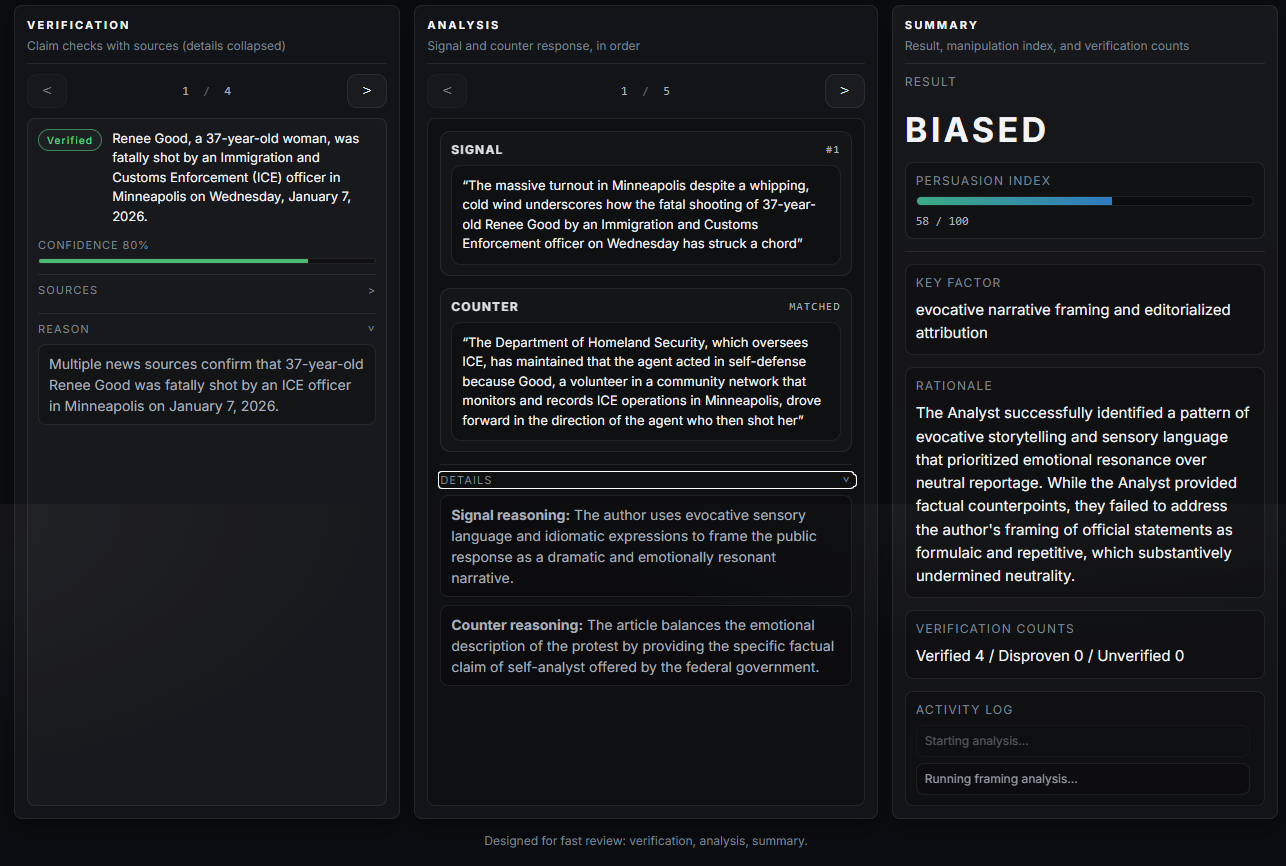
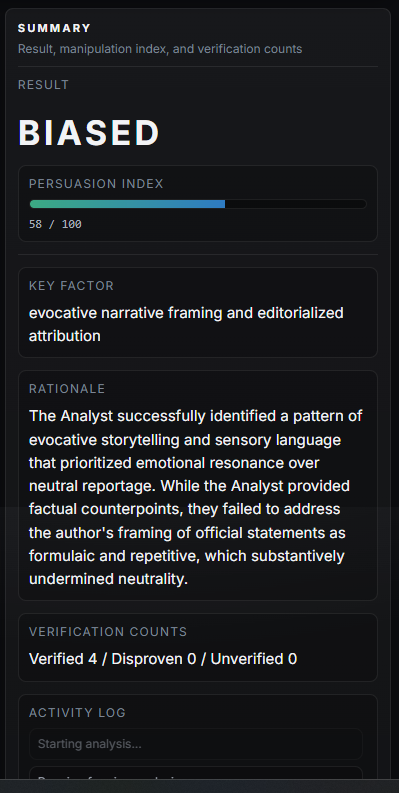
About the Project
I built BiasLens because I kept running into the same problem when reading the news.
A lot of articles felt subtly manipulative, oddly emotional and loaded but it was hard to tell if I was reacting to real facts or the way the story was being told.
Most tools today only label articles as biased or neutral. They do not show how the bias happens. They also do not check whether the most important claims in the article actually hold up. I wanted to build something that could do both. I wanted a system that could show the framing and also verify the facts at the same time.
What BiasLens Does
BiasLens analyzes a news article in two ways at once.
First, it looks at the language and framing of the article. It finds emotionally loaded words, selective wording, and patterns that can shape how the reader feels about an event.
Second, it extracts the most important factual claims from the article and checks them against real online sources. Each claim is marked as supported, contradicted, or unverified, along with confidence and evidence links so the user can see where the information comes from.
The goal is not to tell people what to believe. The goal is to give people clearer visibility into how stories are written and whether their key facts actually hold up.
How I Built It
BiasLens is built using an agentic system, meaning that instead of relying on one large model to do everything, the work is split between multiple specialized agents that interact, delegate tasks and come to an agreement.
Each agent has a focused role:
- One agent analyzes framing and emotionally loaded language
- A counterpart argues it
- Another agent extracts key factual claims
- Another agent retrieves real online sources
- A synthesis agent combines the results into a final verdict
This approach is still mostly seen in research projects and experimental systems. Most consumer tools do not use agentic pipelines yet. Building BiasLens this way makes the analysis more structured, more transparent, and easier to expand in the future.
What I Learned
While building BiasLens, I learned that real world fact checking is much harder than simple classification.
It is not enough to label something as biased. You need to search for evidence, compare sources, deal with missing information, and make sure the system does not hallucinate answers.
Challenges
Some of the biggest challenges were:
- Preventing incorrect source selection which led to resource waste
- Getting reliable evidence for breaking news
- Keeping the system fast enough to feel usable
- Designing an interface that explains complex analysis simply
Future Direction
In the future, I want to continue developing BiasLens into a real transparency tool for reading the news.
Built With
- css
- gemini
- google-cloud
- html
- javascript
- llms
- netlify
- render
- you.com

Log in or sign up for Devpost to join the conversation.