-
-
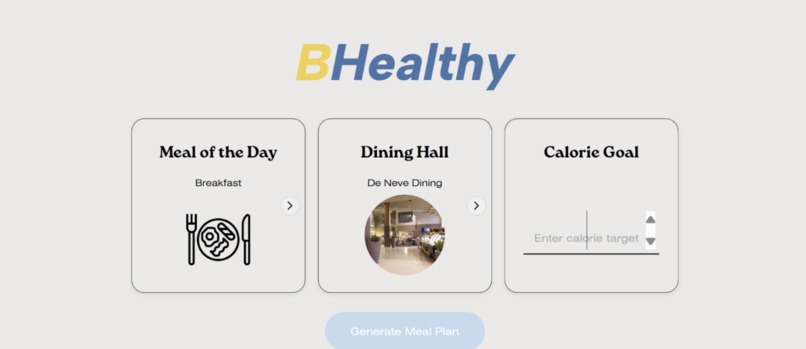
BHealthy UI
Inspiration
At UCLA dining halls, it is surprisingly easy to lose track of how much you are eating. Many students, ourselves included, end up overeating or undereating because tracking calories manually takes too long. College life is busy, with many college students sporting messy, packed Google Calendars. No one wants to do math before every meal or even spend the brain power to choose from the plethora of dining options after a long day of classes and clubs.
What it does
BHealthy makes that process effortless: in under 10 seconds, students can generate quick personalized meal recommendations that fit with their health goals using AI.
How we built it
During the hackathon, our team learned how to build a full-stack web application integrated with AWS Bedrock for generative AI. Our frontend, built with React and implemented with AWS S3, communicates with the Node.js backend through JSON-formatted requests. We use AWS Lambda REST APIs for AI calls, and AWS EC2 for backend webscraping. Our workflow involved GitHub for version control and collaboration and Amazon Q to speed up our development process.
Challenges we ran into
We faced several challenges, including configuring AWS Lambda’s module system (CommonJS versus ES Modules), preventing unnecessary file uploads such as node_modules to GitHub, and fine-tuning AI prompts so the model would return balanced and appealing meals instead of only vegetables or high-calorie options.
Accomplishments that we're proud of
We are most proud of being able to demo a live working MVP during the pitch presentation, given the short amount of time we had to develop our product.
What we learned
Throughout the hackathon, we learned how to build and deploy a full-stack web application using multiple AWS services, including Bedrock, Lambda, EC2, and S3. We gained hands-on experience with integrating generative AI into a real product, handling API communication between the frontend and backend, and troubleshooting deployment and configuration issues.
What's next for BHealthy
Looking ahead, we plan to expand beyond calorie tracking to prioritize macronutrient balance, improve AI prompt design for more diverse and realistic meal outputs, and make BHealthy extensible to other on-campus dining and other universities.
Built With
- aws-lambda
- bedrock
- ec2
- express.js
- git
- javascript
- node.js
- react
- s3

Log in or sign up for Devpost to join the conversation.