-
-
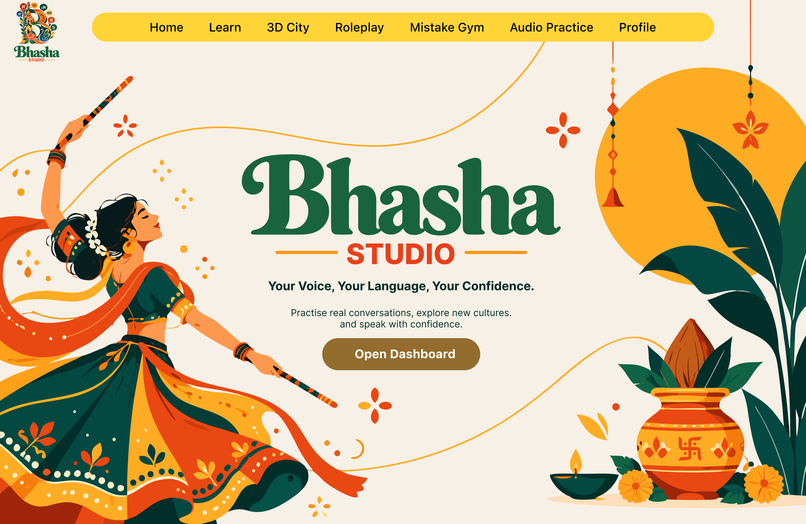
Main Landing Page
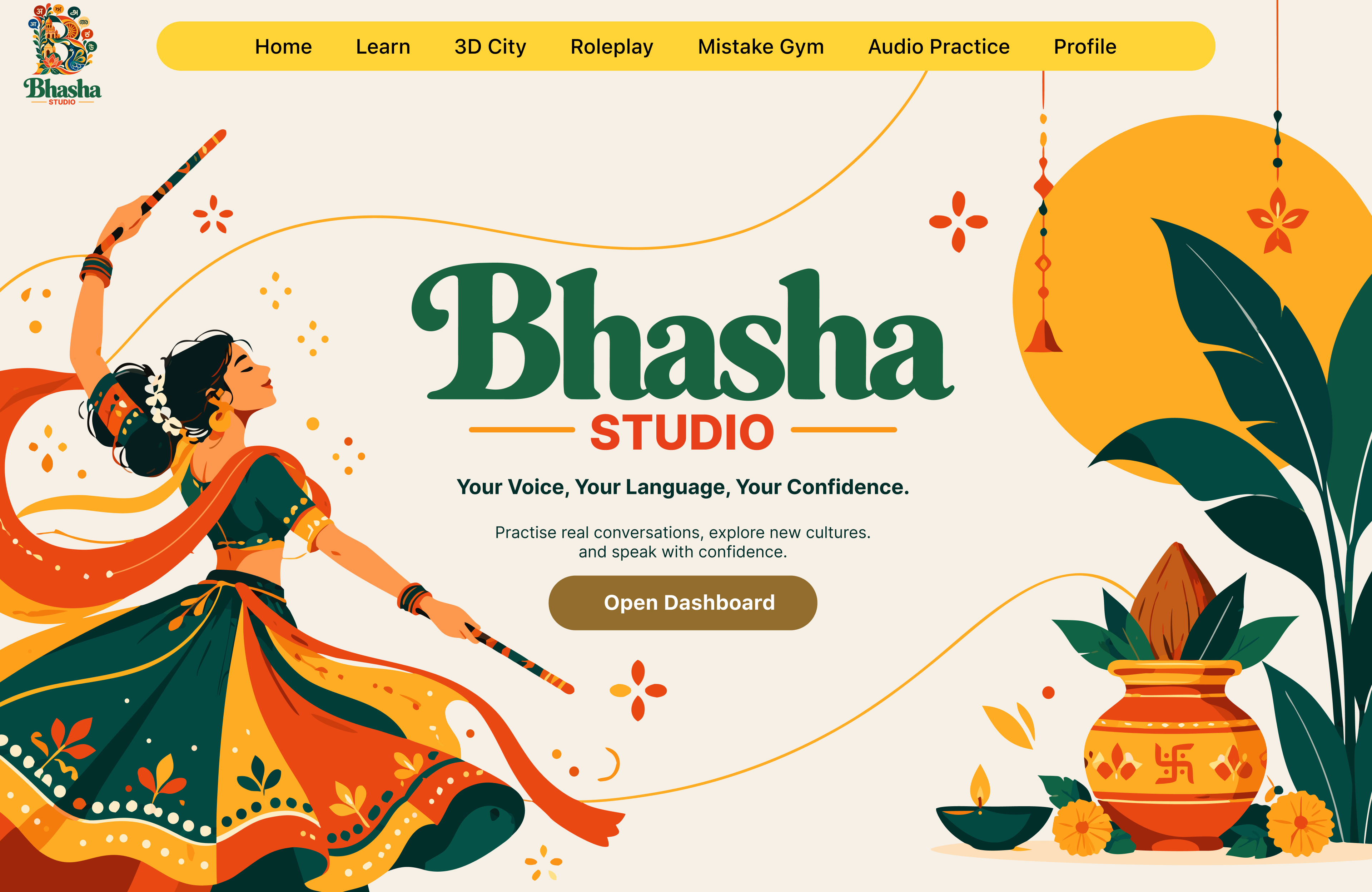
Bhasha Studio – Team Hogwarts
1. Inspiration
India is home to diverse languages, cultures, and accents, yet millions of learners hesitate to speak English or regional languages confidently. Fear of making mistakes, being judged, and the high cost of speaking coaches often prevent people from practising.
We were inspired to bridge this gap by creating a platform where anyone can practise speaking freely, make mistakes without hesitation, and build confidence through realistic AI-powered conversations. Our vision is to make language learning practical, accessible, and culturally relevant.
2. What it does
Bhasha Studio is an AI-powered, voice-first language learning platform that helps users improve their speaking confidence through interactive, real-world conversations.
Key features include:
- AI-powered roleplay conversations for everyday situations, interviews, shopping, travelling, and workplace interactions.
- Multilingual support for English, Hindi, and regional Indian languages, including accents and code-switching.
- Instant pronunciation feedback with corrections for grammar, fluency, and vocabulary.
- Personalized learning paths based on individual goals, skill levels, and weaknesses.
- A judgement-free environment to practise speaking without fear of embarrassment.
- Gamified learning through XP, badges, streaks, and progress tracking.
- Career-focused practice for interviews, client calls, and professional conversations.
3. How we built it
We built Bhasha Studio using a modern web technology stack, combining AI language models, speech technologies, and interactive learning experiences.
- Frontend: React 19, Next.js 14, TypeScript, and Tailwind CSS.
- UI/UX:Figma and Antigravity.
- AI Engine: Google Gemini API, Sarvam AI, and optional OpenAI integrations.
- Voice Processing: Sarvam Speech API, Web Speech API, and audio processing.
- Backend:Next.js API Routes, Node.js, Express, and WebSockets.
- Database: Supabase (PostgreSQL), IndexedDB, and Redis.
- Interactive Learning: React State, Framer Motion, Chart.js, and Lottie.
- Deployment & Testing:GitHub, Vercel, Jest, Vitest, and Playwright.
The platform connects AI-powered conversations with speech processing, personalized feedback, and progress tracking to create an engaging, speaking-first learning experience.
4. Challenges we ran into
Building Bhasha Studio involved several technical and design challenges:
- Handling different Indian languages, regional accents, and natural code-switching.
- Maintaining smooth, real-time voice conversations with minimal response delays.
- Providing meaningful pronunciation feedback instead of generic corrections.
- Designing personalized learning paths that identify individual weaknesses.
- Creating culturally relevant scenarios based on everyday Indian conversations.
- Integrating multiple AI, speech, backend, and frontend services into one seamless experience.
5. Accomplishments that we're proud of
We are proud to have conceptualized a speaking-first language learning platform that focuses on practical communication rather than traditional memorization.
- Designed an AI-powered multilingual speaking companion.
- Incorporated realistic roleplay scenarios into the learning experience.
- Developed a personalized learning and feedback approach.
- Focused on Indian accents, regional languages, and code-switching.
- Introduced gamification through XP, streaks, badges, and progress tracking.
- Designed a scalable architecture combining AI, voice technologies, and modern web development.
Most importantly, we transformed a common communication barrier into an opportunity for accessible, confidence-driven learning.
6. What we learned
Throughout this project, we gained valuable experience in combining artificial intelligence with practical, user-focused problem-solving.
- Explored how AI language models can power contextual and interactive conversations.
- Learned about speech-to-text and text-to-speech technologies for multilingual applications.
- Understood the challenges of real-time voice processing and pronunciation feedback.
- Improved our knowledge of full-stack development and API integration.
- Recognized the importance of personalization, accessibility, and user experience in educational technology.
- Strengthened our teamwork, research, and problem-solving skills.
We learned that effective language learning is not just about understanding words; it is about having the confidence to use them.
7. What's next for Bhasha Studio
Our vision is to evolve Bhasha Studio into a comprehensive AI-powered communication and language learning ecosystem.
- Expanded Language Support: Introduce more Indian regional and international languages.
- **Advanced Accent Analysis:Improve pronunciation assessment and accent-specific feedback.
- Live Conversation Mode: Enable more natural, uninterrupted, real-time AI conversations.
- AI Interview Simulator: Provide industry-specific mock interviews with detailed performance analysis.
- Adaptive Learning Engine: Generate increasingly personalized practice sessions using learning history.
- Community Learning:Introduce speaking challenges, collaborative learning, and peer interaction.
- Offline Learning Support: Explore offline practice capabilities for users with limited internet connectivity.
- Advanced Analytics: Provide detailed insights into fluency, pronunciation, vocabulary, and speaking confidence.
Our ultimate goal is to make Bhasha Studio a platform where language is never a barrier to opportunity.
Built With
- figma
- geminiapi
- javascript
- postgresql
- react19
- sarvam
- tailwindcss
- three.js
- vercel
