-
-
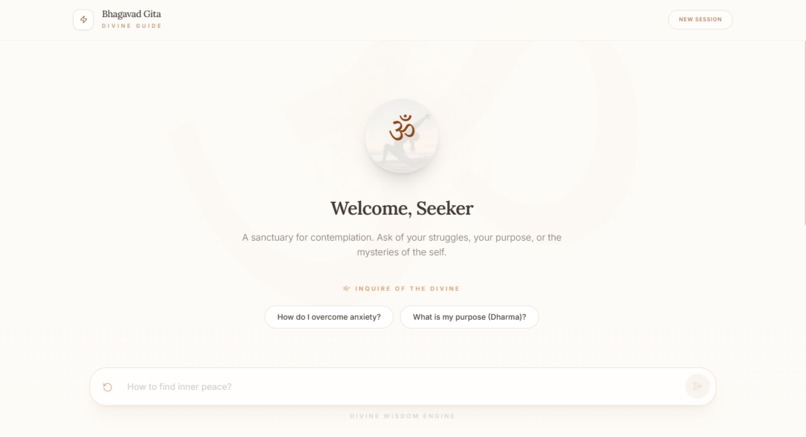
Home Screen
Inspiration
The Bhagavad Gita is one of the most influential philosophical texts in human history, yet engaging with it meaningfully often requires prior study, language familiarity, or access to scholarly interpretation. I was inspired by the idea that deep wisdom should be approachable, especially for people who are actively searching for clarity during moments of uncertainty or decision-making.
Through my prior work with Sanskrit and English parallel corpora and instruction-tuned language models, I saw an opportunity to explore whether modern AI could engage with scripture in a thoughtful and respectful way. Rather than summarizing verses, I wanted to create a system that could help people reason through questions using the Gita itself.
What I Built
I built a Gemini-powered application that enables structured conversations with the Bhagavad Gita. Users can ask real-world questions related to duty, ethics, conflict, or purpose, and receive responses grounded directly in relevant verses, along with clear explanations that connect the scripture to the question being asked.
The goal was not to replace interpretation, but to create a guided way for users to explore the text and understand how its ideas apply to modern situations.
How I Built It
The project was built using Gemini 3 through Gemini App Studio. The core design focuses on grounding every response in curated Sanskrit and English verse data and enforcing a structured output that includes the verse, its translation, and a reasoned explanation.
Carefully designed prompts guide Gemini to map abstract questions to philosophical themes present in the Gita. This approach allows the model to reason over the text rather than generating generic answers. The application is intentionally lightweight and publicly accessible, making it easy to evaluate without any setup or login.
Challenges Faced
One of the primary challenges was maintaining depth without oversimplification. Philosophical texts demand precision, and even small shifts in interpretation can change meaning. Achieving consistent, grounded responses required multiple iterations on prompt structure and output constraints.
Another challenge was balancing accessibility with rigor. The responses needed to remain understandable to users unfamiliar with the Gita, while still preserving the seriousness and intent of the original text.
What I Learned
This project demonstrated that large language models are most effective when used as reasoning systems rather than content generators. With proper grounding and structure, Gemini can engage meaningfully with dense philosophical material and support thoughtful exploration instead of surface-level interaction.
More importantly, I learned that technology can serve as a bridge between ancient knowledge and modern inquiry when it is designed with care, restraint, and respect for the source material.

Log in or sign up for Devpost to join the conversation.