-
-
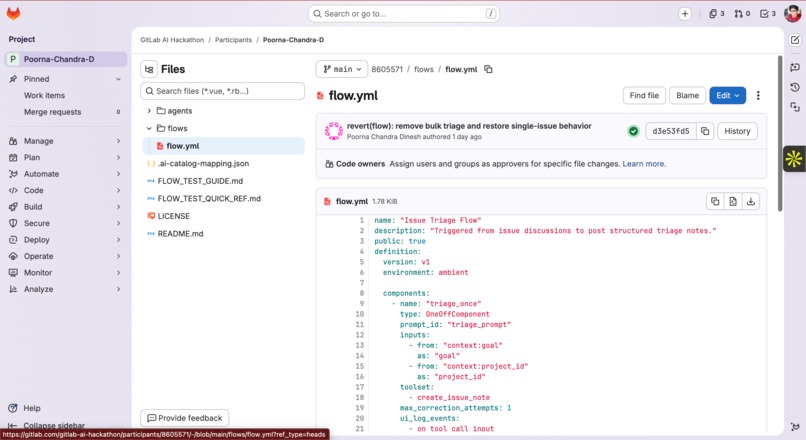
flow.yaml
-
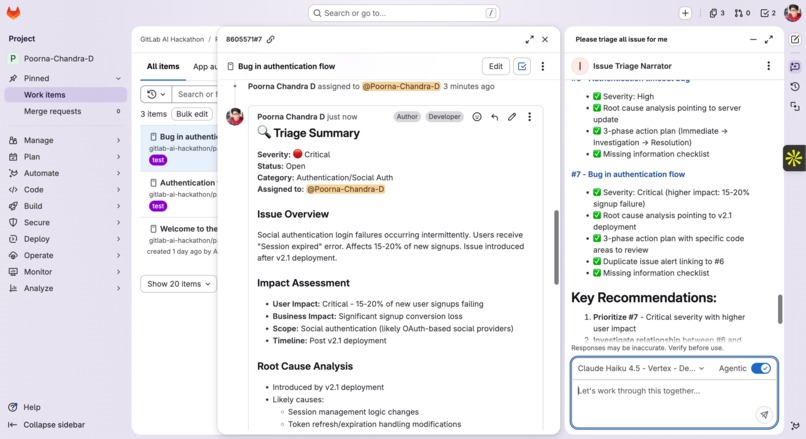
flow trigger and Agent
Inspiration
Issue triage is important, but it often turns into repetitive overhead. We kept seeing the same delay: a new issue arrives, and someone has to manually summarize it, guess severity, explain impact, and suggest next steps before real fixing can even begin. Issue Triage Narrator was inspired by that gap. We wanted to automate the first response so teams can move faster without sacrificing triage quality.
What it does
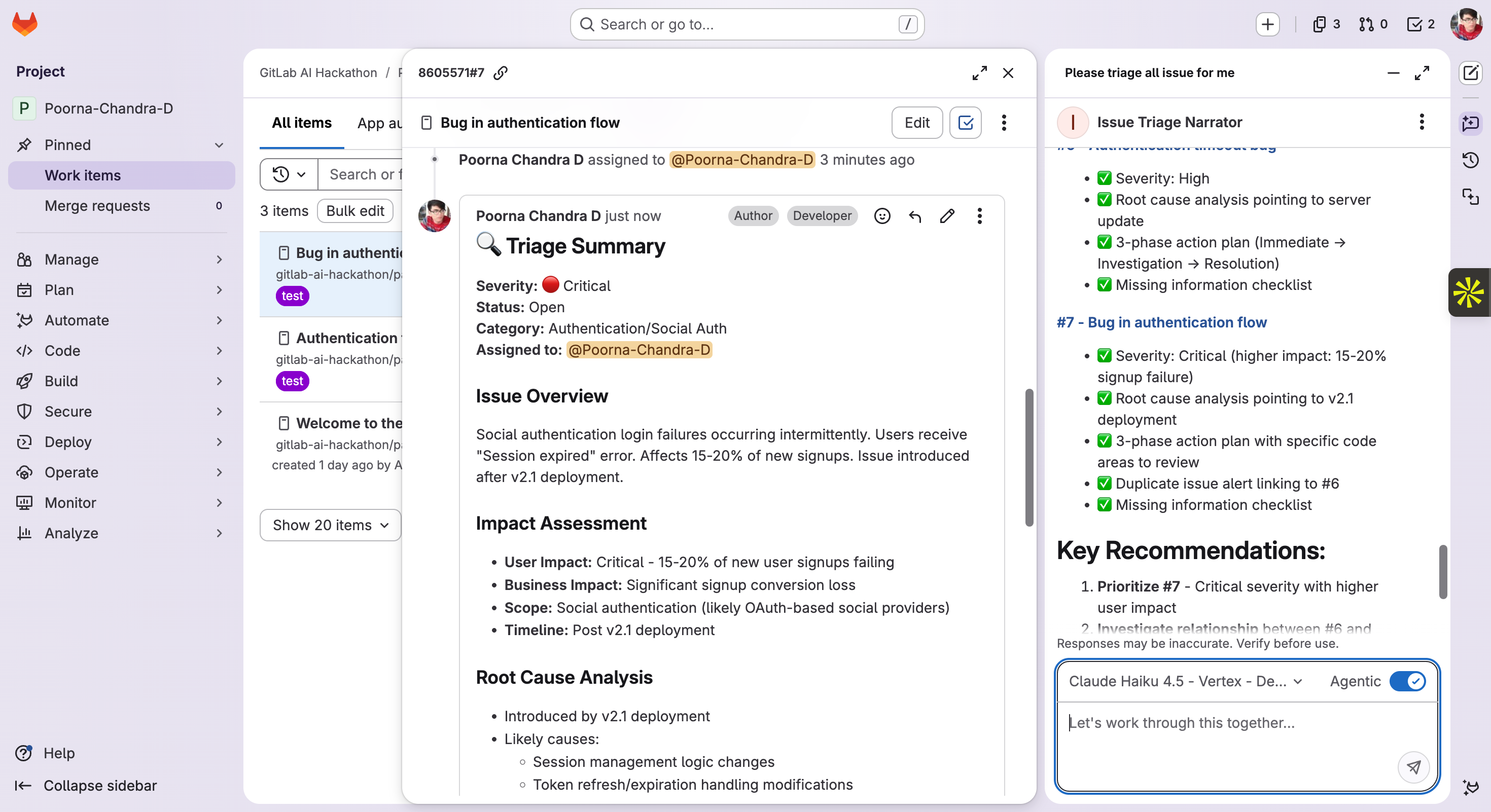
Issue Triage Narrator is a GitLab Duo agent + flow that triggers from an issue mention and posts a structured triage note. For each triggered issue, it creates a comment with:
- Problem Summary
- Severity
- Impact
- Next Actions
- Missing Info It is designed as single-issue-per-trigger to keep behavior reliable and predictable.
How we built it
We built this as a custom public hackathon project using:
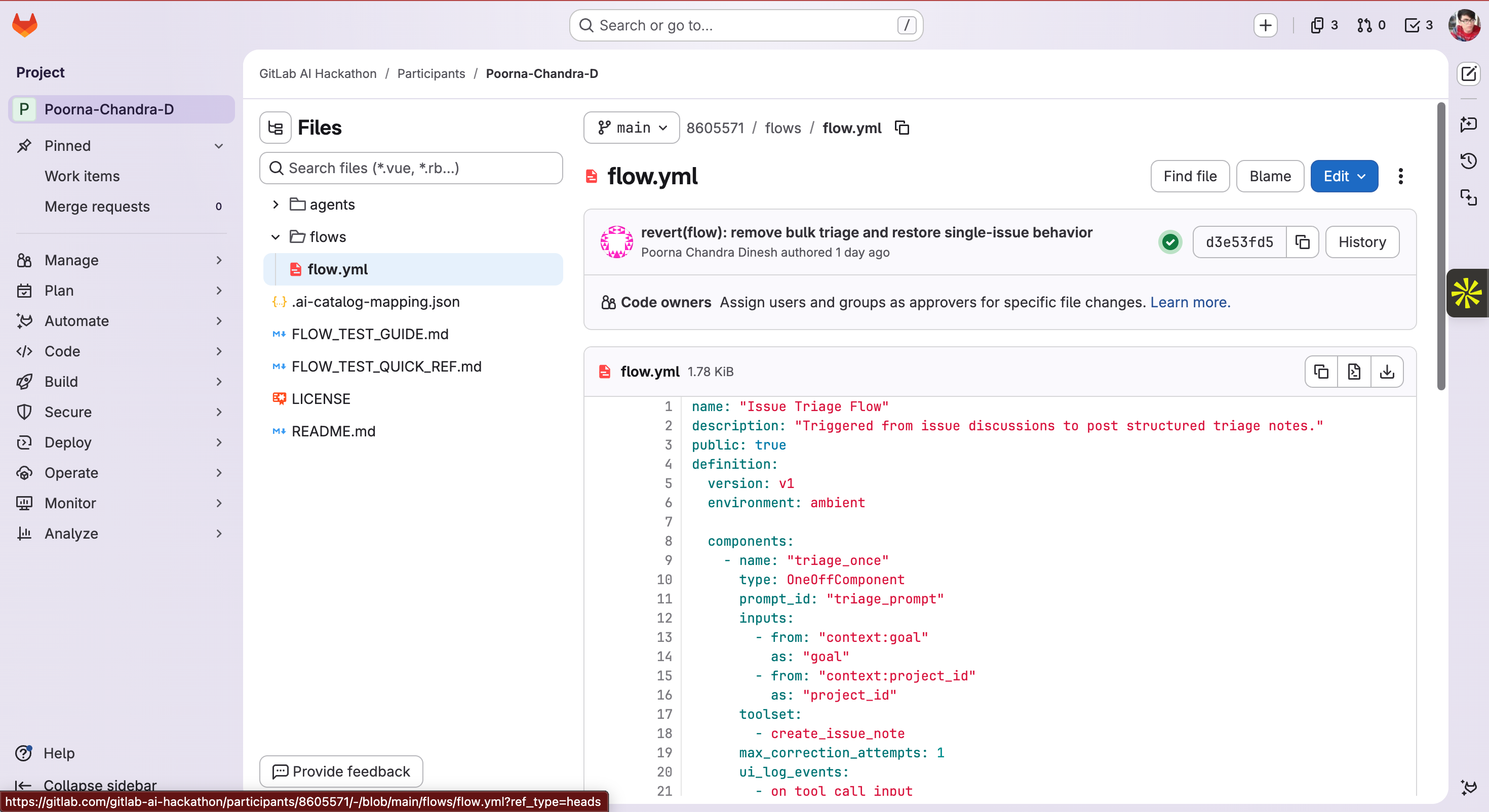
agents/agent.ymlfor the triage agent behaviorflows/flow.ymlfor workflow orchestration and tool calls- Markdown guides for end-to-end testing and submission validation
Implementation approach:
- Parse issue context from the trigger payload.
- Use guarded prompt instructions to enforce structured output.
- Post one triage note to the triggered issue.
- Stop immediately after completion.
- We iterated through multiple runtime tests using GitLab workload logs and versioned tags, then stabilized on the current single-issue design.
Challenges we ran into
- The biggest challenge was runtime consistency, not initial setup.
- Some runs completed with Tool completed: 0 (no action taken).
- Some sessions used older catalog-synced configs instead of the newest repo state.
- Bulk triage experiments caused loop-like behavior and unpredictable outcomes.
- We had to repeatedly compare live
DUO_WORKFLOW_FLOW_CONFIGlogs against local definitions to isolate version drift.
Accomplishments that we're proud of
- Built a working issue-triggered automation that takes real action, not just chat responses.
- Shipped a clean, structured triage output format that is immediately useful to maintainers.
- Diagnosed and resolved multiple production-like workflow issues under time pressure.
- Simplified the final architecture to prioritize reliability.
- Published and validated the project with public repo, instructions, and open-source MIT licensing.
What we learned
- Reliability beats feature count in workflow automation.
- Clear guardrails in prompts are essential for predictable tool use.
- Catalog/version sync visibility matters as much as code correctness.
- Iterative testing with real logs is the fastest path to a stable flow.
- A narrow, well-executed automation creates more value than a broad but flaky one.
What's next for Issue Triage Narrator
- Add configurable triage templates by issue type (bug, incident, feature request).
- Improve severity scoring with lightweight heuristics from issue metadata.
- Add optional label suggestions (for human approval) based on triage content.
- Introduce better observability signals so stale config/version drift is easier to detect.
- Expand from single-issue reliability toward safe batch processing only after strict loop controls are proven.


Log in or sign up for Devpost to join the conversation.