Inspiration
Agents remember facts: your name, your last order, your address. They don't remember the person.
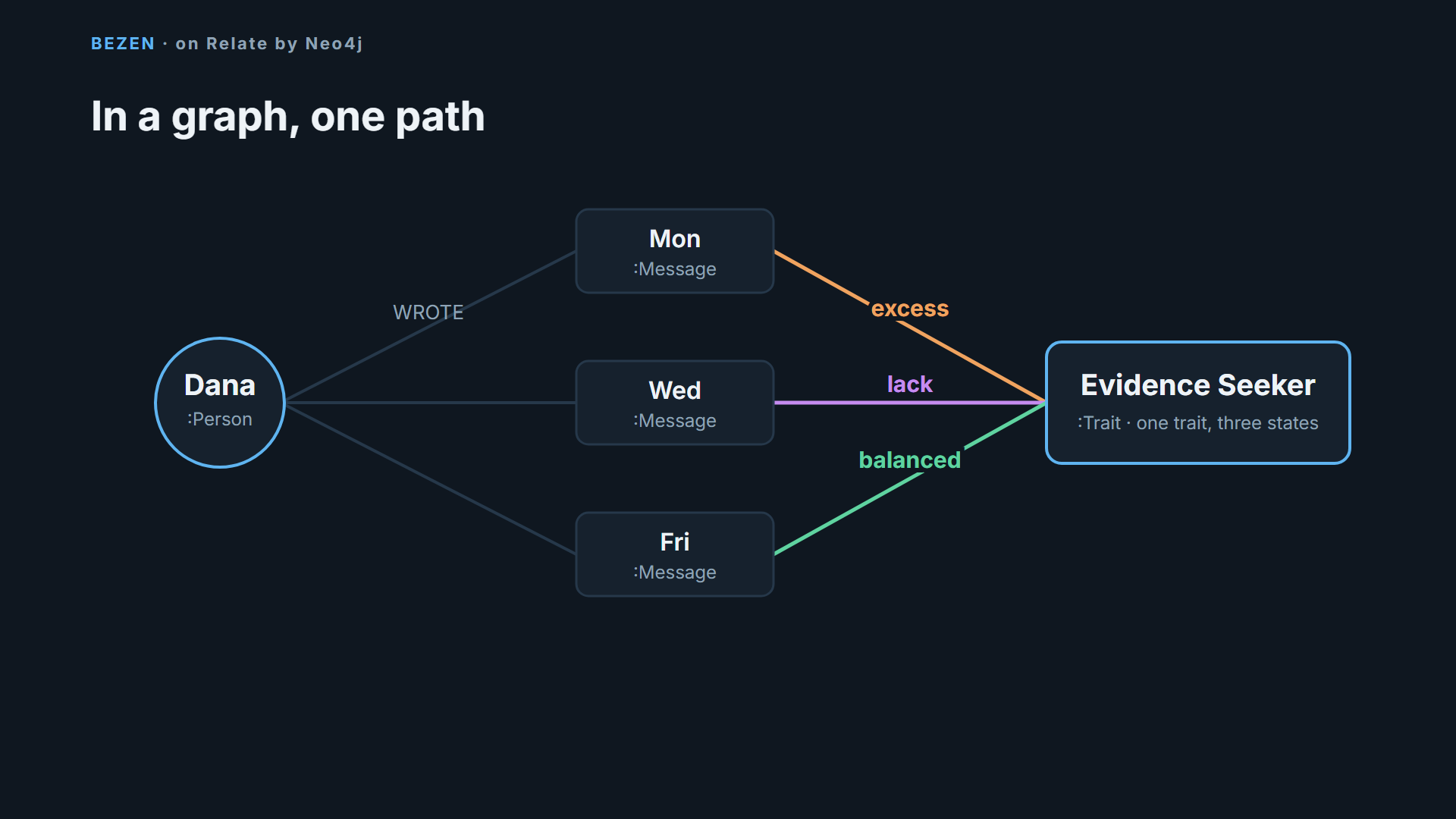
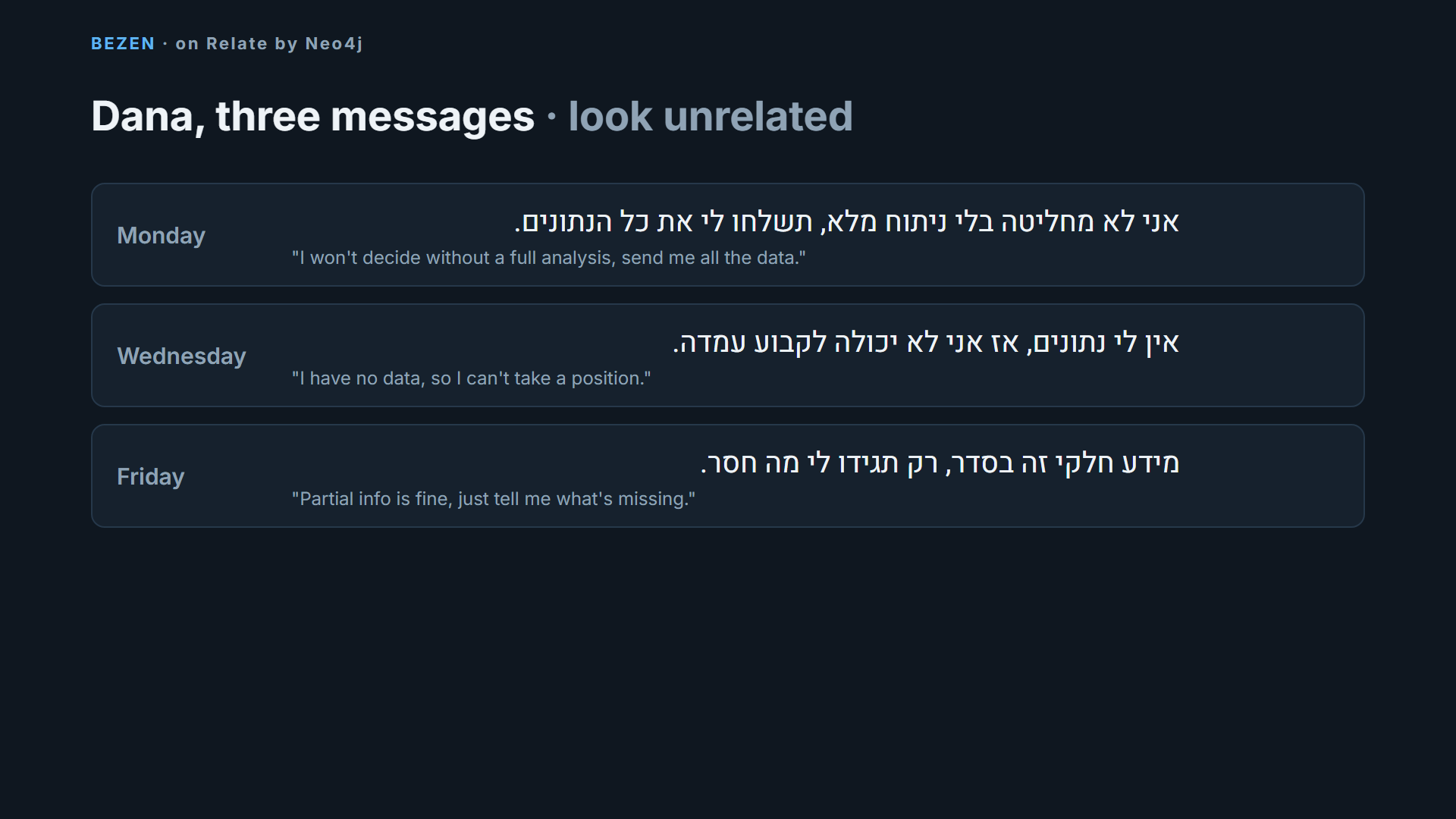
Dana writes on Monday "I won't decide without a full analysis, send me all the data", on Wednesday "I have no data, so I can't take a position", and on Friday "partial info is fine, just tell me what's missing". Three messages that look unrelated. In a graph they are one path: the same trait (Evidence Seeker) moving from excess to lack to balance. An agent that sees that path answers the person, not the sentence.
BEZEN reads people this way: every trait has a lack side, a balanced side and an excess side. Relate gave us a place to keep that reading over time.
What it does
- Any Obsidian vault to one Relate file. Notes become nodes,
key:: [[x]]fields become typed edges, quoted lines becomeSentencenodes. The public sample vault holds the 32 traits published at bezenai.com. - Meaning inside the graph. Every line of every trait becomes an
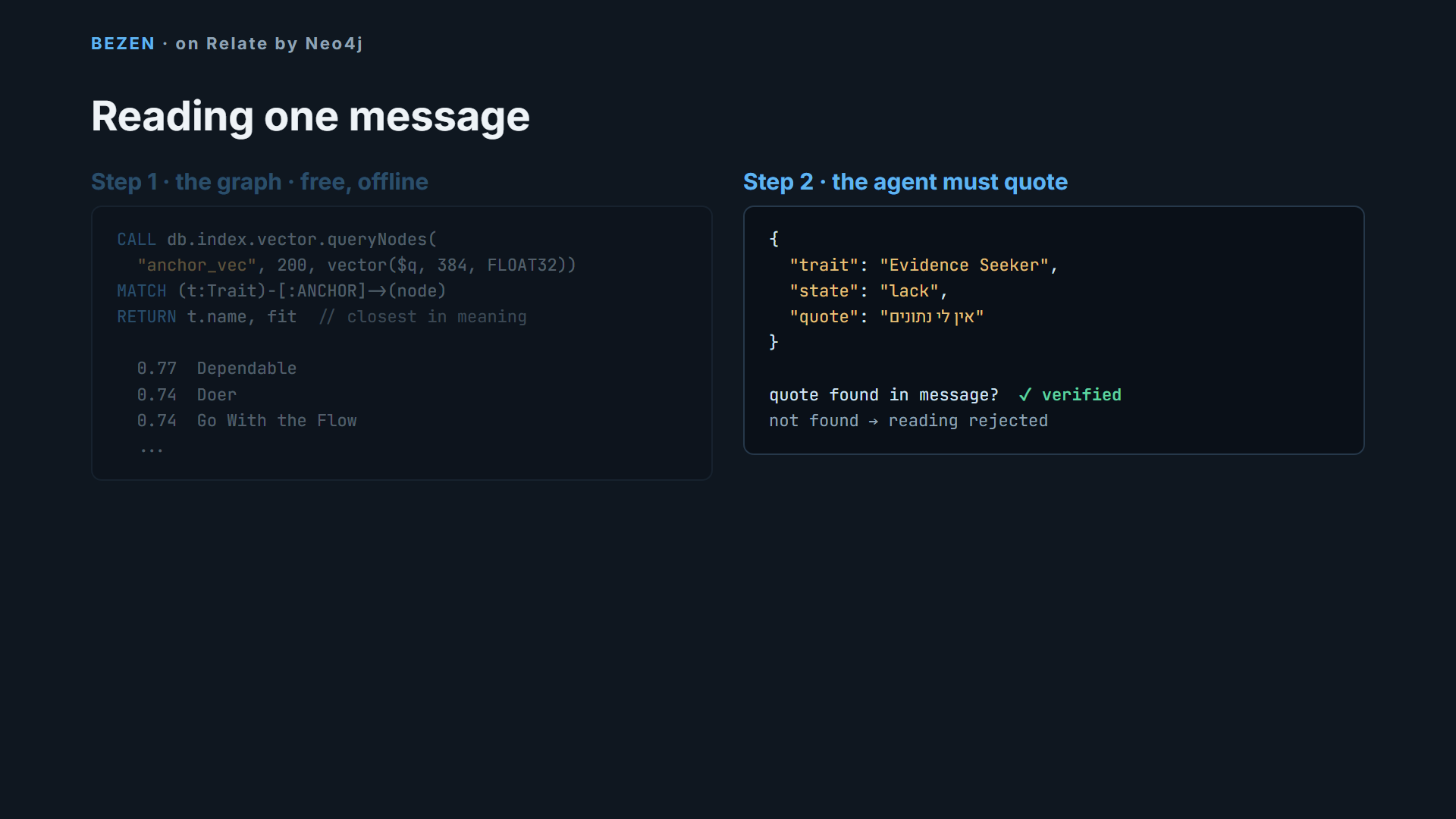
Anchornode with a 384-dim vector from a small local multilingual model, indexed with Relate'sCREATE VECTOR INDEX. - Two-step reading of a message. Step 1 (free, offline): one Cypher query with
db.index.vector.queryNodesfinds the closest traits. Step 2 (optional): an agent picks one trait and its state and must quote the person's own words; the quote is checked in code against the message, and a reading without a real quote is rejected. - Memory of a person. Each message is stored as
(:Person)-[:WROTE]->(:Message)-[:READS_AS {state}]->(:Trait). One query answers: across everything this person said, which trait keeps showing, in which states, and what is the balanced next sentence.
How we built it
Relate embedded in Python (relate-db), Cypher (MATCH, MERGE, collect, reduce, OPTIONAL MATCH), vector() values, CREATE VECTOR INDEX, db.index.vector.queryNodes, vector.similarity.cosine. Embeddings with fastembed (paraphrase-multilingual-MiniLM-L12-v2), so everything up to the agent step runs locally with no API key.
Measured, not claimed
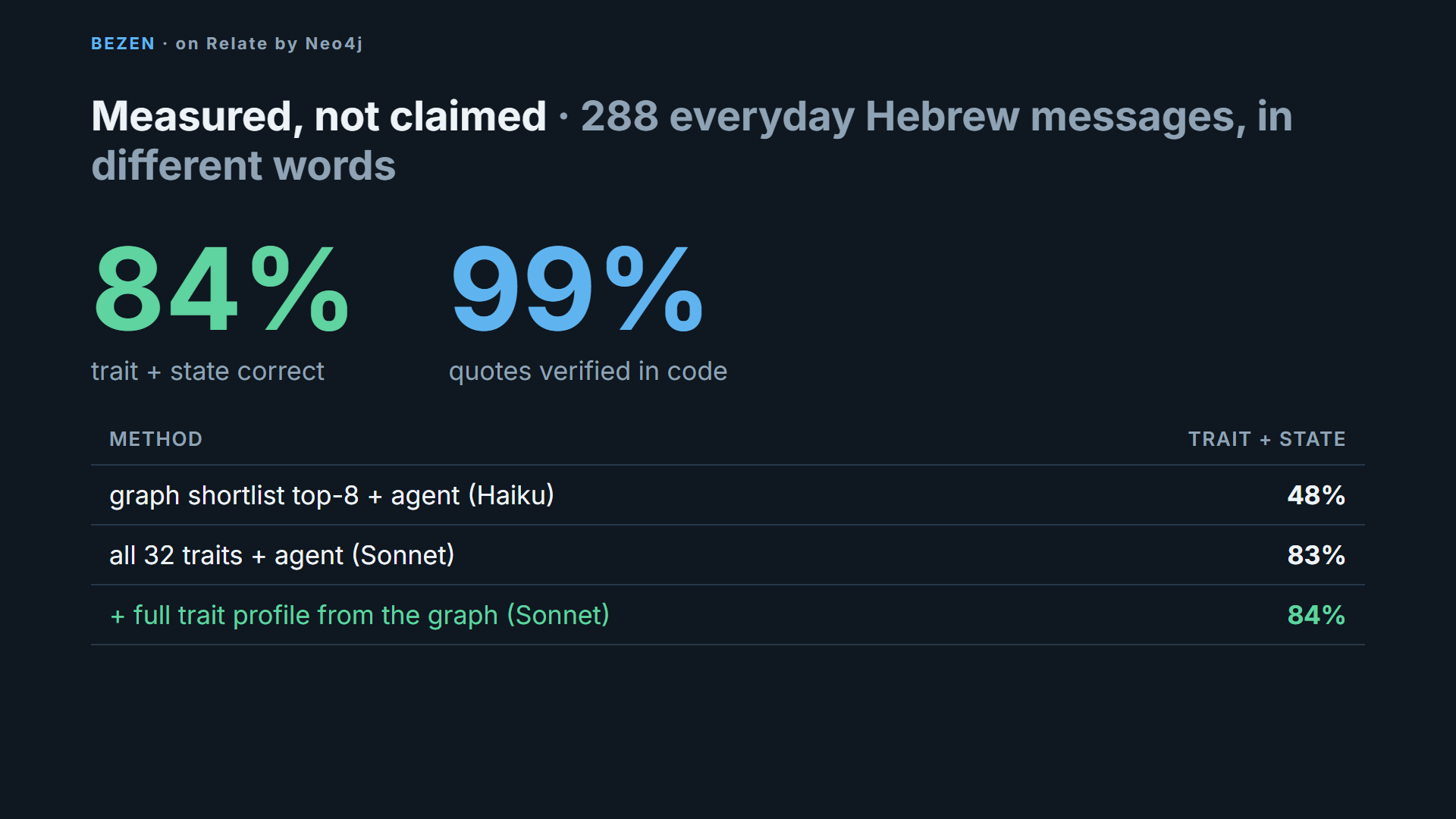
We had a model write 288 everyday Hebrew messages (3 per state for each of 32 traits), in different words from the trait sentences, and checked trait and state:
| Method | trait + state | quotes verified |
|---|---|---|
| word overlap (trigrams) | ~20% | - |
| graph shortlist top-8 + agent (Haiku) | 48% | 99% |
| all 32 traits + agent (Sonnet) | 83% | 99% |
| + full trait profile from the graph (Sonnet) | 84% | 99% |
Challenges and what we learned
Our first test, on 10 messages, scored 10 out of 10. On 288 messages the same setup scored 48%. A small test set is luck, so we tested big. With 32 traits the agent should see all of them; the graph's real value is the memory across messages and the traceable path (message, anchor, trait, state, balanced sentence). The hardest state to read is lack (about 75%).
What's next
The same code runs locally on BEZEN's private pattern library (hundreds of patterns), where the graph shortlist matters most. Nothing from that library is in the public repo.
Disclosure
Started during the contest (first commit 16 Nov 2026). Reused own earlier work: the 32 public trait descriptions and the "quote checked in code" idea from earlier BEZEN projects. Code written with Claude (Anthropic) as a coding assistant; the 288 test messages were generated with Claude Sonnet; the optional agent step calls Claude Haiku / Sonnet. Video narrated in Hebrew by Zion Cohen, with English subtitles.
