-
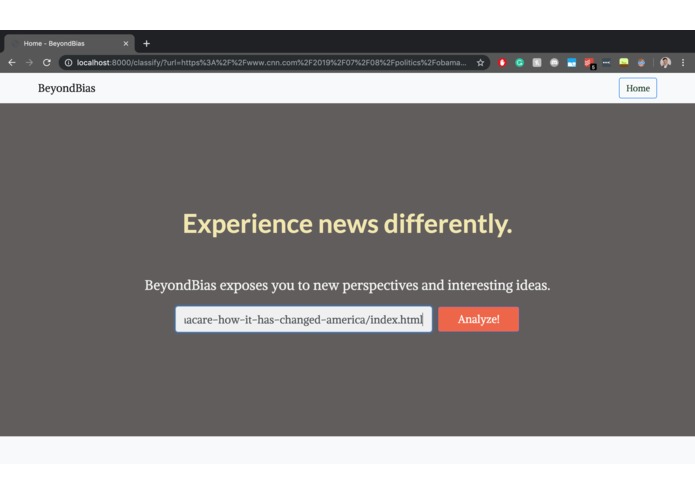
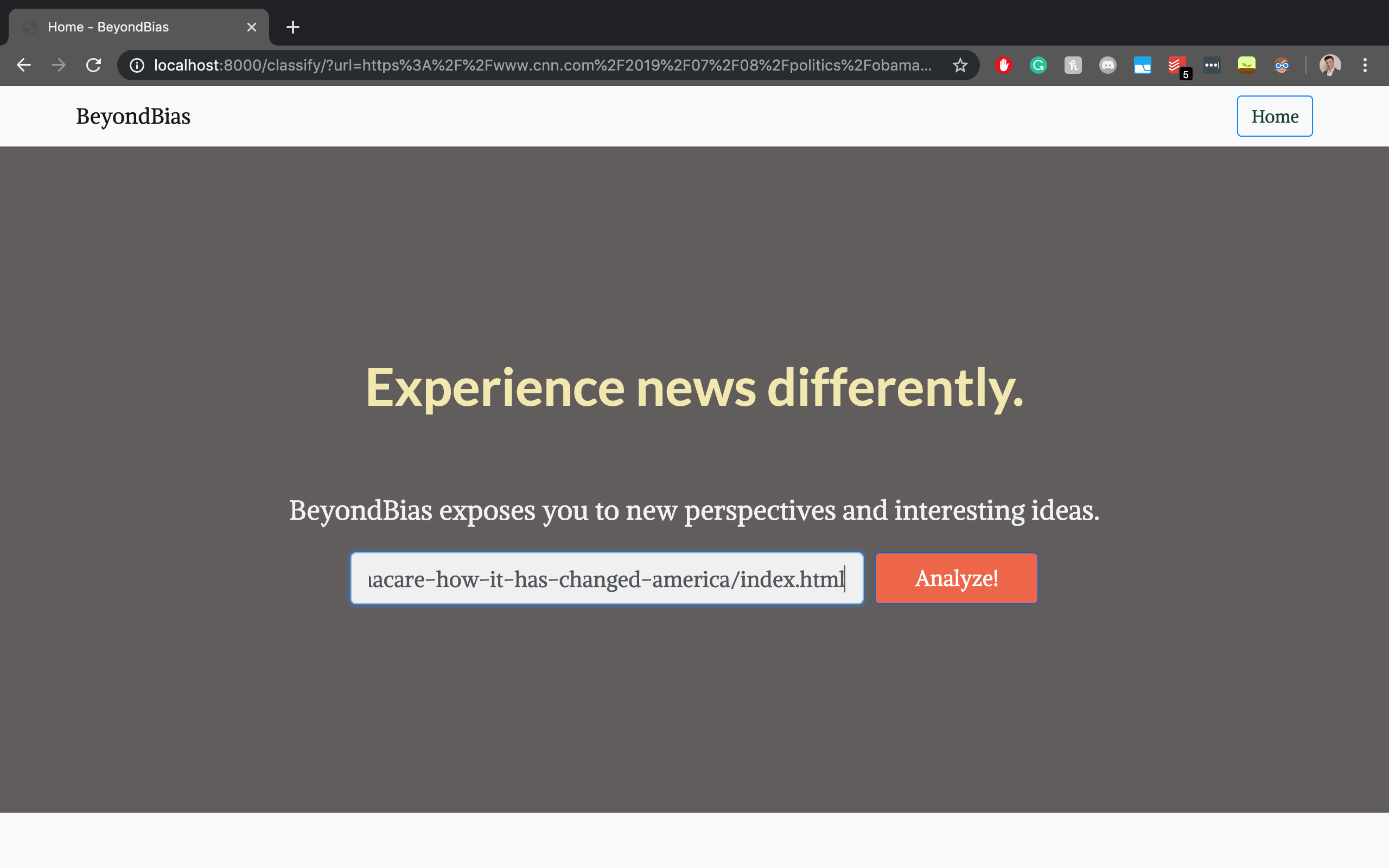
Search bar
-
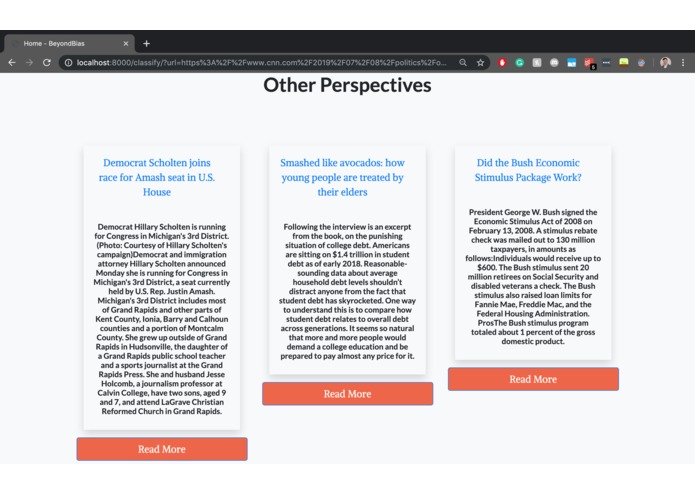
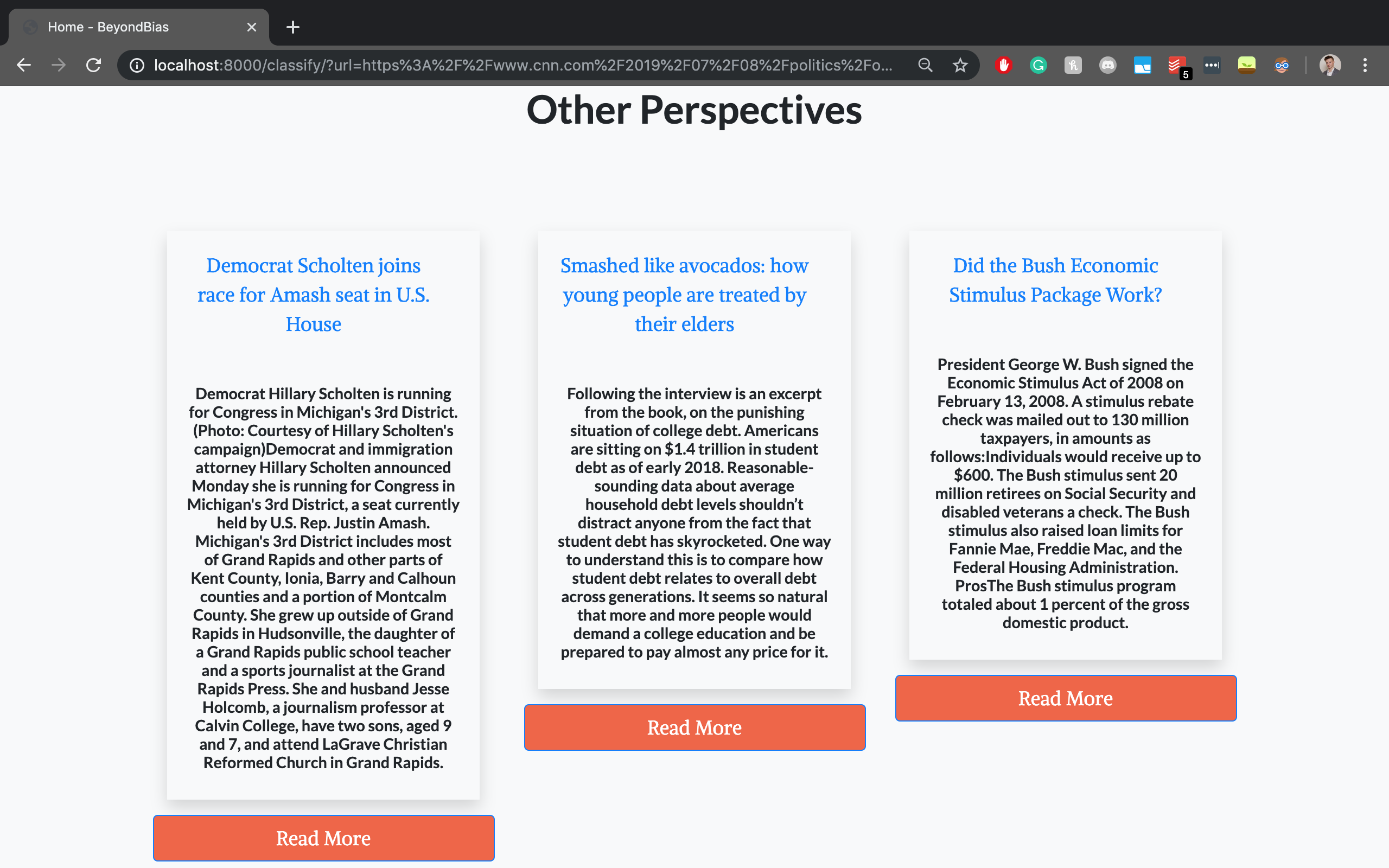
Articles of opposite bias
Inspiration
Disinformation and misinformation loom large in today's world. As it becomes easier to share information, it becomes more important that we develop quick and intuitive ways of viewing all perspectives. This project aims to begin this process by offering a ‘bias reverser’, in which users can view articles of the same topic from different sides. According to the FBI, online radicalization is on the rise. Much of this occurs due to an echo chamber. Views become more and more extreme, and a well-trained recommendation system only shows users content that will confirm their beliefs. Therefore, it’s extremely important that browsing is consciously inclusive of all sides.
What it does
BeyondBias is a web app which promotes the spread of information by offering readers of political articles the opportunity to consult similar articles written from different perspectives. We find the political bias of a given article by matching its URL with the top-level domain, which is then matched against a list of classified sources.We then retrieve articles about the same topic with reversed biases, to allow users to consider all sides of an argument. Finally, we return the three most relevant articles. This offers users the opportunity to learn about arguments that would otherwise have been unfamiliar to them.
How I built it
We built the application using top-down approach, beginning from the Minimum Viable Product that addressed our problem. We determined that we needed a program that took the URL of a seed article as input and the URLs of articles on the same topic from reverse biases as output. Then we split this task into the two following components: a front end GUI and a backend model.
Challenges I ran into
The first problem we ran into was retrieving articles that addressed the same topic as the seed article. Even if two articles share many of the same words, they may not belong to the same time period, and they might still be about different topics. To fix this issue, we implemented a cosine similarity metric that we computed between the original article and candidate articles. This allowed us to select only those articles that scored above a given similarity threshold.
Although we originally planned to create a Chrome Extension, we decided that a web app would offer more potential for wide use. Chrome is only used by a subset of those online, but websites are accessible to all.
Prior to this project, none of us were familiar with Django template tags. Troubleshooting all of the integrations was challenging, but rewarding.
Accomplishments that I'm proud of
We began with just one mission: reduce bias when reading the news. Although we didn’t have a specific plan, we brainstormed and thought about bias reversal. This idea allowed us to develop an idea that has not been implemented before. Also, our diverse team allowed us to have some very interesting experiences this weekend.
We are also proud of our perseverance through numerous technical challenges, and our commitment to this project’s mission. We plan to continue related work in the future.
What I learned
We learned a lot about full-stack web development and the challenges and triumphs that come from this venture. As we did more research throughout the weekend, it became more and more apparent that this project is vital in today’s age.
Also, we learned a lot about each other. It was very interesting to hear about our different backgrounds.
What's next for BeyondBias
We hope to continue working together remotely in the future on similar projects. Also, we hope to develop this website into a cross-platform extension, to keep the audience while increasing the utility.

Log in or sign up for Devpost to join the conversation.