Inspiration
Competitive gaming measures almost everything that happens inside a match, but it rarely explains what is happening to the person behind the screen.
A player may perform worse because of poor decision-making, fatigue, stress, lack of sleep, an unsuitable training schedule or a combination of all of them. Traditional analytics usually treats these signals separately: gameplay data lives in one platform, wearable data in another, wellbeing information somewhere else, and the final interpretation depends entirely on a coach having enough time and expertise to connect the dots.
Beyond the Game is not based only on a hypothesis. Its foundations were developed through a real project delivered to a public university as a client.
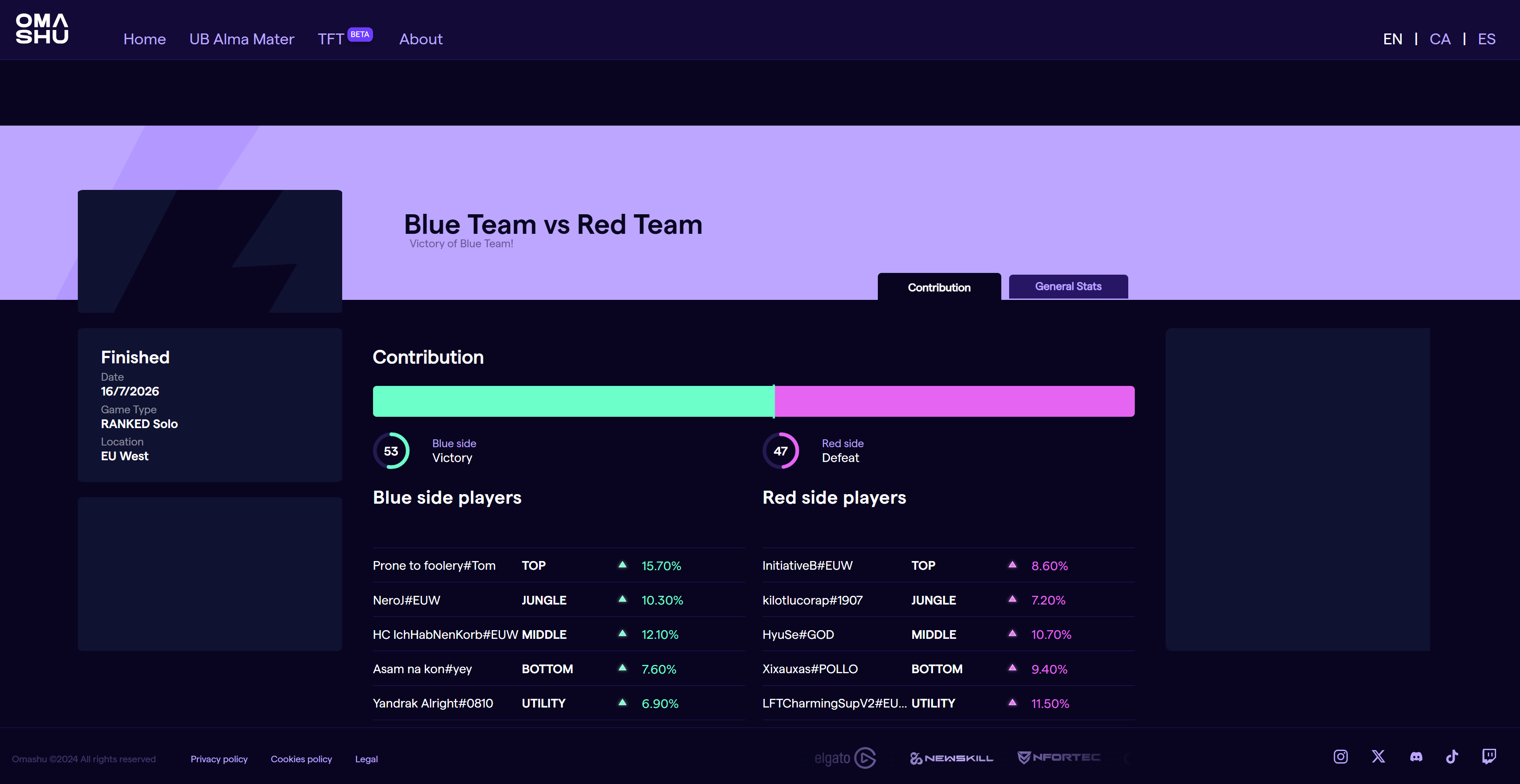
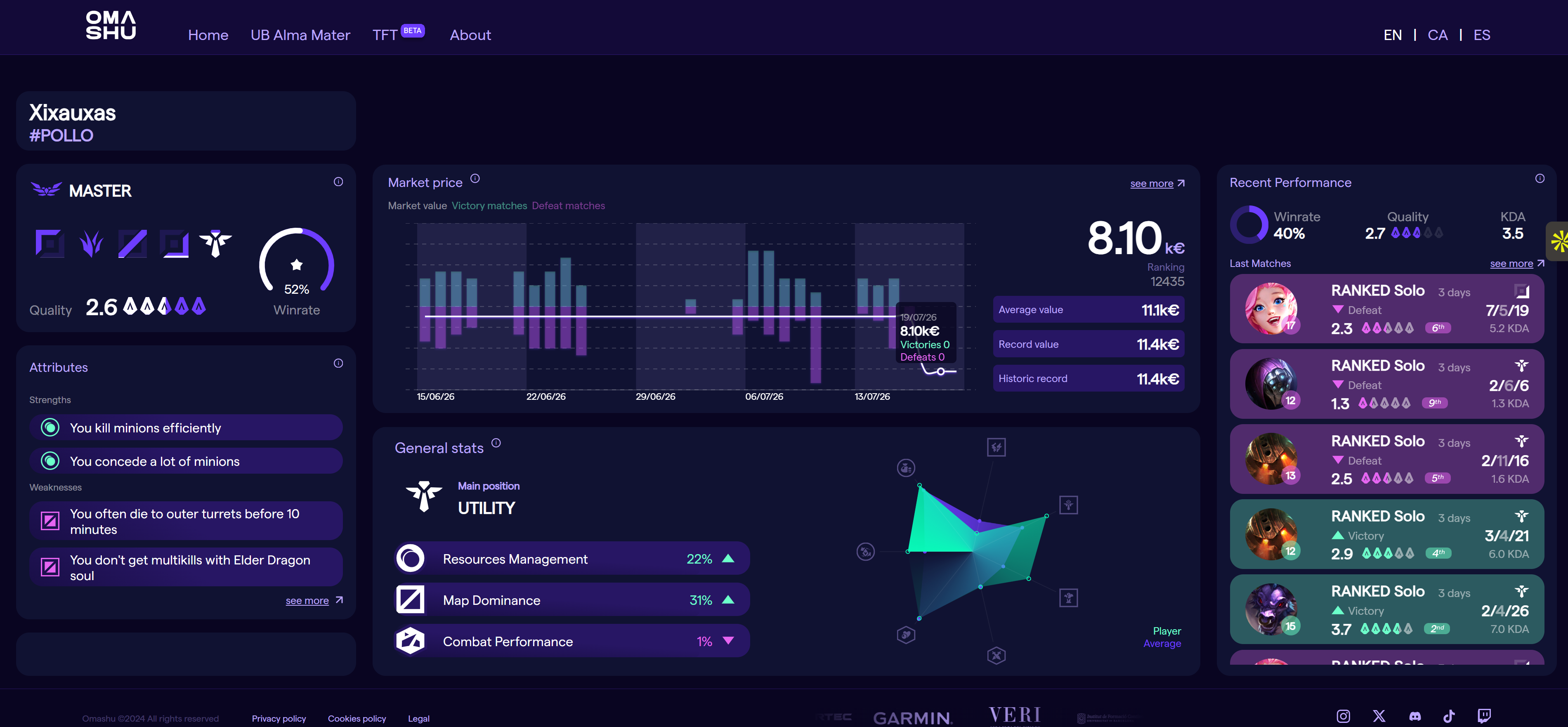
For three months, during a live internal League of Legends competition, we collected and processed data from 56 players participating in a mixed-gender competitive environment. Gameplay and match information was gathered through game APIs, while Garmin wearable devices collected biometric, activity, stress, sleep and recovery-related data 24/7 throughout the competition.
This gave us a unique opportunity to study players longitudinally: not only how they performed in one match, but how their gameplay, training, recovery and wellbeing evolved over time.
The project has since moved into an even more demanding competitive setting. Under my leadership, the university now has an official League of Legends team competing in the Spanish first division. This creates a real pathway for Beyond the Game to evolve from an internal competition and research environment into a platform capable of supporting players and coaches at one of the highest levels of national competition.
The project also comes from a very personal turning point.
After a major client failed to pay for completed work, my previous company entered insolvency. I had to let a team of 15 people go and watch years of work become fragmented across repositories, infrastructure, experiments and unfinished products.
I am now rebuilding alone, using a 15-year-old laptop, my personal ChatGPT subscription and the technology and knowledge that survived.
Build Week became an opportunity to turn that difficult ending into a new beginning: to reunify years of gameplay analytics, machine learning, biometric research and product development into one coherent, AI-native platform.
The goal is not only to help people perform better.
It is to help them understand what affects their performance without losing sight of their health, wellbeing and humanity.
What it does
Beyond the Game is a human-performance intelligence platform that combines competitive gaming data, wearable information, machine-learning models and generative AI to explain performance and provide personalized guidance.
The platform brings together:
- Gameplay and match telemetry
- Historical player performance
- Mechanical, tactical and decision-making indicators
- Machine-learning predictions
- Garmin wearable and biometric signals
- Sleep, stress, activity and recovery information
- Training workload
- Self-reported wellbeing and personal context
- AI-generated explanations and recommendations
Instead of evaluating players through isolated matches, Beyond the Game creates a longitudinal profile of how each person plays, trains, recovers and evolves over time.
Conceptually, the system models performance as:
[ P_t = f(G_t, B_t, R_t, C_t, H_{t-n:t}) ]
where:
- (G_t) represents gameplay performance
- (B_t) represents biometric and wearable signals
- (R_t) represents recovery, sleep and wellbeing
- (C_t) represents the player's current personal and competitive context
- (H_{t-n:t}) represents recent historical patterns
The system does not simply place all these variables on another dashboard.
Its AI performance copilot connects the available evidence and translates it into an understandable narrative for players and coaches.
For example, it may identify that a player's mechanical execution remained stable while their decision-making deteriorated during the final matches of a training session. It can then show that the same pattern coincided with reduced sleep, unusually high stress, increased workload or insufficient recovery.
The platform can provide personalized guidance such as:
- Reducing the duration of the next training session
- Adjusting the balance between practice and recovery
- Focusing on a specific weakness instead of repeating general training
- Identifying recurring performance patterns
- Detecting sustained changes that may indicate fatigue or burnout risk
- Comparing the player primarily against their own baseline
- Explaining which changes appear meaningful and which may be normal variation
- Giving coaches a concise summary of the factors most likely to affect the next competition
Every conclusion is connected to the underlying data that supports it. The product is designed to distinguish between a recurring pattern, an early signal and a possible coincidence rather than presenting every correlation as certainty.
Beyond the Game is not a medical diagnostic product. It is a performance and wellbeing support system designed to help players, coaches and organizations make better-informed decisions.
How we built it
Beyond the Game brings together several years of technical work that previously existed across multiple independent systems.
The foundations were created during a real three-month deployment for a public university. The system operated throughout an internal League of Legends competition involving 56 players in a mixed-gender environment.
Data collection ran continuously throughout the project:
- Gameplay and match data were obtained through game APIs
- Player histories were processed through our own data infrastructure
- Garmin wearable devices collected biometric and activity information 24/7
- Sleep, stress and recovery-related measurements were incorporated
- Players provided contextual and wellbeing information
- Machine-learning systems processed historical and current performance data
- Dashboards made the resulting information available to players, coaches and researchers
This was not a one-day experiment or a fictional dataset created for a demonstration.
It was a live competitive environment in which players were training, competing, sleeping, recovering and changing over several months.
The original technology was distributed across repositories and services responsible for:
- Data ingestion
- Game API integrations
- Match processing
- Time-series telemetry
- Player profiles
- Performance scoring
- Machine-learning models
- Predictions and simulations
- Wearable integrations
- Biometric processing
- Dashboards
- Research prototypes
- Coach and player tools
During Build Week, the main technical objective was not to start from zero. It was to understand, consolidate and connect these fragmented systems into one product experience.
The current architecture is being organized around:
- A web application for players and coaches
- Backend services for gameplay and wearable data
- A unified player identity and timeline
- A structured human-performance data model
- Machine-learning models for evaluation and pattern detection
- A contextual evidence layer connecting performance, recovery and wellbeing
- GPT-5.6 as the reasoning, explanation and communication layer
- Codex as a core development partner for understanding and integrating the existing repositories
The platform does not ask a language model to interpret a random collection of raw statistics.
Before information reaches GPT-5.6, the system prepares a controlled evidence package containing relevant events, historical comparisons, detected changes, player baselines, biometric context and model outputs.
GPT-5.6 then acts as the performance copilot. It can:
- Explain complex relationships in natural language
- Compare sessions and competitive periods
- Summarize the most relevant changes
- Adapt explanations for a player, coach or researcher
- Highlight uncertainty and limitations
- Transform technical outputs into practical recommendations
- Answer follow-up questions using the player's real context
Machine learning and generative AI have different responsibilities.
The underlying models calculate scores, detect patterns, compare historical periods and estimate the importance of different variables. GPT-5.6 makes those results understandable, contextual and actionable.
Codex has been fundamental to the rebuilding process.
The project spans multiple repositories, programming languages, infrastructure decisions and development periods. Some systems were created by a team that no longer exists, while others contain undocumented business logic developed over several years.
Codex has helped me:
- Inspect and understand legacy repositories
- Trace dependencies between services
- Identify duplicated or obsolete systems
- Document undocumented logic
- Refactor existing code
- Design a unified architecture
- Connect previously isolated components
- Build interfaces and integrations
- Diagnose infrastructure problems
- Turn years of fragmented development into a product that one person can continue building
Without that assistance, rebuilding a platform of this scale alone and under these conditions would be extremely difficult.
Challenges we ran into
The first challenge was fragmentation.
Years of development had produced valuable technology, but that technology was spread across different repositories, databases, services, dashboards and research prototypes.
Some components were already running in production. Others were experimental. Several had dependencies created by people who were no longer part of the team. Important logic existed in code without enough documentation, and different generations of the platform solved similar problems in different ways.
The second challenge was integrating highly heterogeneous data.
Gameplay events, match statistics, wearable measurements, sleep summaries, stress indicators and subjective wellbeing responses all have different:
- Scales
- Formats
- Collection frequencies
- Levels of reliability
- Historical depth
- Privacy requirements
A game may generate thousands of events in less than an hour, while sleep produces one daily summary and wellbeing may depend on a subjective questionnaire. These signals cannot simply be placed next to each other and treated as equivalent.
The third challenge was avoiding false conclusions.
A relationship between poor sleep and lower performance does not automatically prove causation. A temporary decline may come from the opponent, a role change, a strategic decision, illness, hardware problems or normal statistical variation.
For that reason, the system must communicate uncertainty and show the evidence behind its conclusions. Responsible recommendations are more valuable than confident but unsupported claims.
The fourth challenge was privacy.
Biometric and wellbeing data is much more sensitive than normal game statistics. Players need to understand what is collected, why it is collected and who can access it.
The system therefore needs different levels of visibility for players, coaches, organizations and researchers. A coach may need to know that a player is insufficiently recovered without receiving unnecessary private health information.
The fifth challenge was deciding what not to build.
The complete vision includes gameplay analytics, scouting, predictions, simulation, biometrics, wellbeing, workload management, coaching tools and personalized recommendations.
Trying to complete every part at once would have produced a large but incoherent product.
We therefore focused the experience around one clear journey:
A player connects their data, the system reconstructs their recent performance, identifies a meaningful relationship between gameplay and wellbeing, and the AI explains what happened, how confident it is and what the player should consider doing next.
The final challenge was personal and operational.
I am rebuilding a technically ambitious platform alone, with limited hardware and limited financial resources, after the closure of the company that originally supported its development.
That limitation has also improved the product.
It has forced every feature to justify its existence, every integration to reduce complexity and every screen to communicate its value clearly.
Accomplishments that we're proud of
We are proud that Beyond the Game is based on real technology, real players and a sustained competitive deployment rather than a purely hypothetical demonstration.
For three months, the original platform supported data collection and analysis throughout a live internal League of Legends competition involving 56 players.
Gameplay information was collected through APIs, while Garmin wearable devices provided continuous data about activity, sleep, stress and recovery. This allowed us to begin constructing a genuinely longitudinal view of each player.
We did not only analyse how they played.
We could begin to understand how their performance related to the way they trained, recovered and evolved throughout the competition.
We are also proud of the mixed-gender environment in which the project was deployed. The system was designed around individual performance and personal baselines rather than assumptions about what a typical player should look like.
Another accomplishment is the progression from an internal university competition to national-level competition.
Today, under my leadership, the university has an official League of Legends team competing in the Spanish first division. This gives the project a real environment in which it can continue to be validated under higher competitive pressure and with more demanding coaching needs.
We are proud of turning multiple technical systems into one coherent product vision.
Instead of presenting gameplay analytics, biometrics, machine learning and AI as unrelated features, Beyond the Game connects them around one central question:
What is influencing this person's performance, and what can they realistically do about it?
We are also proud of making advanced analysis understandable.
A specialist may be comfortable reading dozens of metrics, confidence intervals and model outputs, but most players are not. The AI copilot transforms those signals into a clear narrative while preserving the evidence behind every conclusion.
Finally, rebuilding the project at all is something I am deeply proud of.
The previous company may have closed, but the experience, technology, knowledge and determination behind it did not disappear.
What previously required a team is now being reconstructed by one person, one old computer and a new generation of AI development tools.
What we learned
We learned that collecting more data does not automatically create more understanding.
The value does not come from adding another metric to a dashboard. It comes from connecting the right signals, identifying which changes matter and communicating them at the right moment.
We learned that personal baselines are often more useful than generic averages.
Two players can have very different normal sleep patterns, stress responses, training loads and competitive behaviours. Comparing every person against one universal standard can hide the most important information.
A player's most relevant comparison is often with their own historical performance.
We learned that wellbeing should not be treated as a secondary section placed next to performance.
Sleep, recovery, stress, workload and personal context are part of performance itself. They influence how someone learns, communicates, reacts and makes decisions.
We learned that machine learning and generative AI are most effective when they have clearly separated roles.
Machine learning is well suited to:
- Processing large historical datasets
- Calculating performance indicators
- Detecting recurring patterns
- Identifying anomalies
- Comparing periods
- Estimating confidence
GPT-5.6 is well suited to:
- Interpreting the structured evidence
- Explaining results
- Connecting technical outputs to context
- Adapting information to different audiences
- Supporting follow-up questions
- Turning analysis into practical guidance
The combination is substantially more useful than asking a language model to analyse raw statistics without a reliable analytical foundation.
We also learned that uncertainty must be visible.
The platform must distinguish between:
- A strong recurring relationship
- A statistically meaningful change
- An early warning signal
- An incomplete observation
- A possible coincidence
Showing uncertainty does not weaken the product. It makes it more trustworthy.
We learned that sensitive data requires careful product design.
Players should remain in control of their biometric and wellbeing information. Organizations do not need unrestricted access to every measurement in order to make better decisions.
Finally, I learned that rebuilding alone requires a different mindset from managing a 15-person team.
Every feature must justify its cost. Every dependency must be understandable. Every integration must simplify the future rather than preserve unnecessary complexity.
Most importantly, the product's central value must be understandable in a few seconds.
What's next for Beyond the Game: Human Performance AI
The next step is to transform the current prototype and existing technology into a complete player and coach platform.
The roadmap includes:
- Consolidating the existing repositories into a maintainable architecture.
- Expanding the unified player timeline with gameplay, wearable, training and wellbeing data.
- Improving Garmin and other wearable integrations.
- Creating personalized baselines for every player.
- Adding explainability and confidence indicators to every AI-generated insight.
- Developing workload, recovery and wellbeing planning tools.
- Building separate experiences for players, coaches, analysts and researchers.
- Testing the platform with the university's first-division League of Legends team.
- Validating recommendations through structured studies and real competitive environments.
- Creating privacy-preserving team insights that do not unnecessarily expose individual health data.
- Expanding the platform to additional games and competitive ecosystems.
- Exploring applications beyond esports in other cognitively demanding activities.
The immediate product experience will focus on making complex data useful every day.
A player should be able to open the platform and understand:
- How they are currently performing
- What has changed
- Which factors may be influencing that change
- How confident the system is
- What they should consider doing next
A coach should be able to understand the state of the team without manually reviewing dozens of dashboards, spreadsheets and wearable reports.
The university's first-division team provides a real next environment for the platform. It allows us to move from an internal competition involving 56 players toward a more focused, demanding and professionally structured use case.
The long-term vision is for Beyond the Game to become a human-performance operating system.
A platform that understands how someone plays, trains, sleeps, recovers, learns and evolves over time.
Gaming is the starting point because it provides an unusually rich and measurable environment. Every match contains thousands of actions, decisions and interactions, making it possible to study human performance at a level of detail that is difficult to achieve elsewhere.
But the final ambition is broader than esports.
We want to use AI to help people pursue high performance without losing sight of their health, wellbeing and humanity.
Built With
- cuda
- garmin
- ovh.com
- riot-games
- supabase
- vercel

Log in or sign up for Devpost to join the conversation.