-
-
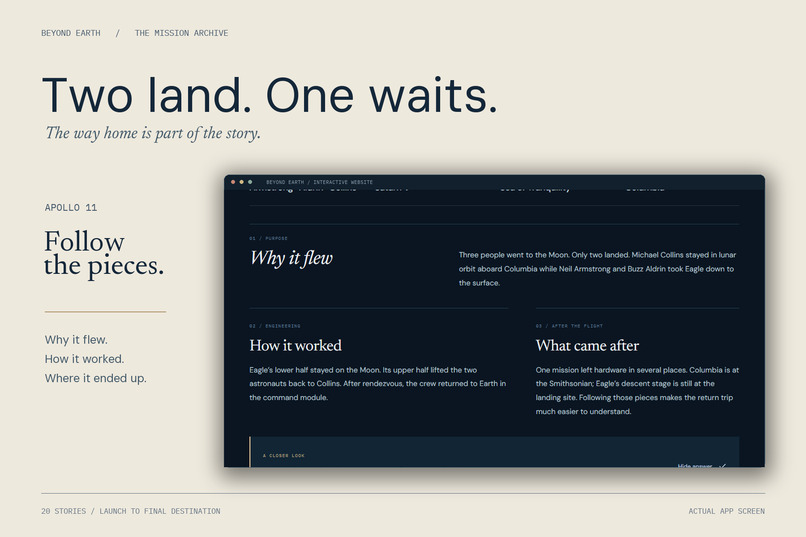
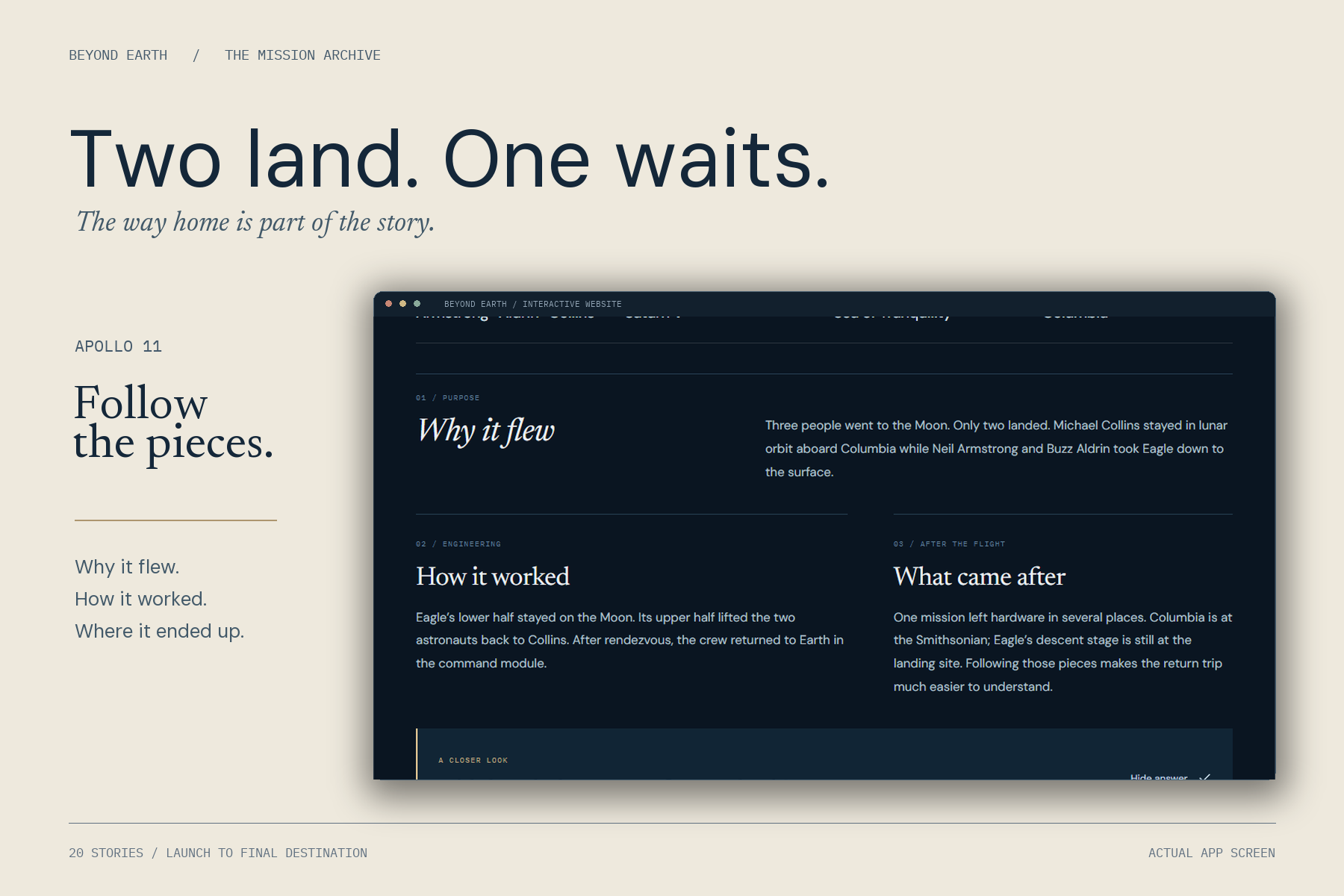
Two astronauts landed. One waited above. Follow Apollo 11's hardware to see how all three came home.
-
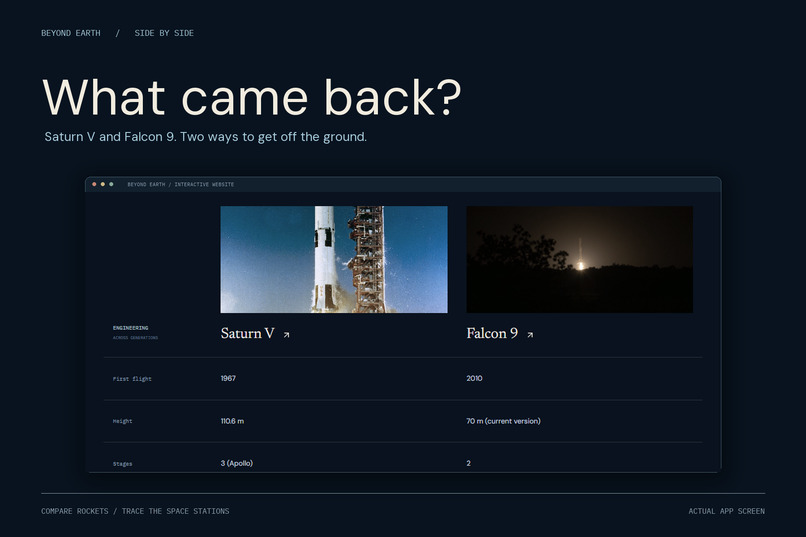
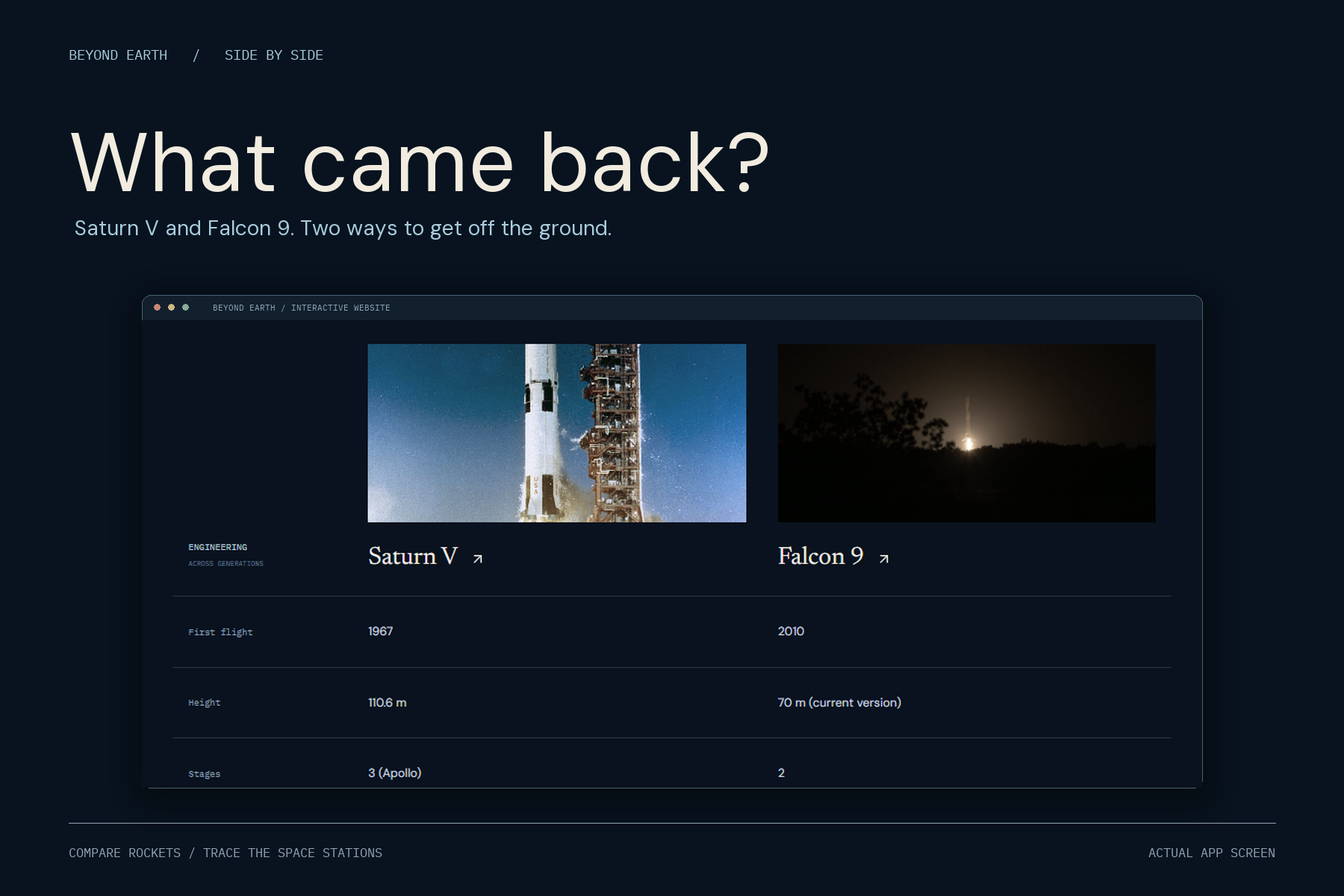
Compare Saturn V and Falcon 9: their size, stages, missions, and what could fly again.
-
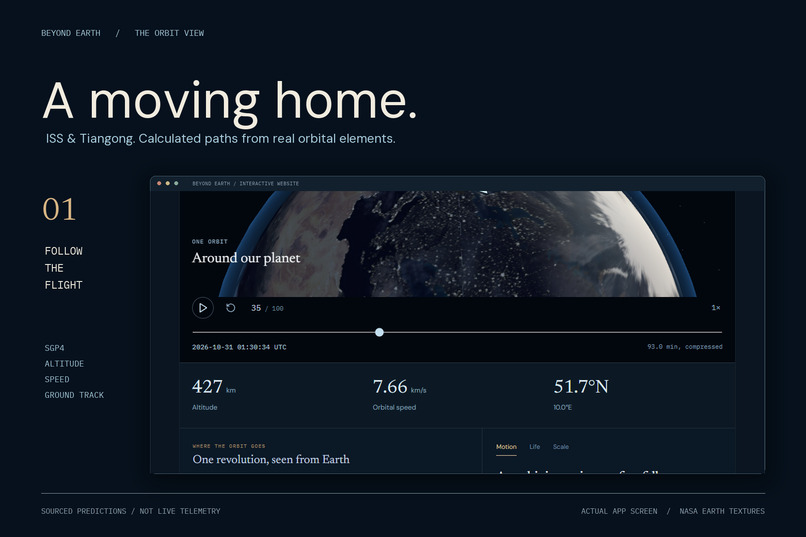
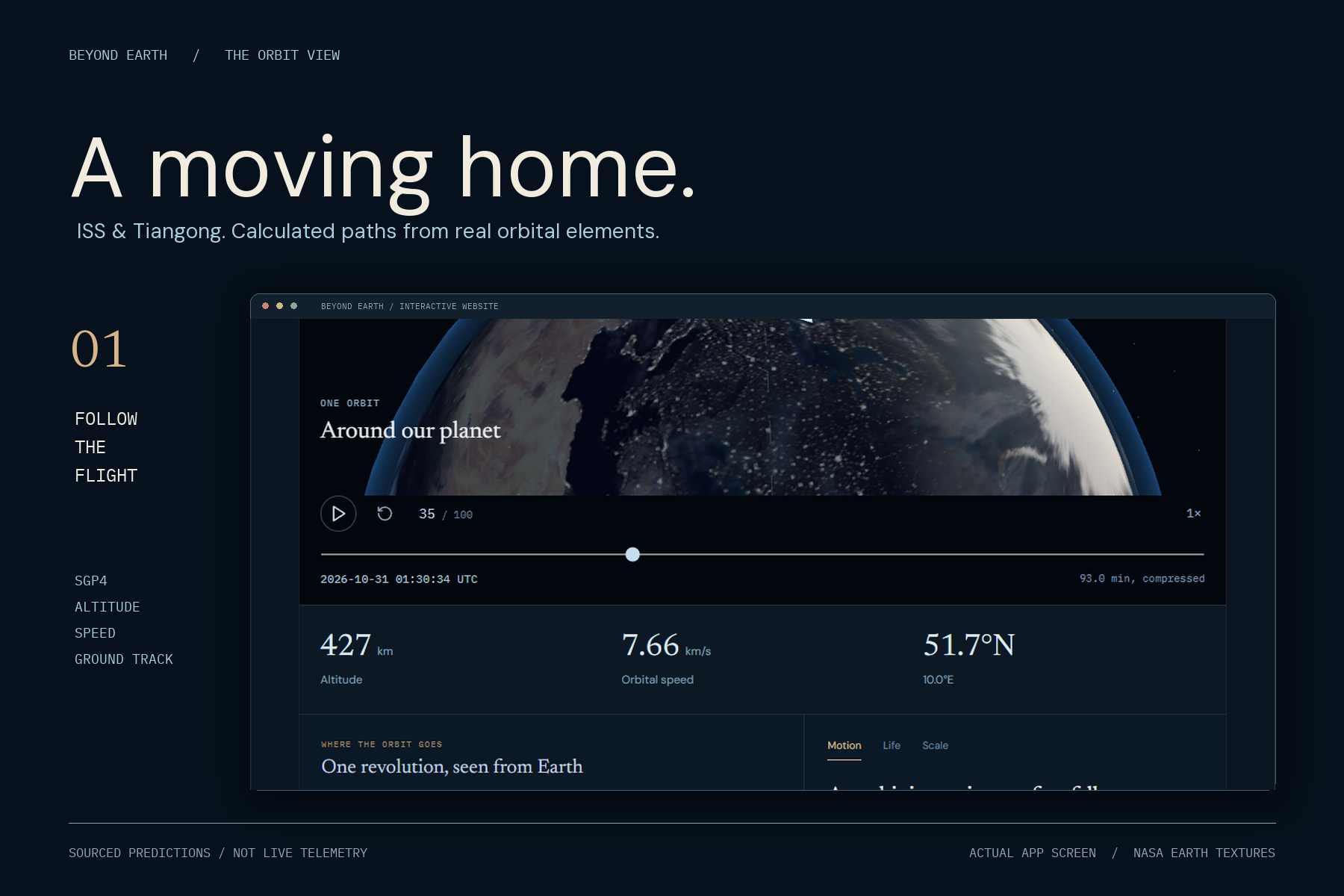
Follow ISS and Tiangong using real orbital elements, calculated positions, and an interactive ground track.
-
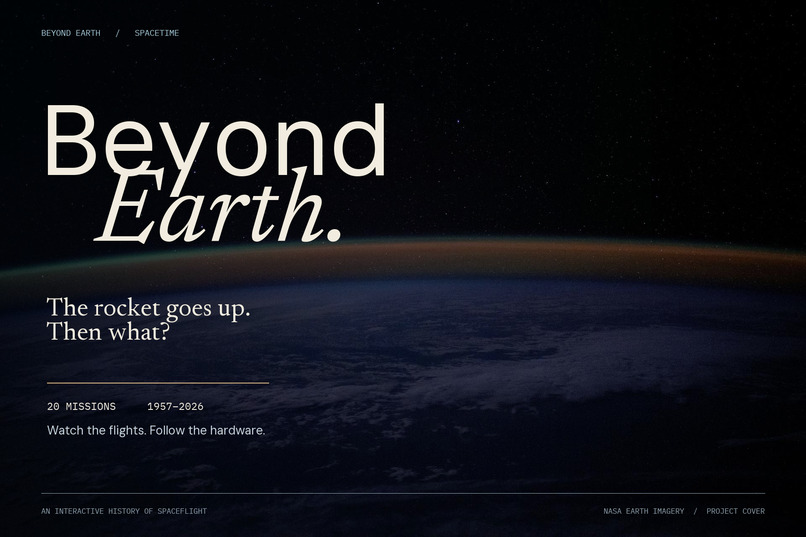
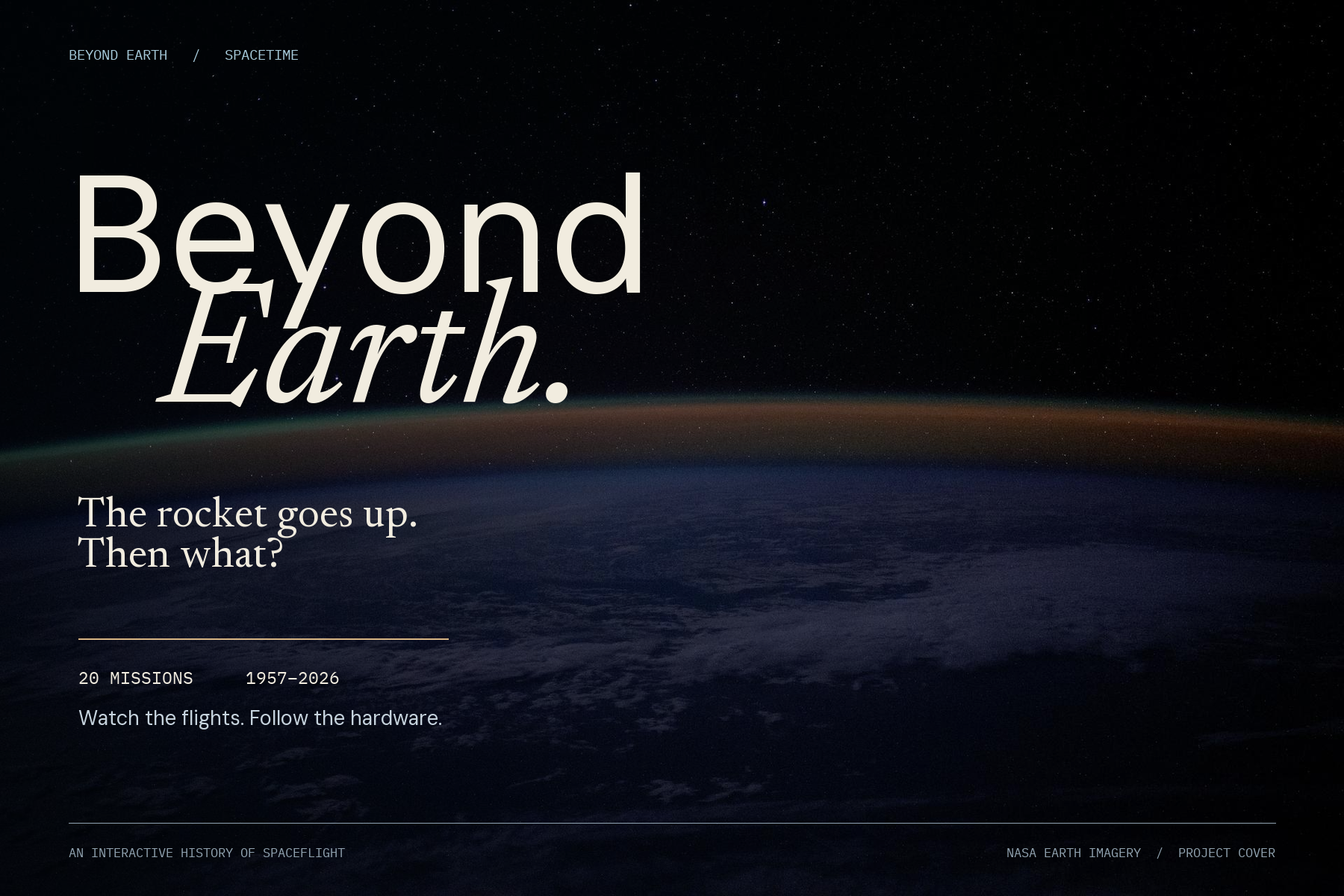
Beyond Earth: 20 spaceflight stories, from the first radio signals to life in orbit.
-
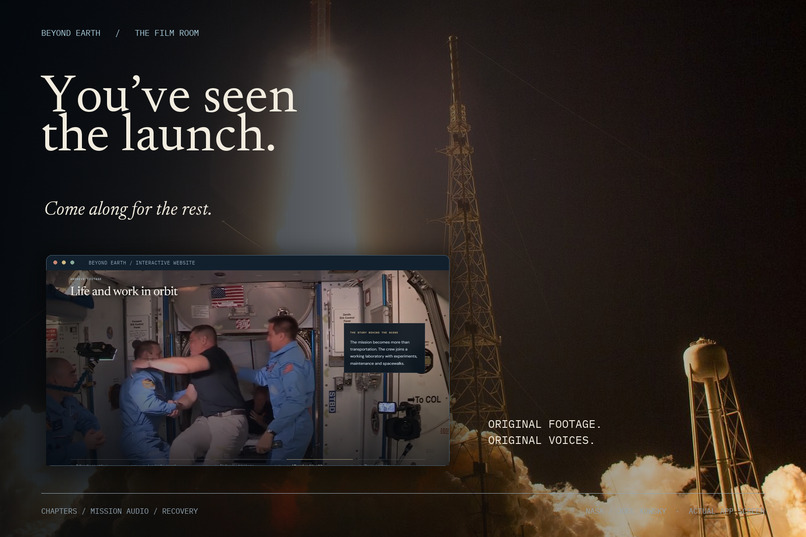
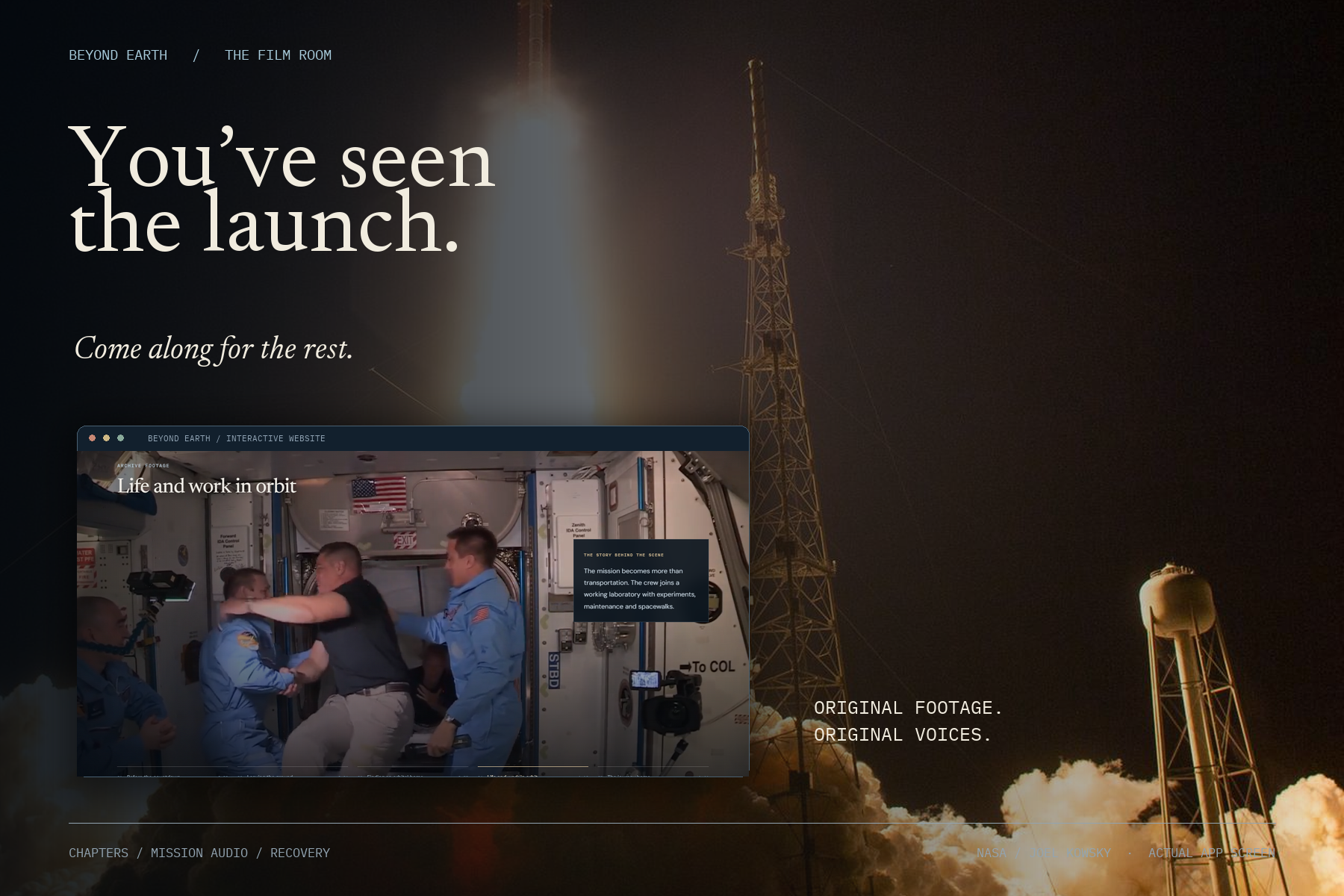
Watch NASA mission footage with original recorded voices, chapter controls, and explanations along the way.
Inspiration
A rocket disappears into the sky. What happens next?
We wanted to follow that question beyond launch day. Some spacecraft return home. Others burn up, become museum exhibits, or keep traveling long after their original missions end. Beyond Earth brings those stories together in a place people can explore without knowing the technical vocabulary first.
What it does
Beyond Earth is an interactive history of spaceflight, with 20 representative rockets, satellites, stations, and missions across a timeline from 1957 to 2026.
Each entry follows the same questions: How did it launch? What did it accomplish? How did its mission end? Where is it now?
Visitors can watch NASA archival films with original recorded voices, move between film chapters, explore mission stories, and test common misconceptions. Comparison views connect Saturn V with Falcon 9 and trace the development of space stations from Salyut 1 to Mir, ISS, and Tiangong.
The ISS and Tiangong orbit views use real orbital elements from AMSAT and SGP4 calculations. Visitors can follow a predicted position, inspect altitude and speed, and see the ground track. The data source and timestamp are visible. Historical flight illustrations are labeled separately.
How we built it
We built the application with React, TypeScript, and Vite. Three.js renders Earth and the orbital scenes, satellite.js calculates orbital positions, and Lenis provides smooth scrolling.
Mission records and media are bundled locally so the core experience can run without external API requests. NASA footage provides real launch, station, and recovery scenes. An optional licensed soundtrack can be switched off independently.
We used AI-assisted development for implementation and iteration. Source footage, illustrations, and calculated orbital positions are identified so visitors can understand what they are seeing.
Challenges we ran into
Our first orbit scenes looked polished but felt repetitive. A globe and an orbit line could show movement without explaining why anyone should care. We added real mission footage, people inside the station, recovery scenes, chapter controls, and questions that give visitors a reason to explore.
Data accuracy was another challenge. Orbital elements support position predictions; they do not recreate a historic launch or provide live telemetry. We separated those experiences and made stale data use its own timestamp instead of presenting an outdated prediction as current.
Accomplishments we're proud of
We connected footage, history, and orbital calculations in one experience. Visitors can move from watching a launch to understanding a spacecraft's purpose, comparing its engineering, and finding out where it ended up.
We also made the experience usable on phones, with readable mission details, touch-friendly controls, and independent audio settings.
What we learned
Realism comes from context as much as rendering. A recorded voice, a view inside a spacecraft, or a clear explanation can communicate more than another visual effect.
We also learned to make the limits of our data part of the interface. Showing a source and timestamp helps people interpret a visualization.
What's next
We want to add more missions and countries, spacecraft-specific 3D models, event-level citations, accessible captions for archival films, and automatic orbital-data updates.
Historical trajectory reconstruction is a future goal that would require appropriate historical flight data.
Credits
Archival footage and imagery are credited to NASA and the other sources identified in the application. Orbital elements are sourced from AMSAT.
"Space 1990" Kevin MacLeod (incompetech.com). Licensed under Creative Commons: By Attribution 4.0 License. https://creativecommons.org/licenses/by/4.0/

Log in or sign up for Devpost to join the conversation.