-
-
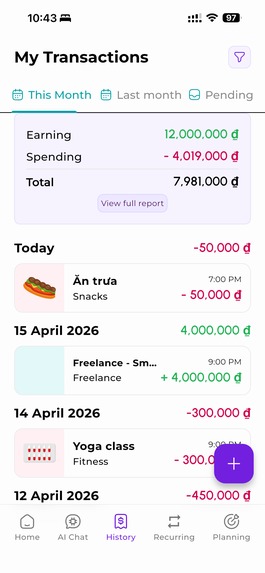
Danh sách giao dịch
-
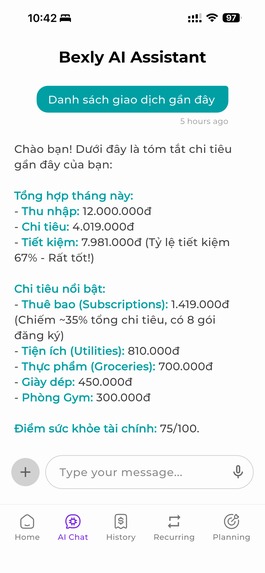
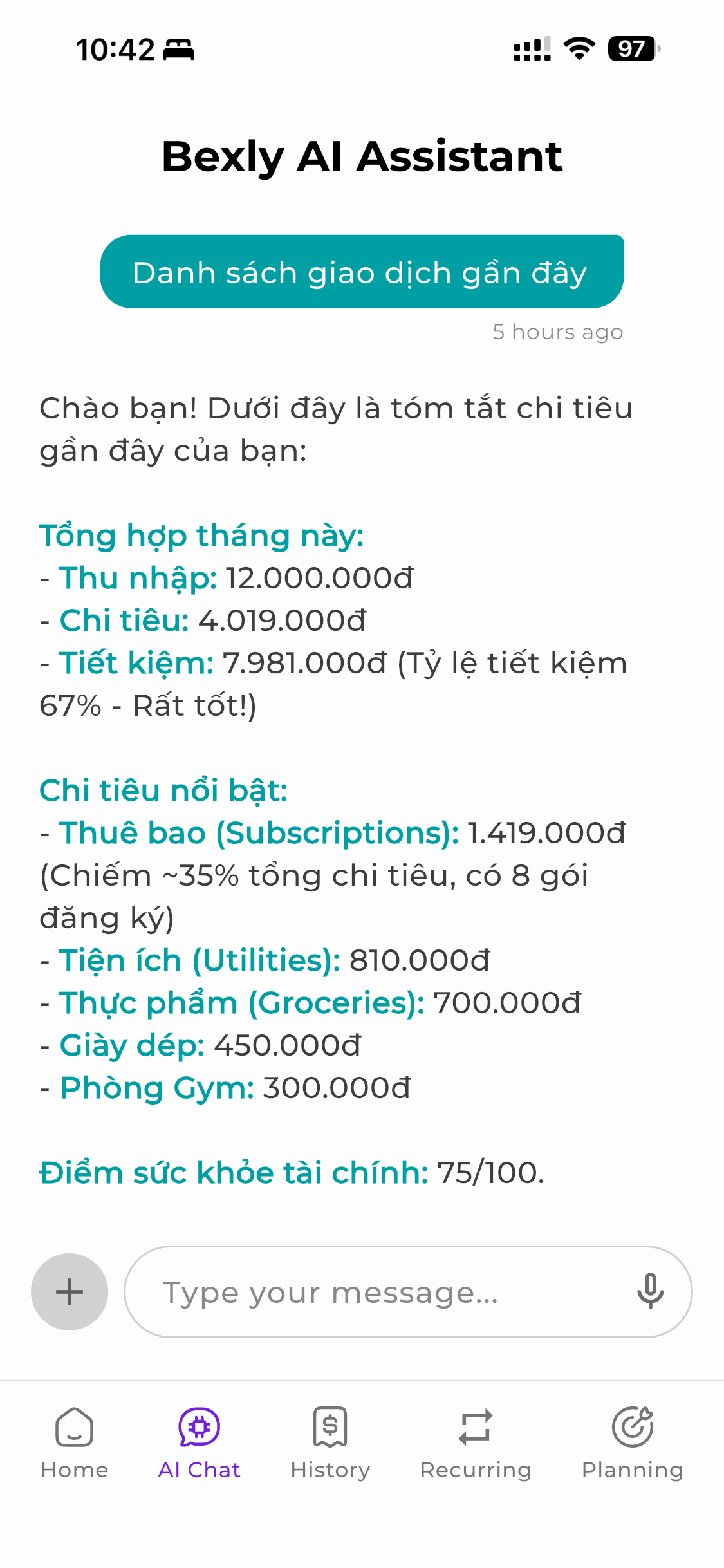
Trợ lý AI
-
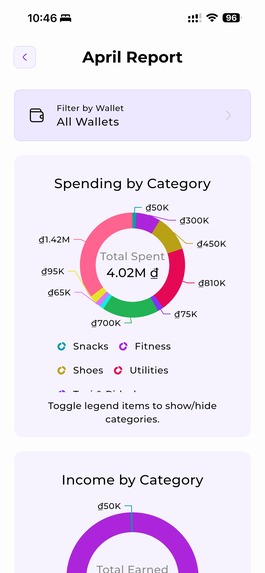
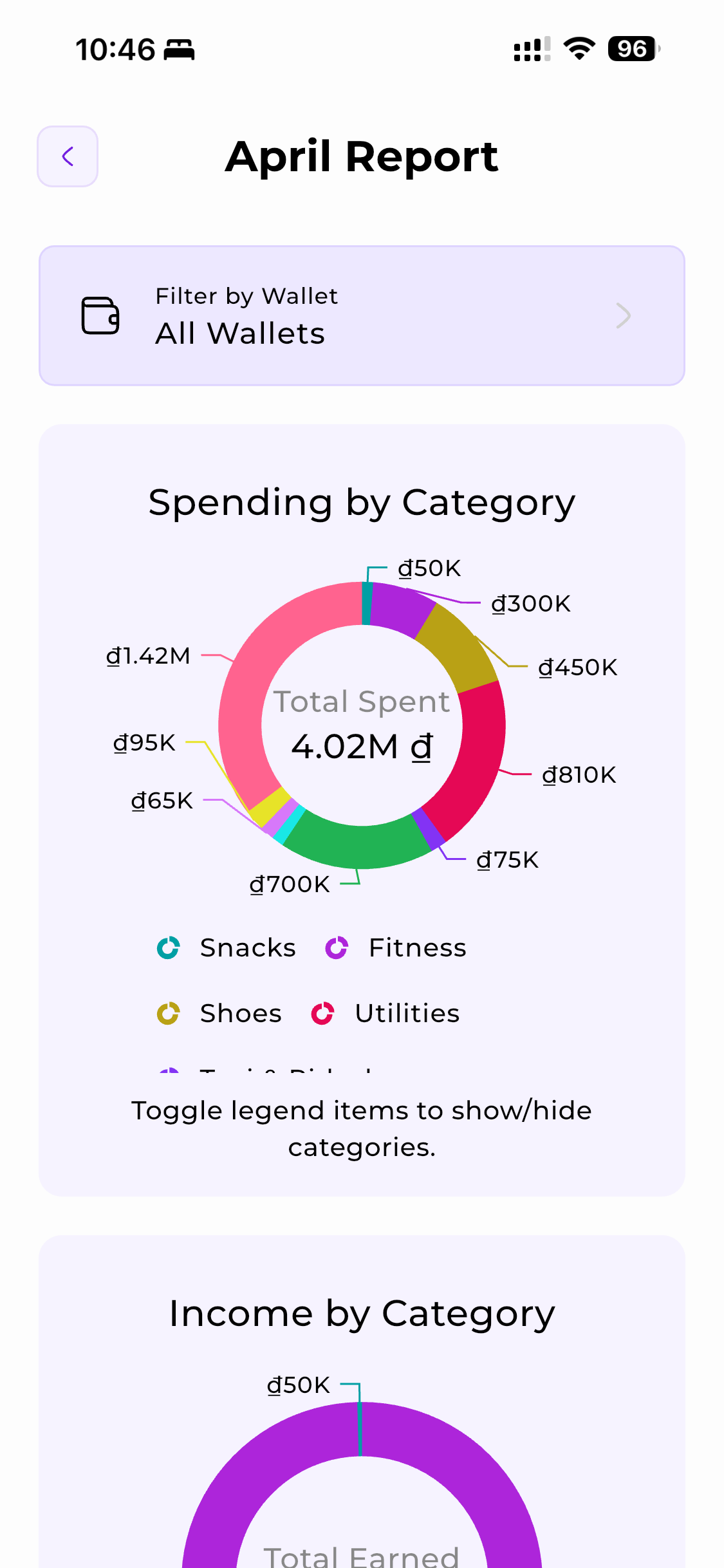
Thống kê chi tiêu
Inspiration
Managing personal finances shouldn't require spreadsheets or financial literacy courses. We observed that most banking apps stop at showing transaction history - they don't understand the customer's financial behavior or proactively help them improve it.
When we saw Shinhan Bank Vietnam's [SB1] use case - an AI Personal Financial Coach embedded in the SOL app - it aligned perfectly with what we've been building: an AI assistant that doesn't just track money, but actively coaches users to make better financial decisions, in their own language.
Crucially, banking regulation in Vietnam requires customer financial data to stay within bank infrastructure. This means cloud-only AI solutions (OpenAI, Google Gemini, etc.) are not viable for production deployment. Our entire stack - from the AI model to the database - is open-source and self-hostable, making it the right fit for Shinhan's compliance requirements.
What it does
Bexly is an AI-powered personal financial coach that:
Conversational Finance Management
- Users create transactions, budgets, savings goals, and recurring charges through natural language - "I spent 150k on lunch", "Set a 5M budget for food this month", "Save 20M for a vacation by December"
- The AI understands context: saying "I pay Netflix 200k monthly" automatically creates a recurring charge, not a one-time expense
- Supports 15+ structured actions:
create_expense,create_income,create_budget,create_goal,create_recurring,get_balance,get_summary,list_transactions, and more
Proactive Financial Coaching
- Financial Health Score (0-100): Dynamic score based on savings rate, budget adherence, expense trends, and goal progress - displayed on the dashboard and referenced by the AI in conversations
- Spending Forecast: Predicts end-of-month balance based on current spending velocity - warns users before shortfalls happen
- Anomaly Detection: Flags transactions exceeding 3x the category average - pushes alerts so users catch overspending in real-time
- Daily Digest: Morning notification summarizing yesterday's activity and month-to-date status
- The AI doesn't wait for questions - it proactively coaches: "Your dining spend is 40% higher than last month - want to set a budget?"
Product Recommendation Engine
- Based on spending analysis, the AI suggests relevant Shinhan financial products:
- High dining/shopping spend → Shinhan cashback credit card
- Idle balance in current account → high-yield savings account
- No insurance transactions → life/health insurance product
- Frequent international spend → Shinhan FX savings card
- Banking actions:
open_savings_account,apply_credit_card,apply_loan,transfer_to_savings - Auto-suggest savings plans: "You have 5M idle this month → open a 6-month savings at 5.5% and earn 275k interest"
Smart Document Understanding
- Receipt/Invoice OCR: Snap a photo of any receipt → AI extracts amount, merchant, category, date automatically
- Banking Screenshot Import: Take a screenshot of another banking app → AI bulk-extracts all visible transactions
- Email Sync: Connects to Gmail, parses banking notification emails using AI, and imports transactions with review workflow
- Supports camera, gallery, and PDF input
Multi-Currency & Multi-Language
- 14 languages: Vietnamese, English, Japanese, Korean, Chinese, Thai, Indonesian, Hindi, Arabic, and more
- Multi-wallet with independent currencies and real-time exchange rates
- Voice input with locale-aware speech recognition (Vietnamese default)
How we built it
AI Architecture - Open-Source, Self-Hosted, On-Premise Ready
Every component of our AI stack is open-source and can be deployed on Shinhan's own infrastructure:
| Component | License | On-Premise Deployment |
|---|---|---|
| Qwen 3.5 (35B-A3B) | Apache 2.0 | Self-hosted via vLLM on any Linux server with GPU |
| vLLM | Apache 2.0 | OpenAI-compatible API server, Docker-ready |
| Supabase | Apache 2.0 | Self-hosted (PostgreSQL + Auth + Edge Functions) |
| SQLite/Drift | Public Domain | Runs locally on user's device |
| Flutter | BSD 3-Clause | Fully owned source code |
| Pockaw (upstream) | MIT | Open-source Flutter personal-finance starter we forked and extended |
No dependency on proprietary cloud AI APIs. The entire inference pipeline runs on a single GPU server. For production banking deployment, Shinhan can:
- Deploy vLLM + Qwen on their own GPU cluster
- Self-host Supabase for cloud sync and auth
- All customer financial data stays within Shinhan's data center
- Zero data leaves the bank's infrastructure
Current Self-Hosted Setup:
- vLLM serving Qwen 3.5 via OpenAI-compatible API (
/v1/chat/completions) - Single-GPU demo deployment with fallback to a secondary Qwen 3.5 cloud endpoint for resilience during hackathon demos - production would run multiple Qwen instances behind a load balancer, fully inside Shinhan's data center
- Vision capabilities for receipt OCR via the same Qwen model
Action Protocol Design
The AI doesn't just chat - it acts. We designed a structured action protocol where the model embeds JSON actions within its response:
ACTION_JSON: {"action": "create_expense", "amount": 150000, "currency": "VND", "category": "Food & Dining", "description": "Lunch"}
The app parses these actions, executes them against the local database, syncs to cloud, and confirms back to the user - all in one conversational turn. Destructive actions (delete, bulk operations) require explicit user confirmation via inline buttons.
Tech Stack
- Frontend: Flutter (cross-platform - Android, iOS, Web, macOS, Linux) with Riverpod + Hooks for state management
- Database: Drift/SQLite (16 tables, 12 DAOs, schema v27) with cloud sync to Supabase PostgreSQL
- Auth: Supabase with Google/Apple/Facebook social login
- AI Proxy: Supabase Edge Functions (Deno) - routes AI requests with JWT auth, keeps keys server-side
- Background Processing: WorkManager for email sync, recurring charge automation, daily digest generation
- OCR Pipeline: Strategy pattern with 5 provider implementations (
DosAiOcrProvider,GeminiOcrProvider,OpenAiOcrProvider,ClaudeOcrProvider,FallbackOcrProvider)
Built on Open-Source Foundation
Bexly is a fork of Pockaw - an MIT-licensed Flutter personal finance tracker. Pockaw gave us a production-quality starting point for the core wallet/transaction/budget UI and offline-first Drift database layer, so we could focus our hackathon effort on what matters for SB1: the AI coach, action protocol, self-hosted inference pipeline, Shinhan product recommender, and financial health intelligence. This is the open-source philosophy in action - stand on the shoulders of the community, contribute back when possible, and avoid rebuilding what already works well.
How Qwen Powers Bexly
Qwen is the brain behind every feature - not a wrapper, but the core reasoning engine:
| # | Role | How Qwen is Used |
|---|---|---|
| 1 | Financial Coach Brain | System prompt with coaching persona + spending context injection → Qwen reasons about user's financial behavior, generates personalized advice, and decides which actions to take |
| 2 | Action Engine | Qwen parses natural language intent → embeds structured ACTION_JSON in response → app executes database operations (create transactions, budgets, goals, banking actions) |
| 3 | Vision OCR | Qwen Vision processes receipt/invoice photos → extracts amount, merchant, category, date into structured data |
| 4 | Product Recommender | Qwen analyzes spending patterns against Shinhan product catalog → generates contextual recommendations with reasoning |
All inference runs on a self-hosted vLLM instance - no external API calls, no data leaving the server.
Challenges we ran into
On-premise model optimization: Running a 35B-parameter model on a single GPU required careful tuning - quantization (GPTQ-Int4), context length limits, and memory utilization balancing. We achieved sub-5-second response times suitable for interactive chat on a single consumer GPU
Action ambiguity: "I pay 200k for electricity every month" - is this a one-time expense or a recurring charge? We built keyword detection that auto-upgrades
create_expensetocreate_recurringwhen frequency words are presentReceipt OCR accuracy across Vietnamese receipts: Vietnamese receipts have inconsistent formats, mixed Vietnamese/English text, and varying quality. We solved this with Qwen Vision running on-premise plus carefully structured prompts that handle receipts, invoices, bank statements, and banking app screenshots in one unified pipeline
Financial Health Score without banking API access: Computing a meaningful health score without direct access to bank account data required creative use of transaction history, budget adherence, and goal progress as proxy signals
Multi-currency AI context: When a user has wallets in VND, USD, and JPY, the AI needs to understand which wallet context it's operating in. We implemented a wallet fallback chain (active → default → first available) and pre-fetch exchange rates on chat open
Accomplishments that we're proud of
- Fully open-source, self-hosted AI stack - no dependency on proprietary cloud APIs, deployable on bank infrastructure from day one
- 15+ AI-driven financial actions executable through natural conversation - not just a chatbot, but a financial operating system
- Financial Health Score that gives users a tangible, trackable metric for their financial well-being
- Spending Forecast that predicts end-of-month balance and warns users before problems happen
- 5-provider OCR pipeline with automatic fallback - receipts, screenshots, PDFs all work seamlessly
- Gmail integration that turns banking email notifications into structured transactions with AI parsing
- 14 languages supported out of the box - critical for a banking app serving diverse markets
- 33 feature modules in a clean architecture - from gamification to family shared wallets to subscription management
- Zero exposed API keys - all AI provider keys are server-side via Edge Function proxy
What we learned
- On-premise is not optional for banking: Cloud AI APIs are convenient for development, but Vietnamese banking regulation requires data sovereignty. Building on open-source from the start was the right architectural decision
- LLMs as action engines, not just chatbots: The real power isn't in generating text - it's in parsing user intent into structured database operations. The
ACTION_JSONprotocol was the breakthrough that made the AI genuinely useful - Fallback chains are essential for production AI: No single model is 100% reliable. For production banking, this means multiple Qwen instances rather than falling back to cloud providers
- Vietnamese NLP is hard: Currency formats (150.000 vs 150,000), mixed-script text, and colloquial financial terms required careful prompt engineering
- Financial coaching > financial tracking: Users don't need another app that shows them charts - they need one that tells them what to do
SB1 Expected Outcome Coverage
| # | Shinhan's Expected Outcome | How Bexly Delivers | Status |
|---|---|---|---|
| 1 | Increase DAU/MAU on SOL | Daily Digest notifications, Financial Health Score, gamification streaks, churn prevention re-engagement | Built |
| 2 | Improve cross-sell conversion | AI-driven product recommendations (6 Shinhan products) + banking actions (apply_credit_card, open_savings_account, apply_loan) |
Built |
| 3 | Reduce churn through proactive insights | Spending Anomaly Alerts, Spending Forecast, proactive AI coaching after every transaction | Built |
| 4 | Enhance NPS/CSAT via personalized guidance | Financial Coach persona, personalized conversations, in-app NPS survey (1-5 stars) | Built |
| 5 | Grow CASA balance through savings recommendations | Auto-Suggest Savings with interest calculations, transfer_to_savings action |
Built |
How to Test
Telegram Bot (@BexlyBot)
- Open Telegram and search for @BexlyBot
- Send
/start- the bot will show a welcome message and demo account selector - Pick a demo account - each has different financial profiles:
- Minh - Office Worker, 20M VND/month salary, high dining spend
- Lan - Freelancer, irregular income, 8 subscriptions
- Huy - Student, tight budget, minimal savings
- Trang - Business Owner, multi-currency (VND/USD/EUR/JPY), 4 wallets
- Duc - Expat, USD+VND, international spending patterns
- Try these commands:
/insights- View spending overview with Financial Health Score/demo- Switch to a different demo account/help- See all available commands
- Chat naturally with the AI coach:
Tinh hinh tai chinh thang nay?- Get personalized coaching adviceHow can I save more?- Financial coaching in Englishăn trưa 50k- Record a lunch expenselương 15 triệu- Record salary income
- The AI will reference real spending data and suggest relevant Shinhan banking products based on each persona's patterns
Mobile App (Flutter)
- Download and install Bexly from the provided APK/TestFlight link
- On the login screen, tap "Demo Accounts" to see 5 pre-configured accounts
- Select any demo account - it auto-fills credentials and logs in
- Explore features:
- Dashboard: Financial Health Score, spending forecast, budget status
- AI Chat: Tap the chat icon, try natural language commands
- Transactions: View seeded transaction history
- Budgets & Goals: See budget tracking with progress bars
- Receipt Scanner: Take a photo of any receipt for AI OCR
What Each Demo Account Triggers
| Account | Shinhan Product Triggers |
|---|---|
| Minh (test1) | Cashback Credit Card (high dining), Auto-Save (many small transactions) |
| Lan (test2) | Auto-Save (8 subscriptions), Personal Loan (irregular income) |
| Huy (test3) | Premium Savings (idle balance), Life Insurance (no coverage) |
| Trang (test4) | FX Multi-Currency Card (international transactions), Personal Loan |
| Duc (test5) | FX Multi-Currency Card (USD spending), Premium Savings |
What's next for Bexly
- Shinhan SOL App integration: Embed Bexly AI module inside SOL via Flutter platform channel → real-time transaction feed from Core Banking API, zero manual entry
- Multi-instance Qwen deployment: Load-balanced vLLM cluster for production-grade throughput on Shinhan's GPU infrastructure
- Home screen widgets: Quick glance at balance, budget status, and AI tips without opening the app
- Peer benchmarking: "You spend 20% more on dining than similar users in HCMC" using anonymized aggregate data
- Open Banking API integration: Connect to multiple Vietnamese banks for consolidated financial view
Built With
- alibaba-cloud
- dart
- deno
- docker
- drift
- firebase
- flutter
- github-actions
- next.js
- postgresql
- qwen
- riverpod
- sqlite
- supabase
- typescript
- vllm


Log in or sign up for Devpost to join the conversation.