Inspiration
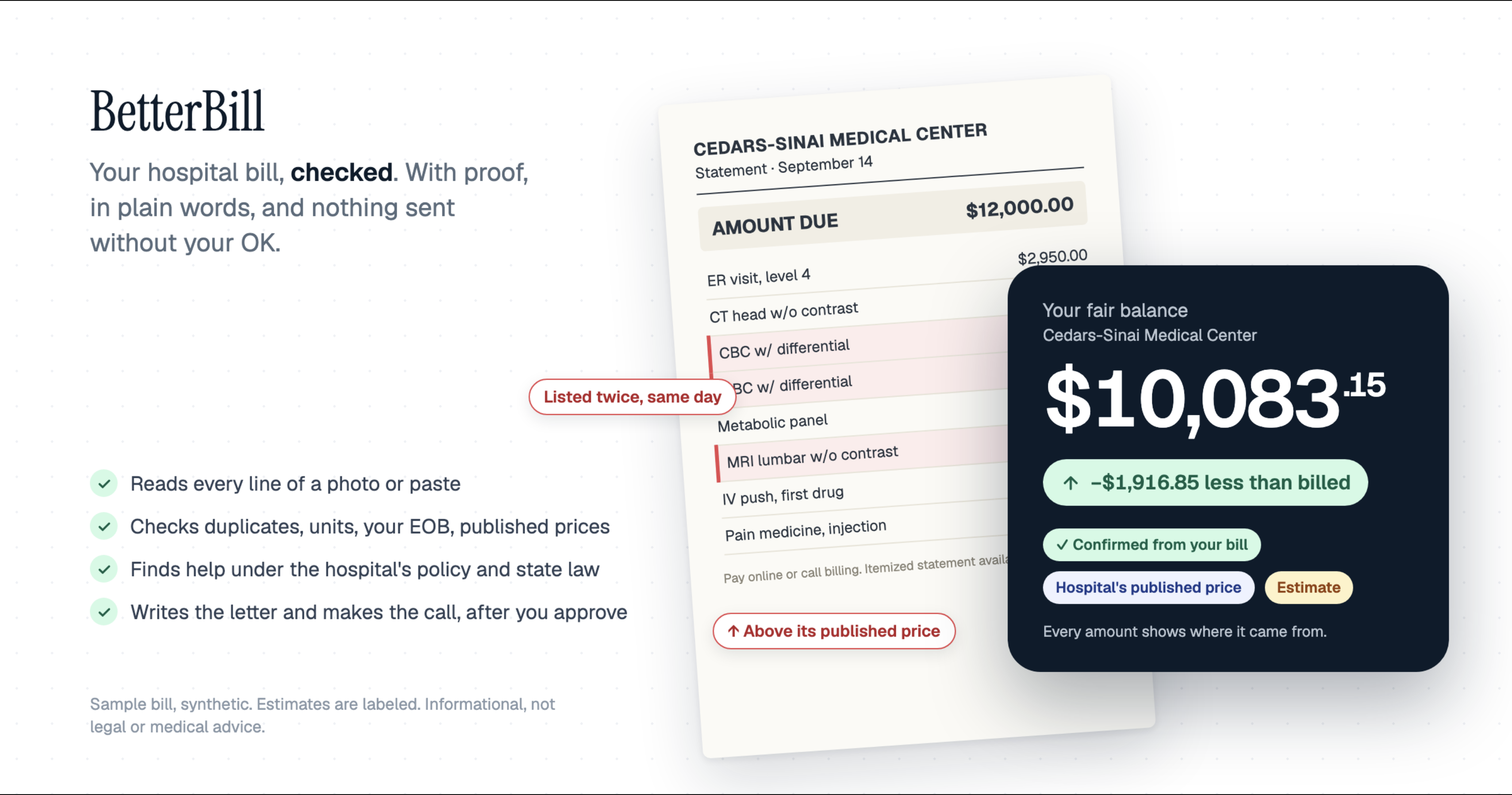
A $12,000 hospital bill arrives. Questioning it means learning billing codes, price files and charity care law, then losing an afternoon on hold.
Close to half (45%) of insured adults ages 19 to 64 got a medical bill in the past year they thought insurance should have covered (Commonwealth Fund, 2023 Health Care Affordability Survey).
Most people just pay it. They don't need another opinion; they need proof they can hand to billing.
AI should do the reading, writing and waiting. Code should do the math. The patient should make the call.
What it does
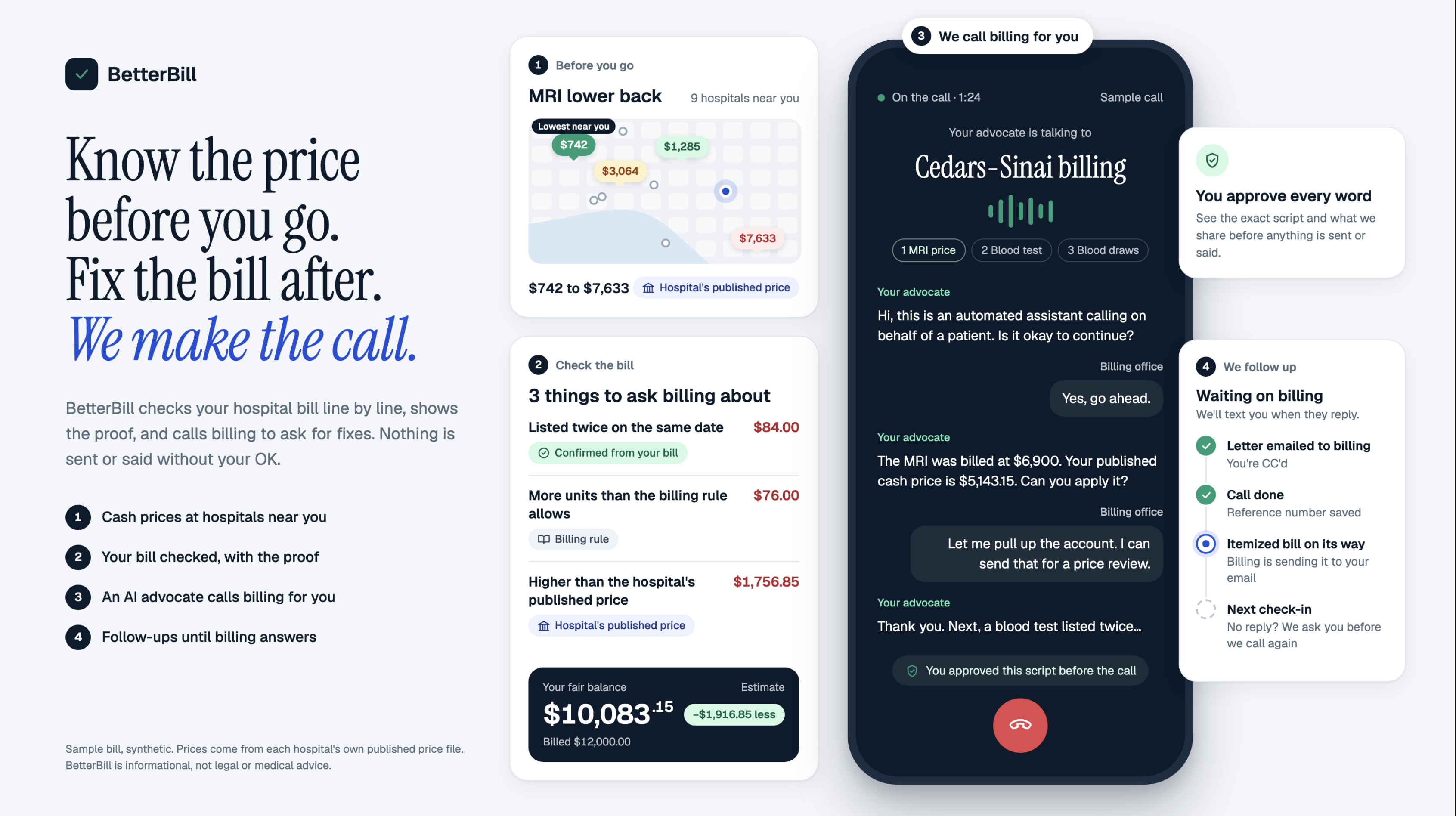
On our $12,000 sample bill, BetterBill finds $1,916.85 less than billed, every item with its source:
- MRI billed at $6,900; Cedars-Sinai's own published cash price is $5,143.15
- An $84 duplicate blood count
- A $76 units error on blood draws
How it works:
- Snap a photo or paste the text.
- Confirm every line, fix misreads, mark care you never got.
- Proof: rules check duplicates, CMS unit limits, the bill vs your insurance statement, and the published price. Every amount carries its source.
- Help paying: the app screens for financial assistance under the hospital's policy, federal rules and several state laws; Browser Use finds a missing policy live.
- Act: a letter is drafted in about 2 seconds on production. The patient approves the exact text, then it is sent and an AI advocate calls billing.
- Share a redacted evidence packet.
On the sample bill, results show up in about a second. Free to check; we keep 10% of confirmed savings only, capped at $1,000.
How we built it
Applied intelligence, split on purpose: AI where it is strong, code where it must be right.
AI does the reading, writing, talking and browsing:
- StepFun
step-5-previewreads photos (transcribing only), Gemini drafts letters, an ElevenLabs agent calls over a Photon line, Browser Use captures real price files and policies.
Code does the parts that cannot be wrong:
- A TypeScript rules engine computes every flag and dollar, in integer cents.
- A claim checker rejects any dollar figure Gemini writes that is not in the bill or the evidence.
- A browsing agent's quote is kept only if it matches the source PDF word for word.
- On calls, a Python LiveKit controller, not the prompt, decides when the advocate may speak.
Our newest call design, a prototype, is our first where the patient never leaves the line: they join a 3-way call and verify their own identity, and the advocate, never pretending to be them, asks for a hold on the account, the itemized bill, records and a reference number.
Challenges we ran into
- Testing without real patients. Real bills are private, so we built 11 realistic sample bills with known mistakes and compared them against real, public hospital prices, policies and laws.
- We traced it, then fixed it. A demo photo took 26 seconds. Sentry's
invoke_agent bill-readerspan showed a live StepFun call despite a saved reading. Saved reads now return in under a second. - A flag is a question, not a verdict. CMS allows up to 4 blood counts a day, so BetterBill asks billing; it never accuses.
Accomplishments that we're proud of
- One workflow from photo to approved call, on web, iOS and Android, from one design in Paper.
- 22 of 22 seeded errors caught on 11 synthetic bills, 0 false flags on 3 clean bills. We built the eval harness before the demo.
- 88.8% line recall on 35 phone photos, including angled, crumpled and dim shots.
- 28 of 28 assistance findings cite their source.
- Seven sponsor tools doing real work: StepFun, Gemini, ElevenLabs, Photon, Browser Use, Sentry, Tiger Data.
- We publish our misses. On 5 recreated KFF Health News "Bill of the Month" cases we caught 1 of 3 in-scope findings. Most other findings were coding judgments, device prices and prior authorization, which our rules deliberately do not guess at.
What we learned
- Trust comes from showing the work. A source on every amount beats a bigger number.
- Let the model talk; let code enforce money, approvals and speaking turns.
- Measure before you demo.
What's next for BetterBill
- A pilot with health plans and employers.
- More hospitals' price files and more states' assistance rules.
- A security review, then real bills from consenting patients.
- The 3-way call tested with consenting patients and billing professionals.
Don't pay what you don't owe.
Built With
- better-auth
- browser-use
- bun
- drizzle-orm
- elevenlabs
- expo.io
- google-gemini
- livekit
- orpc
- photon
- playwright
- postgresql
- python
- react
- react-native
- sentry
- shadcn/ui
- stepfun
- tailwind-css
- tanstack-start
- tiger-data
- typescript
- vercel
- vitest



Log in or sign up for Devpost to join the conversation.