Inspiration
A conversation with Henry Wei from Regeneron changed the question we were trying to answer. We had started with TrialSync, a tool for tracking dependencies in clinical trials. His feedback drew our attention to an earlier risk: the assumptions used to design the trial itself.
One example made that risk concrete. Regeneron and Sanofi's AERIFY program studied itepekimab for COPD. AERIFY-1 met its primary endpoint; AERIFY-2 did not at 52 weeks. The sponsors reported fewer exacerbations than anticipated, reducing statistical power in both trials. (Regeneron Press Release)
That led us to ask: if fewer events occur than a trial expects, how much ability to detect an assumed treatment benefit does it lose? We built BetterBaseline to make that sensitivity visible while the design can still change.
What it does
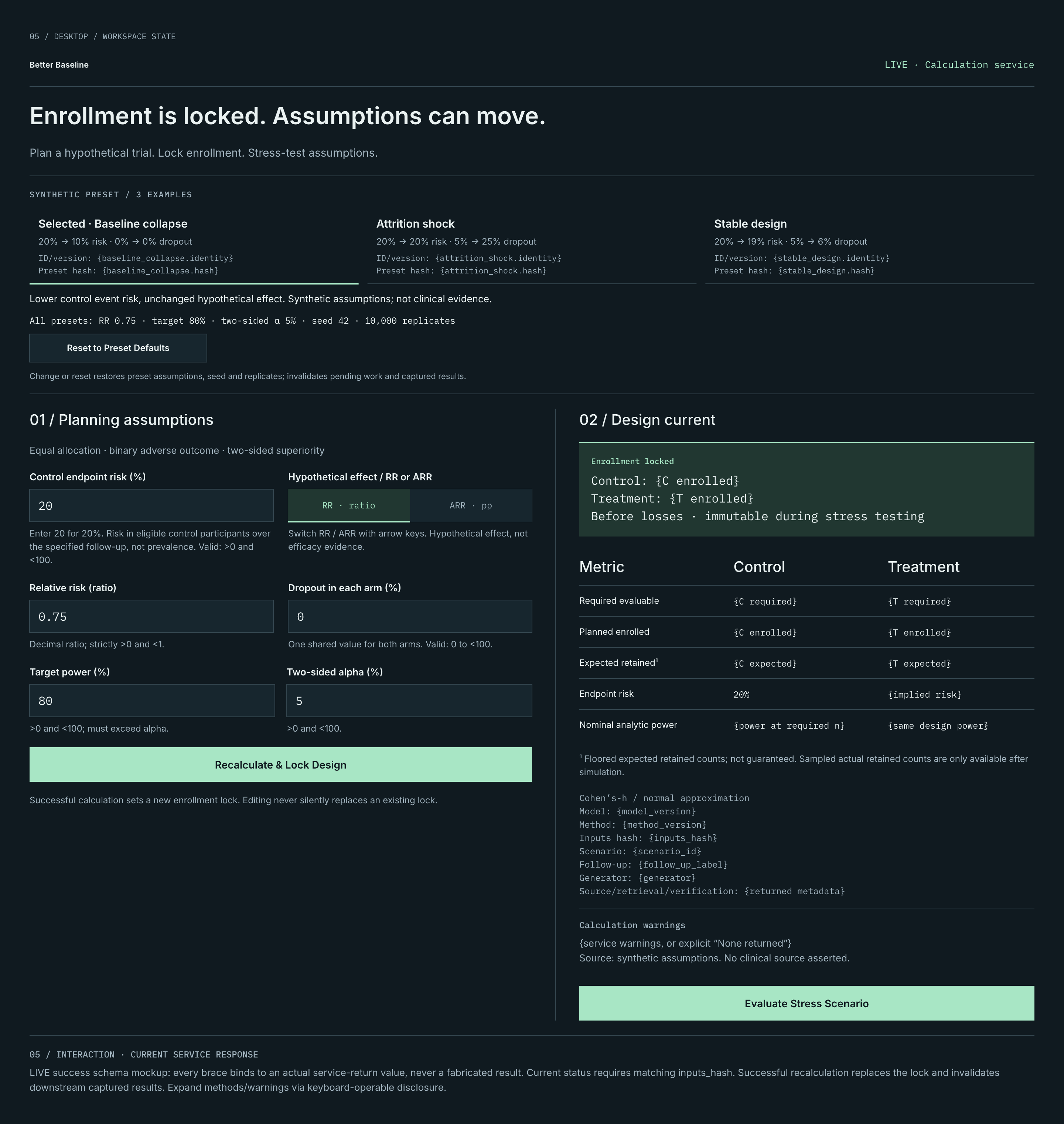
BetterBaseline is an interactive planning prototype for two-arm trials with a binary outcome. Researchers enter a control event risk, assumed treatment effect, target power, and dropout. They calculate a sample size, freeze enrollment, and stress-test what happens when those assumptions change.
Power curves and an assumption-sensitivity heatmap show where the fixed design falls below its target. Seeded Monte Carlo simulations provide a reproducible simulation check, with simulation error reported separately from uncertainty in the assumptions. Exports preserve inputs, methods, and provenance for review.
Our default synthetic example starts with 20% control risk, an assumed relative risk of 0.75, and 903 participants per arm with no dropout. Lowering control risk to 10%, while keeping enrollment and relative risk fixed, lowers approximate conditional power from 80% to 47%.
How could this help with an AERIFY-like problem? The workflow could expose sensitivity to fewer events during planning, prompting a team to examine more conservative assumptions or enrollment margins with a statistician.
Power is the probability of detecting the assumed difference under the specified model and test. It is not the probability that a drug works.
Challenges we ran into
We pivoted from TrialSync midway through the hackathon after industry feedback. That left us learning clinical trial statistics while building the product.
The hardest challenge was showing a meaningful result without overstating it. Enrollment must stay fixed during a stress test. Simulation precision must not be confused with certainty about clinical assumptions. And a real-world example with a recurrent-event endpoint cannot simply be entered into a binary-outcome model.
Accomplishments that we're proud of
We turned an unfamiliar statistical problem into a functional planning workspace with reproducible simulations and visual explanations. The default example lets someone see how a seemingly adequate design becomes fragile when its assumptions shift, while preserving the distinction between historical context and synthetic calculations.
What we learned
Choosing the right problem matters as much as building the solution. Feedback from someone working in the field helped us move from tracking a trial's workflow to examining its design assumptions.
We also learned that an 80% power calculation is conditional on a model and its inputs. Exploring plausible alternatives makes that dependence easier to understand and discuss.
What's next for BetterBaseline
Our next steps are independent statistical validation, usability testing with research teams, and models for recurrent events and survival outcomes. To analyze historical trials, we would need curated protocols and verified original planning assumptions alongside ClinicalTrials.gov metadata. We also want to support shared scenario review and comparison across a research team.
Built With
- fastapi
- javascript
- next.js
- numpy
- python
- react
- scipy
- typescript

Log in or sign up for Devpost to join the conversation.