-
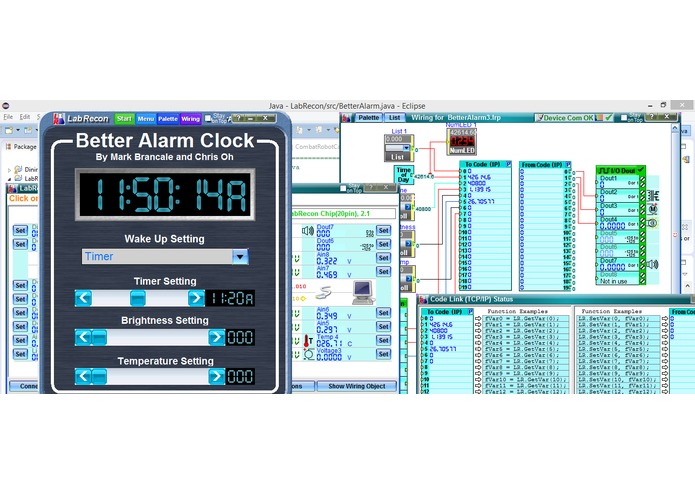
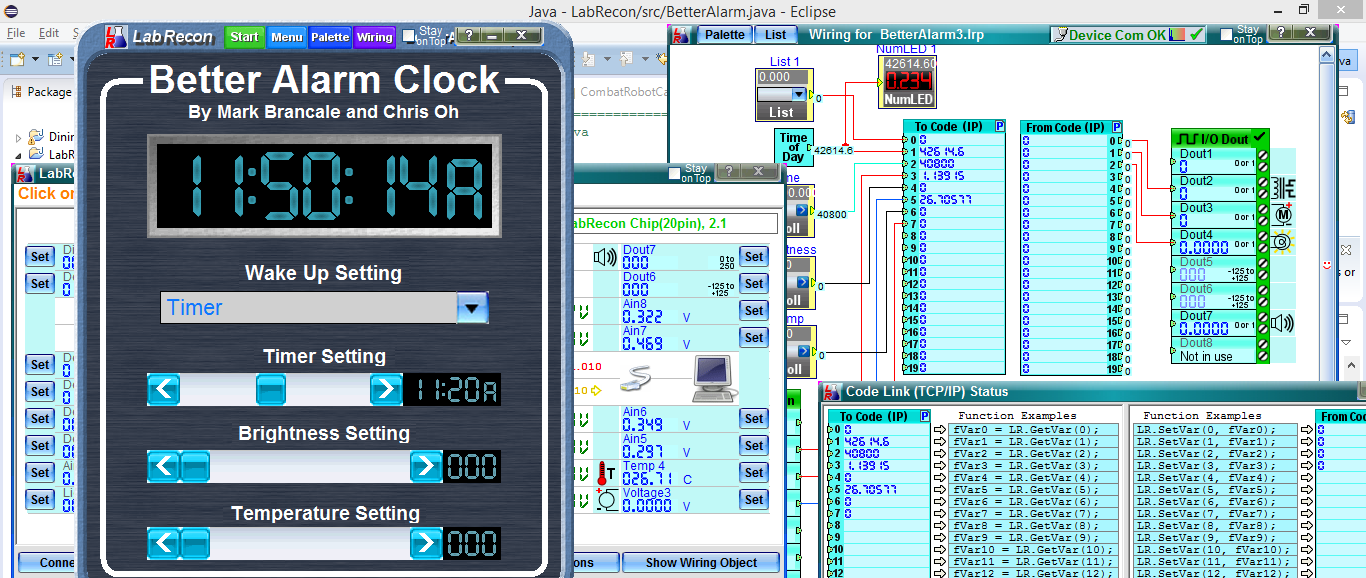
The layout of the website in LabRecon, and the wiring diagram.
-
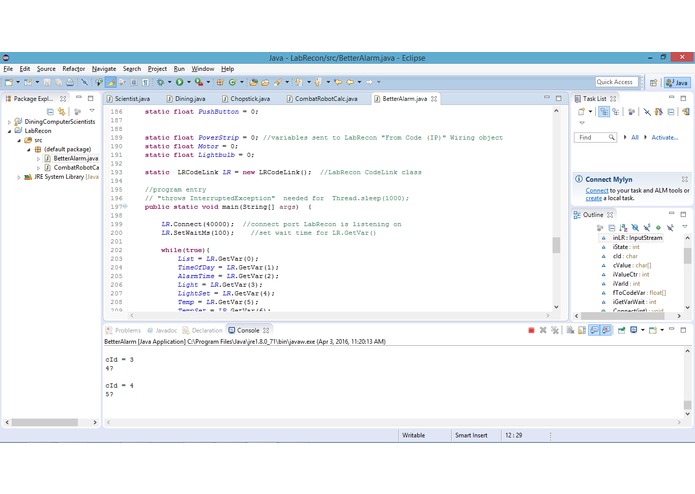
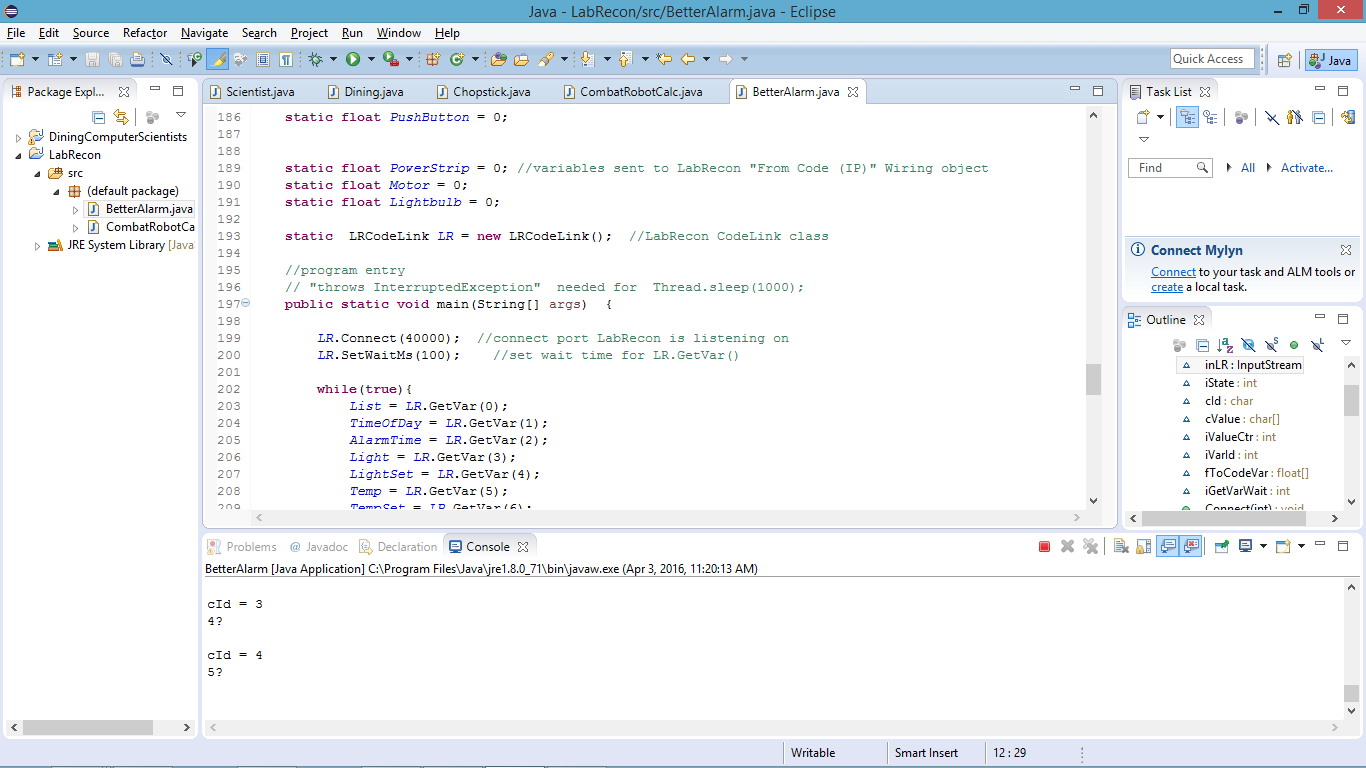
A portion of our Java code.
-
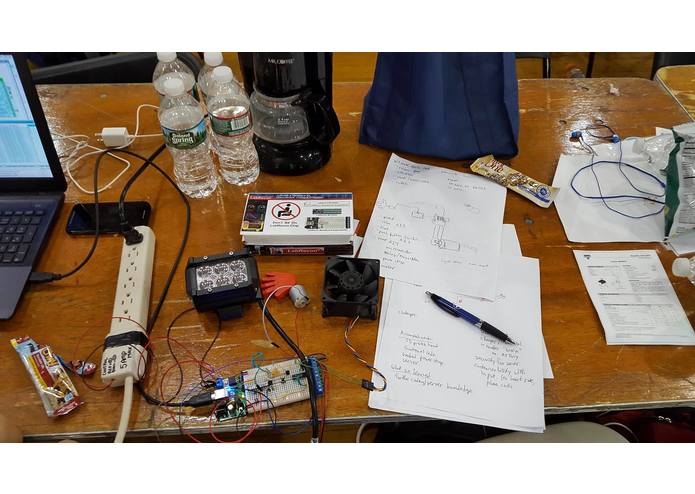
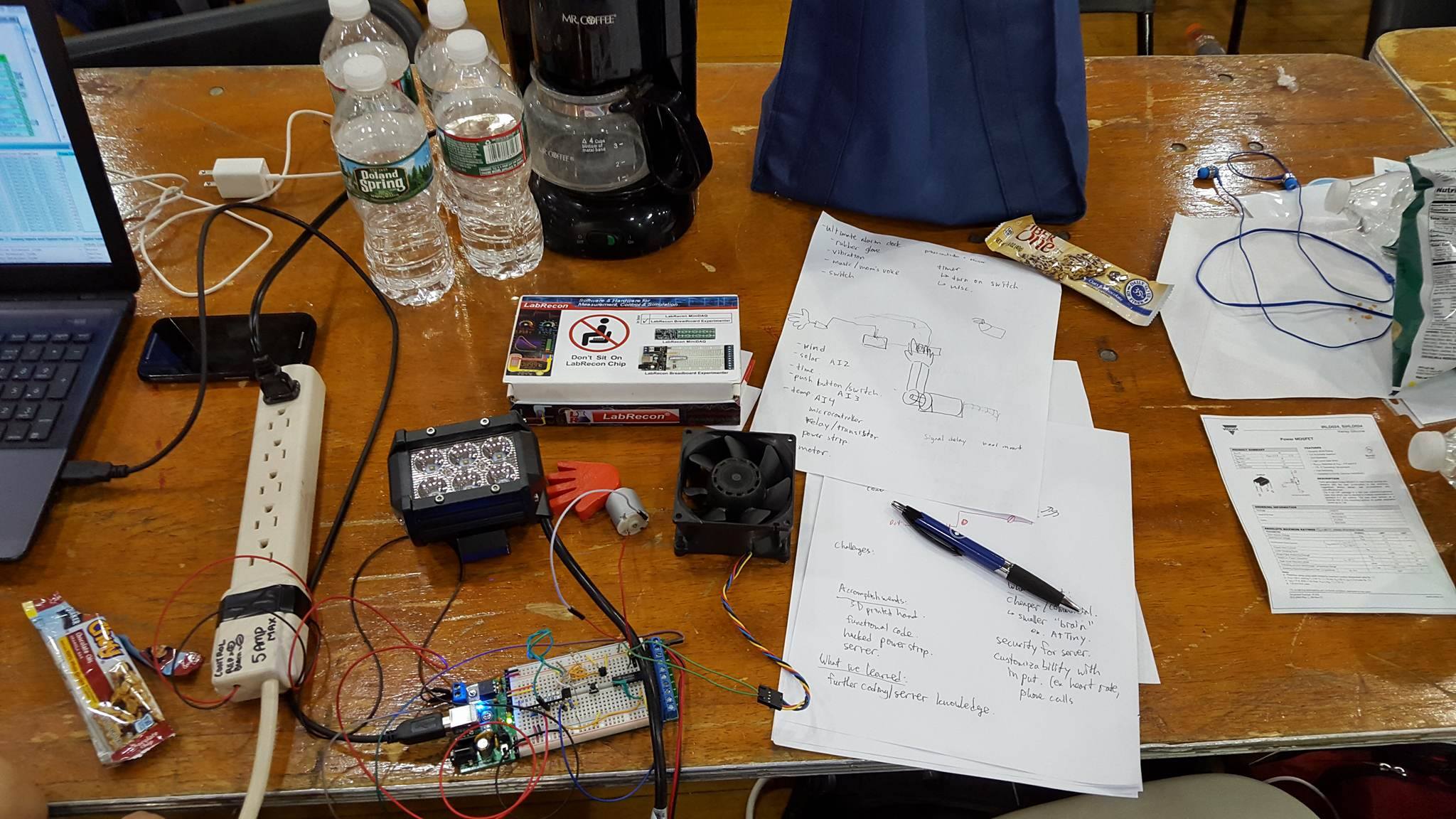
A look at the physical hardware portion.
Inspiration
Our friend Evan told us about how no matter what he does, he will sleep through his alarm clock without fail. He considered adding a motor to his bed to vibrate his mattress until he was forced out. Branching off of this idea, we ran into a hack someone did of a large rubber glove which slapped you awake in the morning. Plus, on an episode of The Office, Michael Scott said he liked waking up to the smell of bacon, and to accomplish this, he woke up earlier to start cooking bacon and went back to sleep to wake up later to the aroma of the fully cooked bacon. We thought that we could take this idea a step further with multiple methods of waking someone up, while also preparing many daily morning duties.
What it does
In order to most effectively motivate someone to get up, we thought of adjusting the alarm clock to the user and allowing the user to customize them. We created a web server which is accessible from any device that is connected to the internet, where you can decide whether the alarm is triggered by many different user inputs. This includes a set time of day, a certain brightness threshold (If the sun rose in the morning and it got much brighter), and a temperature reading. When the alarm is triggered, multiple components will activate. For the motivation aspect, we have a motor which spins a hand in your face, a fan which cools you down (making you less comfortable sleeping), and a very bright light. For the morning duties aspect, our device activates a power strip which can power many other devices such as a coffee machine or a toaster. Once you are through with the alarm, you can press a button to deactivate the processes.
How we built it
Using LabRecon's Breadboard Experimenter, LabRecon software, and additional chips, passive components, and sensors, we created the device. The Breadboard experimenter takes analog inputs from a photocell, temperature sensor (LM35), and push button (for deactivation). This data along with the time of day, and user set inputs for time, temperature, and light (all handled in the LabRecon software) is input into the code we wrote in Java using the LabRecon CodeLink feature. Then, in Java, we handled the logic of the device (When it turns off and on). This then output signals for the light, motor (for the hand), fan, and a solid state relay which we built into the power strip (which required some soldering). Additionally, the web server was a part of the LabRecon software as well. We created our own server using an adhoc script on one of our computers.
Challenges we ran into
Late at night it was hard to notice small errors in the code, and we overreacted to small nuances. Also the wiring could be a little easy to mix up at times.
Accomplishments that we're proud of
We are proud of our functional code, the server which works perfectly, the 3D printed component, completed breadboard, hacked power strip, and ultimately functional hack.
What we learned
We learned more about coding, running a server, LabRecon's software and hardware, and prototyping electronic circuits.
What's next for Better Alarm Clock
We want to make this cheaper and more commercial. We think we can accomplish many of the same tasks with a smaller brain like an ATTiny. We also wish to add more security to the server, or perhaps use a mobile app in place of the server. Additional inputs for the alarm system would be great to implement as well (heart rate, phone calls, etc.).

Log in or sign up for Devpost to join the conversation.