-
-
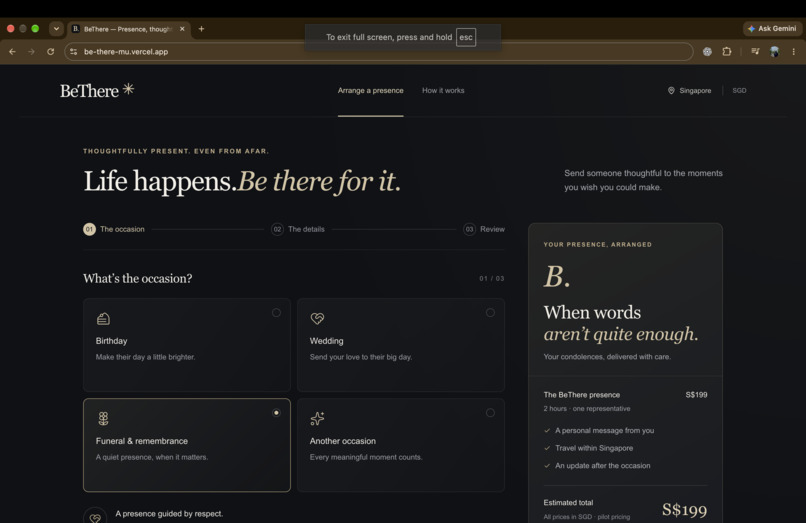
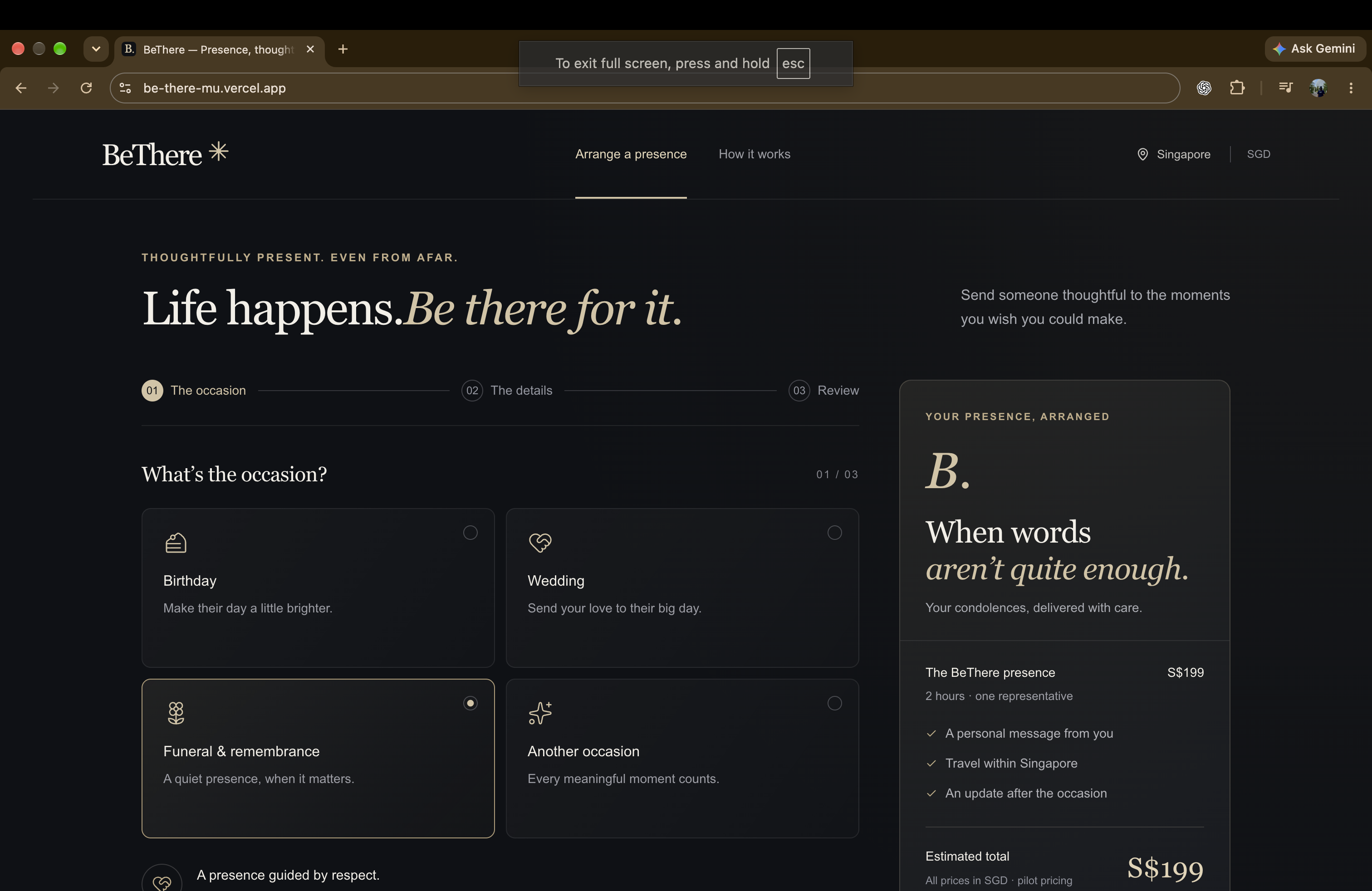
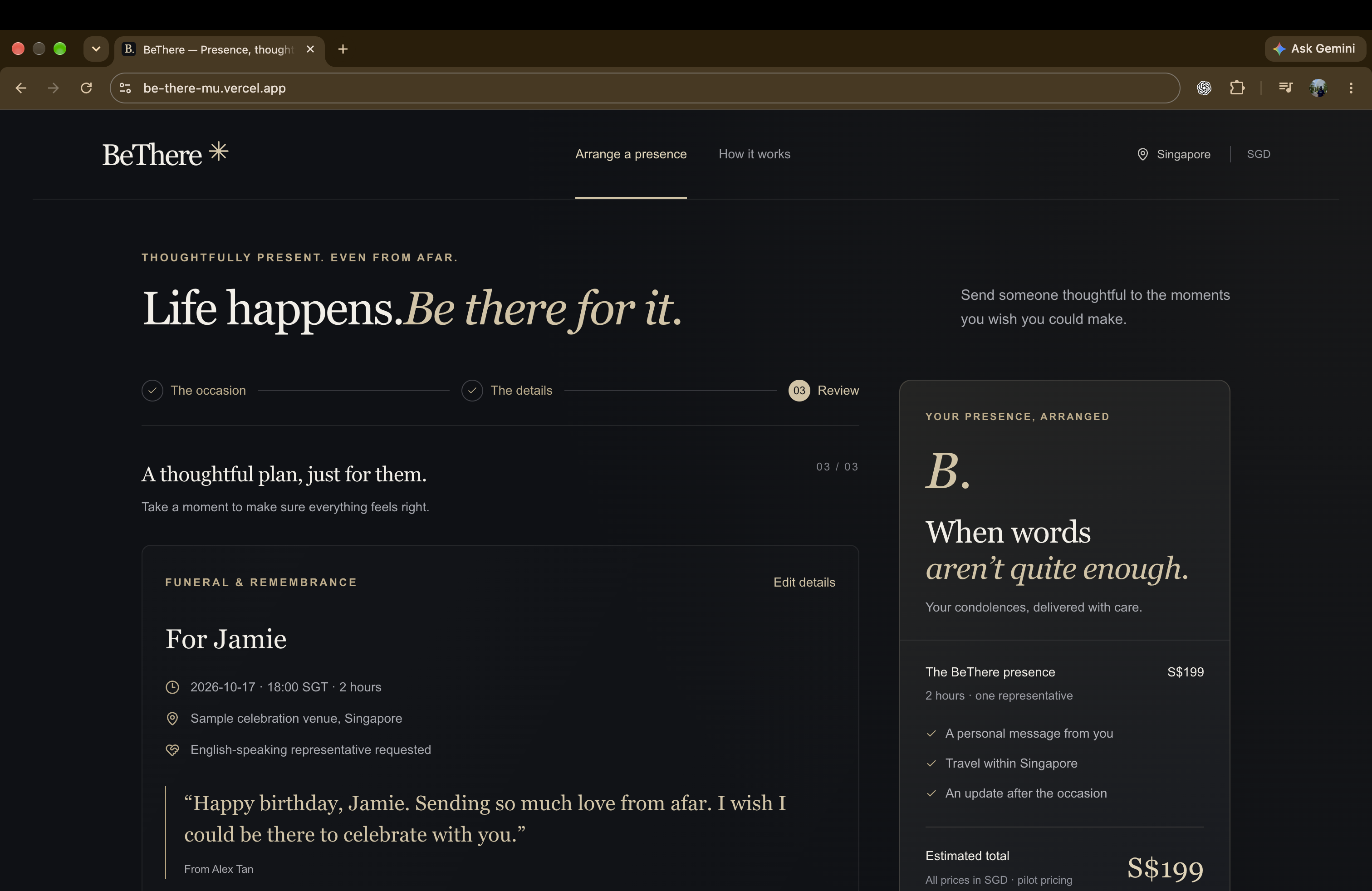
Home Page - Taking an example of a funeral
-
-
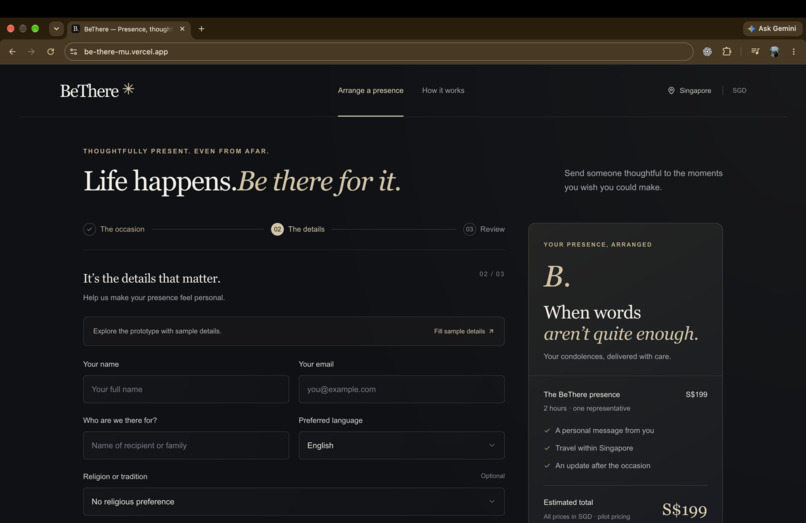
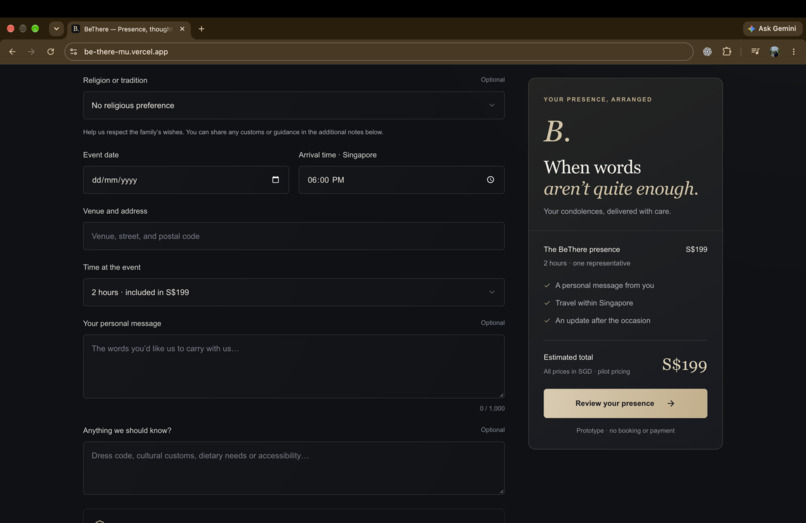
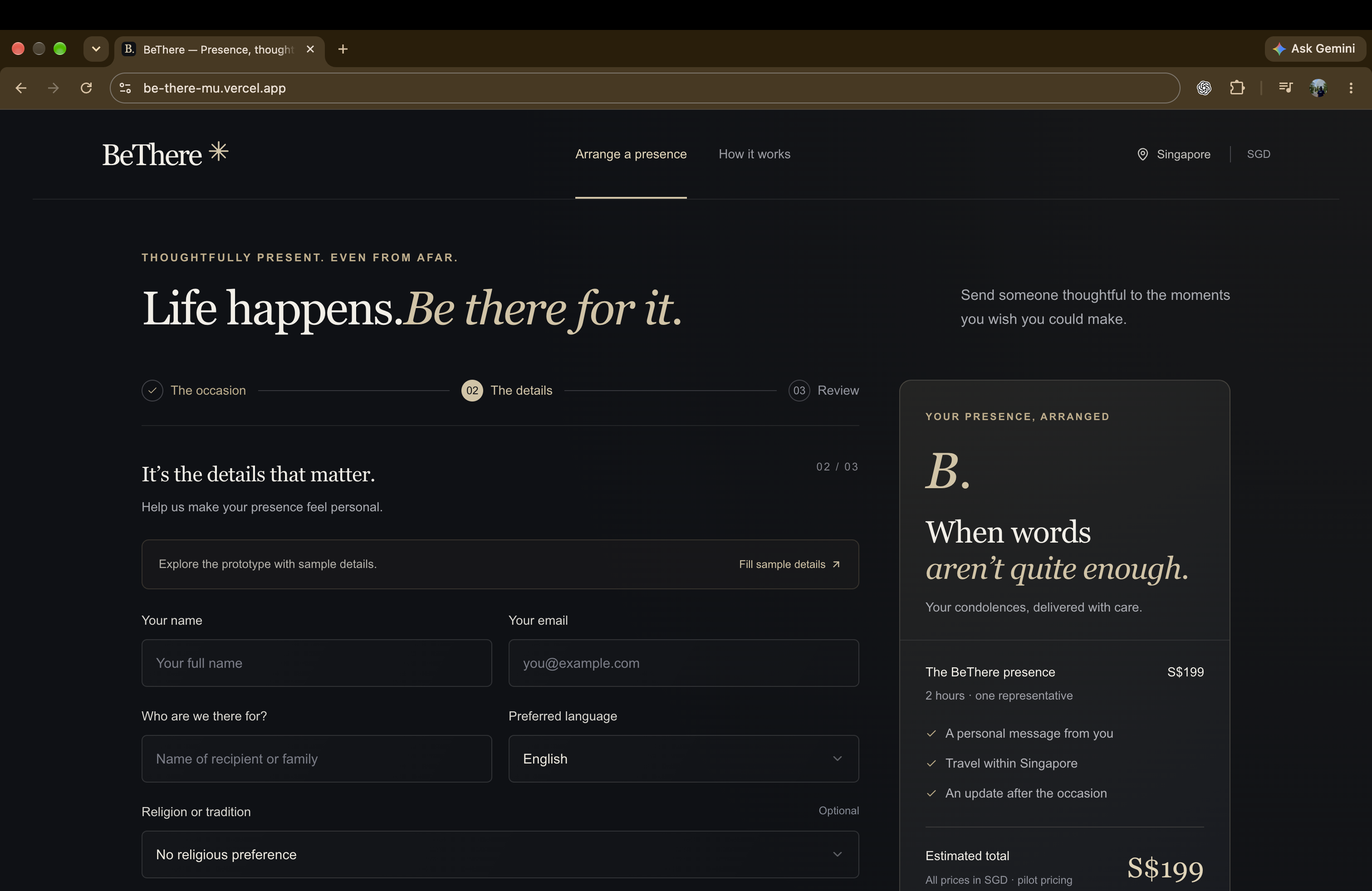
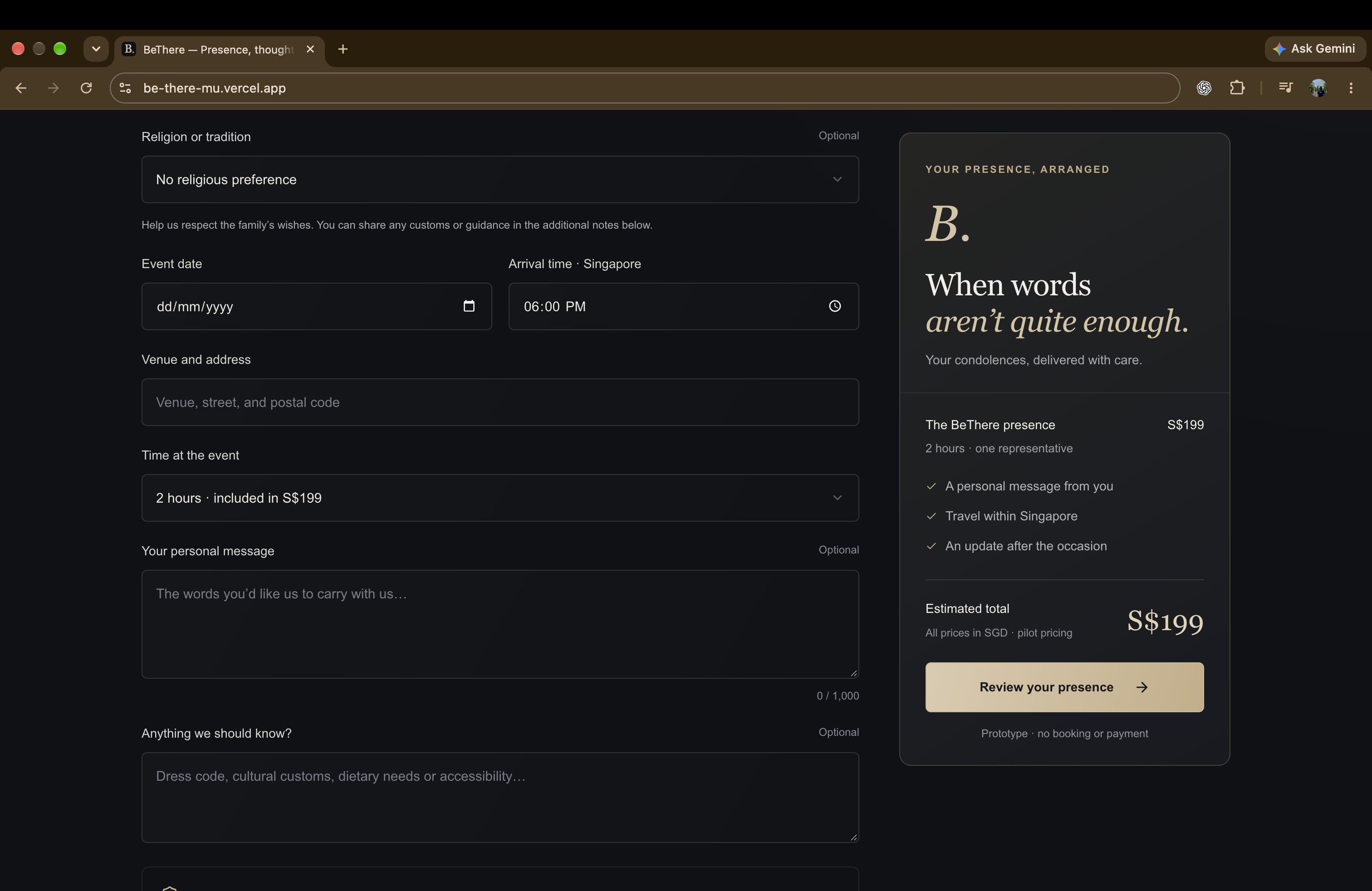
Page to add details like name, location, religion of the host
-
-
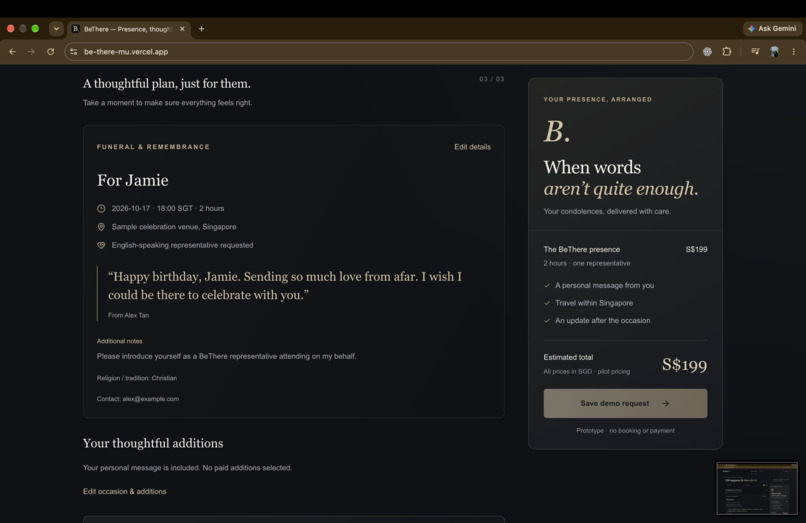
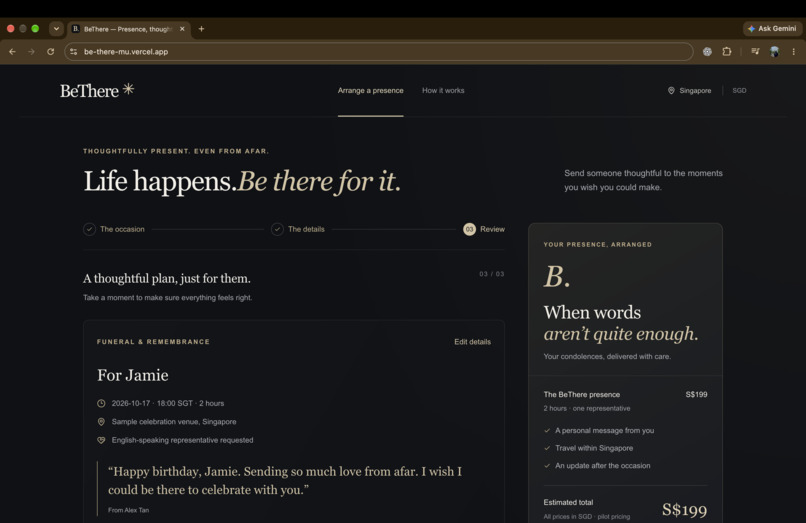
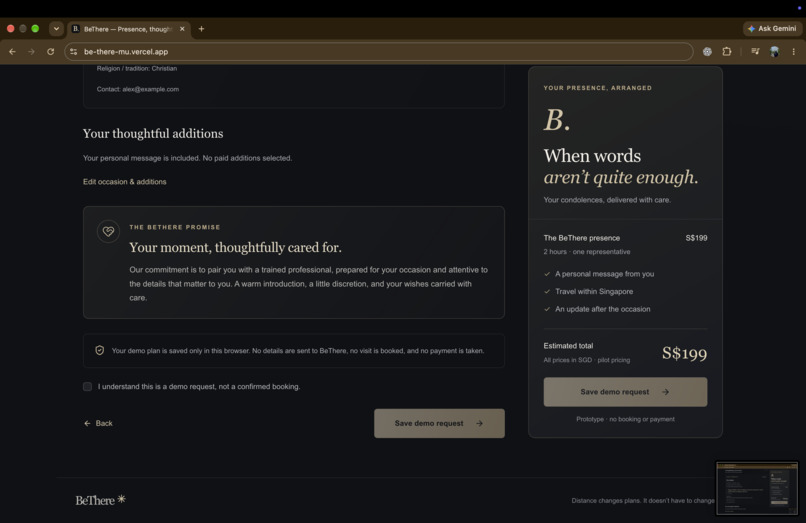
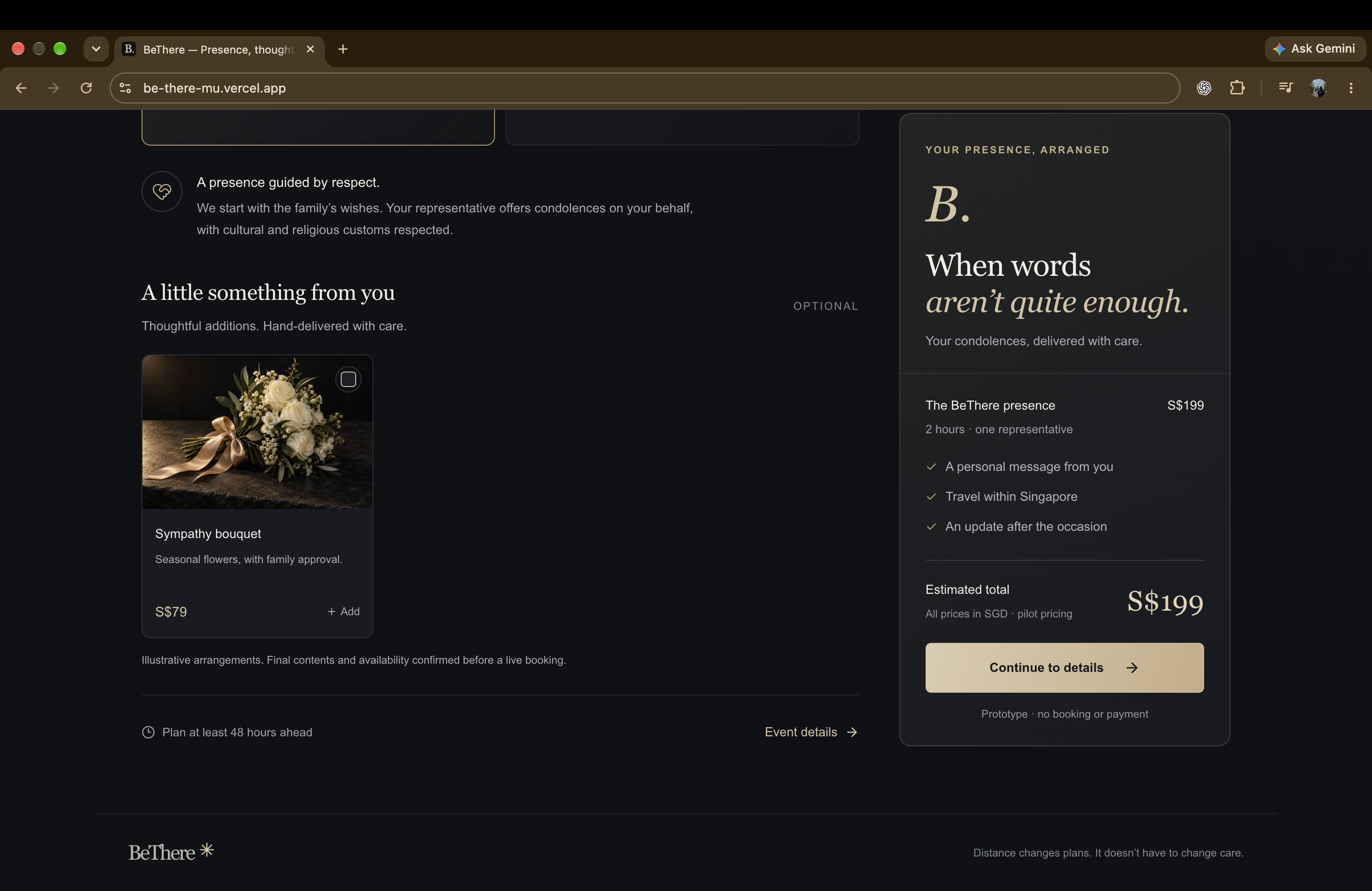
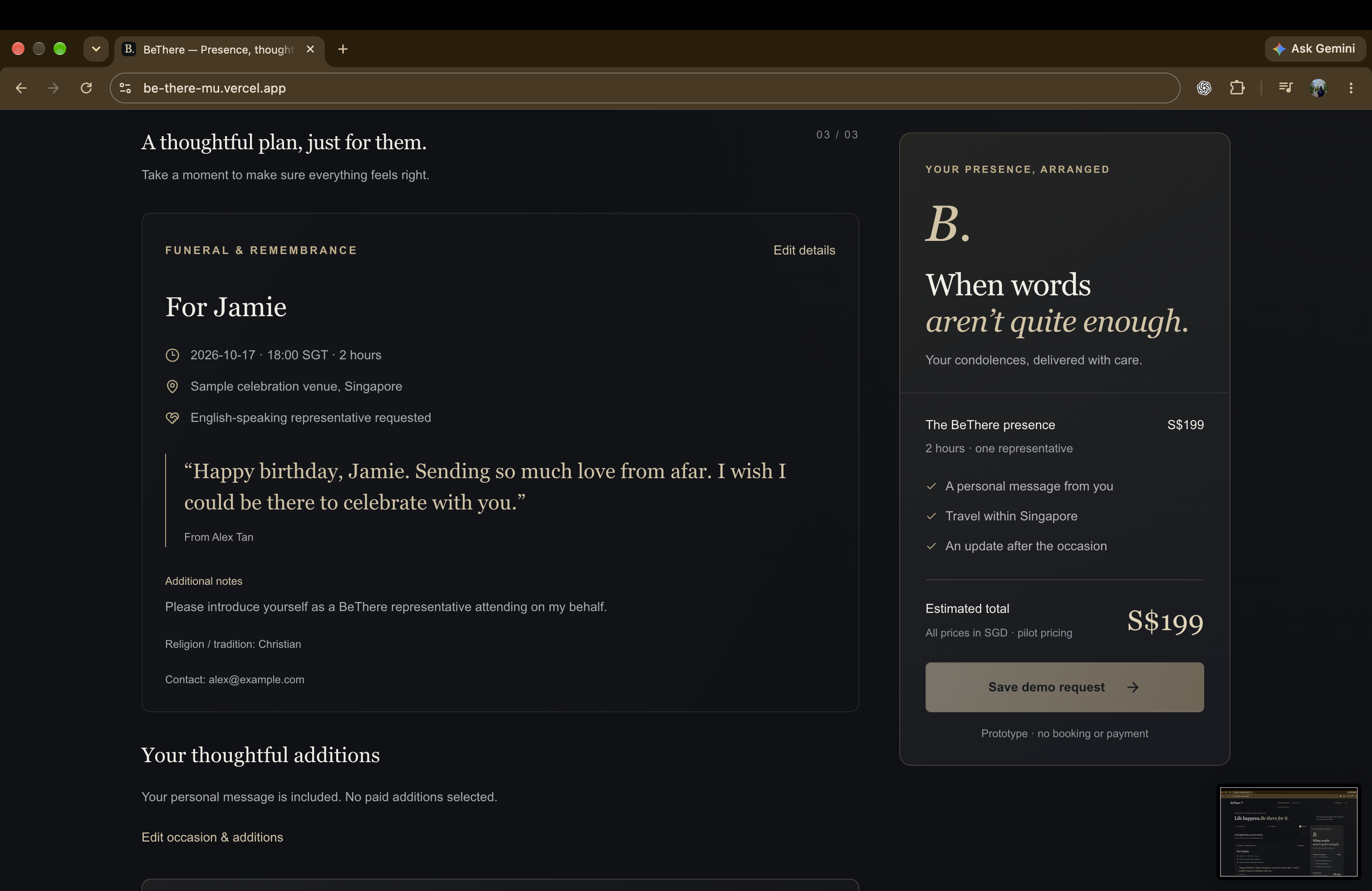
Review Page
-
-
-
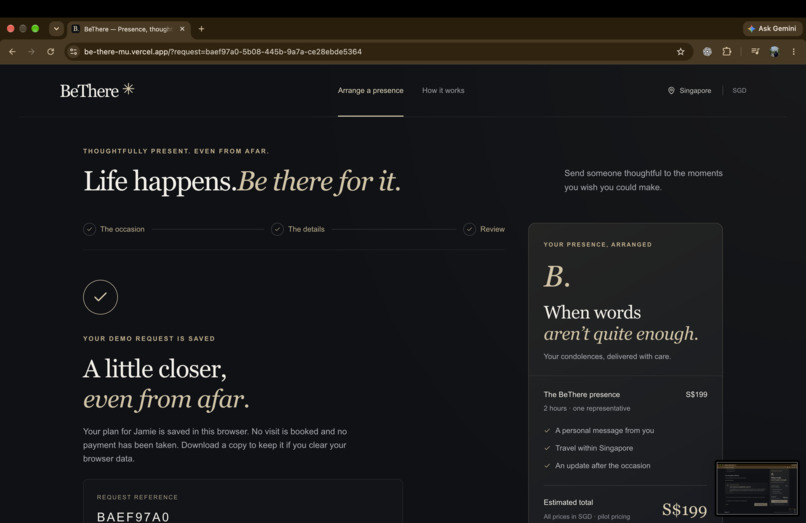
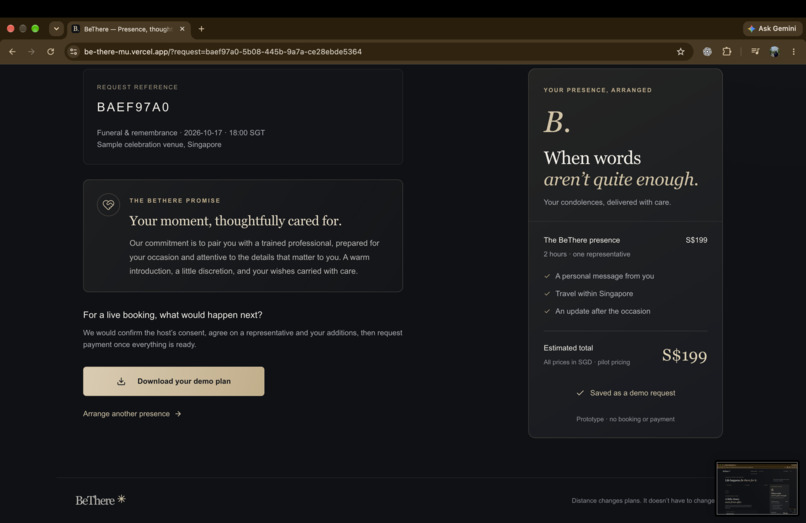
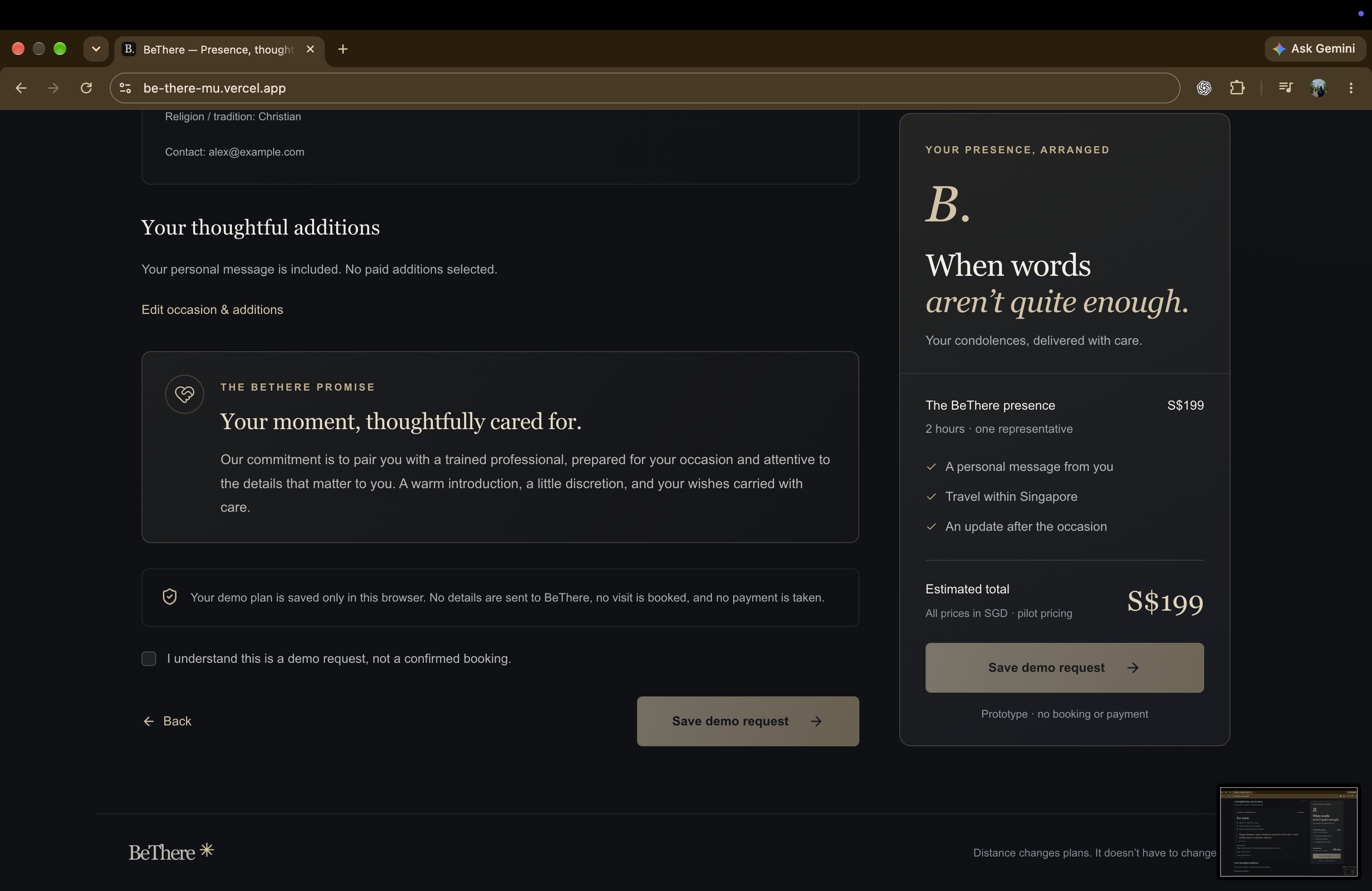
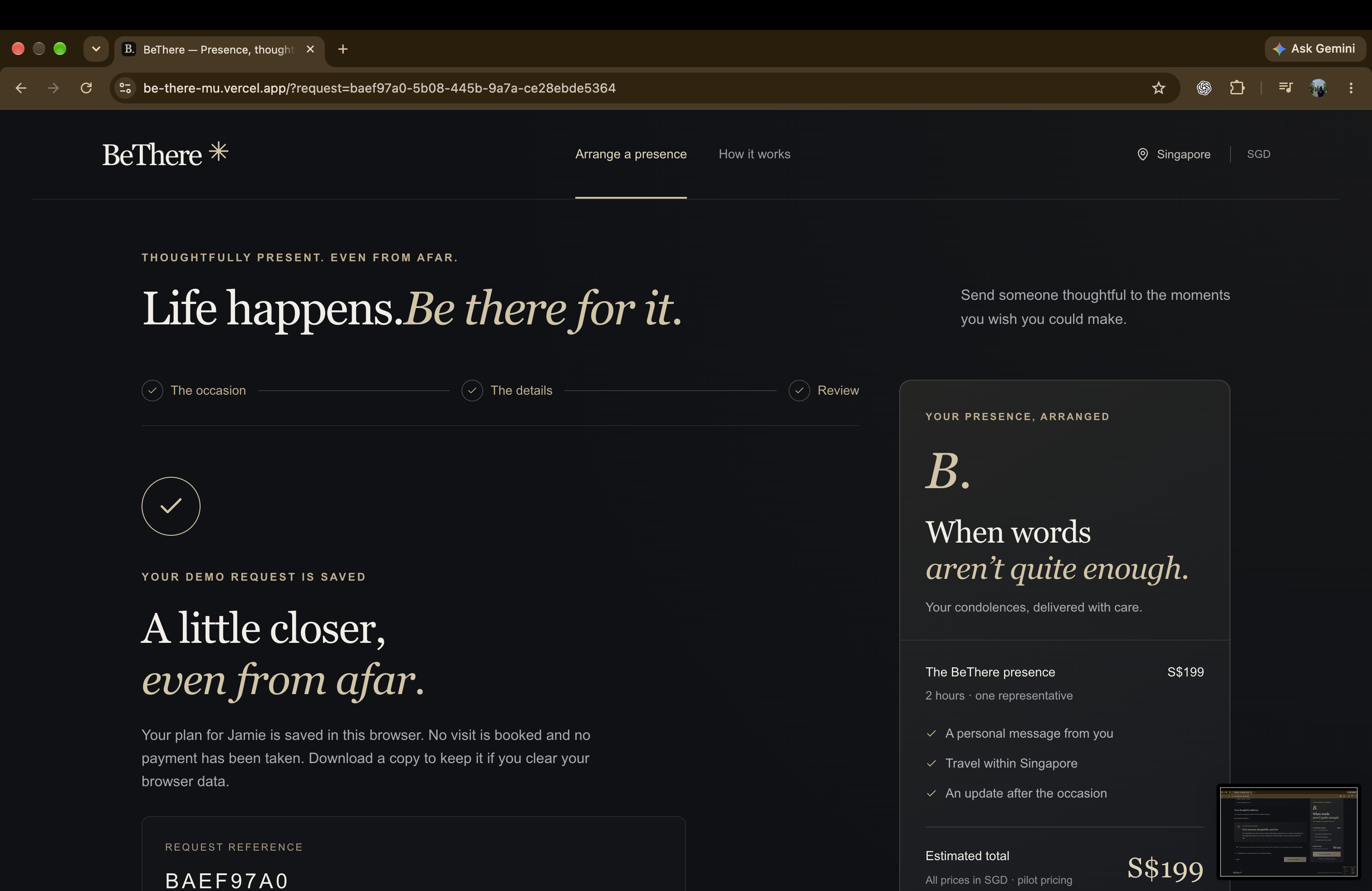
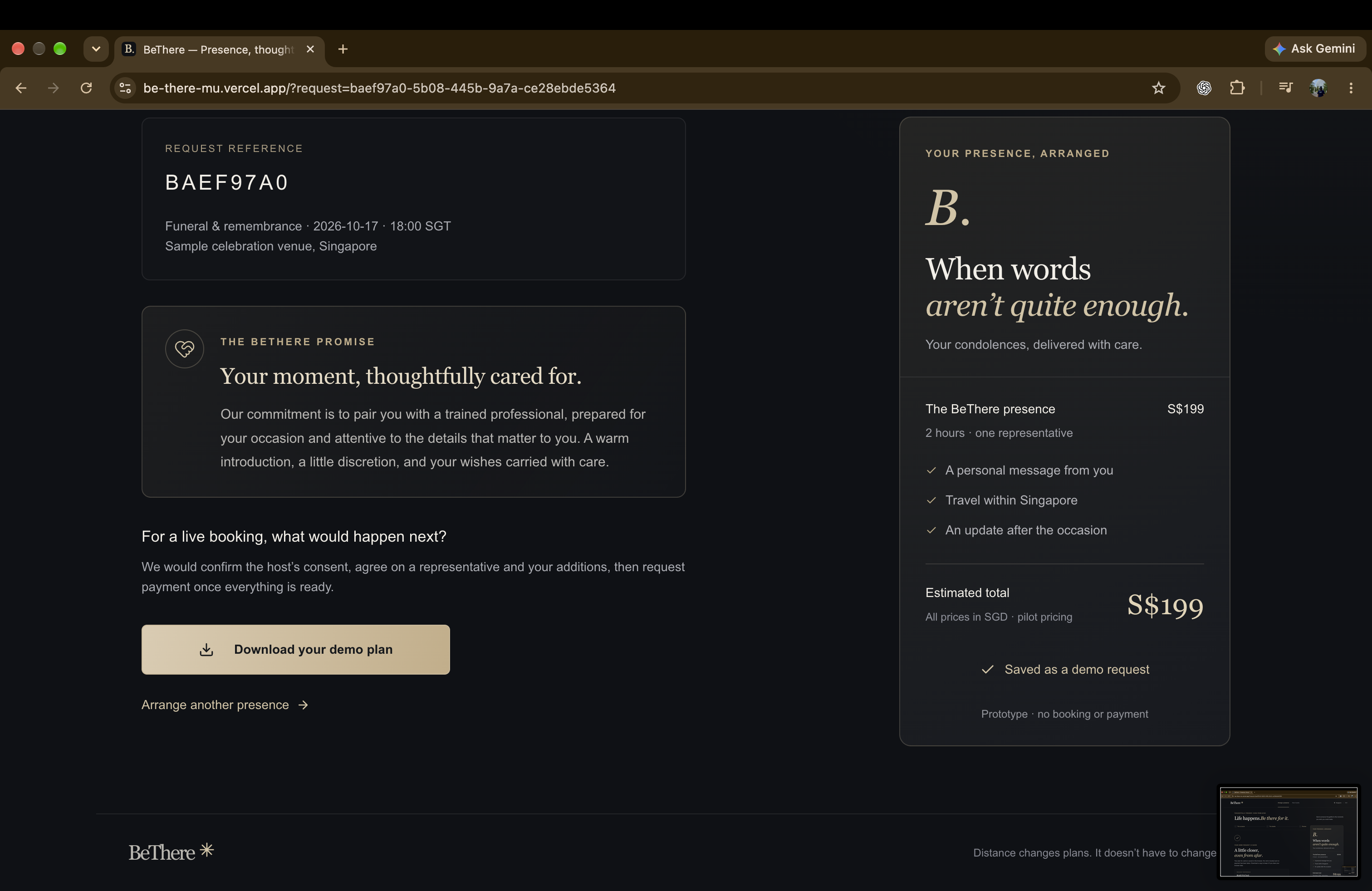
Confirmation Page
-
Inspiration
Some moments are too important to miss, yet life does not always give us a choice.
People move overseas for university, work, or family. Professionals face demanding schedules. Flights get cancelled, emergencies happen, and distance can make attending a birthday, wedding, funeral, or family celebration impossible. A video call allows someone to speak, and a delivery service can send a gift, but neither creates a real human presence in the room.
That gap inspired BeThere.
BeThere is a platform that allows someone to arrange for a trained and carefully screened representative to attend an important social occasion on their behalf. The representative arrives openly as the sender’s representative, delivers their message, presents any requested gifts, and helps ensure that their care is felt even when they cannot attend personally.
My goal is simple: when you cannot be there, your care still can.
What BeThere Does
The BeThere website guides users through a clear three-step booking experience.
First, the user selects an occasion, such as a birthday, wedding, funeral, or another meaningful event. For sensitive occasions such as funerals, users can also provide relevant religious information so that the representative can behave respectfully and follow the family’s customs.
Next, the user enters the event details, writes a personal message, and chooses any additions they would like the representative to bring. These can include:
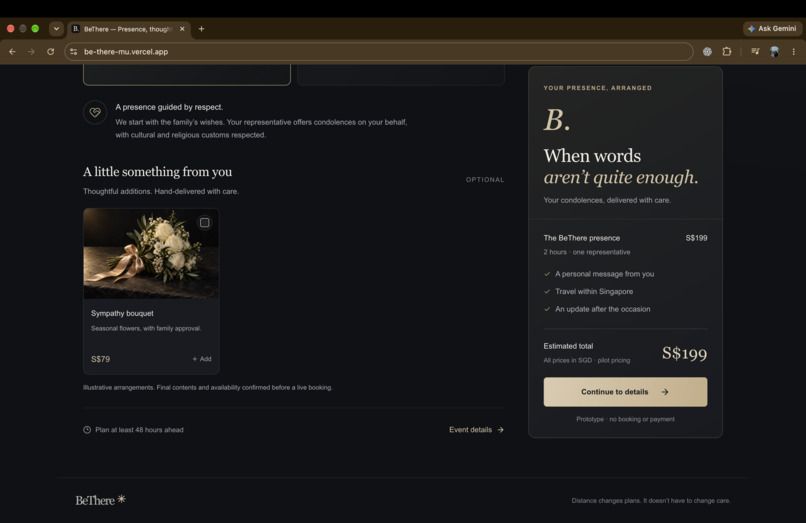
- A small, medium, or large bouquet
- Cake coordination with a selected Singapore bakery
- Gift purchasing and coordination
- Additional attendance time
Finally, the user reviews the complete request, selected additions, and estimated price before saving it.
The current version is an honest working prototype. Requests are stored only in the user’s browser. No payment is taken, no supplier is contacted, and no representative is automatically assigned.
How I Built It
I built BeThere as a responsive web application using Next.js, React, and TypeScript, then deployed it through Vercel.
I separated the user journey into reusable components for occasion selection, event details, additions, pricing, and final review. Pricing rules are handled through modular logic, allowing the total to update as users change bouquet sizes, request additional hours, or select cake and gift coordination.
For the hackathon prototype, I used browser-based local storage. This allowed me to demonstrate a complete request flow without pretending that a production database, payment system, or dispatch operation already existed.
I created the visual design around an Obsidian and Brushed Champagne theme. Deep charcoal backgrounds, restrained champagne accents, subtle borders, and carefully spaced typography give the platform a calm and premium appearance. This was especially important because BeThere deals with emotional and sometimes sensitive occasions. The interface needed to feel trustworthy, respectful, and human.
Business Model
BeThere begins with a base charge of S$199 for two hours, followed by S$79 for each additional hour. Optional services create additional revenue:
- Bouquets: approximately S$49–S$119
- Cake coordination: S$49 service charge
- Gift coordination: S$99 service charge
- Cake, gift, and supplier purchases: charged separately
Representatives receive 30% of the full customer charge, recognising the time, preparation, travel, communication, and emotional responsibility involved in representing someone at an important event.
My initial target market is busy or overseas Singaporeans who value reliability, discretion, and a high standard of service. I would begin within one Singapore service area, using a small roster of screened representatives and manually coordinating each booking. This controlled approach would allow me to validate demand, safety procedures, customer satisfaction, and real operating costs before expanding.
Challenges I Faced
The most difficult challenge was designing a service that feels caring without becoming misleading or uncomfortable. BeThere cannot suggest that a representative is replacing a friend or family member. The representative must attend transparently, with the host’s knowledge and consent, while communicating the sender’s message faithfully.
Sensitive occasions created another challenge. A birthday and a funeral require completely different behaviour. I introduced occasion-specific details, religious preferences, written briefs, and clear consent expectations to make the experience more respectful.
I also faced technical deployment issues. The original project included hosting-specific configuration that was unavailable when I moved the repository to Vercel. Resolving those dependencies taught me how important it is to separate platform-specific code from the core application.
Responsive design presented smaller but meaningful problems as well. Elements that looked polished on a laptop did not always behave correctly on an iPad or mobile screen. I refined the logo, spacing, navigation, and form layout to keep the experience consistent across devices.
Finally, building believable financial projections was challenging. I had to account for representative compensation, supplier expenses, payment fees, customer acquisition, service recovery, and fixed operating costs. This showed me that revenue is not the same as profit and that a promising idea still needs disciplined unit economics.
What I Learned
BeThere taught me that building a startup is much more than creating a polished interface.
I learned to think about the complete service: customer trust, representative training, host consent, privacy, safety, pricing, fulfilment, and what happens when something goes wrong. I also learned the value of stating clearly what a prototype can and cannot do.
From a technical perspective, I strengthened my understanding of component-based development, responsive interfaces, dynamic pricing, local browser storage, GitHub workflows, and Vercel deployment.
Most importantly, I learned that technology works best when it supports a genuinely human need. BeThere is powered by software, but its real value comes from helping one person show care for another.
What Comes Next
The next stage would be a controlled six-month pilot in Singapore. I would recruit and train a small group of representatives, develop identity and background screening procedures, create host-consent and incident-response policies, and test the service through 50–60 paid events.
A production version would add:
- Secure customer accounts and protected booking records
- Integrated payments and refunds
- Representative availability and matching
- Consent records and audit logs
- Supplier and bakery integrations
- Automated reminders and status updates
- Private post-event reports
- Representative ratings and quality monitoring
I would initially keep matching and event coordination human-led. Once the operating process is proven, software could automate scheduling, supplier coordination, reminders, and representative matching.
BeThere began with a simple question: What if distance did not have to mean absence?
This prototype is my first answer.
Built With
- next.js
- react
- typescript
