Inspiration
Prediction markets let you bet on outcomes like "Will Bitcoin finish between \$58,500 and \$61,500 today?" — but the contracts are split across exchanges. Gemini and Kalshi list different strikes, prices, fees, and depth, and the exact bet you want often isn't sold as one contract at all.
Our earlier research on Gemini, Kalshi, and Deribit data showed identical contracts priced a few cents apart, and custom ranges that were often cheaper to build from two contracts than to buy directly. So we asked: what if you just said the bet you want, and we built it for you at the lowest price?
What it does
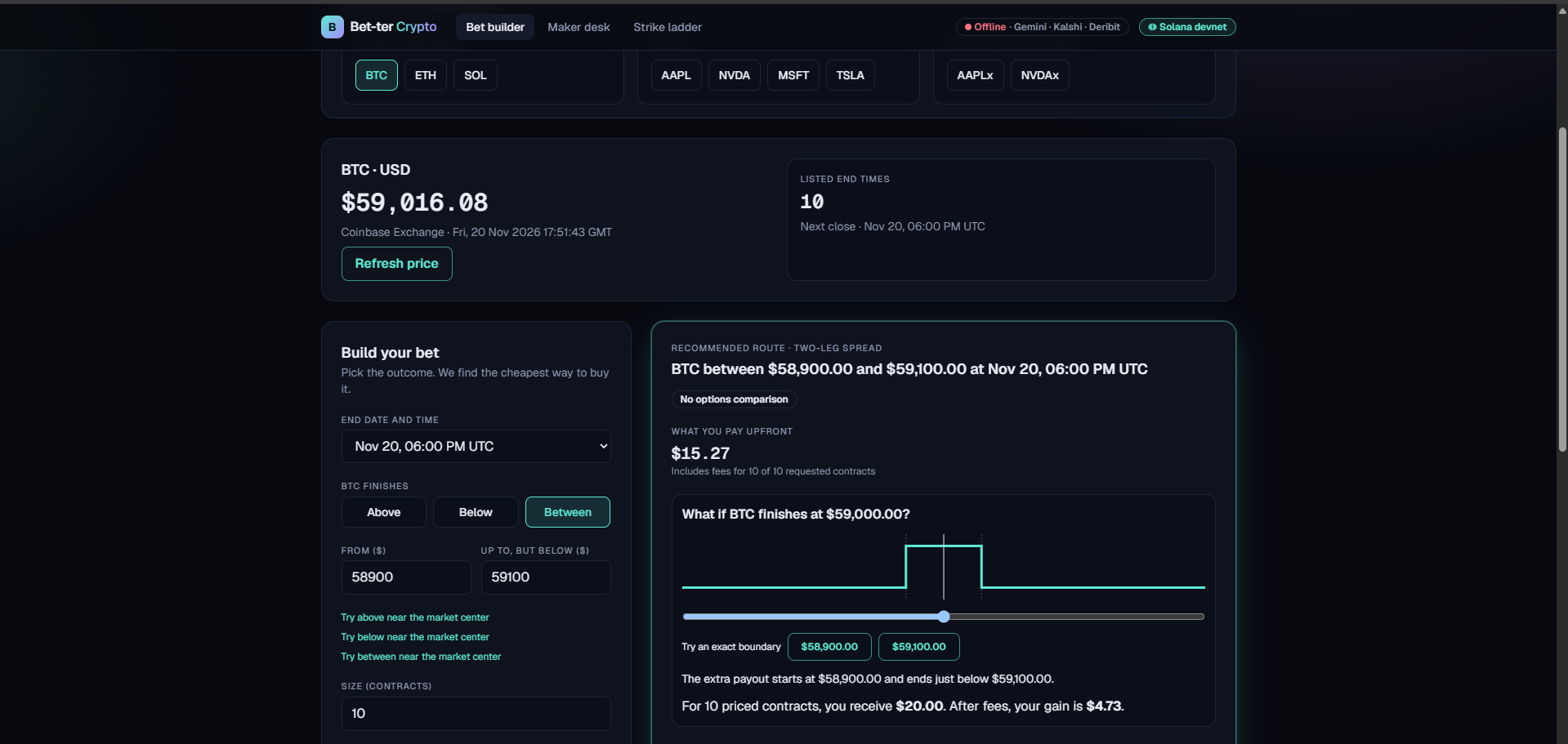
Bet-ter Crypto turns an outcome into the cheapest set of contracts across Gemini and Kalshi.
- Routes the bet — single contract, a YES/NO spread, or a stack of range buckets, mixing exchanges when that's cheaper.
- Prices it realistically — walks live order books for your size and adds each exchange's fees.
- Checks fairness — compares the cost to a fair value implied by Deribit Bitcoin options.
- Flags risk — stale quotes, thin books, and legs that settle on different price indexes.
- Proves it — writes a SHA-256 fingerprint of the quote to Solana, so anyone can verify it later.
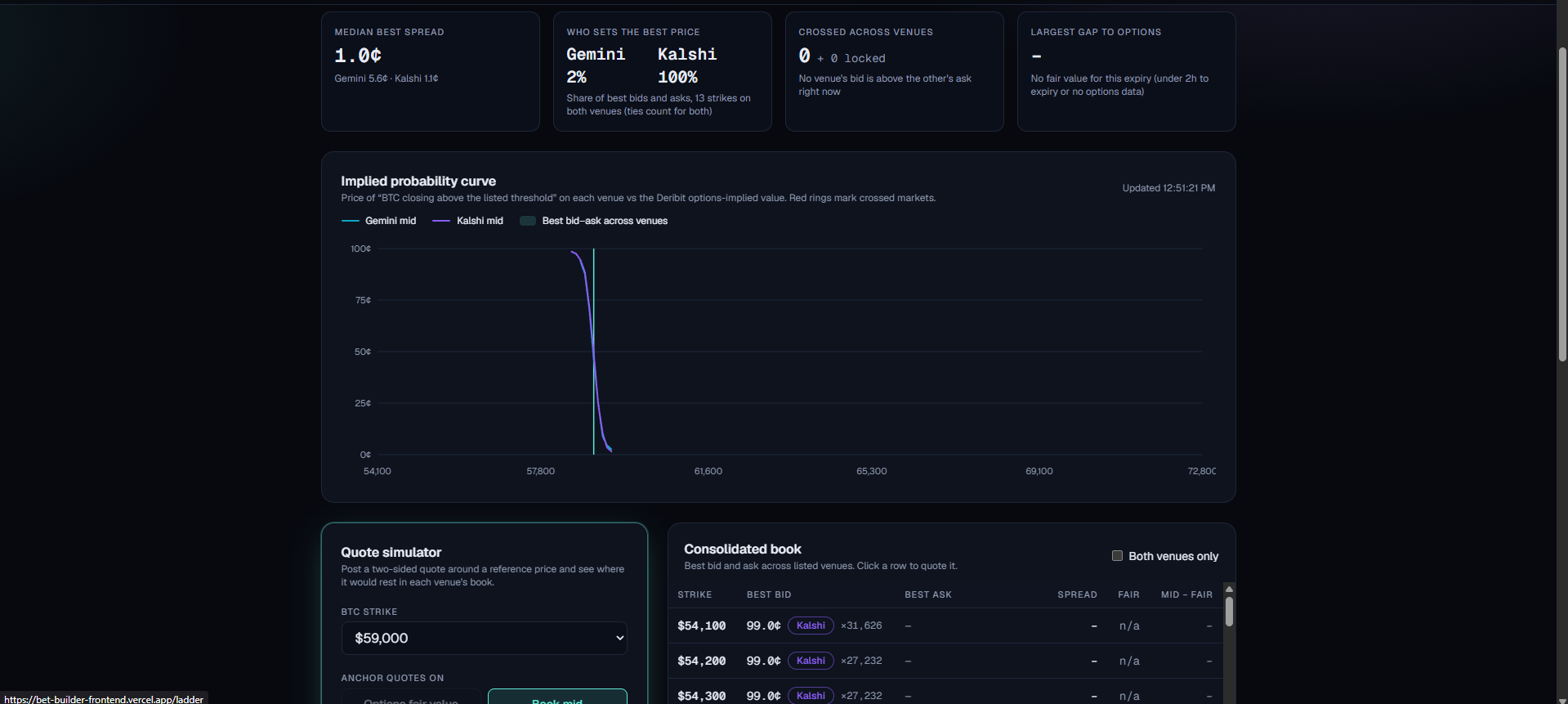
- Maker desk — a market-maker view: one consolidated book, cross-venue spreads, and a quote simulator.
How we built it
- Frontend: Next.js, React, TypeScript, Tailwind — deployed on Vercel.
- Backend: Python + FastAPI on Render, polling Gemini, Kalshi, and Deribit every 30 seconds.
- Pricing engine: enumerates every way to build the payoff and picks the cheapest after fees.
- Fair value: fits an SVI volatility smile to Deribit options and reads off the probability of finishing above each strike.
- Onchain receipts: Solana devnet Memo transactions; Grok explains routes in plain English.
A range bet $[a, b)$ can be built from two threshold contracts:
$$ \text{YES}(S_T \ge a) + \text{NO}(S_T \ge b) = \begin{cases} \$2 & a \le S_T < b \ \$1 & \text{otherwise} \end{cases} $$
so its effective cost is the cash paid minus the guaranteed \$1:
$$ \text{cost} = P_{\text{YES}}(a) + P_{\text{NO}}(b) + \text{fees} - 1 $$
Both exchanges charge a taker fee of
$$ \text{fee} = 0.07 \cdot n \cdot P\,(1 - P) $$
rounded up to the next cent per order, so we price fees per order rather than per contract.
Challenges we ran into
- Matching contracts across exchanges. Kalshi and Gemini use different strike formats and different settlement indexes, so "the same bet" isn't always identical — we flag those routes instead of hiding the difference.
- Arbitrage that isn't. We often saw one exchange's bid above the other's ask, but after fees on both legs almost none of it was profitable. We show the net-after-fees number honestly.
- Fair value near expiry. Options-implied odds get unreliable in the last couple of hours, so we turn the comparison off then.
- Stale quotes. A cheap price is useless if it's frozen; we built a detector for quotes that don't move while Bitcoin does.
- Shipping as a team of four. Parallel branches, merge conflicts, and wiring Vercel, Render, Solana keys, and API keys together safely took real coordination.
What we learned
- The cheapest-looking price isn't the real price — depth, fees, and rounding change the answer.
- Options markets are a powerful, independent "second opinion" on prediction-market prices.
- Putting a fingerprint onchain is a simple, cheap way to make a quote verifiable by anyone.
- Being honest in the UI — "no options comparison," "simulated," "not profitable after fees" — builds more trust than flashy numbers.
What's next
More assets and exchanges (Polymarket, ETH), live order placement, and alerts when a cheaper route appears.


