-
-
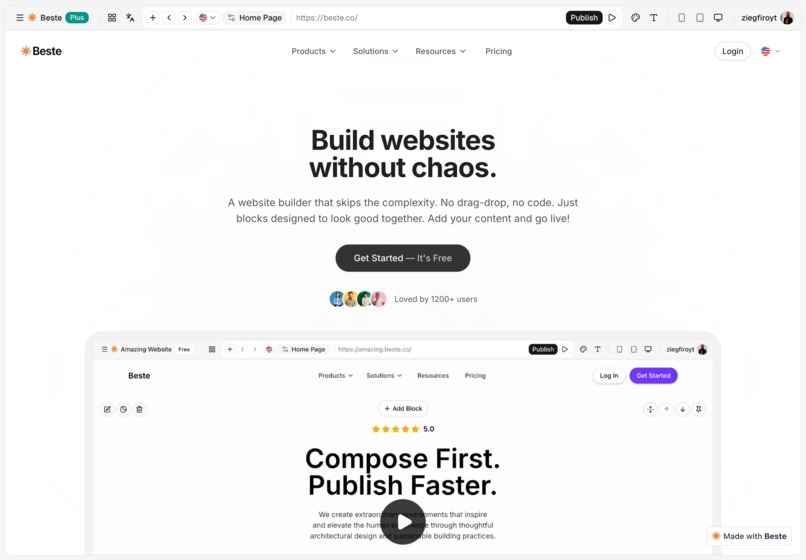
Beste Website Builder
-
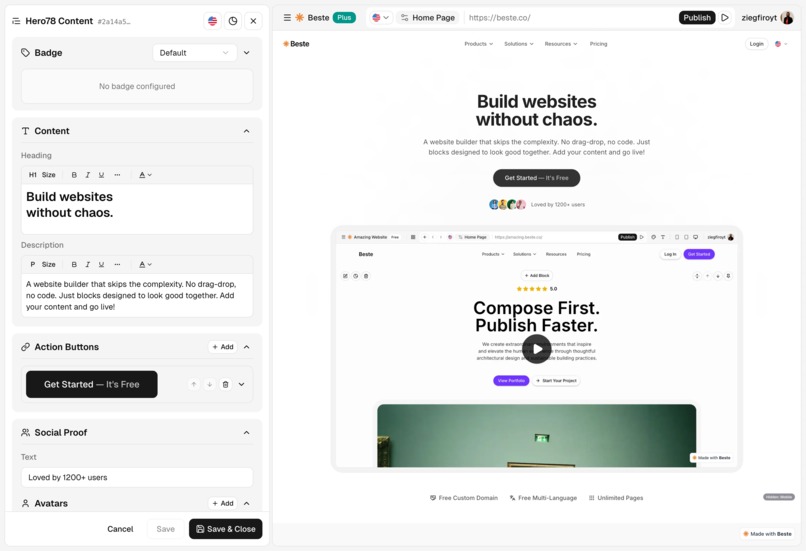
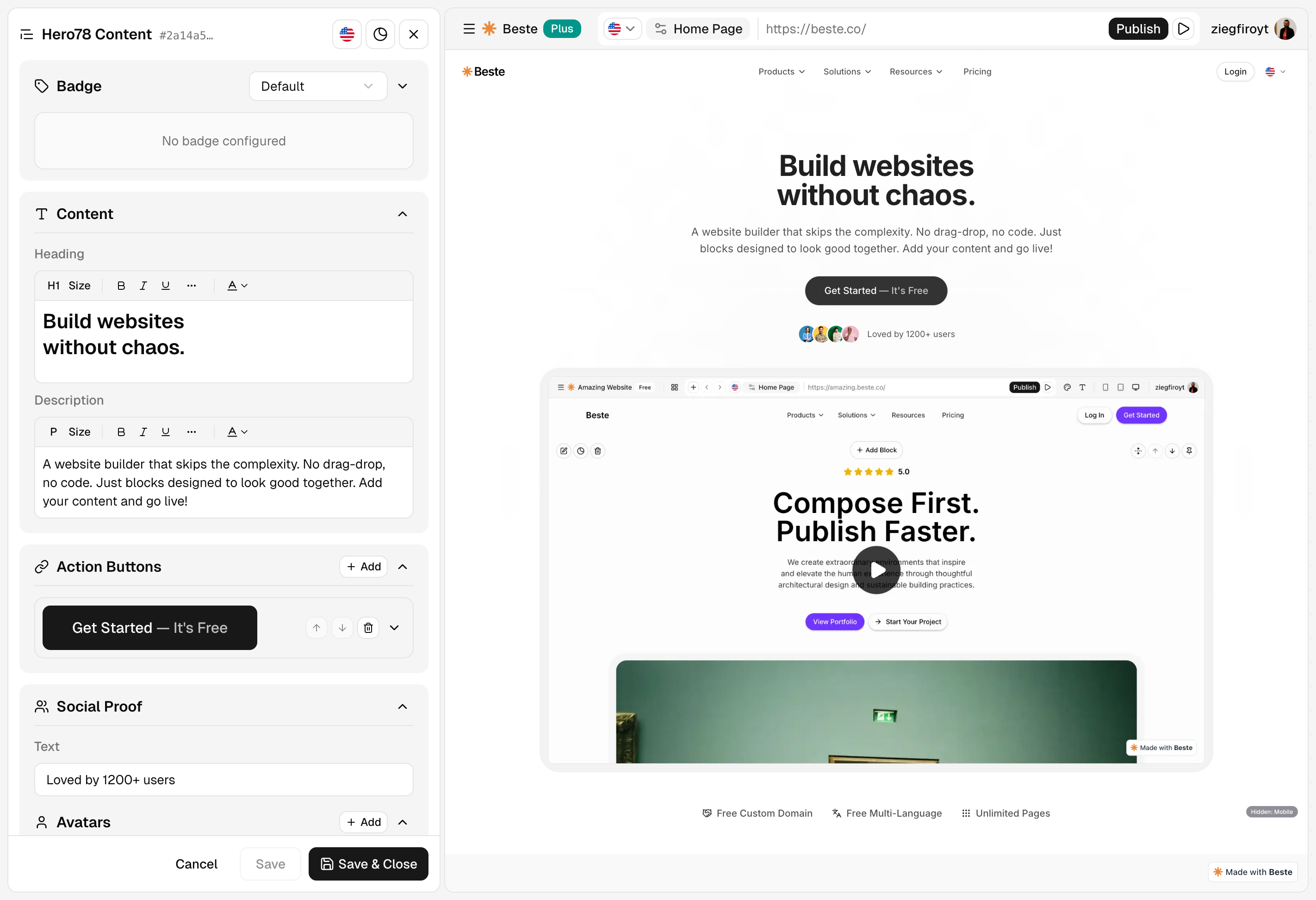
Edit hero section on website builder
-
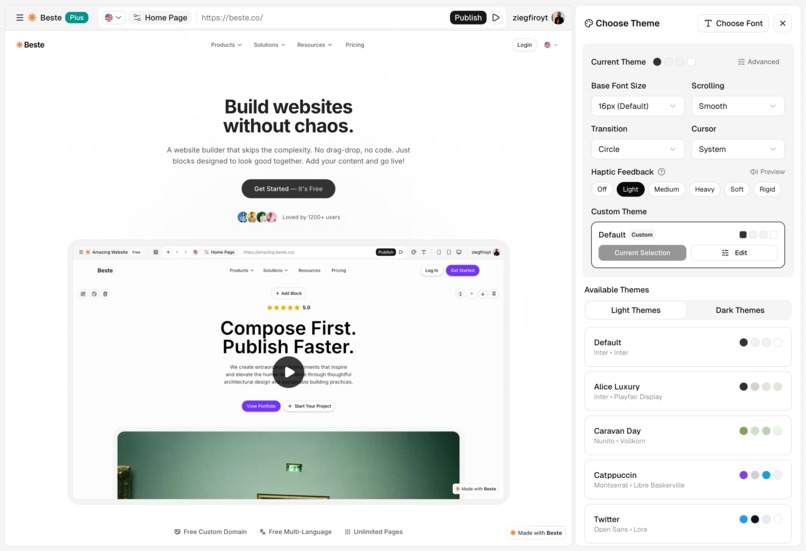
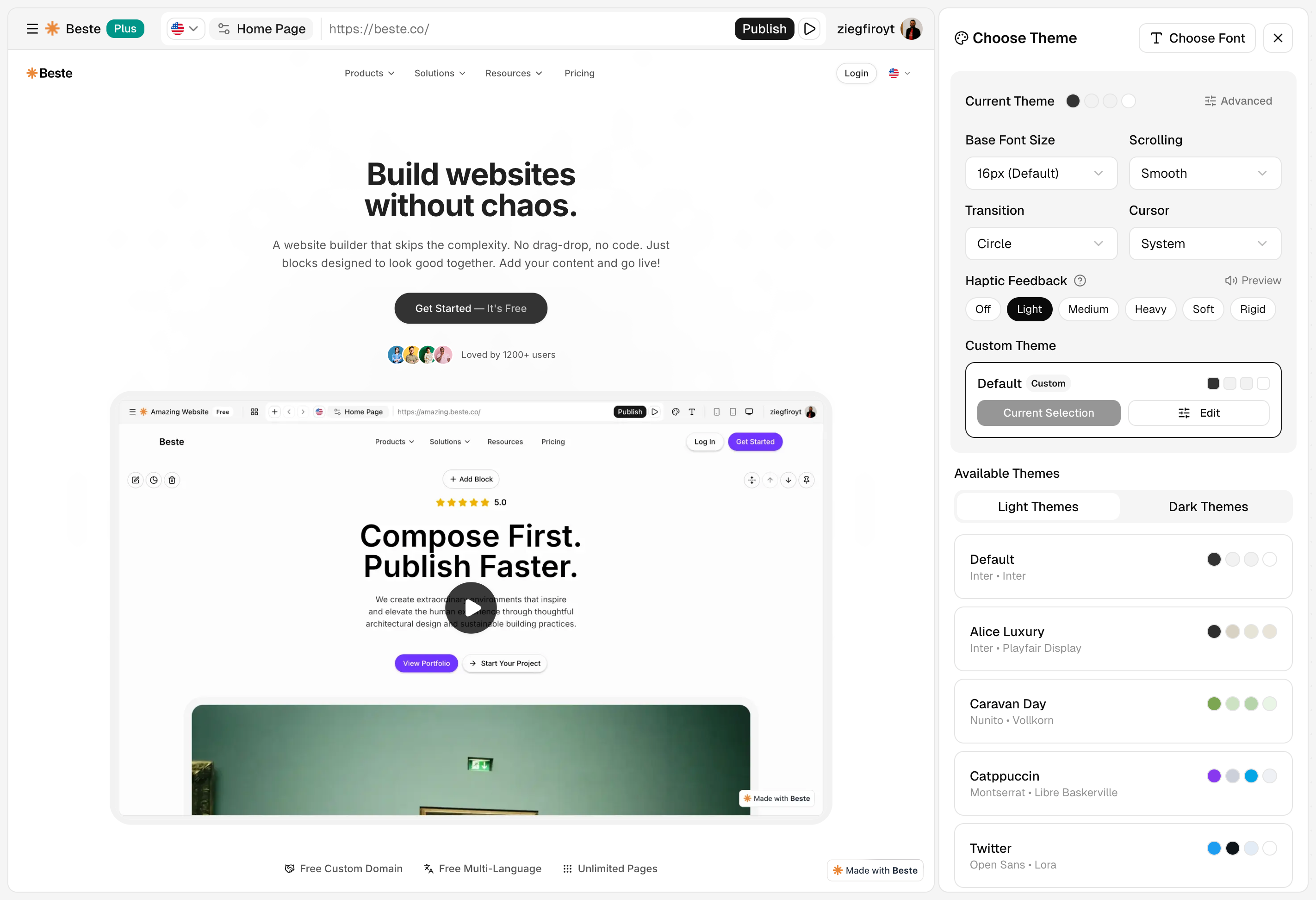
Theme configurations on website builder
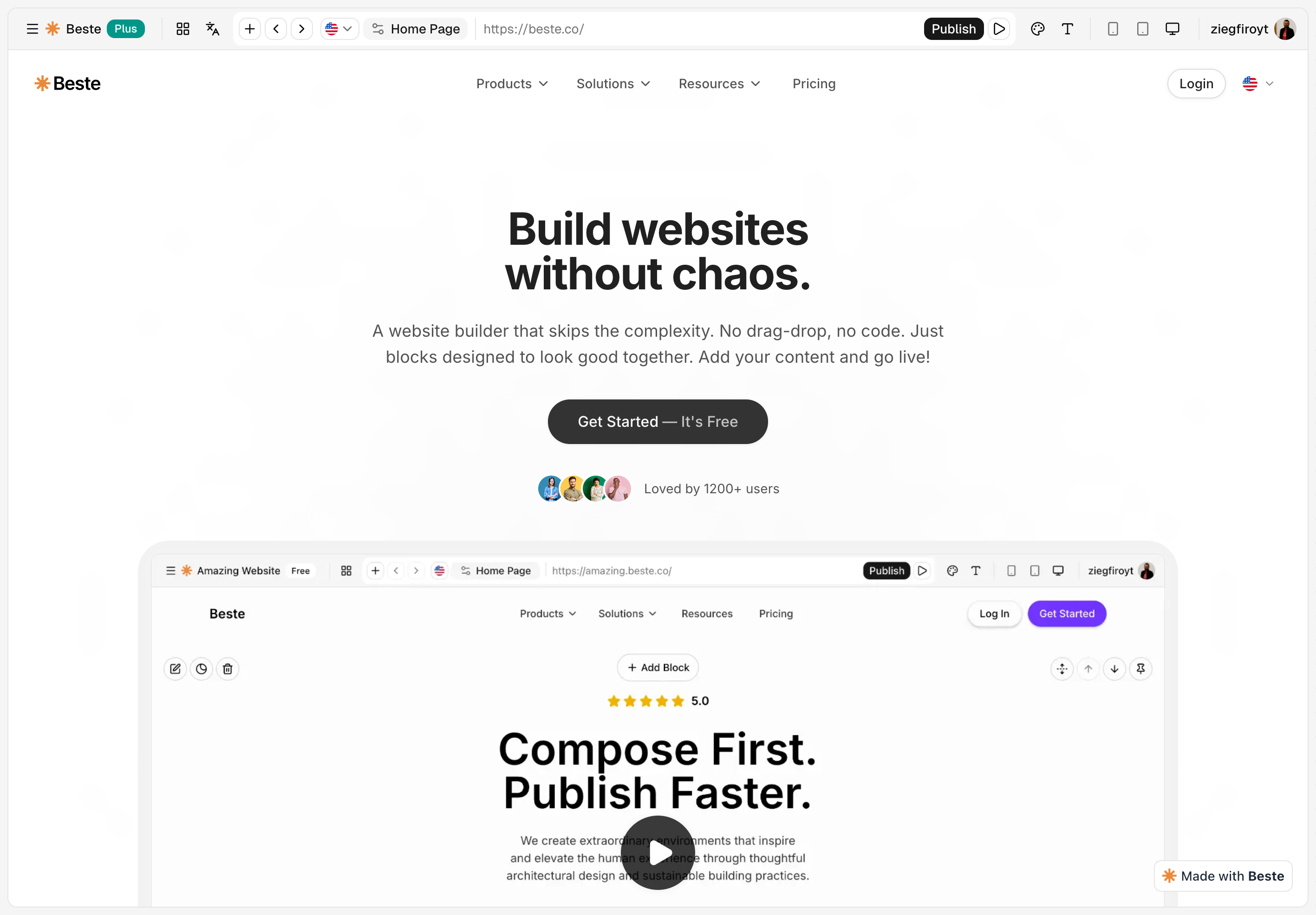
Inspiration
The idea for Beste came from years of frustration with existing website builders. I spent too many hours fighting tools that promised simplicity but delivered complexity. Every platform seemed to fall into one of two traps: either too simple and limiting, producing sites that looked like everyone else's, or too powerful and overwhelming, requiring weeks of learning before you could build anything worthwhile.
I watched small business owners struggle with Wix, paralyzed by choice and confused by endless menus. I saw freelancers abandon their Webflow projects halfway through because the learning curve was steeper than they anticipated. I noticed how people who just wanted a professional online presence ended up spending more time learning their tools than actually running their businesses.
The question that kept coming back to me was simple: what if a website builder gave you professional blocks that just work together? No blank canvas paralysis. No responsive design nightmares. No pixel-pushing for hours. Just pick sections that look good, add your content, and publish.
That question became Beste.
What it does
Beste is a composition-first website builder. Instead of giving users a blank canvas and expecting them to become designers, Beste provides a library of over 300 pre-designed blocks that snap together like Lego pieces. Hero sections, feature grids, testimonials, pricing tables, contact forms, footers — all designed to work together visually and structurally.
The workflow is intentionally simple. You browse the block library, select the sections you need, customize the content through a clean sidebar interface, and publish. The blocks handle responsive design automatically, so your site works perfectly on desktop, tablet, and phone without any manual adjustments. There is no separate mobile editor because none is needed.
Beste includes features that typically cost extra on other platforms. Custom domains are free on all plans, including the free tier. Multi-language support for 32 languages is built in from the start. The blog system requires no additional setup. SSL certificates generate automatically when you connect your domain.
The platform is built for people who want results without complexity. Founders who need to launch quickly. Freelancers who want professional portfolios. Small businesses going online for the first time. Agencies delivering client sites efficiently. Anyone who would rather spend time on their actual work than learning a complicated tool.
How I built it
Beste is built on a modern, carefully chosen tech stack. The frontend uses React and Next.js for performance and developer experience. TypeScript provides type safety throughout the codebase. Tailwind CSS handles styling with consistency and efficiency. The block system is built on shadcn/ui, an open-source component library that provides the foundation for professional, accessible components.
The backend uses Drizzle ORM with PostgreSQL for data management. The entire platform is hosted on Vercel's edge network, ensuring fast loading times globally. This infrastructure choice means sites built with Beste benefit from enterprise-grade performance without users needing to think about hosting, CDNs, or server configuration.
Every block in the library goes through a careful design process. Each section is tested across screen sizes, optimized for performance, and built with accessibility in mind. The responsive behavior is not an afterthought but is baked into every component from the start. When a user selects a hero section, they get a hero section that has already been refined through dozens of iterations.
The editing experience was designed to be invisible. The sidebar interface keeps all controls in one predictable place. There is no hunting through nested menus or right-click context options. Click any element, edit it in the sidebar, see the changes immediately. The tool gets out of the way so users can focus on their content.
I built Beste alone, as a solo founder and developer. No investors to appease, no board to report to, no quarterly targets forcing corners to be cut. Just the quiet, stubborn work of building something right. Every line of code exists because I decided it should, not because a sprint board said it was next.
Challenges I ran into
The hardest challenge was not technical but philosophical: deciding what to leave out.
Modern website builders compete on feature count. They add drag-and-drop editors, animation timelines, custom code injection, plugin marketplaces, and dozens of other capabilities. Each feature sounds valuable in isolation, but together they create the complexity that makes these tools difficult to use.
Beste's core bet is that constraints enable speed. Limiting users to pre-designed blocks instead of pixel-level control eliminates entire categories of decisions. But every time I considered adding a feature that other builders have, I had to ask whether it would make the product better or just more complicated. Saying no to reasonable feature requests is harder than it sounds.
The responsive design system required significant iteration. The goal was complete automation — users should never adjust anything for mobile — but achieving that meant the blocks needed to be smart enough to reorganize themselves gracefully at any screen width. Early versions had edge cases where certain content combinations broke the layout. Solving those edge cases without introducing manual controls took longer than building the initial system.
Building alone means every problem is your problem. There is no one to hand off the difficult bugs to, no specialist to consult when you hit unfamiliar territory. Some days that felt like freedom. Other days it felt like carrying everything on one set of shoulders. The trade-off is worth it for the coherence it provides, but the weight is real.
Accomplishments that I'm proud of
The accomplishment I am most proud of is the responsive design system. Users genuinely do not think about mobile. They build their site, preview it on their phone, and it just works. Every block adapts correctly. No manual adjustments needed. No separate mobile editor to learn. This sounds simple but required careful engineering to achieve.
The free tier makes me proud because it represents a genuine commitment rather than a marketing tactic. Free custom domain, unlimited pages, built-in blog, 32-language support — features that competitors charge for are included from day one. When someone signs up for Beste, they can launch a legitimate professional website without paying anything. That is not a trial or a demo. That is a real product.
Over 700 users are now building with Beste. Watching real people create real websites with something I built alone is difficult to describe. Each site represents a business, a creative project, a personal brand that now exists online because the tool worked well enough to get them there.
The feedback that means most is when users tell me they "kept looking for the mobile editor and then realized they didn't need one." That moment of surprise — expecting complexity and finding simplicity — is exactly what I set out to create.
What I learned
I learned that simplicity is not the absence of features but the presence of clarity. Removing capabilities is easy. Creating a focused tool that still does everything users need is hard. The discipline is in understanding what people actually require versus what they think they want.
I learned that most website problems are not technical problems. They are decision problems. People struggle not because HTML is difficult but because they face too many choices without enough guidance. Reducing choices while maintaining quality is a form of user experience design that does not get enough attention.
I learned that building alone is sustainable if you accept its constraints. Progress is slower than with a team, but direction is clearer. There is no communication overhead, no alignment meetings, no compromises between conflicting visions. What you imagine and what you build can be the same thing.
I learned that the market for "simple" is larger than the market for "powerful." Plenty of users want maximum control and creative freedom. But many more just want their website to exist, to look professional, and to be easy to update. Serving that second group well is a legitimate mission.
What's next for Beste
The immediate roadmap focuses on expanding the block library. More sections, more variations, more starting points for users. Each new block goes through the same design process: tested across devices, optimized for performance, built to work with every other block in the system.
AI-assisted features are coming, but thoughtfully. AI translation to help users create multi-language content faster. AI copywriting suggestions to help overcome blank page syndrome. The goal is to use AI where it genuinely helps without turning Beste into another tool where users spend hours prompting and debugging AI output.
The marketplace will allow designers to create and sell their own blocks and templates. This extends what Beste can offer without compromising the quality bar, since every marketplace submission goes through review. Designers get a new revenue stream. Users get more options. The ecosystem grows.
White-label capabilities will expand for agencies who want to deliver Beste-powered sites under their own brand. This is already possible on paid plans, but deeper customization is coming for agencies who want complete control over their client-facing experience.
The longer-term vision is to make Beste the default answer when someone asks "I need a website, where do I start?" Not because of aggressive marketing, but because people who use it tell others that it actually works. Word of mouth built on genuine satisfaction. That is the growth model worth building toward.
The story is still being written. Per aspera ad astra.
Built With
- drizzle
- fastify
- nextjs
- polar.sh
- railway
- react
- shadcn
- vercel


Log in or sign up for Devpost to join the conversation.