-

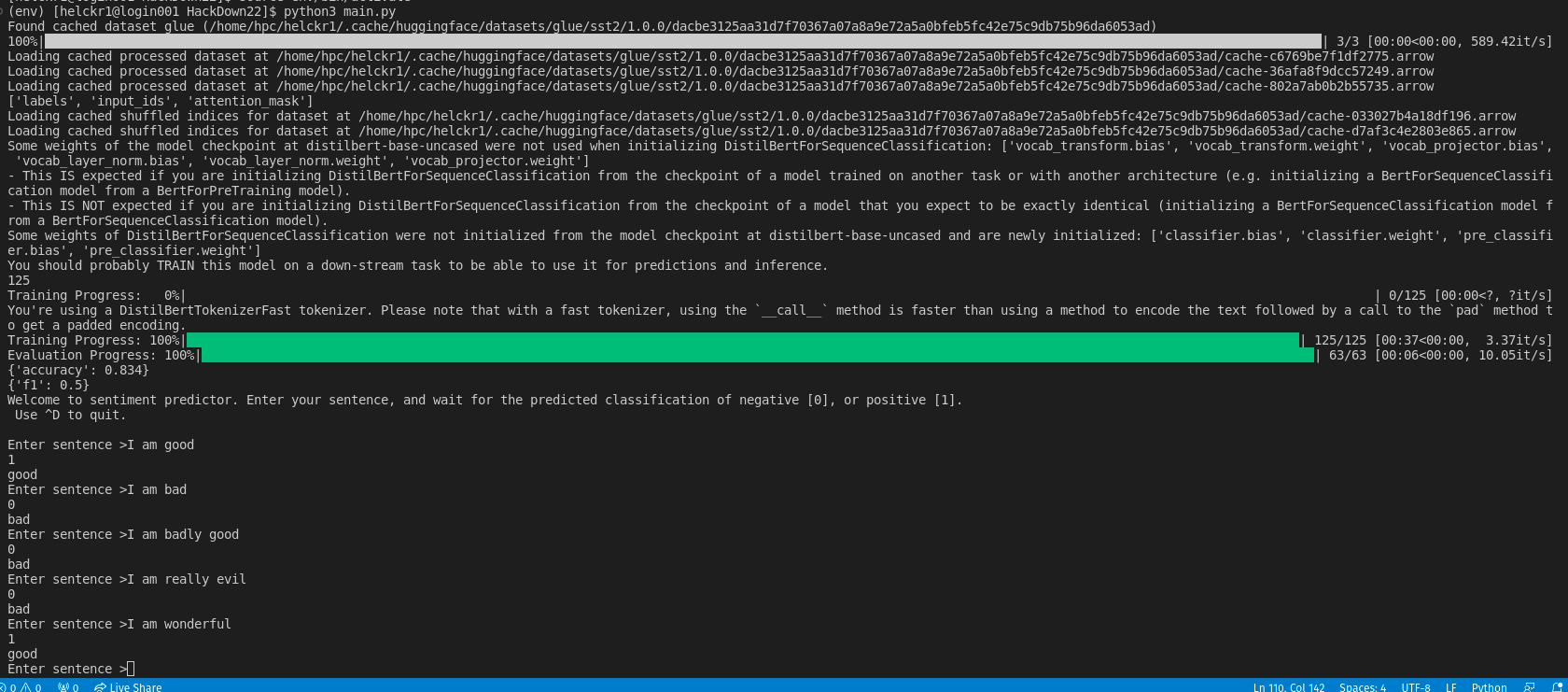
Demo of app
Inspiration
I have been involved in NLP research for about 6 months now, and I am interested in learning more about state of the art models such as the BERT family of transformers.
What it does
This application fine-tunes a pretrained DistilBERT model on a subset of the GLUE:sst2 dataset over a variable number of epochs, and performs sentiment analysis on user input.
How we built it
I made heavy use of the Huggingface and Torch libraries, and their documentation.
Challenges we ran into
The F-1 score achieved by my model when evaluated with a held out test set tends to be low at 0.6 - 0.7. I believe this is because I do not provided enough training data over enough epochs. Doing so would take a really long time.
Accomplishments that we're proud of
The application actually works pretty well. The accuracy score hovers between 0.8 - 0.85 when the model is evaluated with a held out test set, which translates into fairly accurate sentiment analysis for user input.
What we learned
I learned a lot about the Huggingface API, the tqdm library, and the Torch library.
What's next for BERT Sentiment Analysis
I want to incorporate principles of active learning as they can be applied to fine tuning pre-trained models for downstream tasks, using larger subsets of data, and increasing the performance of the model as measured with a held-out test set.
Built With
- bert
- elsa
- huggingface
- python
- torch

Log in or sign up for Devpost to join the conversation.