-
-
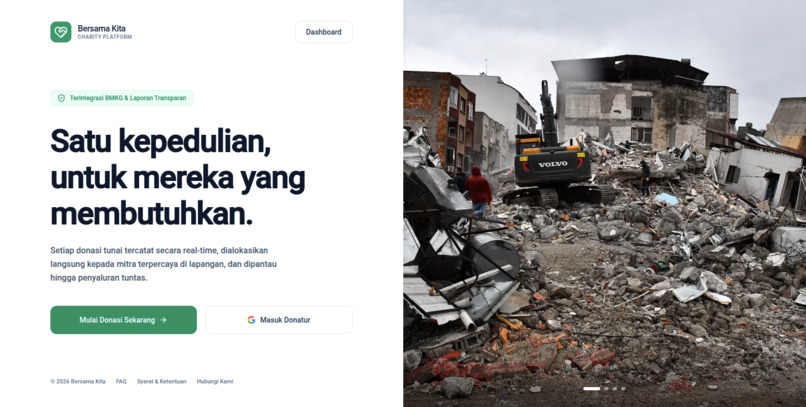
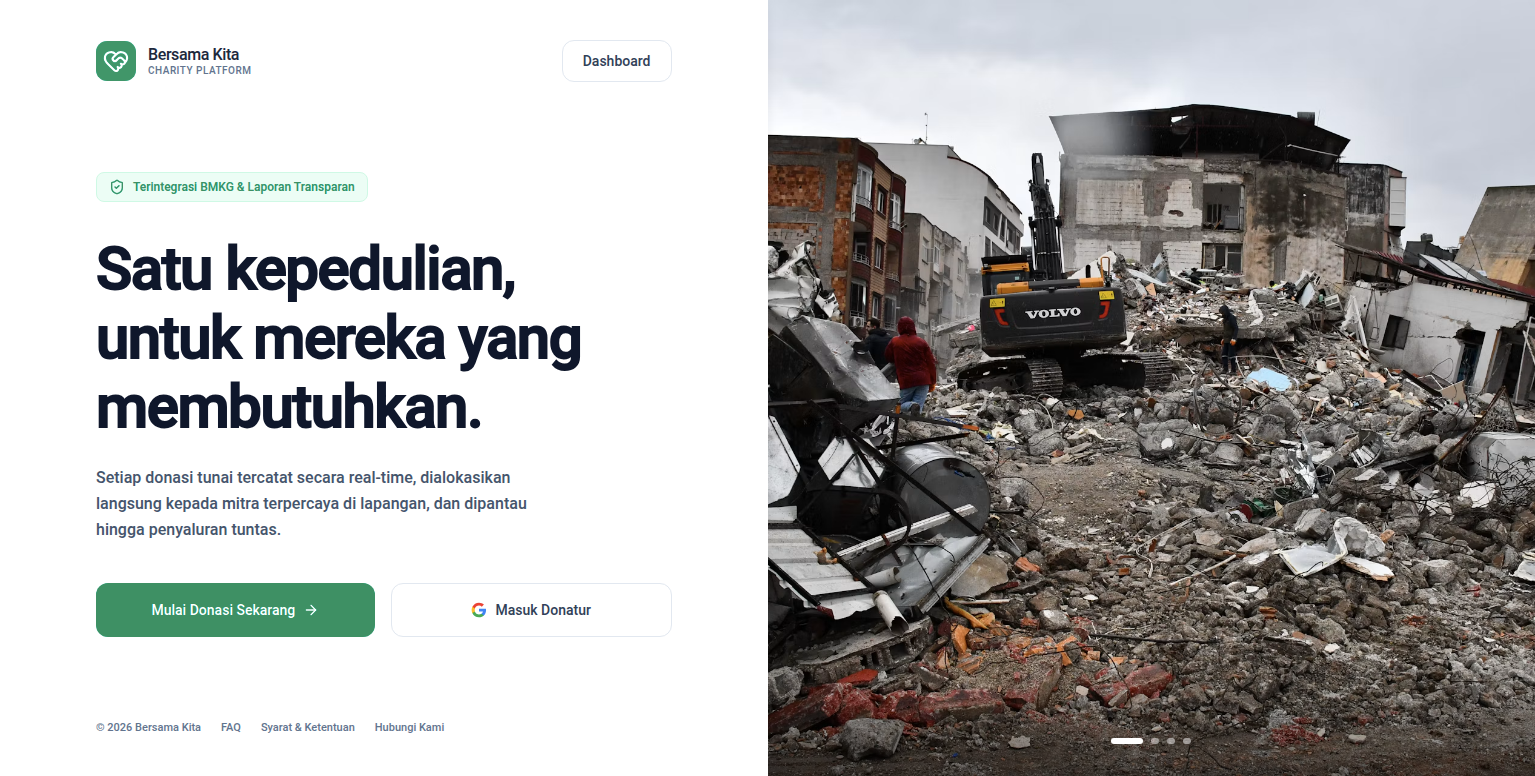
Landing Page
-
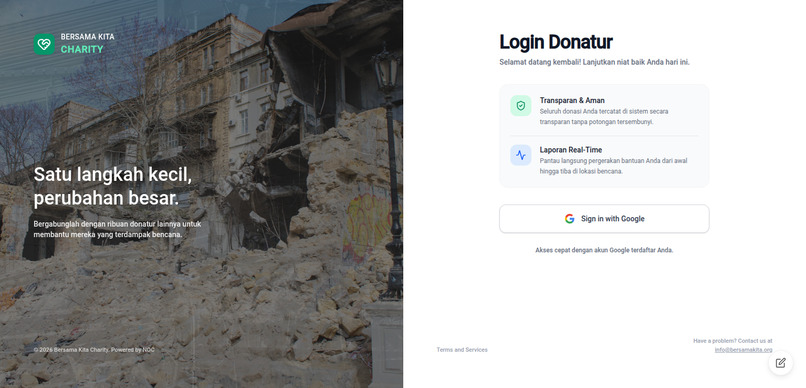
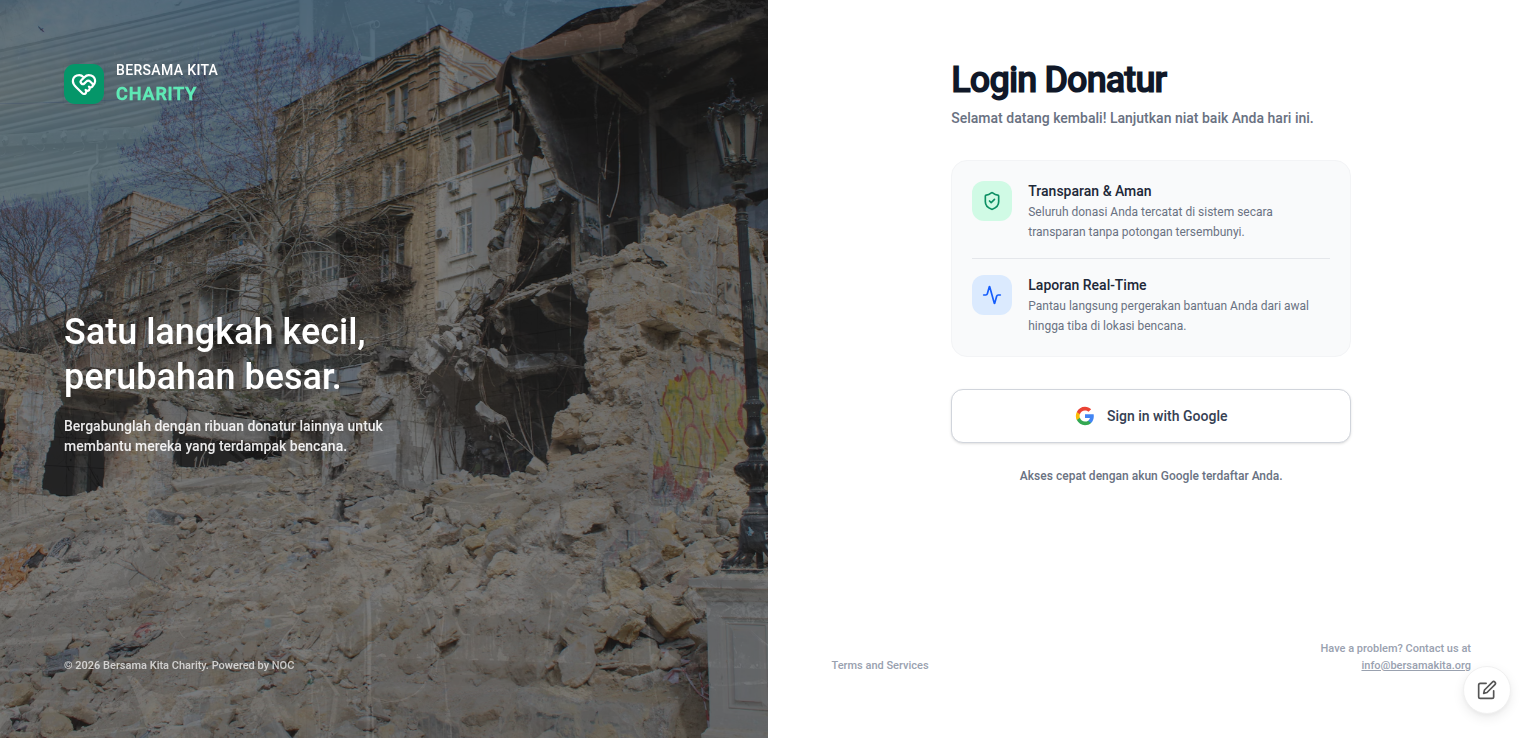
Login Page
-
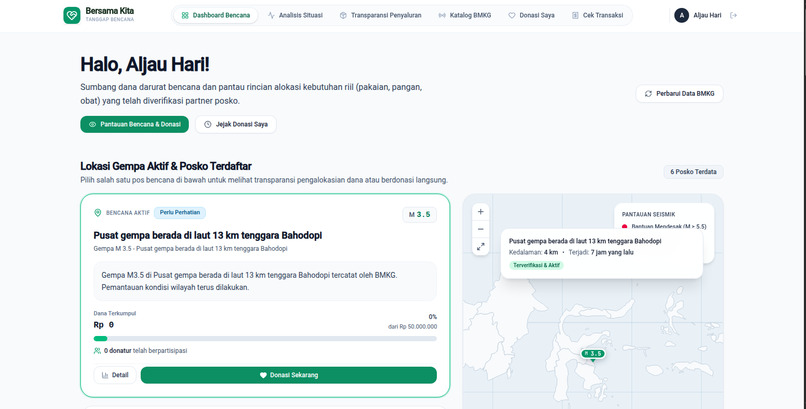
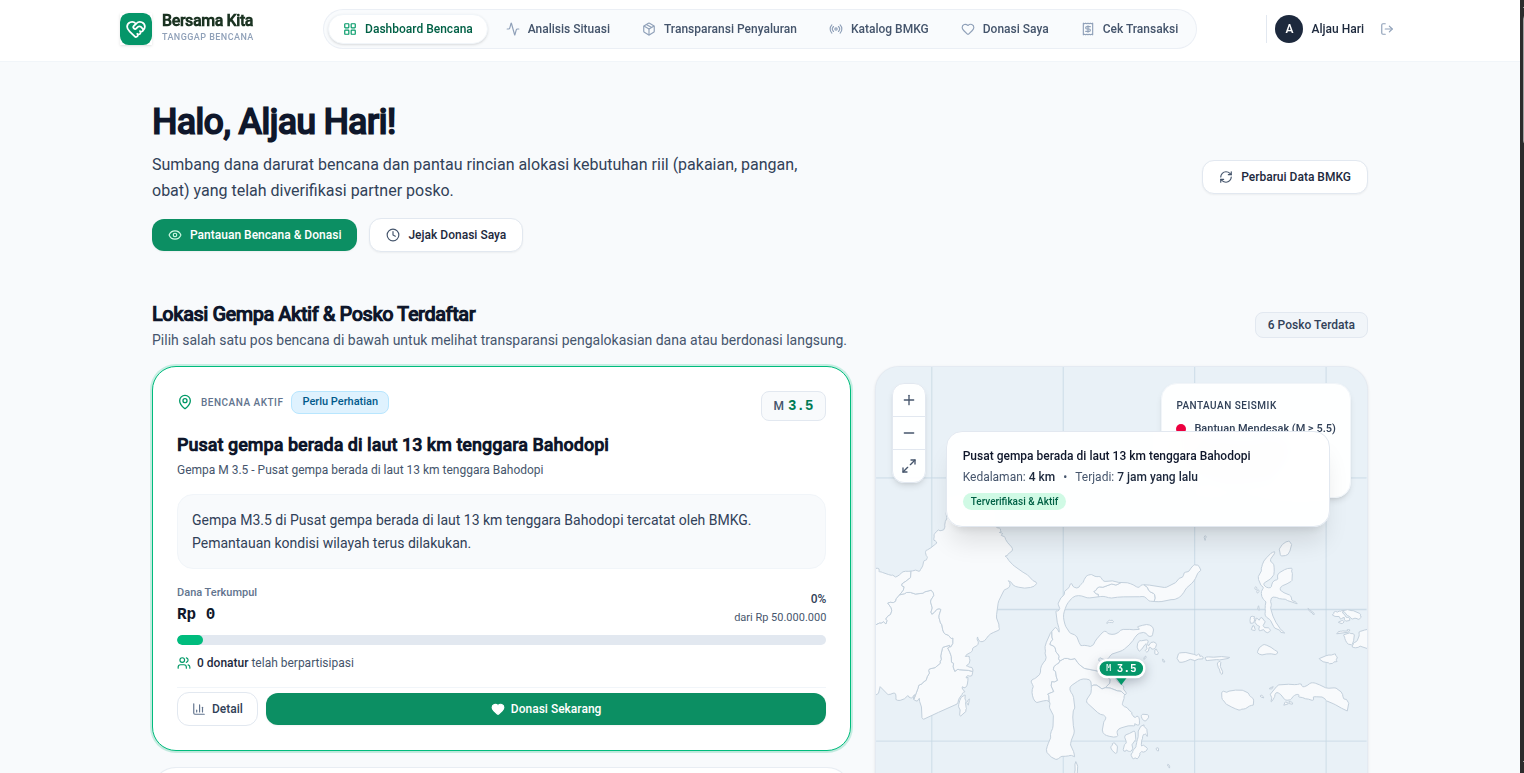
User Dashboard
-
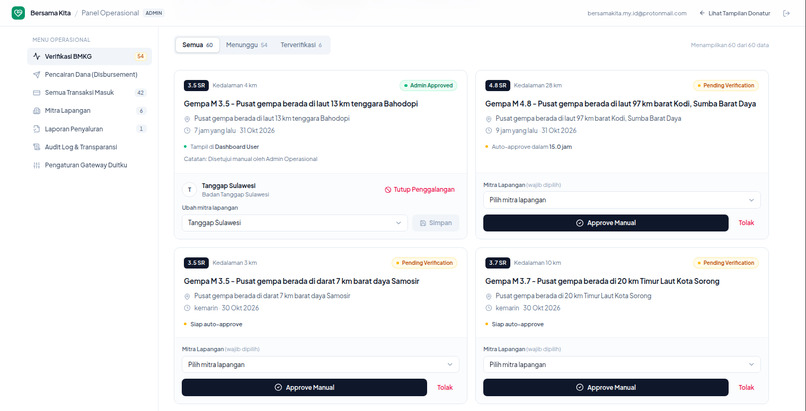
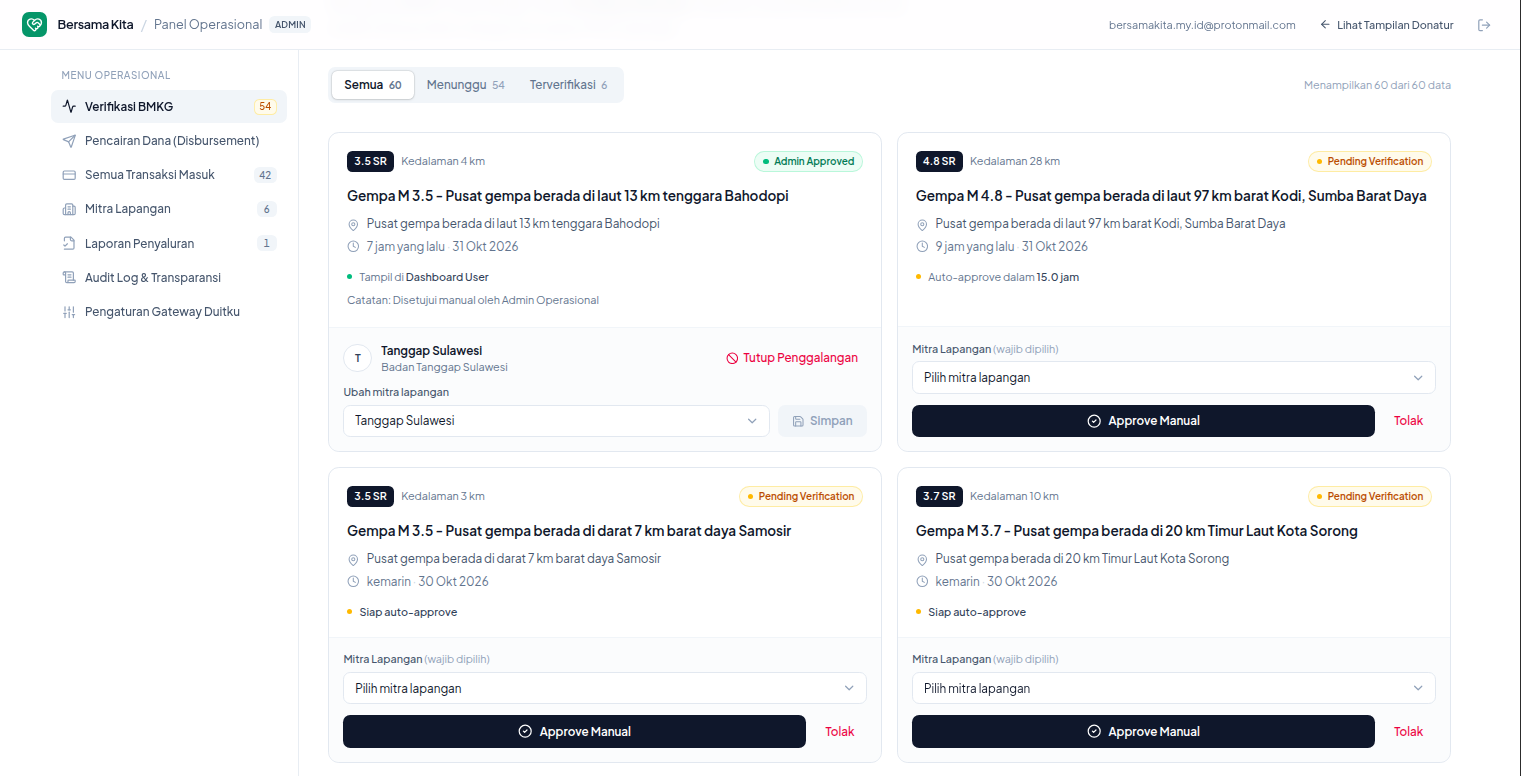
Admin Dashboard
-
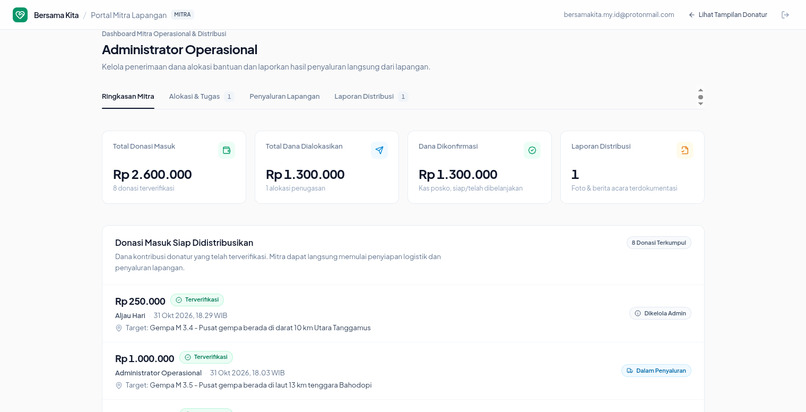
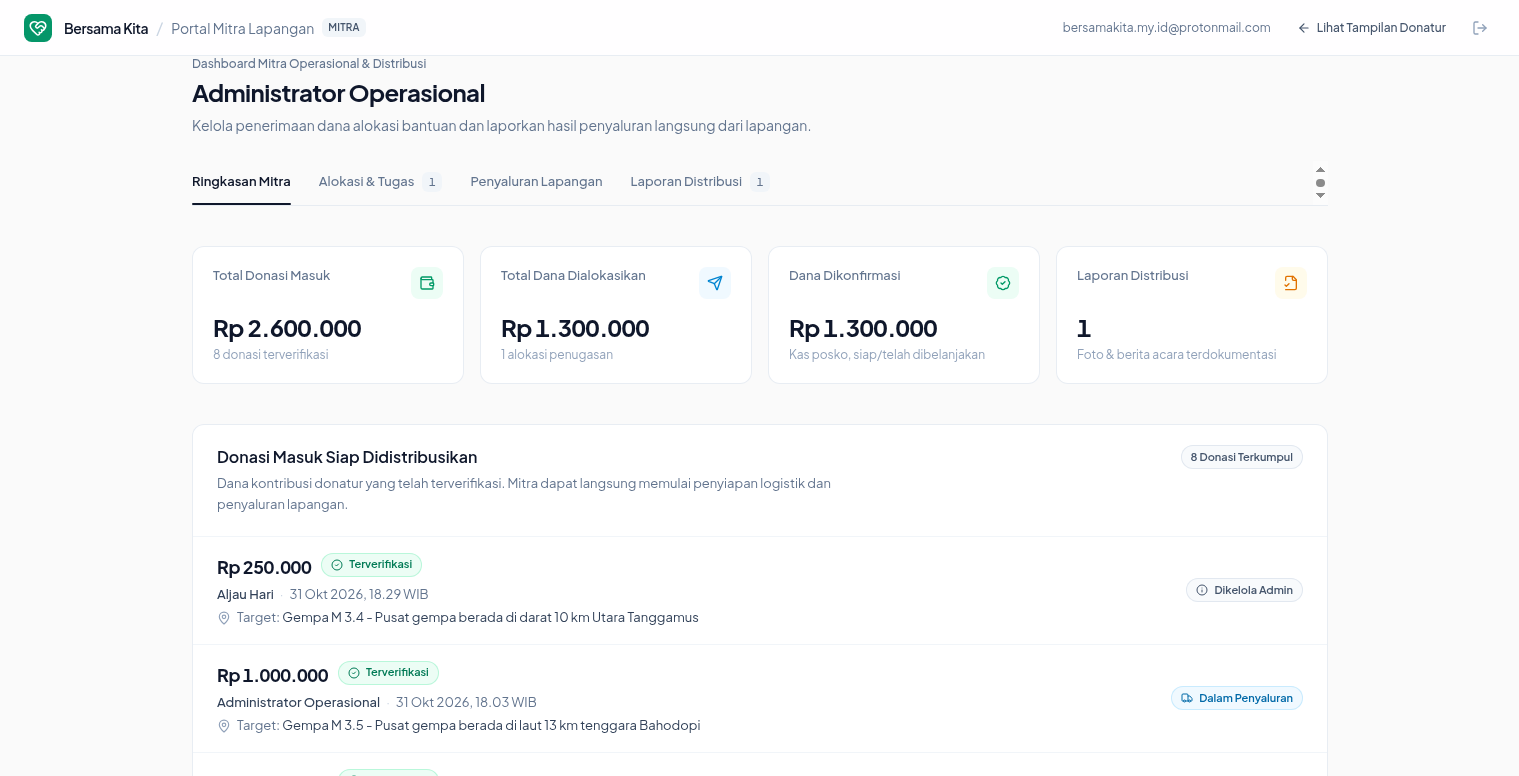
Partner Dashboard
Bersama Kita
Transparent Disaster Relief Donation Platform
Bersama Kita is a digital disaster response and donation platform designed to make disaster relief more transparent, accountable, and efficient. It connects donors, administrators, and local relief partners in one integrated ecosystem, ensuring that donations reach affected communities based on verified information and actual field needs.
Inspiration
Indonesia is located in the Pacific Ring of Fire, making it highly vulnerable to earthquakes and other natural disasters. During emergencies, communities urgently need essential supplies such as clean water, food, medicine, sanitation, and temporary shelter.
However, disaster relief efforts often face several challenges: donations tend to peak during the first week and decline during prolonged recovery periods, while logistical bottlenecks, limited resources, and lengthy distribution processes delay assistance.
Donors also lack reliable information about disaster conditions, fund allocation, and the actual delivery of their contributions. Bersama Kita was created to bridge these gaps through technology-driven humanitarian collaboration.
What it does
Bersama Kita integrates official earthquake information from BMKG with digital fundraising, partner management, and transparent relief distribution.
The platform provides four core solutions:
1.Disaster Mapping & Verified Catalog: Displays verified earthquake information, including magnitude, depth, location, and interactive disaster and relief-post maps.
2.Real-Time Allocation Reporting: Allows field partners to submit fund allocation plans based on actual relief-post needs, making fund usage more transparent to donors.
3.Public Ledger & E-Proof of Delivery: Publishes aggregated donation information, distribution progress, delivery reports, photographs, and handover documentation (Berita Acara).
4.End-to-End Personal Transaction Visibility: Enables donors to track their individual contributions, from pending payment and successful transactions to final distribution.
Key Features
Bersama Kita serves three primary user roles:
Donors: Access verified disaster information, explore interactive maps, donate through QRIS, and monitor personal transaction history and distribution progress.
Administrators: Verify disaster reports, manage campaigns and relief partners, monitor donations, authorize fund disbursements, and generate financial reports.
Field Partners: Access assigned fund allocations, confirm fund receipts, submit allocation plans, and upload distribution reports with photographic evidence.
How we built it
Bersama Kita uses a modern web technology stack:
-Frontend: React, Vite, TypeScript, and Tailwind CSS. -Backend: Node.js and Express.js. -Database: Firebase Firestore. -Authentication: Firebase Authentication with Google Login. -Payment Gateway: Duitku (QRIS Sandbox Mode). -Disaster Data: Open Data BMKG API. -Media Storage: Cloudinary. -Deployment: Vercel.
The system uses a backend proxy for external service communication, Role-Based Access Control (RBAC) for permission management, and layered security to protect credentials and prevent duplicate payment processing.
Its feature-driven architecture separates authentication, disaster management, donations, partners, administration, distribution, and financial management.
Challenges we ran into
Key challenges include maintaining accurate disaster information through external APIs, securing payment callbacks, managing fund allocation consistently, and ensuring that field distribution reports are properly documented.
Currently, payment integration uses Duitku Sandbox Mode and does not yet support real donations. Automated backups, disaster recovery, real-time system monitoring, and full payment reconciliation also require further development.
Accomplishments that we're proud of
We are proud of bringing together multiple aspects of disaster relief into one integrated digital platform. Some of our key accomplishments include:
-End-to-End Disaster Relief Ecosystem: Designed an integrated workflow connecting official BMKG earthquake data, disaster verification, digital donations, fund allocation, and field distribution. -Multi-Role Platform: Developed dedicated user experiences and dashboards for donors, administrators, and field partners, each with specific permissions and responsibilities. -Transparency-Driven Donation System: Designed personal donation tracking, public fund reporting, and a six-stage distribution tracking concept to improve accountability. -Integrated Technology Ecosystem: Established integration with BMKG Open Data, Firebase, Duitku QRIS Sandbox, and Cloudinary to support disaster information, transactions, and distribution documentation. -Security-Focused Architecture: Designed backend proxy communication, Role-Based Access Control (RBAC), layered security, payment callback validation, and idempotency to strengthen system reliability. -Complete Technical Blueprint: Prepared system architecture, API design, access control workflows, and interface designs for the platform's four main views. -24Hour Rapid Prototyping Plan: Structured the development process into four focused phases covering infrastructure, authentication, disaster data, donation transactions, and distribution reporting. -Most importantly, we transformed a humanitarian challenge into a structured digital solution that puts transparency, accountability, and the needs of disaster-affected communities at its center.
What we learned
Through developing Bersama Kita, we learned that effective disaster response requires more than just collecting donations. It requires a well-integrated system that connects verified disaster information, donors, administrators, and local distribution partners.
Key lessons we gained include:
1.The Importance of Verified Information: We learned that reliable disaster data is essential for making informed decisions. Integrating BMKG data with an administrator verification process helps minimize misinformation and ensures that donations are directed toward verified disaster events.
2.Transparency Builds Trust: We realized that transparency should cover the entire donation process, not just the total amount collected. Donors need to track their transactions, understand fund allocations, and access distribution reports and delivery evidence.
3.Technology Must Support Real-World Coordination: We learned that connecting donors, administrators, and local partners through role-based workflows can help improve coordination, reduce administrative barriers, and make aid distribution more organized.
4.Security and Accountability Must Be Built from the Start: Implementing Role-Based Access Control (RBAC), backend validation, secure payment callbacks, and activity logs taught us the importance of protecting user data while maintaining accountability.
5.Rapid Development Requires Clear Priorities: Working within a 24-hour hackathon sprint taught us to prioritize core functionalities, manage technical dependencies, and integrate multiple services such as Firebase, BMKG API, Duitku, and Cloudinary efficiently.
Overall, this project taught us that meaningful digital innovation is not simply about building technology, but about designing a reliable, transparent, and human-centered solution that addresses real community needs.
What's next for Bersama Kita
Future development will focus on production-ready payment integration, automated transaction reconciliation, data backup and recovery, system monitoring, and improved operational notifications.
We also aim to strengthen the platform's ability to support decentralized relief distribution and sustained assistance throughout emergency response and recovery periods.
Built With
- api
- cloudinary
- css
- express.js
- firebase
- firestone
- google-login
- node.js
- react
- tailwind
- typescript
- vercel
- vite


Log in or sign up for Devpost to join the conversation.