Inspiration
ANPR systems are often expensive with a hefty price tag.
What it does
We offer a solution that not only comes with a cheaper price tag, but also smaller in size.
How we built it
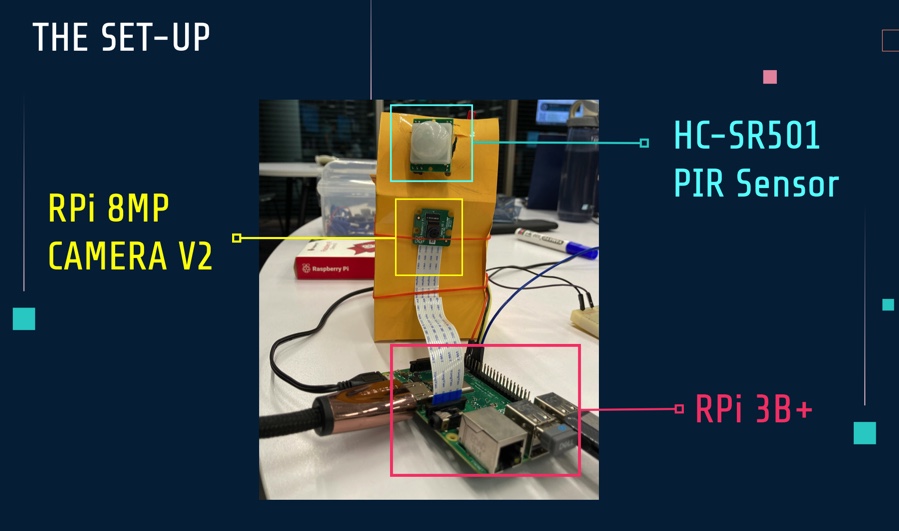
Our ANPR system, to be mounted near the entrance gantry to any premises, runs on a RaspberryPi 3B+ model that integrates an 8mp Pi camera and a HC-SR501 PIR Sensor. The PIR Sensor is used as a motion detector that detects incoming vehicle. Once an incoming vehicle is detected, represented by the lighting up of the yellow LED, it triggers the Pi Camera to capture the vehicle number plate. The captured vehicle number plate is processed using image processing methods such as edge detection and thresholding. The processed image is then fed as an input to an OCR engine which reads and stores the numbers. Finally, the stored numbers will be verified using a database of registered vehicles. Once verified, a signal will be sent for the gantry to be opened. While we do not have an actual gantry to implement our system, we are representing this with the lighting up of a green LED, signalling successful entry, and the lighting up of a red LED, signalling failed entry.
Challenges Faced
We have tried using 'tiny' version of models that are well-known for their performance in detecting objects, such as tiny YOLOv4. However, we have found that such models are still computationally heavy for our implementation on RPi. Thus we have decided to use OCR that is heavily reliant on advanced image processing methods to compensate the absence of object detection models.
Our initial image processing method transformed the captured image into a grayscale image, which is then processed using OCR. However, this method has affected the accuracy of the OCR and our ANPR system was not able to detect the vehicle numbers correctly.
Instead of using grayscale images for contour detection, we used binary thresholding which greatly improves the accuracy of the OCR.
Accomplishments that we're proud of
Even though we only had about 24 hours to plan, design and execute our idea, we are glad that we managed to integrate our code, the devices and the database in less than a day.
What we learned
We have learned about how OCR works and how to integrate the different RaspberryPi devices together.
What's next for berryCADE
While berryCADE performs very well on RaspberryPi, we would like to push this project further by solving the problems that we faced such as the limitation of the RPi device to run computationally expensive A.I models. We feel that having these models to detect the vehicle number plates could further improve our device accuracy. This also means using better and more powerful microcontrollers.

Log in or sign up for Devpost to join the conversation.