-
-
Berkas — Indonesian for the file you hand in. The model perceives, code decides, you confirm.
-
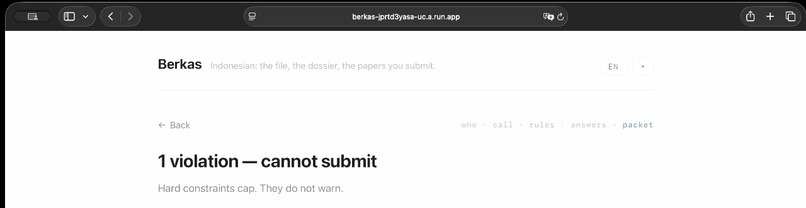
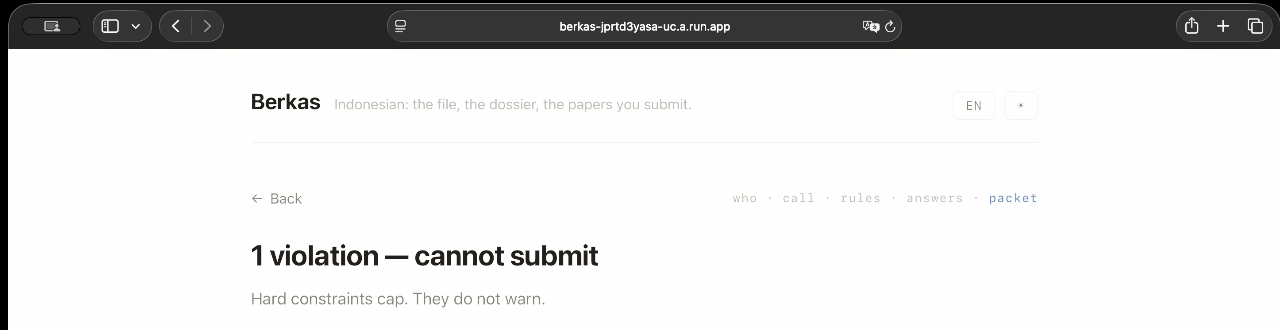
Blocked on the live Cloud Run service. Plain Python gives the verdict, no model involved, so the same draft always gets the same answer.
-
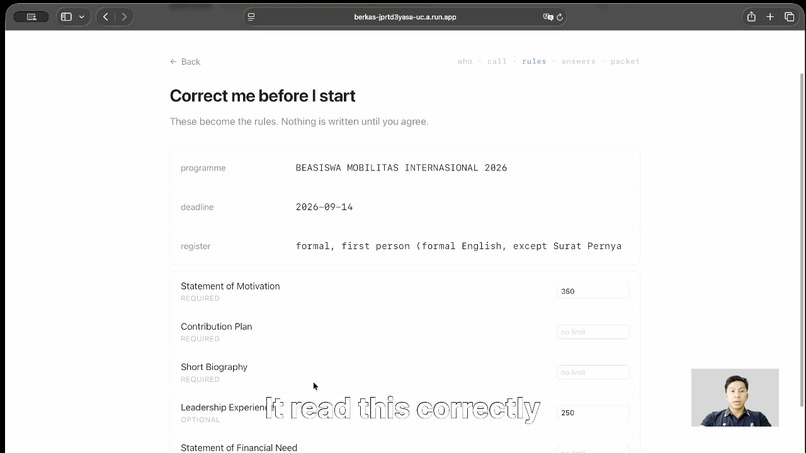
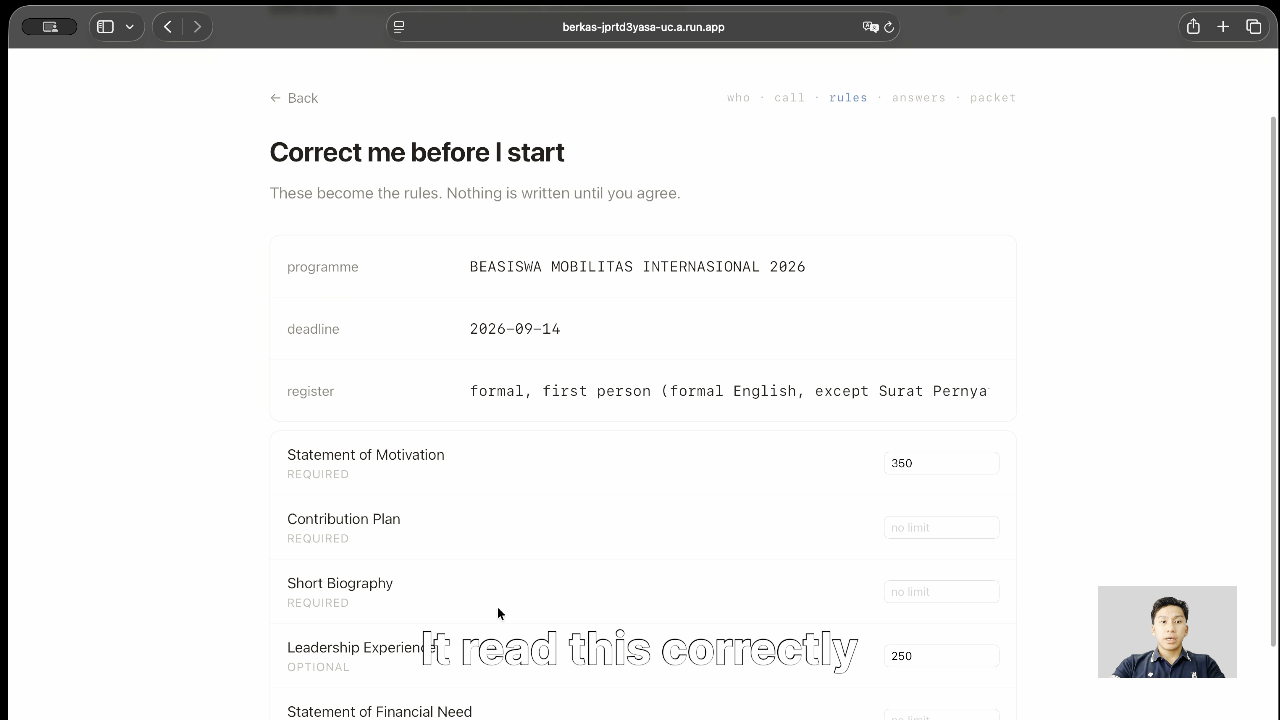
It reads the call, reports what it requires, then stops. I correct it before it becomes the rulebook. Unconfirmed specs return 409.
-
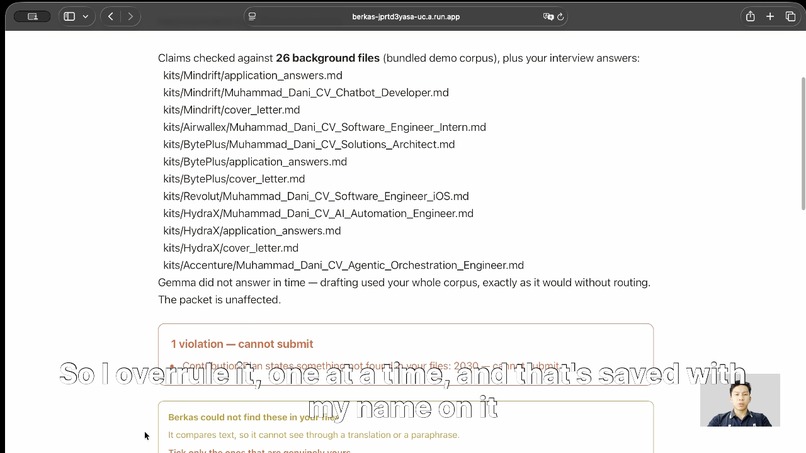
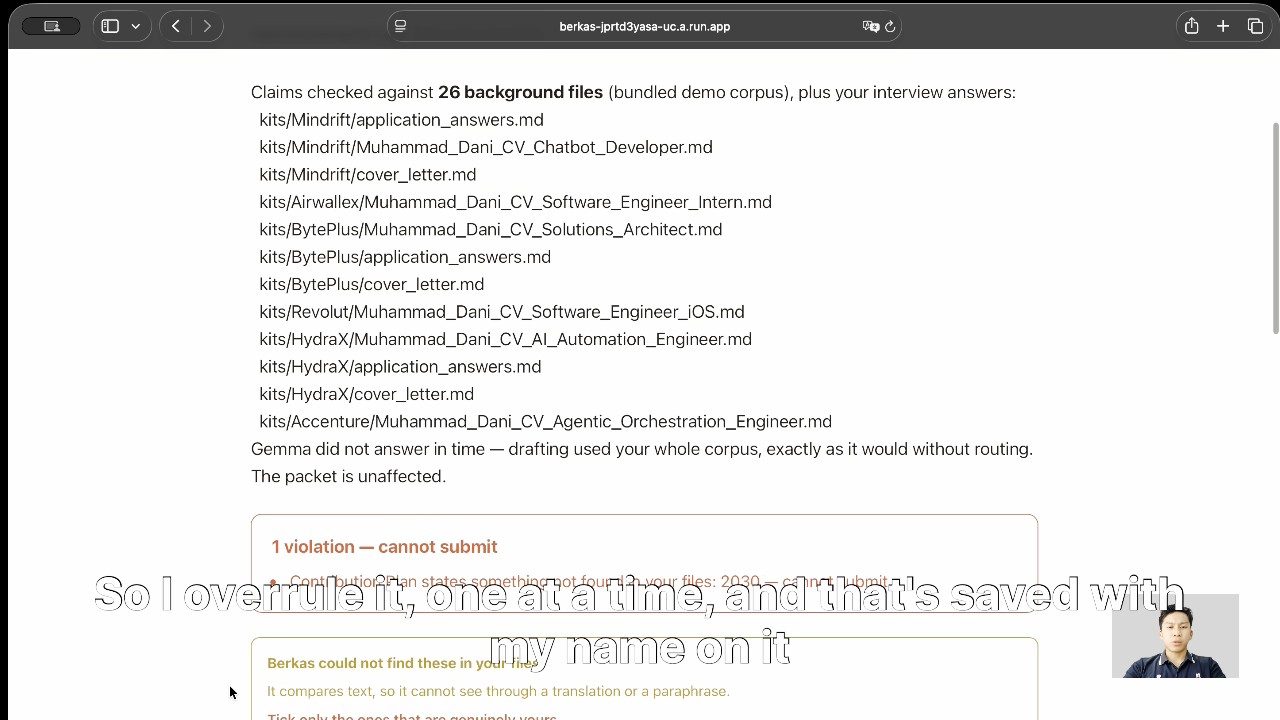
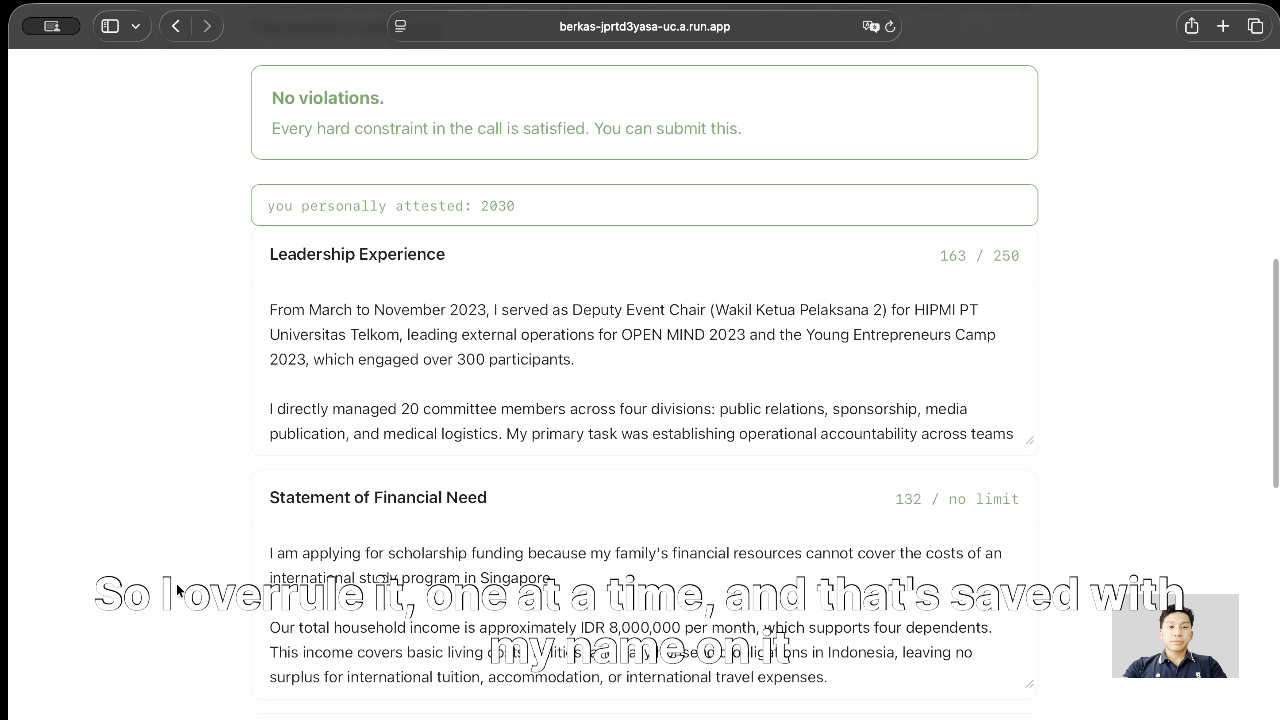
The checker compares text, not meaning. It flags my degree because Indonesian differs from my CV. I overrule each claim, saved with my name.
-
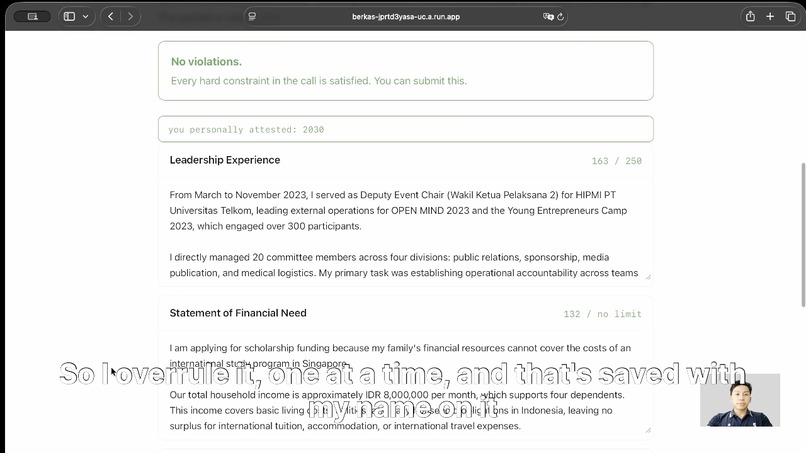
Green only when every hard constraint passes: word caps, required sections, no [NEEDS:] markers, and a deadline checked in my timezone.
-
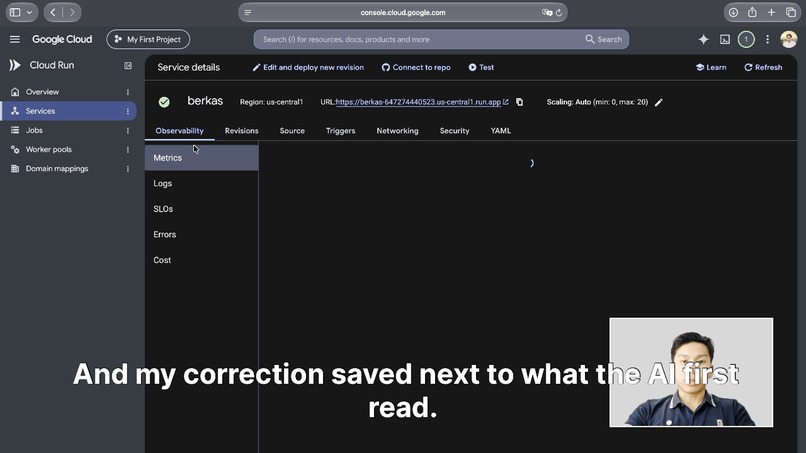
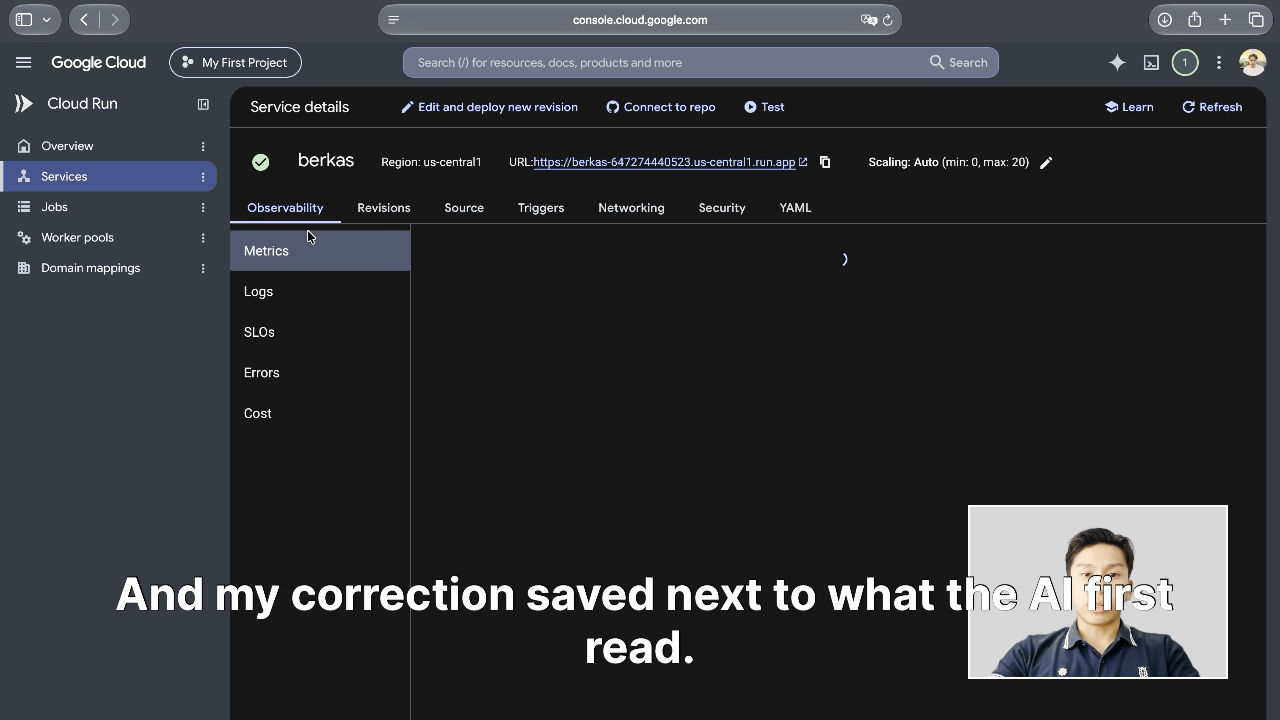
One Cloud Run service in us-central1. Gemini 3.7 Flash via Vertex AI, Gemma 4 via Gemini API, and Firestore in Jakarta.
-
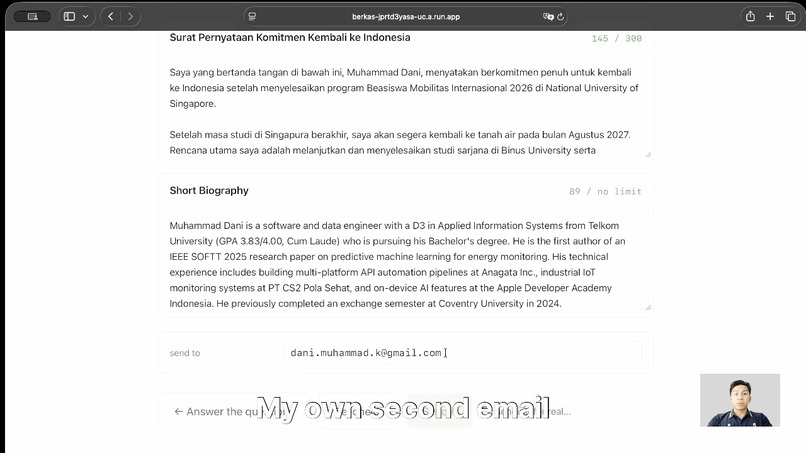
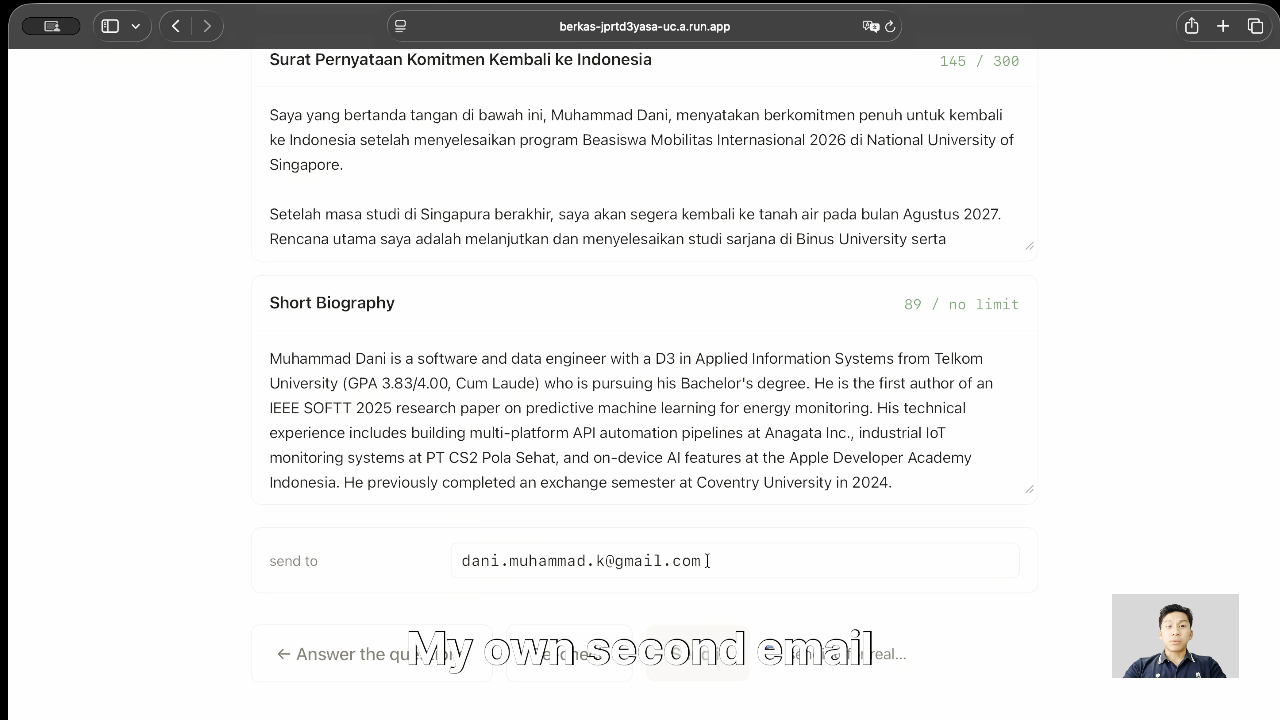
The send is real: Gmail API, real message ID, and a Firestore receipt. It goes to my second inbox, not a real committee.
-
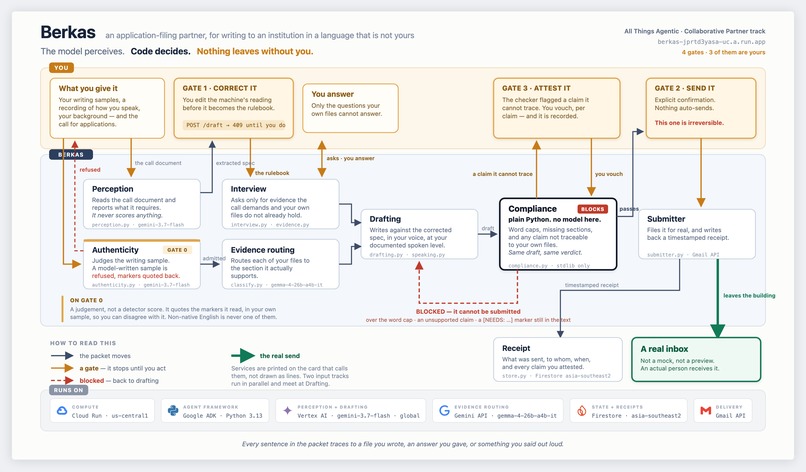
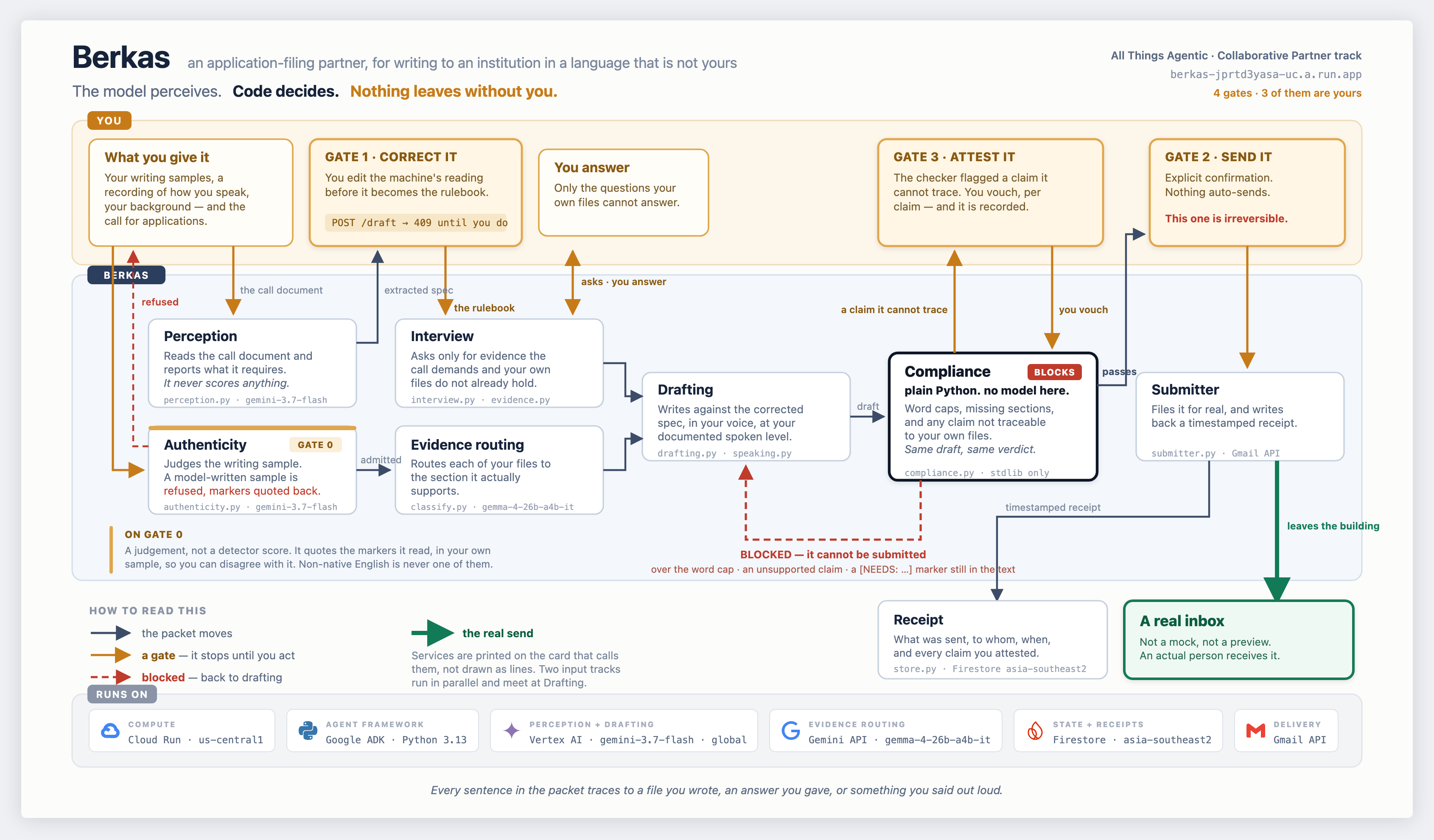
Four gates, and the checker in the middle has no AI in it. Gemini perceives, Gemma routes, Python decides, I confirm.
Inspiration
In July I recorded myself saying I needed a script to present in English. I have made deals in English and I still open every application form with the same tightness in my chest. The problem was never grammar — tools solved grammar years ago. It is that I cannot tell what a specific institution will reject me for, and no writing assistant knows that either.
So I stopped trying to build something that writes better. I built something that knows the rules, lets me correct it when it reads them wrong, and refuses to submit when the rules are broken.
What it does
Berkas reads a call for applications and reports what it actually requires — deadline, word caps, mandatory sections, the register it is written in.
There are three gates, and all three record what you decided.
You correct that reading before it becomes the rulebook. This is the part I care about. The
model is allowed to be wrong; it is not allowed to be wrong and binding. Every correction is
recorded, and the drafting endpoint returns 409 on a spec no human has confirmed.
It then interviews you only for evidence the call demands and your own files do not already contain, drafts against the spec in your documented voice, and a deterministic checker blocks the packet on any hard violation. On your explicit confirmation it sends it for real and returns a timestamped receipt carrying the Gmail message id.
The third gate is the one I did not plan. The checker verifies every number and every named institution against your files — and it compares text, so it cannot see through translation. It flags Sistem Informasi in an Indonesian section against a corpus that attests the same degree in English. The claim is true and the checker is wrong. So you can attest it, and who vouched for what is written to the receipt. It is Gate 1 again, pointed at the system's own checker.
It never invents a claim about your experience. Where a fact is missing, the drafting agent
writes [NEEDS: the thing it would need] instead of a plausible sentence — and the checker treats
that marker as a hard violation, so a packet built on an invented claim cannot be sent. On the very
first end-to-end run, with no interview answers given, it refused to invent a host university, a
household income and a community project, and blocked itself three times. That was not staged.
How we built it
Google ADK in Python on Cloud Run, Gemini 3.7 Flash through Vertex AI at the global endpoint, Gemma 4 through the Gemini API, Firestore for specs, drafts and receipts, and the Gmail API for the send.
The spine is one decision: the model perceives, code decides. Gemini reports what the document
requires. berkas/compliance.py — plain Python, standard library only, no model in the path —
produces the pass/fail verdict. Same draft, same verdict, every time, and the rules are auditable by
reading them rather than by trusting them.
Four rules, all evaluated together so a fix-and-recheck cycle converges instead of playing
whack-a-mole: word caps (exceeds, not reaches — 500/500 is compliant), missing mandatory sections,
unresolved [NEEDS:] markers, and a passed deadline evaluated in the applicant's own timezone.
Two models, doing different jobs. Gemma 4 reads the corpus once and routes each file to the
sections it can support, so drafting sees the relevant files rather than all 26. On my real corpus
it puts the CVs behind the Short Bio, the application answers behind Motivation, and consistently
nothing behind Personal Statement of Financial Need — eleven job applications contain no
household finances, so there is nothing to route. That section is the one that ends up marked
[NEEDS: ...], which is the system agreeing with itself from two directions.
Routing narrows but never starves, and it is honestly best-effort. Gemma answered 0 files for one section on one run and 11 on the next; on the prepay route available to me the same call has taken 25 seconds, returned 429, and failed to answer within ten minutes. So routing runs on a 20-second budget off the event loop, a section it routes nothing to falls back to the whole corpus, and the interface tells you when it did not answer instead of quietly pretending it did. Same principle as everywhere else here: Gemma perceives, it does not decide, and nothing it does is load-bearing.
Both gates live in the API rather than in the browser, so curl gets the same answer as a click.
The tests assert the negatives that matter: on a blocked send, the transport is never called and
no receipt is written.
Challenges we ran into
Gemini 3.x is served only from location=global, which is not obvious from a regional Cloud Run
deployment.
Getting Gemma at all. Gemma is open-weights, so unlike Gemini there is no managed Vertex endpoint to call — I got 404 on every Vertex model path. The documented route is the Gemini API, which was returning 429 (prepayment credits, not rate limiting) from Indonesia. Self-hosting is the other option, so I checked GPU quota through the Service Usage API: zero, across all 60 GPU types. Credits pay the bill but they do not grant the quota, and a quota increase is a review measured in days. I had written Gemma off entirely before the API route came back and I retried it. The lesson I will keep: I declared something dead on one failed call.
Two bugs that only existed in production, and a third that only existed under load. A synchronous client call inside an async route blocks the entire event loop — invisible locally with one request in flight, and on Cloud Run a draft request sat blocked for 599 seconds until the platform killed it. And routing per section, rather than once, turned a 119k-character corpus into a 716k-character prompt.
Two more that only existed in production. gcloud run deploy --source . falls back to
.gitignore when there is no .gcloudignore — and the evidence corpus is gitignored on purpose, so
the service deployed perfectly, reported healthy, and quietly drafted from nothing. It was caught
only because /api/health reports the corpus size; a health check that returns ok while the
product is hollow is not a health check. Separately, access_secret_version(name={"name": ...})
passes a dict where a string belongs. That branch only runs on Cloud Run, so it passed every local
test and then 500'd on the one request the entire project is about.
And the honest one: deciding what the agent is not allowed to do took longer than making it write well.
Accomplishments that we're proud of
The refusals work, and they are tested as refusals. A packet with a violation cannot be sent even by someone who bypasses the interface entirely.
What we learned
That a gate is only worth what it is tested at. "The button is disabled" is a claim about a browser.
"POST /api/send returns 409" is a claim about a system.
And that the same rule has to apply to every model in the stack, not just the one you are suspicious of. My first version of Gemma routing let a section with zero routed files be told "nothing covers this" — which meant one flaky classification could quietly hollow out part of the packet. I had built the exact thing the rest of the project argues against, and I only caught it because the drafts got shorter between two runs.
What's next for Berkas
Indonesian-language calls first — LPDP, Beasiswa Unggulan, and the campus grant forms that are still PDFs. The rulebook abstraction does not care what language the document is in, and the people who need the gate most are the ones filing in a second language.
Built With
- cloud-run
- fastapi
- firestore
- gemini-3.7-flash
- gemma-4
- gmail-api
- google-adk
- pytest
- python
- secret-manager
- vertex-ai

Log in or sign up for Devpost to join the conversation.