-
-

Beriwo logo
-
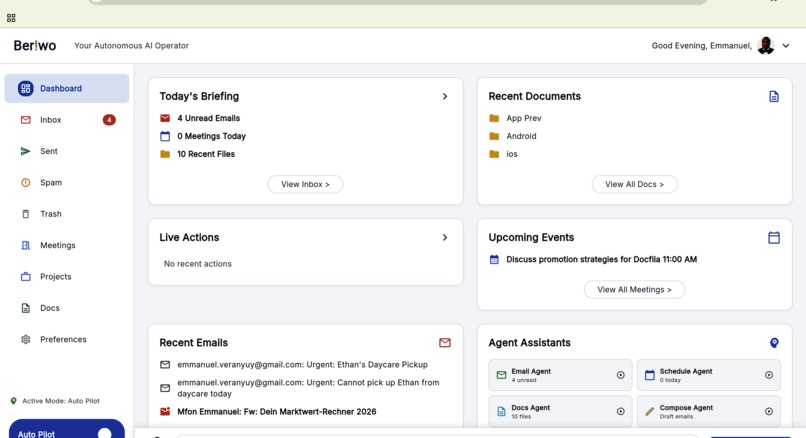
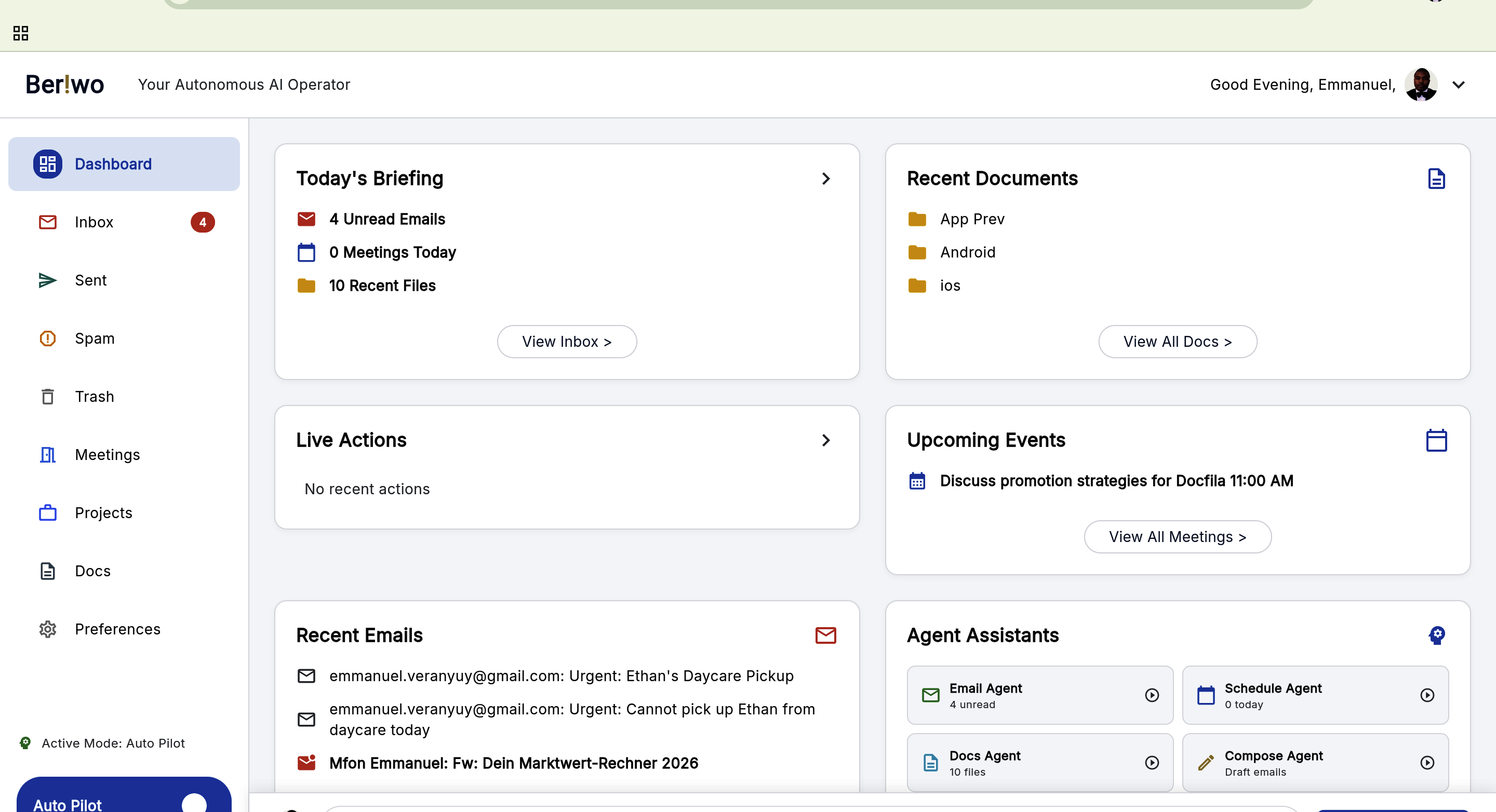
UI screenshots of web app 1
-
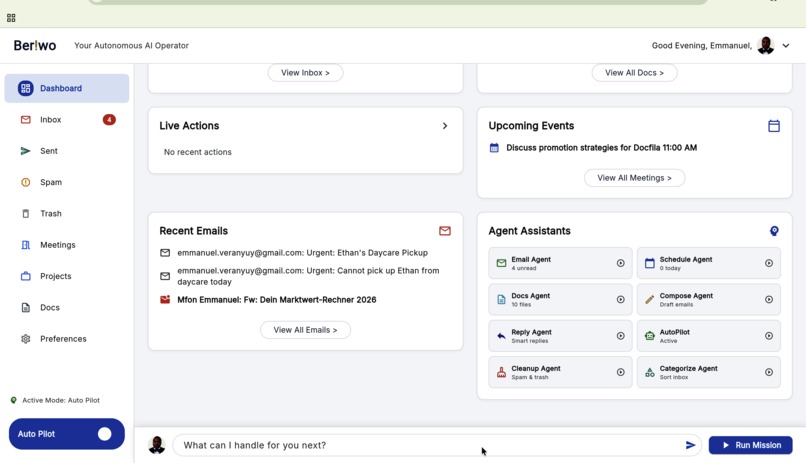
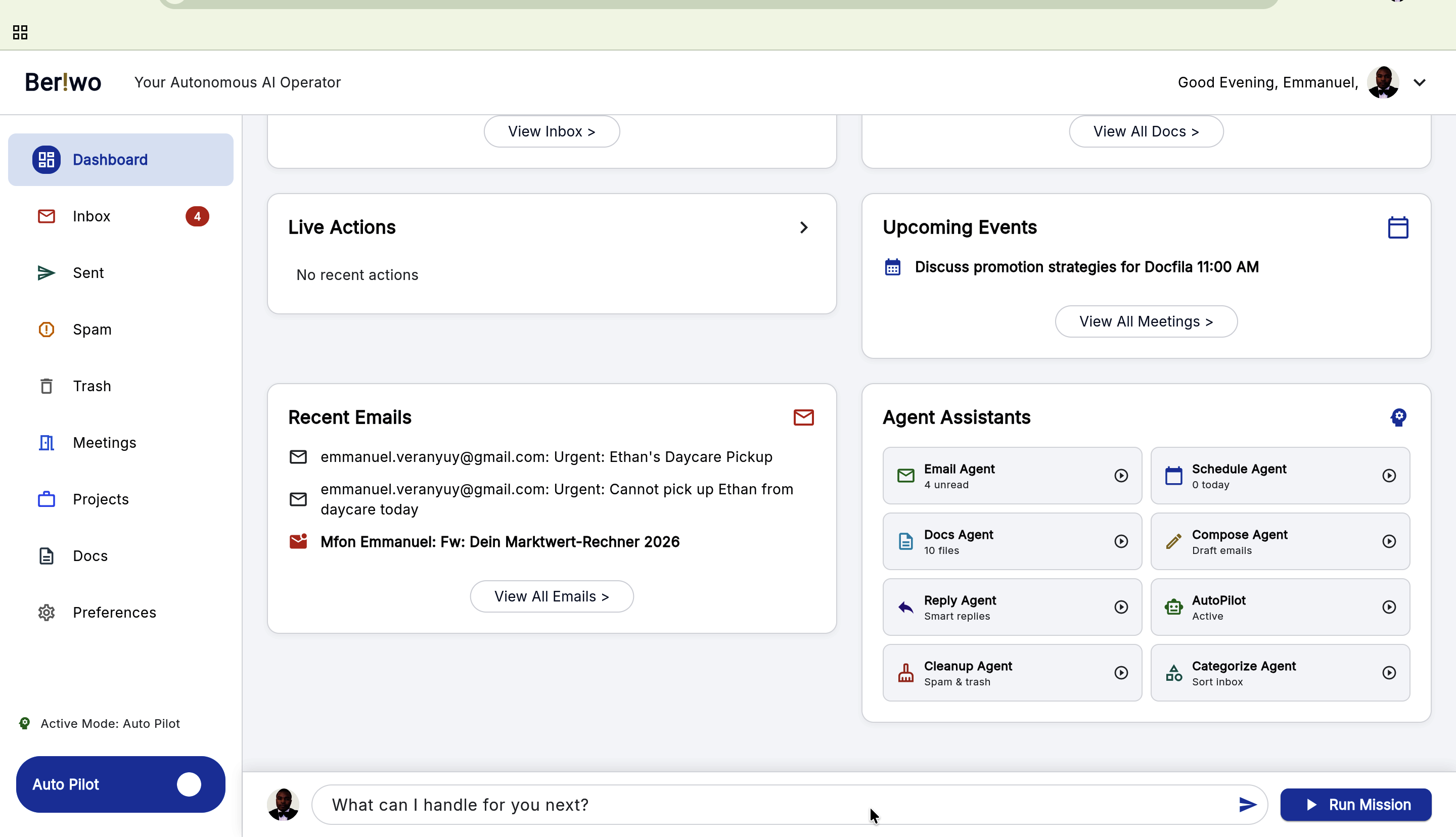
UI screenshots of web app 2

Inspiration
The idea for Beriwo came from a simple frustration: every day, professionals spend hours context-switching between Gmail, Google Calendar, and Google Drive — reading emails, scheduling meetings, finding documents, and repeating the same manual rituals. We imagined saying: "Check my email, find the flight itinerary, add it to my calendar, and text my wife to remind her about pickup" — and having it actually happen, securely, without handing our passwords to an AI.
But the moment we started building, we realized the real problem isn't making AI smart enough — it's making AI trustworthy enough. Every existing approach requires giving an LLM raw API credentials. That's a security nightmare. A prompt injection attack could turn your helpful assistant into a data exfiltration tool. We needed an architecture where the AI can act on your behalf without ever seeing your credentials, and where every action is gated, auditable, and reversible. When we saw Auth0's "Authorized to Act" hackathon and the Token Vault SDK, we knew this was the missing piece.
What it does
Beriwo is an autonomous AI executive assistant that manages your Gmail, Google Calendar, and Google Drive through a secure, consent-gated pipeline. It doesn't just answer questions — it acts.
- Daily Briefing: Cross-references emails, calendar events, and Drive files, then prioritizes everything into URGENT / TODAY / FYI categories — like having a chief of staff in your browser.
- 10 Google Tools: List, read, send, and reply to emails. Create, update, and delete calendar events with Google Meet links. Browse and read Drive files. Trash emails and mark spam.
- Consent-Gated Writes: Every write operation (send email, create event, delete meeting, trash email) requires explicit user approval through a consent card in the UI. The AI plans the action; you decide if it executes.
- Smart Memory: Remembers your preferences, contacts, routines, and patterns across conversations — persisted to Firestore so it gets smarter over time.
- Self-Correcting Agent: A reflection loop (up to 3 passes) detects when the executor missed tools and re-runs automatically, ensuring reliable results.
- Real-Time Streaming: SSE-powered live pipeline shows exactly what the agent is doing — Planning → Executing → Synthesizing — with tool-by-tool progress.
- Email Management: Mark emails as spam, move to trash, categorize inbox into Social Media / Business / Bills / Work / Promotion / Potential Spam.
- Cleanup & Categorize Agents: One-click agents to empty spam/trash or auto-categorize your entire inbox.
How we built it
Beriwo is built on a 3-phase sandboxed AI pipeline — the core architectural innovation that ensures security by design:
Phase 1 — Sandbox Planner (no tools, no tokens): A Gemini 2.5 Flash instance analyzes the user's request and produces a structured JSON action plan. It references available tools but physically cannot call them. This prevents prompt injection from reaching tool execution.
Phase 2 — Policy Gate + Secure Executor (Token Vault + RBAC + Consent + Step-Up Auth): The plan passes through 5 security layers before execution. Auth0 RBAC claims (set via a Post-Login Action) physically remove unauthorized tools. Write tools are stripped unless the user explicitly approves. High-risk operations require re-authentication (step-up auth with a 5-minute window). Only then does the executor run — with credentials resolved by Auth0 Token Vault, never visible to the AI model.
Phase 3 — Synthesis Module (no tools, no tokens): Takes raw tool results and formats them into clear, markdown-formatted responses with cross-service insights and memory extraction.
Tech Stack:
- Frontend: Flutter Web (Dart) with Provider state management,
flutter_markdownfor rich responses, Auth0 SPA SDK with PKCE - Backend: Firebase Cloud Functions (TypeScript, Node.js 22, Express), Genkit v1.30 (beta) with Gemini 2.5 Flash
- Auth: Auth0 Token Vault (
@auth0/ai-genkit), Auth0 Actions for RBAC, Management API for token retrieval, step-up authentication viaauth_timeclaims - Database: Cloud Firestore for conversations, cross-session memory, and FGA audit logs
- APIs: Gmail API, Google Calendar API, Google Drive API
- Hosting: Firebase Hosting at beriwo-inc.web.app
We used 7 Auth0 features: Token Vault, Post-Login Actions (RBAC), consent-gated execution, step-up authentication, FGA-style audit trail, social connection with token refresh, and interrupt & resume flow.
Challenges we ran into
- Token Vault + SPA Compatibility: Auth0 Token Vault's built-in token exchange is designed for Regular Web App clients with long-lived refresh tokens. SPAs use rotating refresh tokens and opaque access tokens, which Token Vault cannot exchange directly. We solved this with a hybrid architecture — Token Vault still governs all tool access and security policy, while the Management API's
read:user_idp_tokensscope retrieves the downstream Google token server-side. This kept credentials out of the AI while working within SPA constraints. - Interrupt Survival Across OAuth Redirects: When Token Vault detects missing Google authorization mid-conversation, it interrupts the pipeline. But the OAuth redirect wipes the SPA state. We built a
localStorage-based persistence layer that saves the interrupted message before the redirect and auto-retries after the user returns — making the flow seamless. - Prompt Injection in a 3-Phase Pipeline: Ensuring that a malicious email body (read by the executor) couldn't trick the synthesis module into performing actions was non-trivial. The sandboxed architecture — where the synthesis module has zero tool access — was specifically designed to mitigate this class of attack.
- Firebase Functions Cold Start + Genkit Loading: The Genkit SDK, Auth0AI, and Firebase Admin SDK together caused function discovery timeouts. We solved this with lazy-loading all heavy dependencies inside
ensureApp()and aFUNCTIONS_DISCOVERY_TIMEOUT=60000environment variable. - Response Speed: The 3-phase pipeline means 3 sequential LLM calls. We built a fast-plan detector that bypasses the planner for common operations (check email, delete, mark spam), skips synthesis for simple results, disables the reflection loop for ≤2-tool plans, and runs Firestore I/O in parallel — cutting response times from ~12s to ~3-5s for common actions.
Accomplishments that we're proud of
- Zero-credential AI: The Gemini model never sees a single Google token, API key, or user credential — ever. Auth0 Token Vault resolves credentials server-side, and the 3-phase pipeline ensures the AI's tool access and user communication are physically separated.
- 5-Layer Security Stack: RBAC, consent gate, step-up auth, sandboxed pipeline, and FGA audit trail — all enforced at the code level (tool removal), not the prompt level. This isn't "please don't do bad things" — it's architecturally impossible for the AI to bypass security.
- Production-Ready Consent Flow: The floating consent banner, per-message consent cards, and the fast-exit path for all-blocked operations create a genuine "human-in-the-loop" experience for AI write operations.
- Cross-Service Intelligence: Beriwo doesn't just fetch data from three services — it connects the dots. An email about "Project X" gets linked to a meeting about "Project X" and a Drive document with the same name, organized by urgency.
- Self-Correcting Execution: The reflection loop detects missing tool calls and autonomously re-runs, achieving reliable multi-step task completion without user intervention.
- Auth0 Feature Depth: We didn't just use Auth0 for login. We used 7 features across the full stack — Token Vault for credential isolation, Actions for RBAC, Management API for token retrieval, step-up auth for high-risk operations, FGA patterns for audit, social connections for Google integration, and interrupt/resume for seamless OAuth flows.
What we learned
- Security must be architectural, not instructional. Telling an LLM "don't misuse credentials" in a system prompt is not security — it's a suggestion. Real security comes from physically removing tools, tokens, and permissions from the AI's execution context. The 3-phase pipeline taught us that the best security boundary is one the AI doesn't even know exists.
- Auth0 Token Vault changes the game for AI agents. Before Token Vault, there was no clean way to give an AI agent delegated authority over user accounts without exposing credentials. The combination of Token Vault + Genkit's tool system creates a genuinely new paradigm for secure AI-human collaboration.
- SPA + AI agent = unique challenges. The SPA's rotating refresh tokens, opaque access tokens, and stateless nature create real friction with server-side AI pipelines. The hybrid token architecture we built is a pattern we think other teams will need as AI agents become more common in web apps.
- Speed and security are not enemies. Our fast-plan detector proves you can have a rigorous 5-layer security pipeline AND sub-5-second response times — you just need to be smart about which layers to invoke for which operations.
- Users need to see the AI working. The SSE-powered phase indicators (Planning → Executing → Synthesizing) with tool-by-tool progress dramatically increased trust. Users who can see what the AI is doing are far more willing to grant consent for write operations.
What's next for Beriwo
- More Integrations: Slack, Microsoft Teams, Notion, Jira, and GitHub — expanding from Google Workspace to a truly universal executive assistant.
- Proactive Agent Mode: AutoPilot that runs on a schedule — triaging your inbox every morning, flagging urgent items, pre-drafting responses, and cleaning up spam automatically (with consent patterns learned over time).
- Voice Interface: "Hey Beriwo, what's on my plate today?" — voice-first interaction for hands-free productivity.
- Team Collaboration: Shared workspaces where Beriwo coordinates across team members' calendars and email threads, respecting individual RBAC permissions.
- Fine-Grained Authorization with Auth0 FGA: Moving from our Firestore audit log to a full Auth0 FGA implementation with relationship-based access control — enabling scenarios like "Beriwo can read my calendar but only my assistant can approve meeting changes."
- Mobile App: Bringing Beriwo to iOS and Android with Flutter's cross-platform capabilities, using the same backend and Auth0 security stack.
- Enterprise Tier: Admin dashboard, usage analytics, custom RBAC policies, SOC 2 compliance reporting generated from the FGA audit trail.
Built With
- auth0-actions
- auth0-management-api
- auth0-spa-sdk
- auth0-step-up-authentication
- auth0-token-vault
- cloud-firestore
- dart
- events
- express.js
- firebase-cloud-functions
- firebase-hosting
- flutter-web
- gemini-2.5-flash
- genkit-v1.30
- gmail-api
- google-calendar-api
- google-drive-api
- node.js
- server-sent
- typescript

Log in or sign up for Devpost to join the conversation.