-
-

Benny!
-
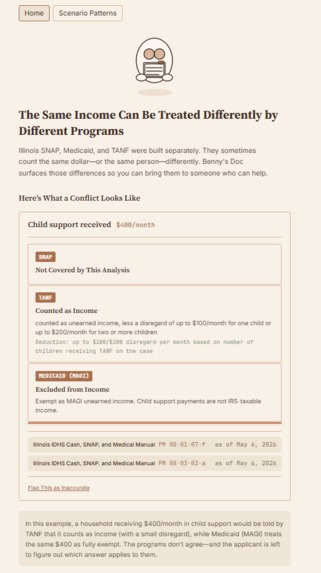
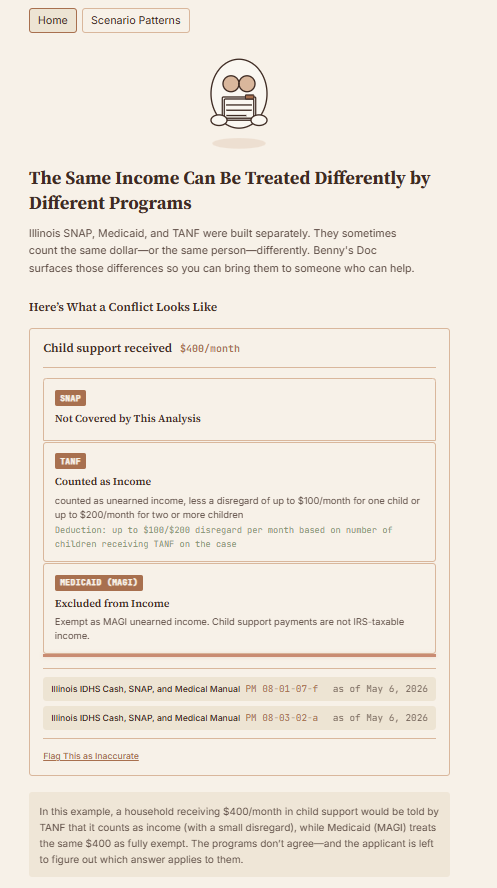
Example of Benny's Doc AI usage--summarizes hardcoded data in a digestible way. Includes sources as well.
-
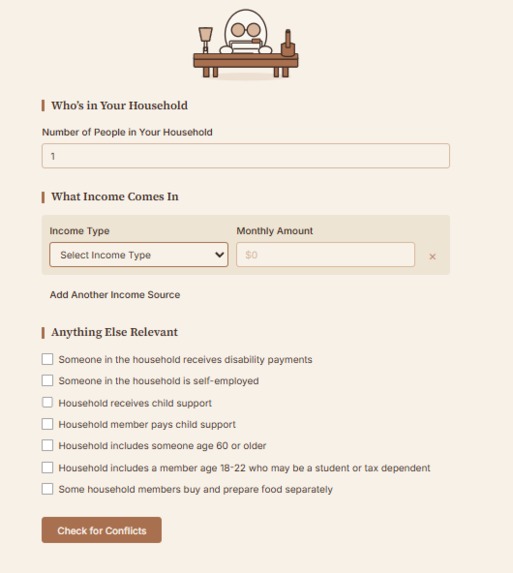
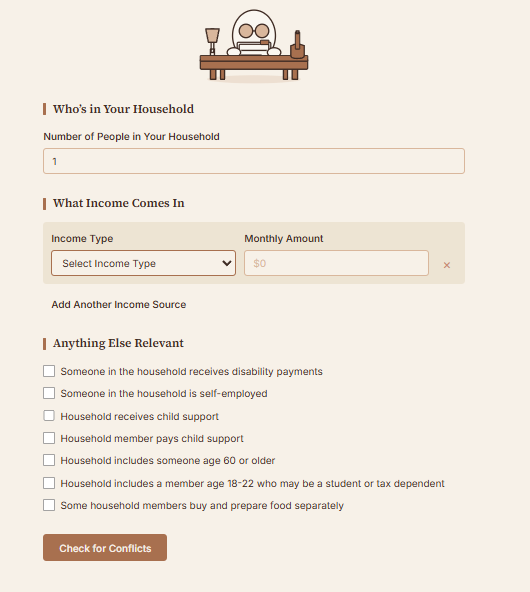
Page where users input their particular circumstance, such as # of household residents, income amount and type, and other relevant info.
-
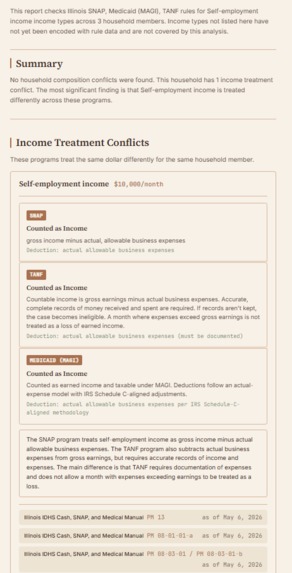
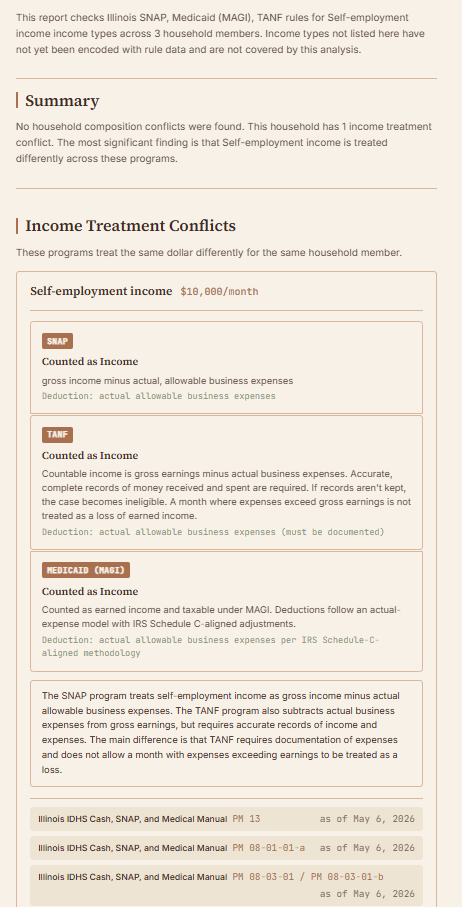
Another example of Benny's Doc AI usage.
-
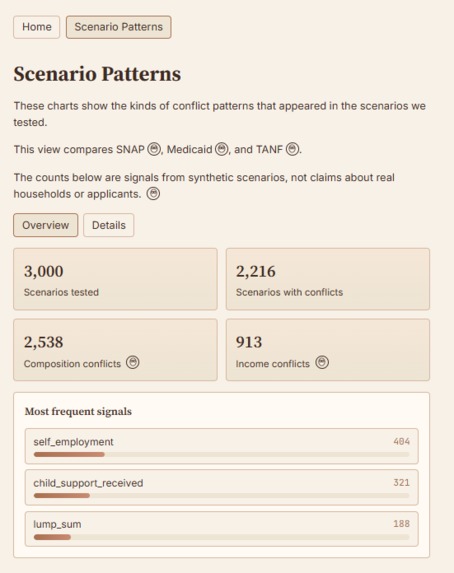
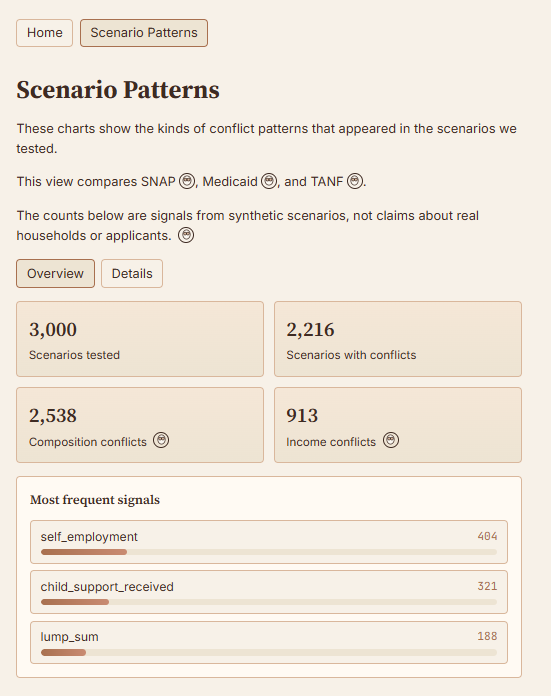
Synthesized pattern scenarios to strongly indicate frequent logical conflicts between benefit types.

Inspiration
I grew up in a working class family, where SNAP benefits served as a big part of our livelihood. I remember one specific time when our benefits suddenly stopped, with no clear explanation or reason. As a 7 year old, all I could do was watch my parents struggle and try to figure out an overtly complex system. The true stress came from the fact that if they couldn't figure this out, it was me, their child, who was at risk.
Years later, I realized just how common experiences like these are. In Illinois, 43.58% of SNAP benefits denials and terminations are later found to be improper. Nationally, this was almost identical at 43.81%. This isn't some case of fraud, but rather a system that built SNAP, Medicaid, and TANF separately, without any resources to readily connect them together. It's a volatile, disconnected system that puts 150,000 Illinois residents who are reliant on SNAP and other benefits in danger, and 41.7 million people monthly nationwide.
As an adult, I wanted to build a tool that my parents never hand and prevent others from the feeling of hopelessness, anxiety, and confusion I felt as a child.
What it does
Benny's Doc checks Illinois SNAP, Medicaid, and TANF against each other for a single household and finds the exact places where their rules disagree. For example, TANF counts child support a family receives as income. Medicaid, under federal MAGI rules, excludes that same dollar completely. Same family, same dollar amount, but two different answers. It gives full transparency for the user, giving the information necessary for them to make their own decision.
Every conflict comes with a plain language explanation and a direct citation to the exact section of the Illinois policy manual it came from, so nothing has to be taken on faith. Information is only ever saved locally, meaning no information goes outside the web application or onto any servers--keeping all information secure. The tool also tests thousands of generated household scenarios at once to show which kinds of income or family situations cause conflicts most often, and it never gives advice or tells a user what to do. It only shows where the system disagrees with itself.
How we built it
The core of Benny's Doc is a deterministic rule engine, not an AI model. Every rule is hand verified against the real Illinois IDHS Cash, SNAP, and Medical Manual, with a citation and a date attached to every single entry. The engine compares a household against all three programs and flags any place where they treat the same income or the same household member differently.
AI only enters after a conflict is already confirmed by the engine. We use the Groq API with Llama 3.3 70B to take the two specific conflicting rules and explain, in plain language, why they disagree. The AI is never given the full rule set and is explicitly instructed not to introduce any fact it was not given.
The app is built with vanilla JavaScript and Vite, with no framework, and is deployed on Netlify. All household data stays on the user's device. Nothing is sent to a server or saved anywhere outside the user's own browser.
Challenges we ran into
The biggest challenge was data accuracy. Illinois publishes hundreds of pages of policy manual covering SNAP, Medicaid, and TANF, and a single wrong rule could create a fake conflict, which would undermine the entire purpose of the tool. We treated every rule as unverified until it was checked directly against the live IDHS manual, and several specific claims we initially had wrong, including a self employment deduction rule that turned out not to exist, were caught and corrected this way before they ever reached the app.
Furthermore, the entire scale of the app had to be minimized. The sheer volume of policy information would take weeks to do by hand, but it's one of the only ways to fully accurately confirm information. As such, the scale was taken down to three major benefit programs, along with only focusing on the state of Illinois. It was difficult having to make this decision, as we wanted to make this tool as accessible as possible--but understanding constraints and feasibility allowed us to create a finished product.
We also hit a real deployment bug late in the build. The app worked perfectly in local development but loaded as a blank page once deployed, because our rule data files lived outside the folder Vite actually bundles for production. Diagnosing it meant learning that local development and a production build can behave completely differently, even when the code itself never changed.
Accomplishments that we're proud of
We're proud that every single rule in Benny's Doc traces back to a specific, dated citation in the real Illinois policy manual, not a guess and not something an AI model invented. We're also proud of keeping a hard line between what the deterministic engine does and what the AI does. The engine finds conflicts. The AI only explains them. That separation means the system can never hallucinate a rule that does not exist.
We're also proud of building something that can act as real evidence. The scenario testing feature ran Benny's Doc against 3,000 generated household scenarios and found that nearly three out of every four contained a real conflict between at least two programs. That is not a small number, and it shows this is not a rare edge case.
Lastly, we are most proud of what we've built. It's an web application meant to support others who are confused, anxious, and lost when it comes to these benefit programs. Our application serves as a stepping stone for people to gain the knowledge and courage to seek further assistance.
What we learned
We learned that good AI reasoning sometimes means knowing exactly where AI should not be involved. The most important design decision in this project was deciding the AI would never be allowed to determine whether a conflict exists or what a rule says, only to explain a conflict the deterministic engine had already proven was real. Not only would having an AI pull this sort of information be potentially illegal, it would also be morally incorrect to carelessly allow AI to possibly give false information to people who are in a truly vulnerable position.
We also learned how much real research a project like this actually requires. Building something trustworthy about a topic like public benefits means treating every claim the same way a journalist would, checking the primary source directly rather than trusting a summary, no matter how confident that summary sounds.
What's next for Benny's Doc
The most immediate next step is expanding towards nationwide coverage. Right now Benny's Doc covers three Illinois programs and a focused set of income types, alienating most of the U.S population. Adding more income types, more household situations, and eventually more states would make it useful and accessible to far more families, as long as every new rule is verified the same meticulous way the current ones were.
We would also like to put Benny's Doc directly in front of real benefits navigators and legal aid organizations, the people who already do this kind of cross program checking by hand every day, and see where the tool actually helps and where it still falls short.
We'd love to work with professionals in this legal area, but also with families who struggle with tracking benefits. It would allow for us to shape Benny's Doc into something far more accessible and useful as a tool for both professionals, organizations, and individuals.
Built With
- css
- groq
- javascript
- json
- local-storage
- node.js
- vite

Log in or sign up for Devpost to join the conversation.