BenefitBridge AI
Inspiration
Government welfare schemes have the potential to improve millions of lives, yet many people never receive these benefits simply because they are unaware of the schemes available to them or find the eligibility criteria too confusing. While exploring different government portals, I realized that information is spread across multiple websites, every scheme has different requirements, and users often spend a lot of time searching without getting a clear answer.
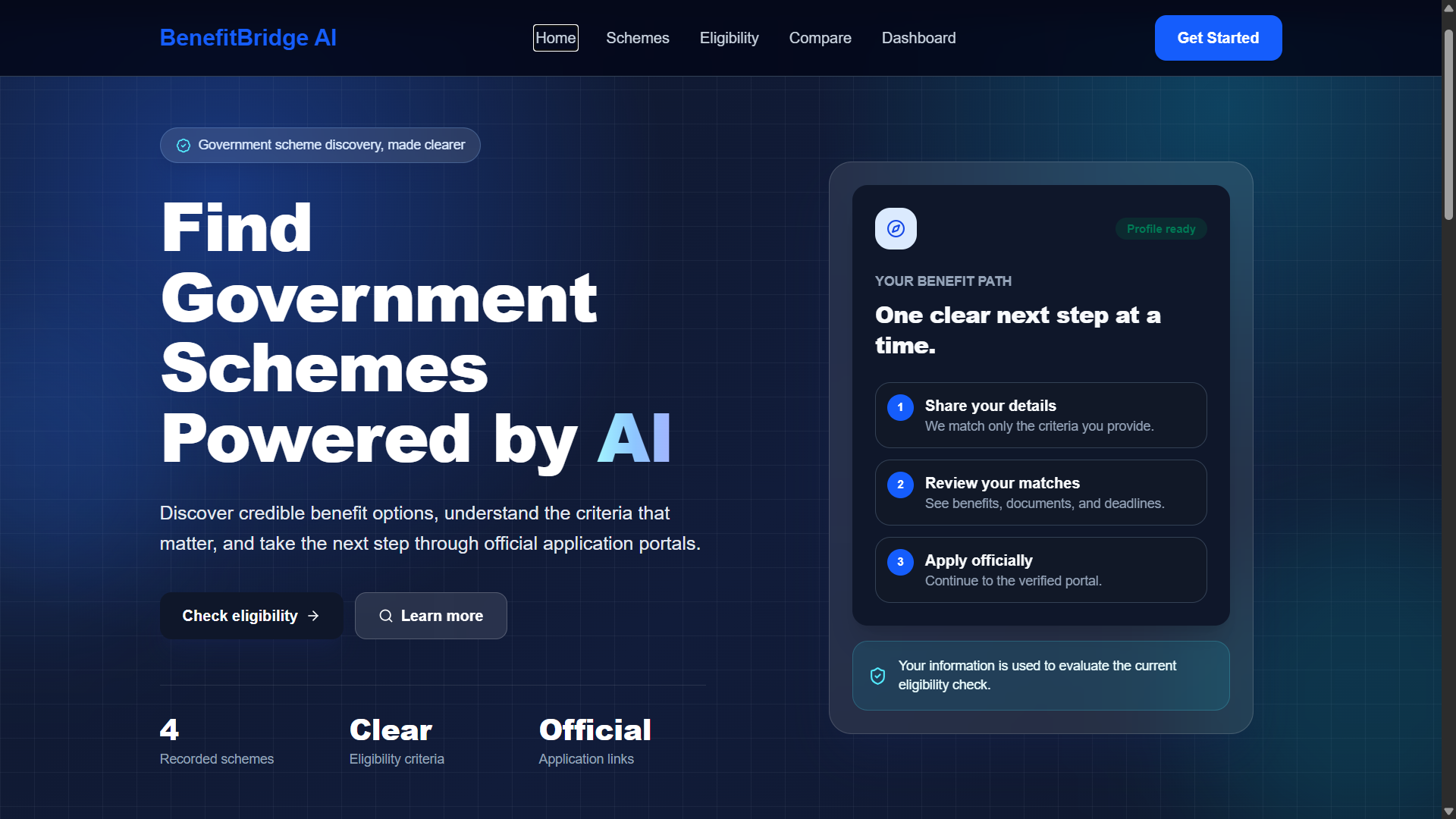
I wanted to build a platform that removes this complexity. My goal was to create a single application where users could simply enter a few personal details and instantly discover the government schemes they are eligible for. Instead of manually searching through multiple websites, they would receive personalized recommendations, understand why they qualify, know which documents are required, and access the official application portals from one place.
The project is focused on making government welfare information easier to access and helping users make informed decisions without unnecessary confusion.
What it does
BenefitBridge AI is an AI-assisted web application that helps users discover government schemes based on their personal profile.
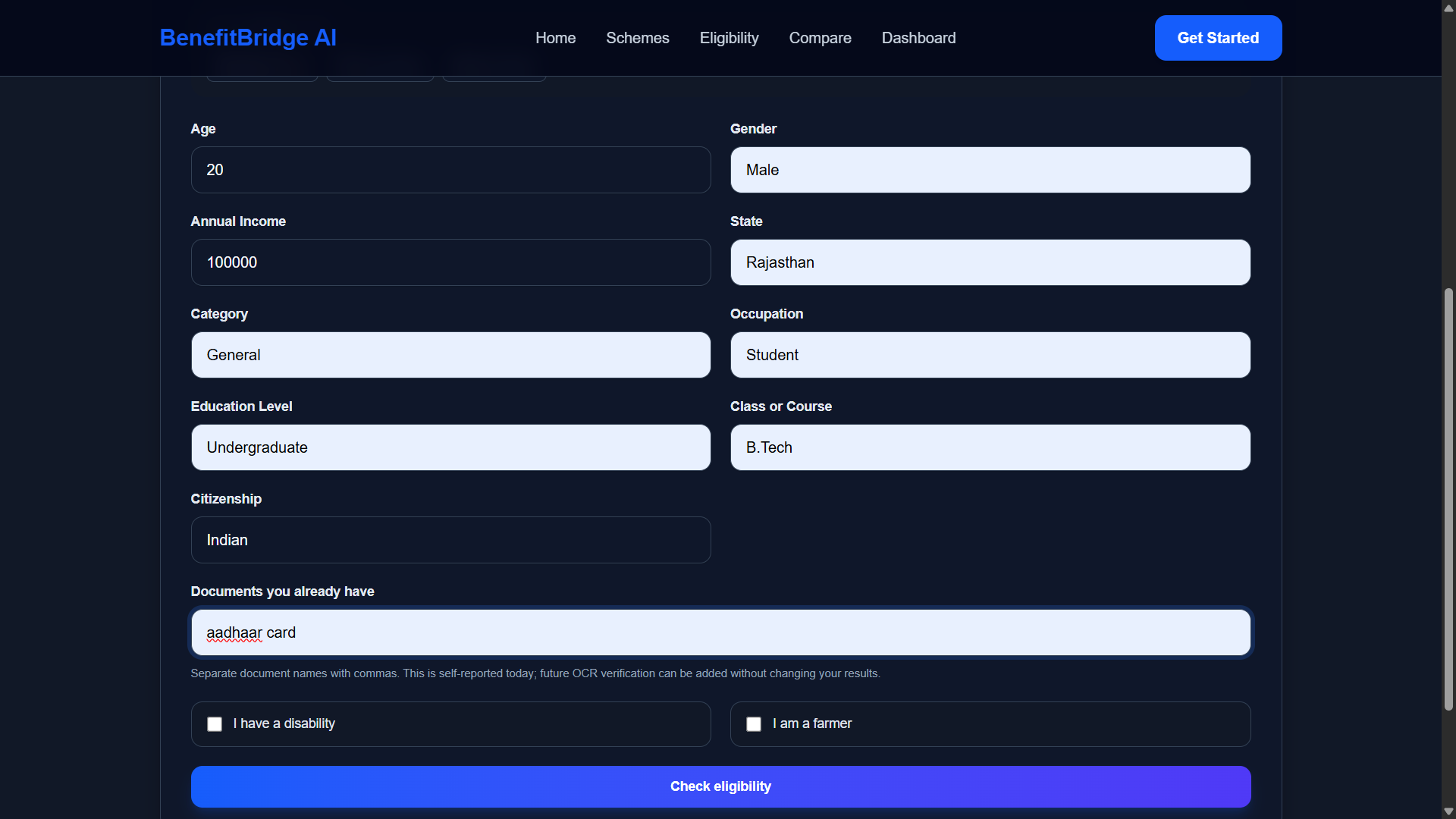
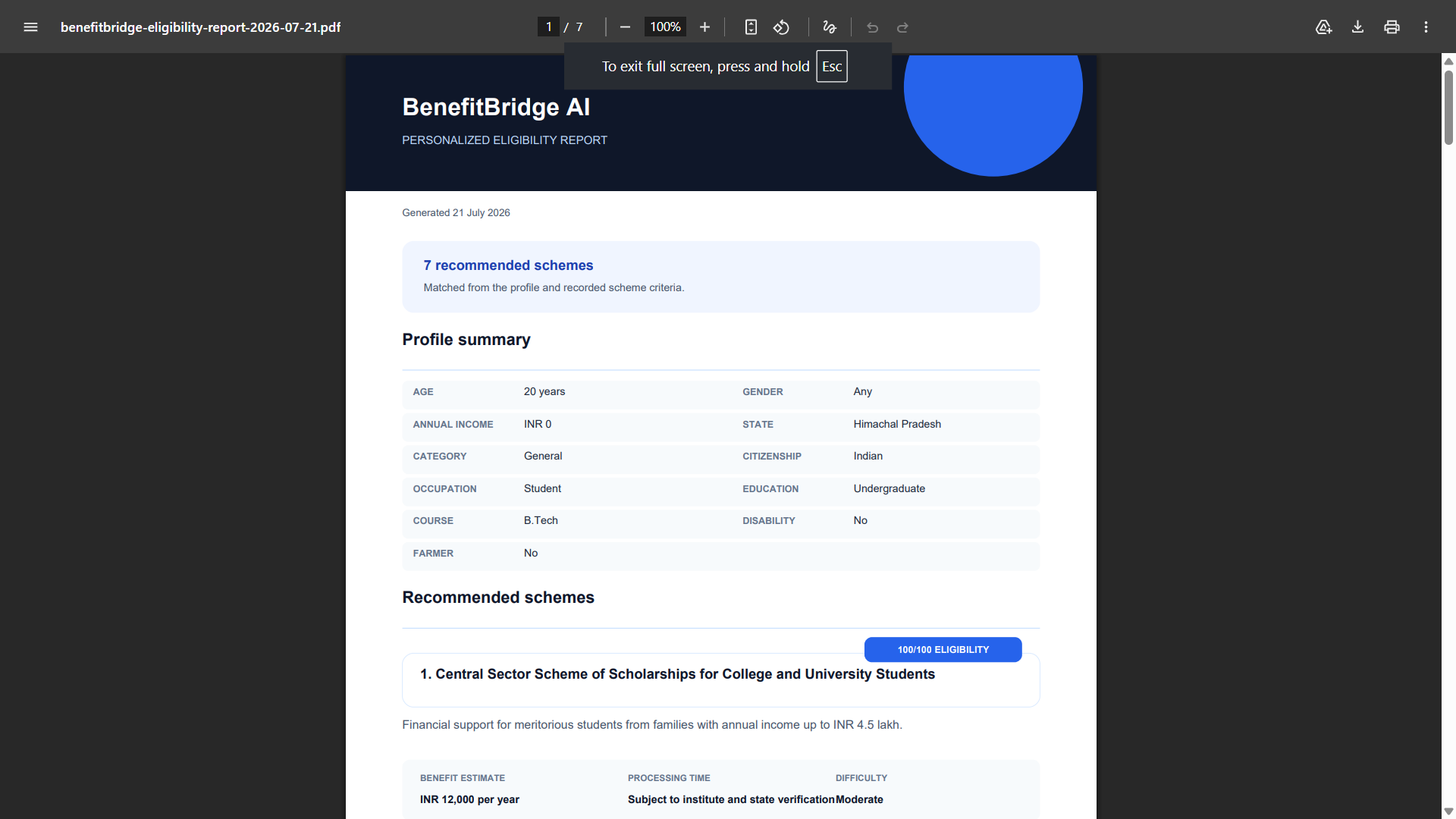
Users enter information such as their age, annual family income, education level, occupation, state, gender, and category. The platform evaluates these details against the eligibility criteria of different government schemes and recommends the schemes that best match the user's profile.
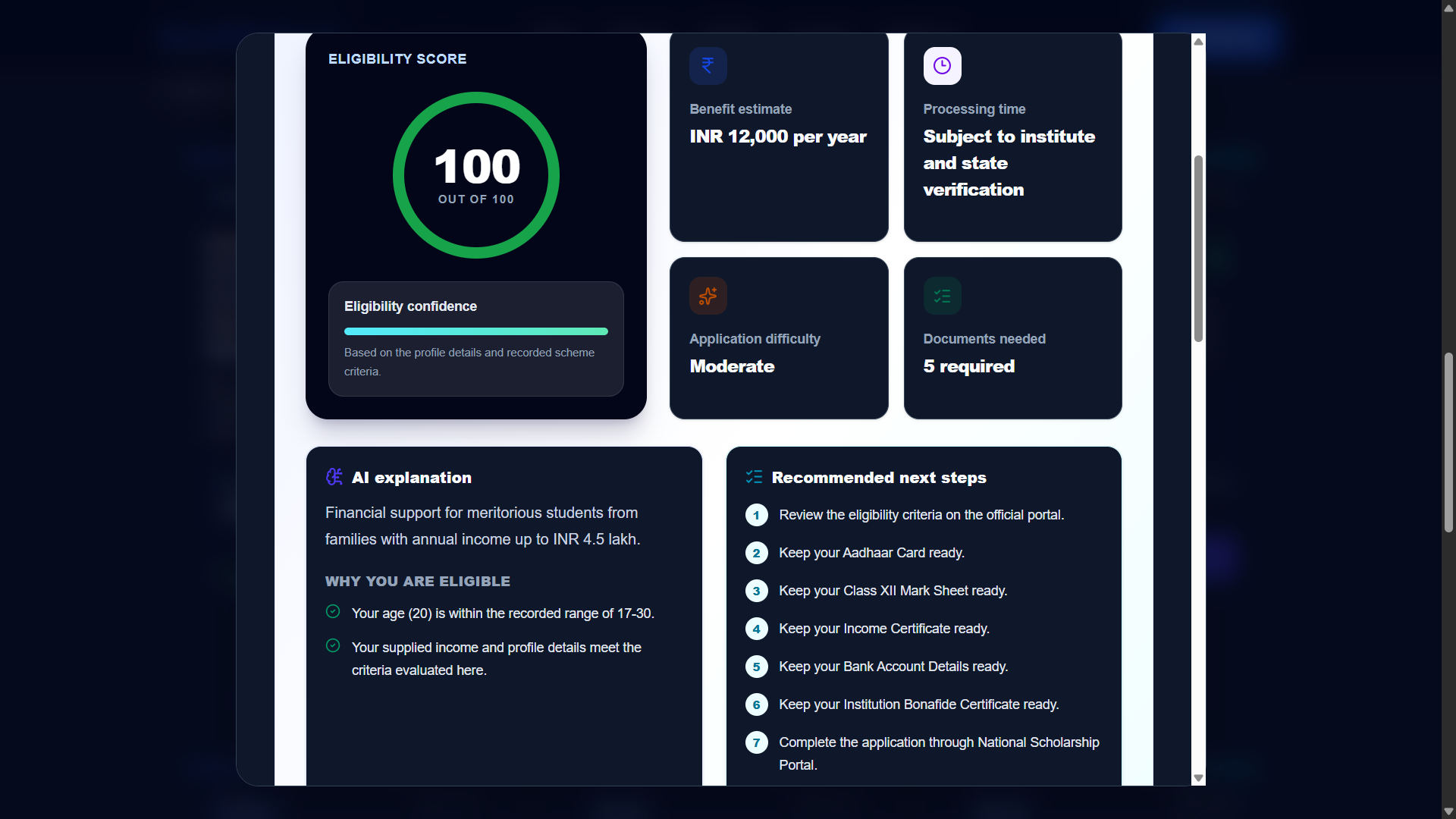
For every recommendation, the platform provides:
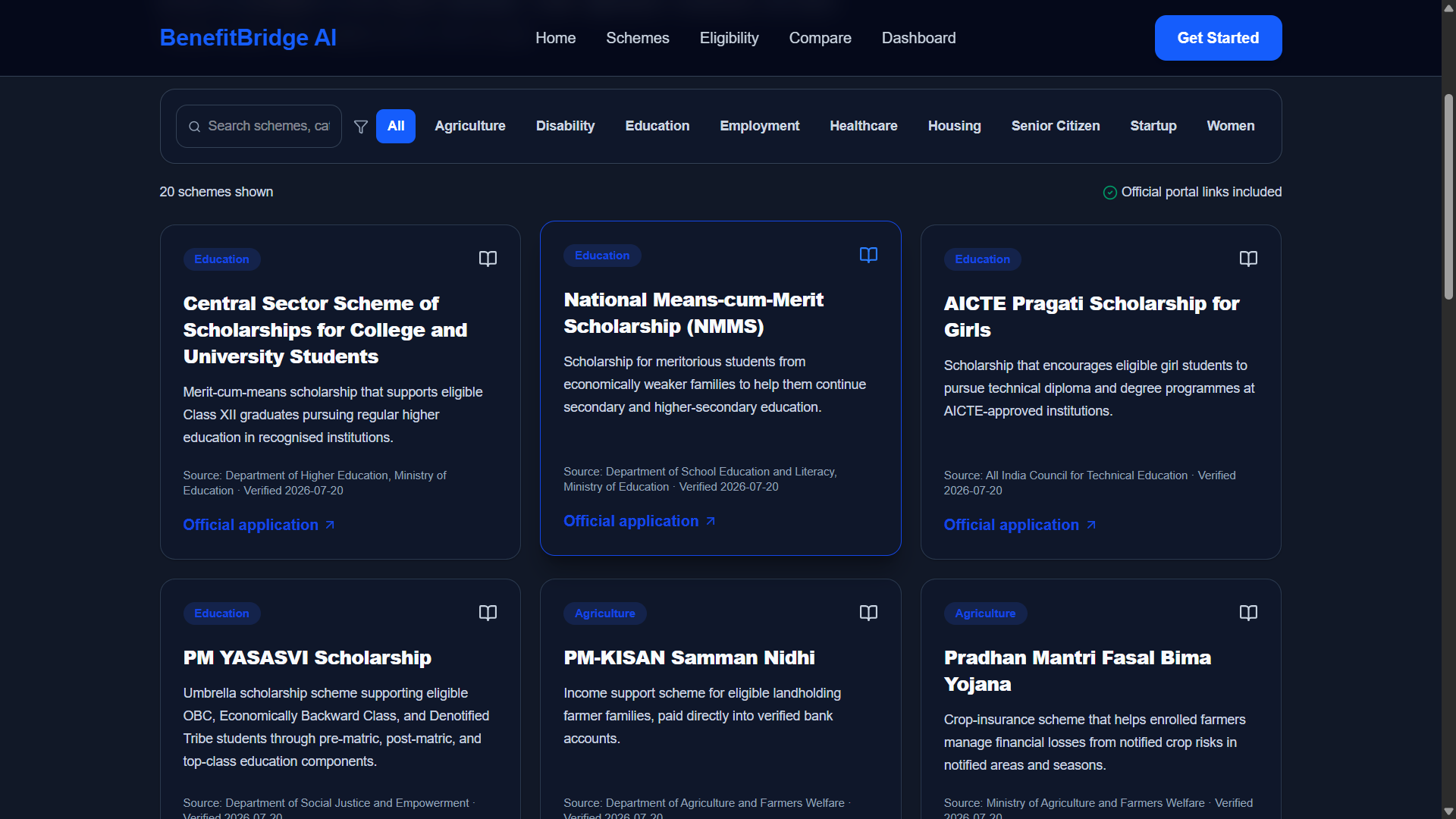
- Personalized government scheme recommendations
- Eligibility information
- Benefit details
- Required documents
- Match score
- Official government application links
The platform also allows users to compare multiple government schemes side by side and generate a downloadable PDF report containing all of their personalized recommendations. This makes it easier for users to review their options and continue the application process using verified government portals.
How I built it
I built the frontend using Next.js, React, TypeScript, and Tailwind CSS to create a responsive and user-friendly interface.
The backend was developed using FastAPI and Python, where the eligibility engine processes user information against a curated dataset of government schemes stored in structured JSON files.
The application architecture is modular so that additional government schemes and categories can easily be added in the future without changing the overall system design.
The project is deployed using:
- Vercel for the frontend
- Render for the backend
Throughout development, I focused on creating a clean user experience while keeping the backend organized and maintainable.
Challenges I ran into
One of the biggest challenges was designing an eligibility system that could evaluate multiple user attributes against different government schemes while keeping the logic organized and scalable.
Another challenge was preparing and organizing government scheme information into a consistent data structure. Every scheme has different eligibility conditions, benefit types, required documents, and application processes, so creating a standardized format required careful planning.
Deployment introduced another set of challenges. I spent significant time debugging frontend-backend communication, configuring environment variables, handling CORS settings, resolving deployment issues on Render, and ensuring that both the deployed frontend and backend worked together reliably.
Since this was a solo project, I was responsible for every stage of development, including planning, UI design, backend development, testing, debugging, deployment, documentation, and preparing the final demonstration.
Accomplishments that I'm proud of
The accomplishment I'm most proud of is successfully building and deploying a complete full-stack application as a solo project.
Beyond simply recommending schemes, the platform provides eligibility explanations, required document guidance, scheme comparison, downloadable PDF reports, and direct links to official government application portals, creating a complete experience for users.
I'm also proud that the project is fully deployed and accessible online with a responsive interface and a clean architecture that can be extended in the future.
What I learned
This project gave me valuable experience in full-stack web development using Next.js and FastAPI.
I improved my understanding of REST APIs, backend architecture, deployment workflows, frontend-backend integration, state management, debugging, and responsive UI design.
More importantly, I learned that building a useful product requires much more than writing code. Understanding real user problems, organizing data effectively, testing carefully, and continuously improving the user experience are equally important.
Working on this project also showed me how AI-assisted development can significantly improve productivity when combined with thoughtful engineering decisions, careful testing, and manual verification.
How I used GPT-5.6 and Codex
OpenAI's GPT-5.6 and Codex played an important role throughout the development of BenefitBridge AI, acting as development assistants rather than replacing the software engineering process.
At the beginning of the project, I used GPT-5.6 to brainstorm ideas and evaluate different problem statements before deciding to build a platform focused on government welfare scheme discovery. It helped me think through the overall project scope, identify useful features for users, and refine the application's architecture into a practical full-stack solution.
As development progressed, GPT-5.6 assisted me in designing the backend structure, planning REST API endpoints, organizing the project into modular components, and improving the overall code architecture. Whenever I encountered technical challenges, I used it to better understand errors, explore different implementation approaches, and debug issues related to FastAPI, frontend-backend communication, deployment, environment variables, CORS configuration, and application setup.
GPT-5.6 also helped me improve the user experience by suggesting interface refinements, improving API responses, reviewing application flow, strengthening project documentation, and helping prepare supporting materials such as the GitHub README, demo video script, and presentation. Throughout the project, it served as a technical advisor that helped me evaluate different approaches before implementing them.
Codex was primarily used to accelerate development. It helped generate boilerplate code, suggest improvements for existing components, review implementations, and speed up repetitive programming tasks. During development, I used Codex while building frontend components, backend services, API routes, data models, validation logic, project organization, and debugging issues that arose during implementation. This allowed me to spend more time testing features, refining the user experience, and improving the overall quality of the application.
Although GPT-5.6 and Codex significantly accelerated development, every feature, suggestion, and implementation was carefully reviewed, tested, modified when necessary, and verified by me before becoming part of the final application. I treated these AI tools as collaborative development assistants that helped me work more efficiently while ensuring I fully understood the final implementation and remained responsible for the project's architecture, functionality, testing, deployment, and final presentation.
What's next for BenefitBridge AI
BenefitBridge AI is designed to be easily expandable, and I have several ideas for future improvements.
I plan to expand the government scheme database with additional central and state government schemes while keeping the information regularly updated. I also want to support multiple regional languages so that more users can comfortably access the platform.
Another future goal is integrating official government APIs wherever available to provide more accurate and up-to-date information. I also plan to improve the recommendation engine with smarter AI-powered explanations that clearly tell users why they qualify or do not qualify for a particular scheme.
Finally, I would like to introduce user accounts that allow people to save recommendations, track applications, receive notifications about newly introduced schemes, and maintain their benefit history, making BenefitBridge AI a long-term digital assistant for government welfare programs.
Built With
- css3
- fastapi
- html5
- javascript
- json
- next.js
- openaicodex
- openaigpt5.6
- python
- react
- render
- restapi
- tailwindcss
- typescript
- vercel

Log in or sign up for Devpost to join the conversation.