-
-
The input
-
architecture
-
Useful official doc links
Inspiration
There are 40 million Americans who qualify for SNAP but never apply. Not because they don't need it. Not because they're ineligible. But because the system was designed to be navigated by lawyers, not by a 20-year-old working a dining hall shift at 2 AM, skipping meals to make rent. We built BenefitBridge for the student who knows something is wrong but doesn't know the words to ask for help. For the single parent who got one document wrong and watched their application die in a bureaucratic black hole. For everyone who's ever thought "I probably don't qualify" and walked away hungry. BenefitBridge doesn't just calculate eligibility — it restores dignity. It turns "I don't know where to start" into "I know exactly what to do." It catches the rejection before it happens, so the only thing standing between a person and the help they need is a caseworker who actually gets to see their application. We didn't build this to win a hackathon. We built it because the system is broken, the data proves it, and fixing it is the only option that matters.
What it does
BenefitBridge is an AI-powered decision-support tool that predicts and fixes rejection points before submission. It turns a system designed to reject into one that actually delivers aid.
The 5-step flow:
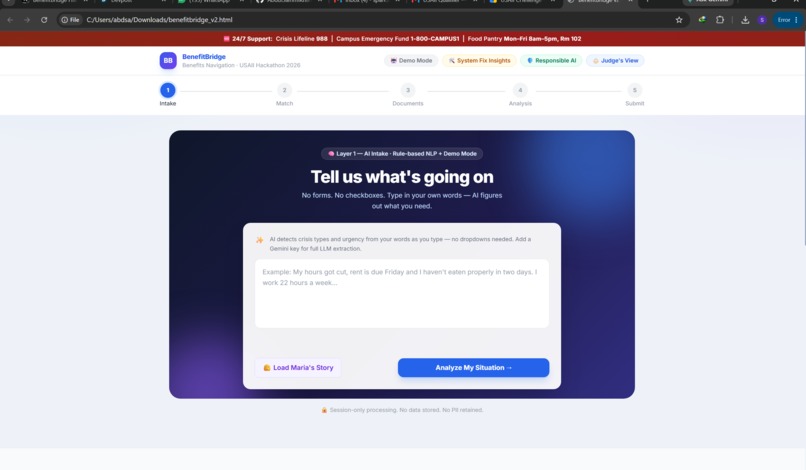
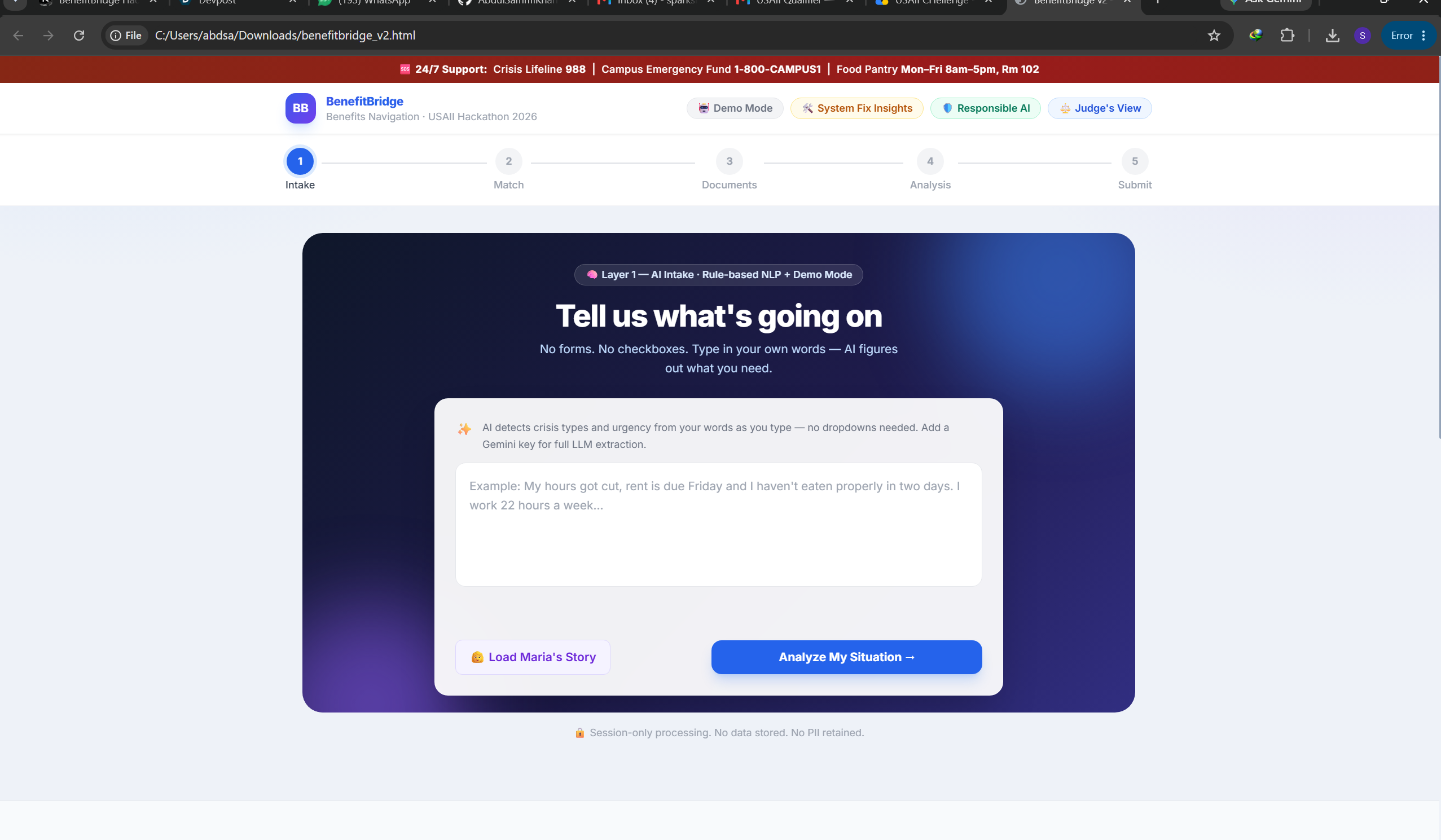
- AI Intake — Student types crisis in their own words ("my hours got cut, rent due friday"). NLP detects needs and urgency.
- Program Match — Hardcoded USDA FY2026 rules check eligibility. The student gate (7 CFR 273.5) runs FIRST.
- Document Upload — AI Vision simulates OCR extraction with confidence scores.
- Rejection Predictor — Rule-derived risk assessment catches procedural errors before submission. Approval probability capped at 92%.
- Human Certification — Two checkboxes required. AI never touches the submit button.
How we built it
Single-file HTML app with Tailwind CSS CDN. Zero backend. Zero build step. Opens with a double-click.
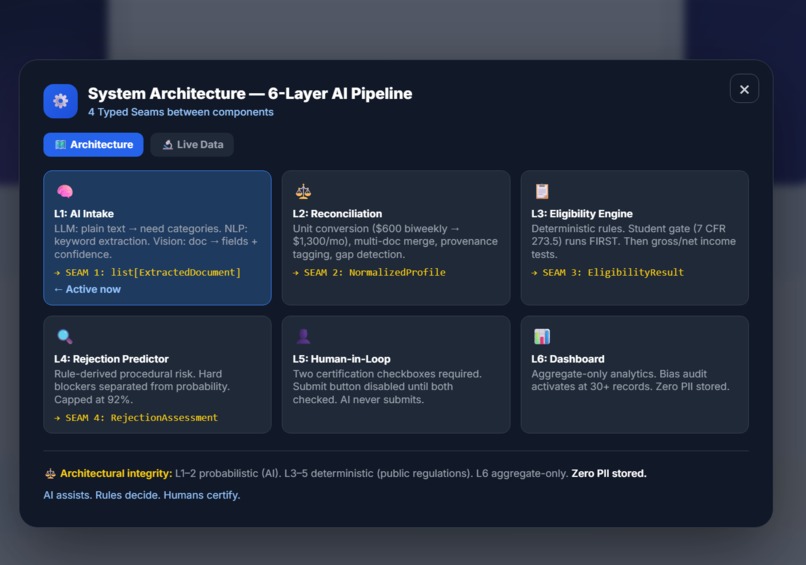
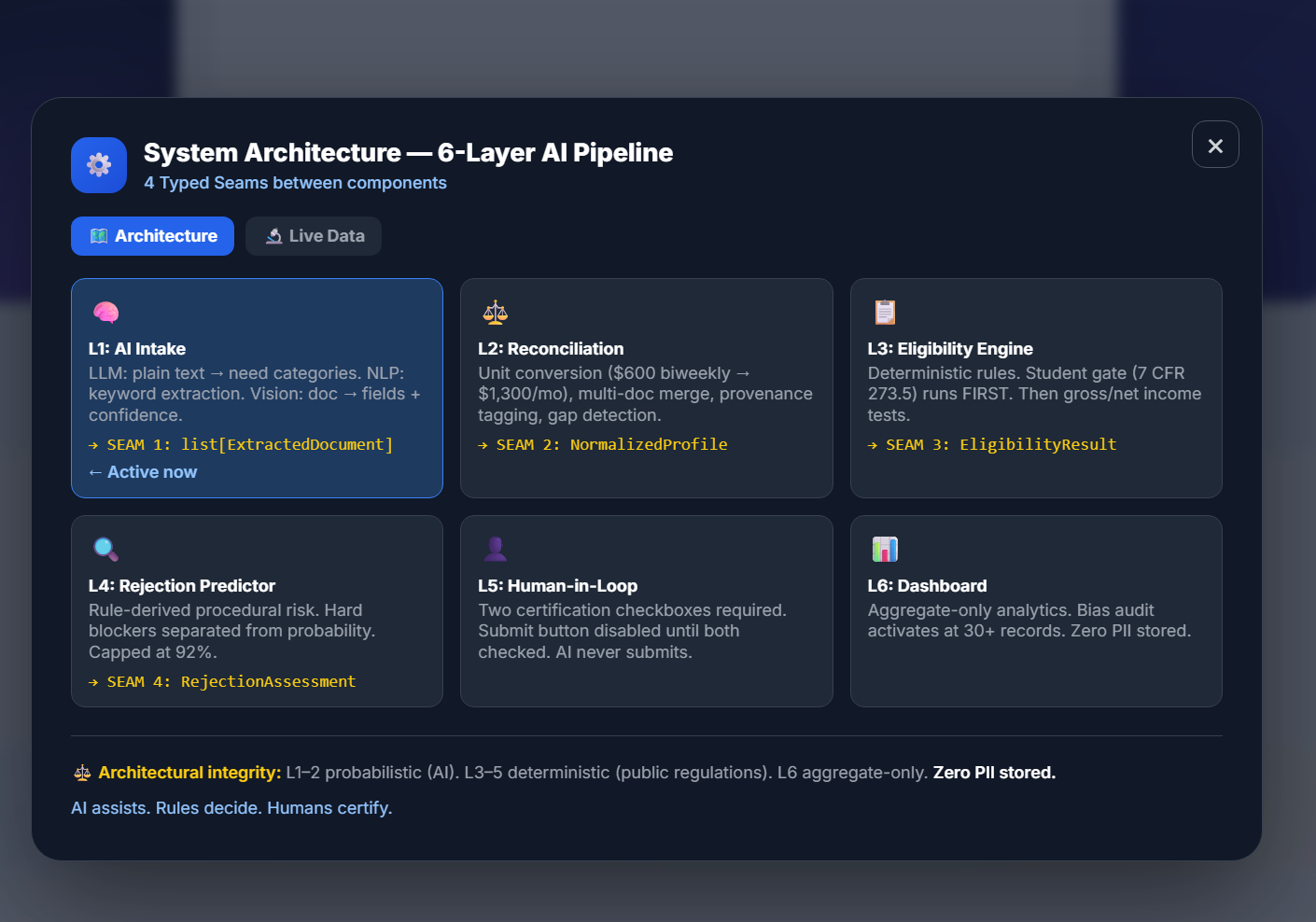
Architecture — 6 layers / 4 typed seams:
- L1 AI Intake → SEAM 1:
list[ExtractedDocument] - L2 Reconciliation → SEAM 2:
NormalizedProfile(unit conversion, provenance) - L3 Eligibility Engine → SEAM 3:
EligibilityResult(hardcoded USDA rules) - L4 Rejection Predictor → SEAM 4:
RejectionAssessment(rule-derived, 92% cap) - L5 Human-in-the-Loop (two certification checkboxes, disabled submit)
- L6 Dashboard (aggregate insights, zero PII)
Challenges we ran into
The biggest challenge was architectural integrity: ensuring the student exemption rule (7 CFR 273.5) ran before any income test. Most benefit tools check income first and miss the hidden exemption that actually unlocks eligibility for students. We built the rule engine with explicit ordering so the student gate always fires first.
Accomplishments that we're proud of
- The Rejection Predictor: Catches a 45-day-old paystub and shows 65% → 92% after fix. Nobody else has this.
- Live Data Inspector: Proves typed seams exist by showing the real
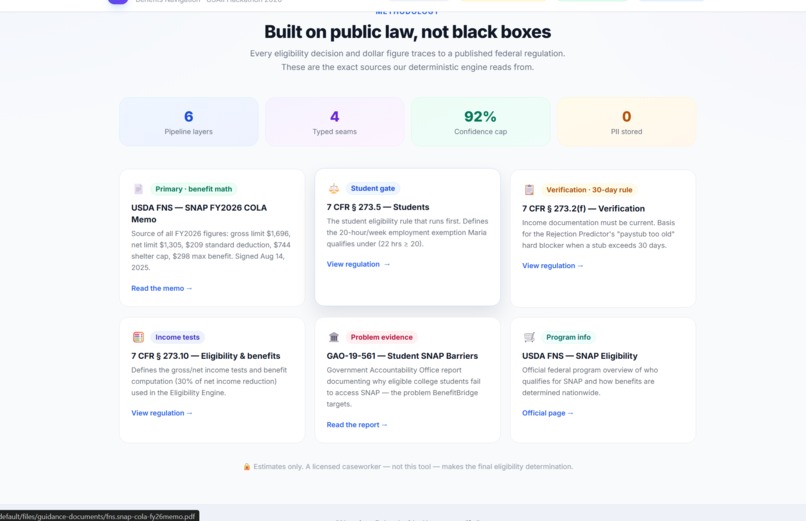
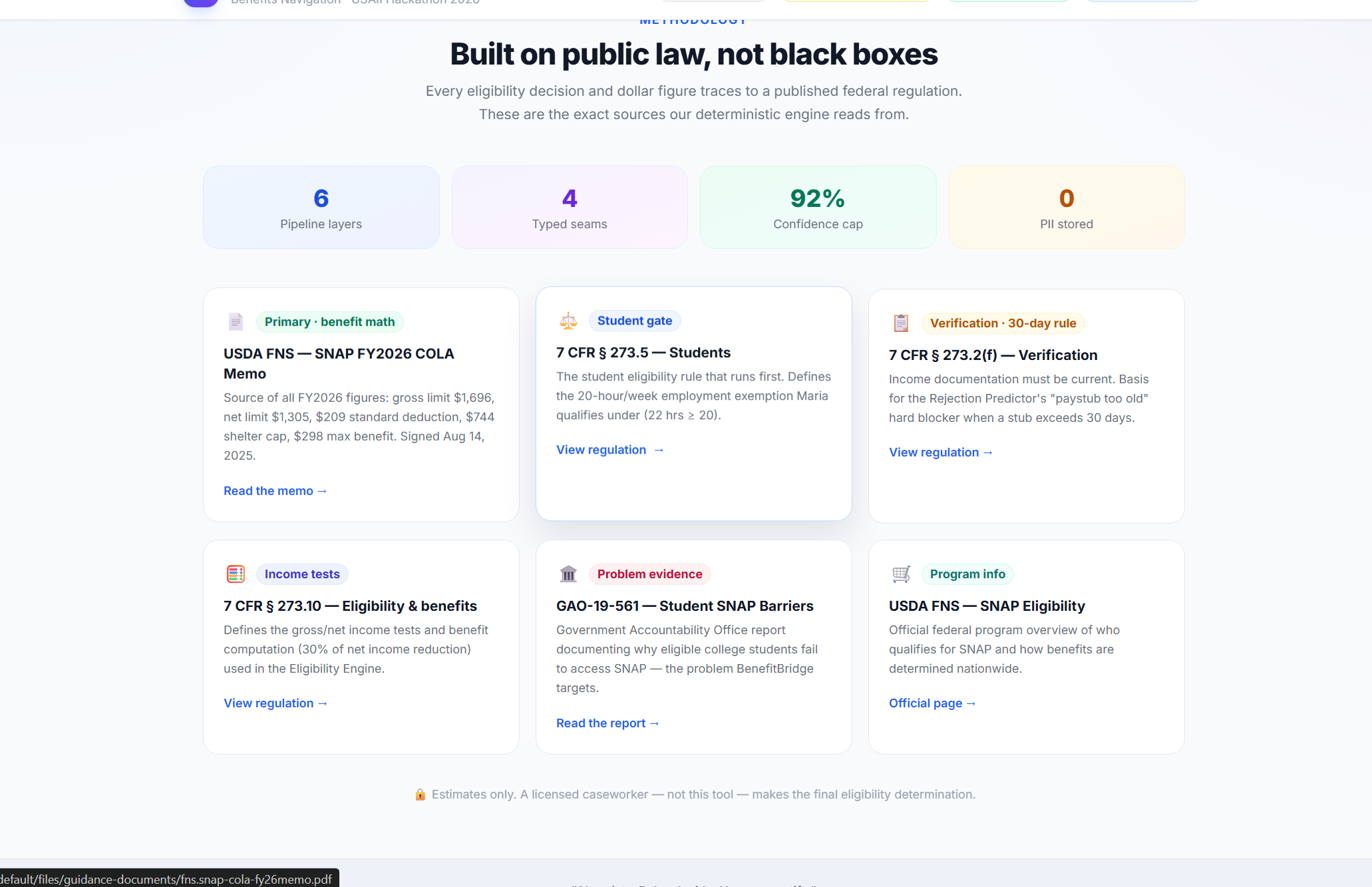
stateobject as JSON at each step. - Verified government numbers: Every dollar traces to USDA FY2026 COLA memo or CFR section.
- Zero PII: Session-only. No server. No database.
What we learned
Hardcoded rules are more trustworthy than ML for eligibility decisions. A language model should never decide whether someone eats. The 92% confidence cap is not a marketing choice — it is an architectural humility buffer for unknown unknowns in bureaucratic systems.
What's next
- Connect to state SNAP portal APIs for real submission
- Integrate with university registrar systems for auto-enrollment verification
- Deploy pilot with campus financial aid offices
- Expand to Medicaid, WIC, and LIHEAP with state-specific rule modules
Built With
- claude-code
- claude-pro
- cursor
- gemini
- html
- javascript
- kimi
- openai-api
- svg
- tailwind-css


Log in or sign up for Devpost to join the conversation.