Inspiration
Every year, benefits people already earned quietly expire: FSA dollars that reset on December 31, a 401(k) match left on the table, PTO forfeited past the rollover limit, credit card that lapse every month. Added up from public sources (U.S. Travel Association, IRS, and the CFPB), that's more than \$100 billion a year in the U.S. alone.
The money isn't hard to get. It's buried in fine print, spread across a dozen portals, and due on different dates you can't keep track of. We wanted to make keeping it feel like more like a fun game instead of doing work.
What it does
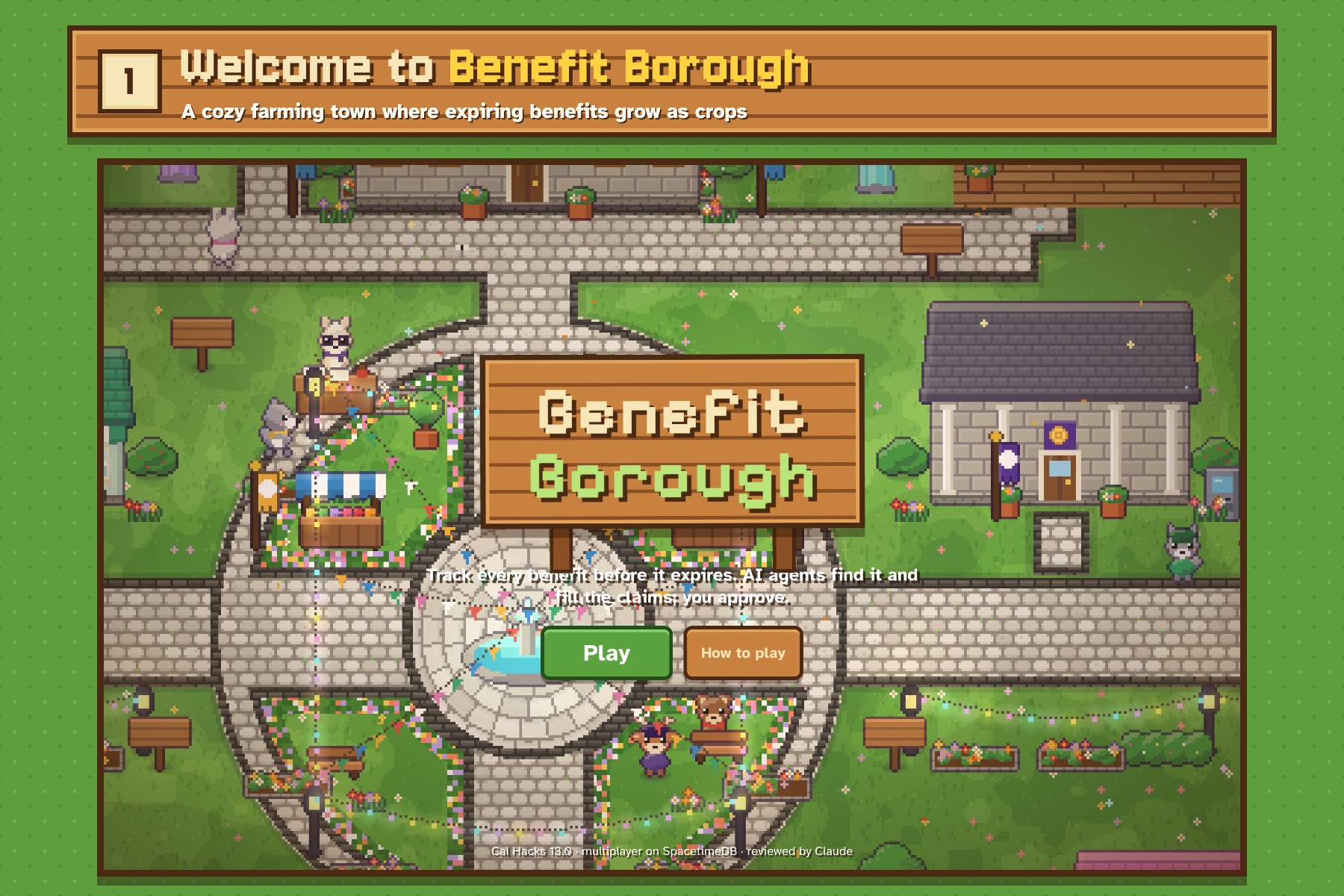
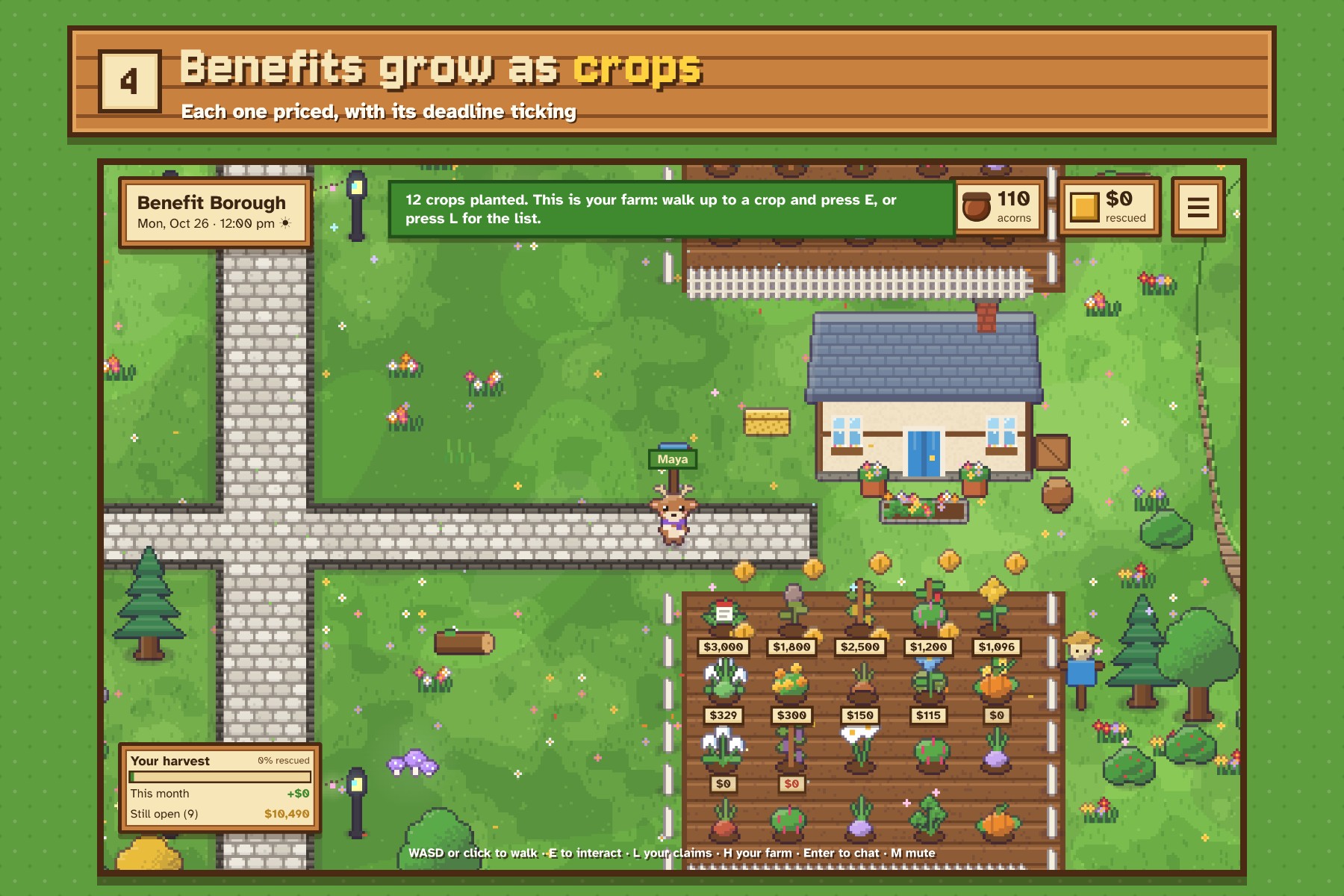
Benefit Borough is a cozy, multiplayer pixel-art farming town where every expiring benefit grows as a crop. The closer the deadline, the more it wilts.
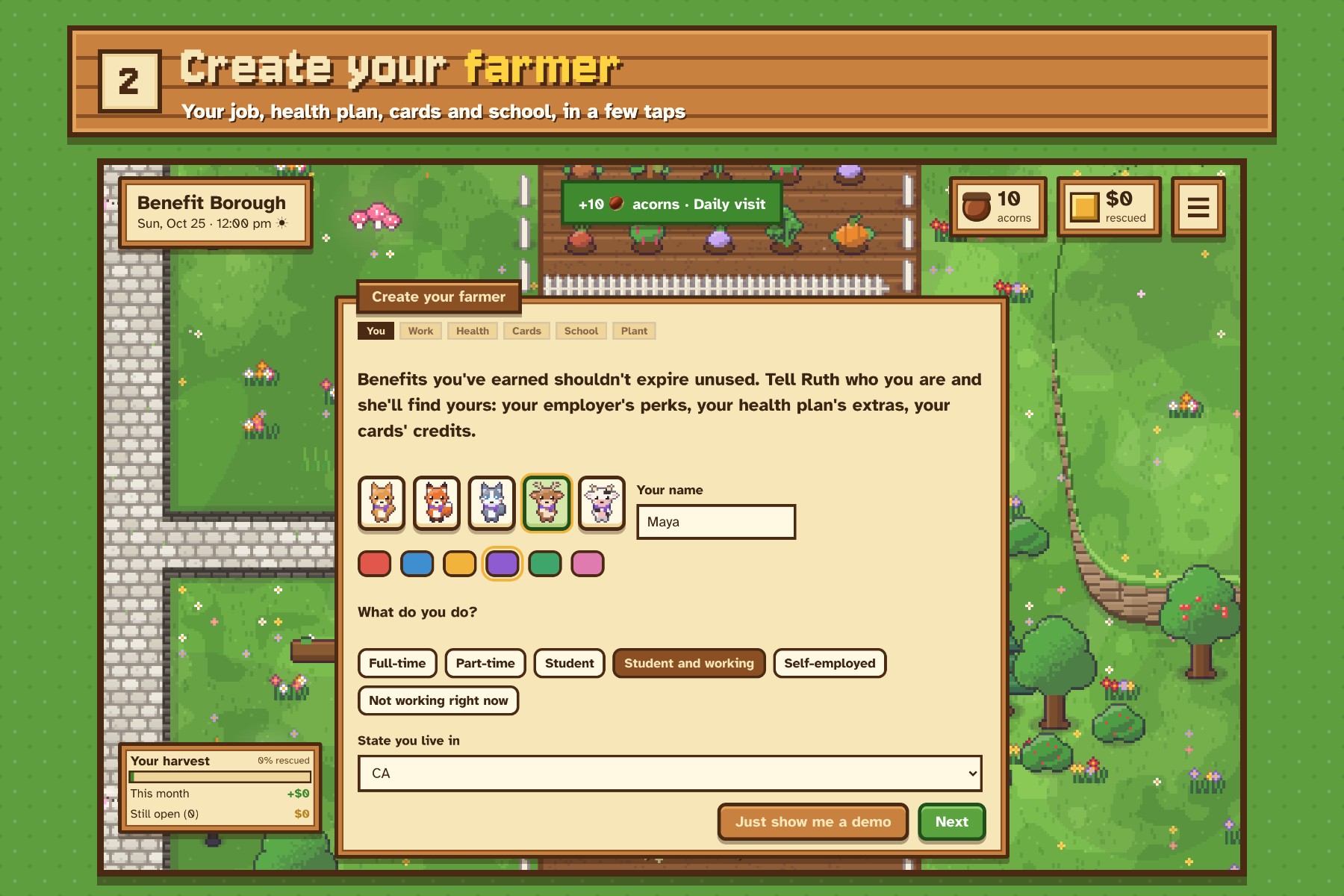
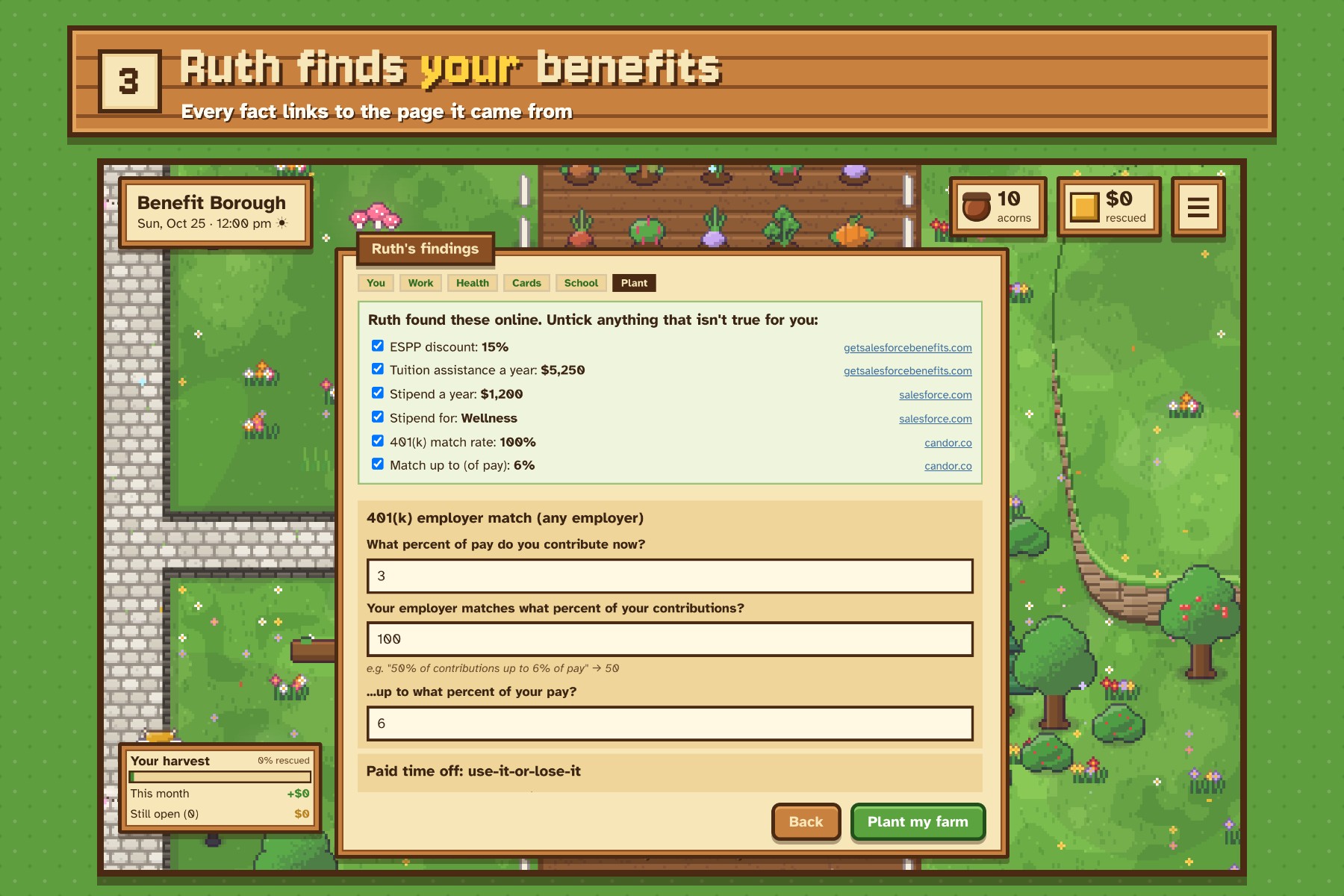
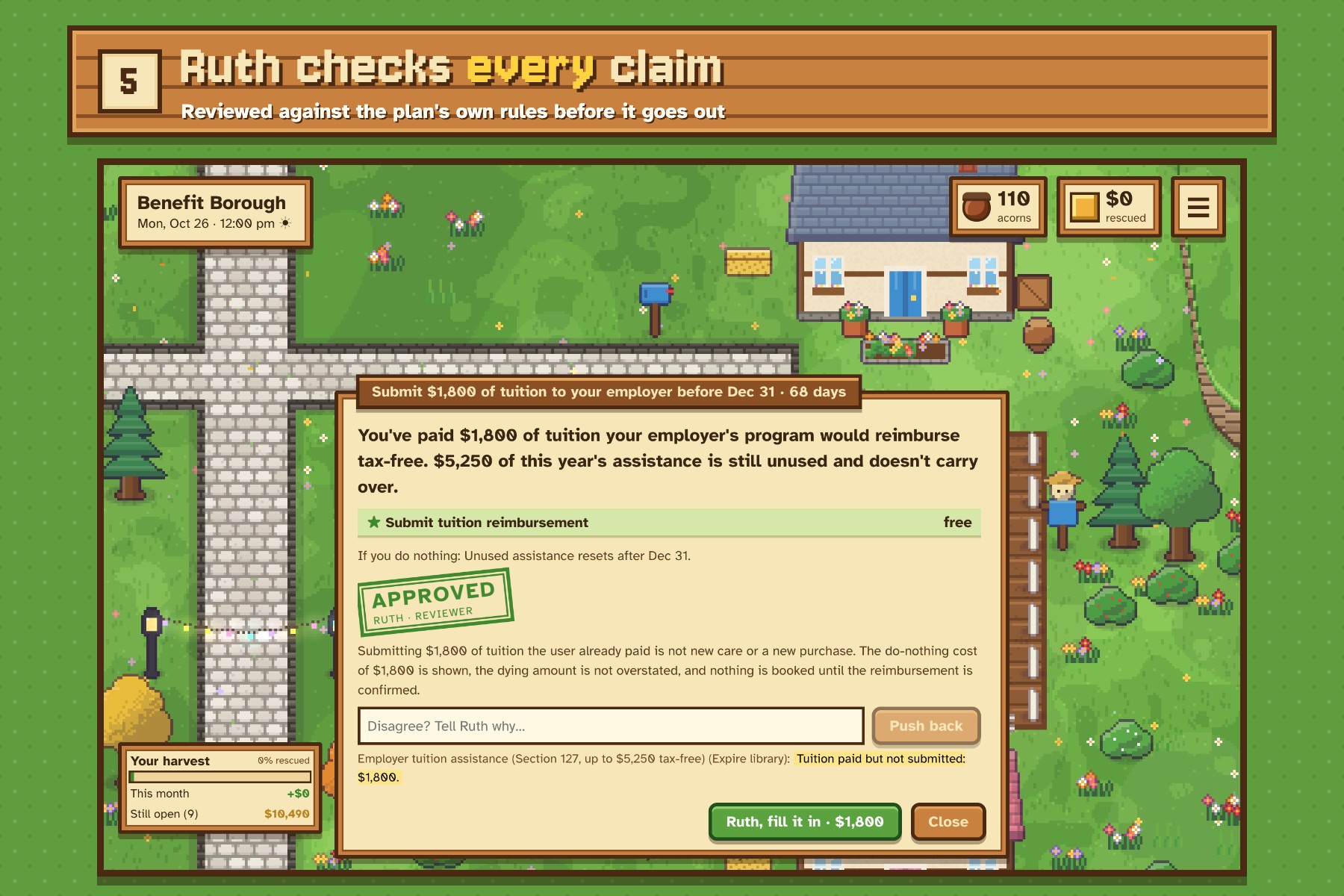
Create your farmer by telling the game your employer, health plan, cards, university, and other miscellaneous details. Ruth, an alpaca in reading glasses who is also the town's AI reviewer, looks up your employer's, insurer's and school's published benefits on the web. Every fact comes back with its source page and an exact quote, and you confirm each one before it's planted.
Plant from 29 sourced plans (401(k) match, PTO, FSA/HSA, stipends, card credits, points and miles, tuition and education credits, FAFSA, etc). Or upload a benefits guide, a statement, or even a photo of one.
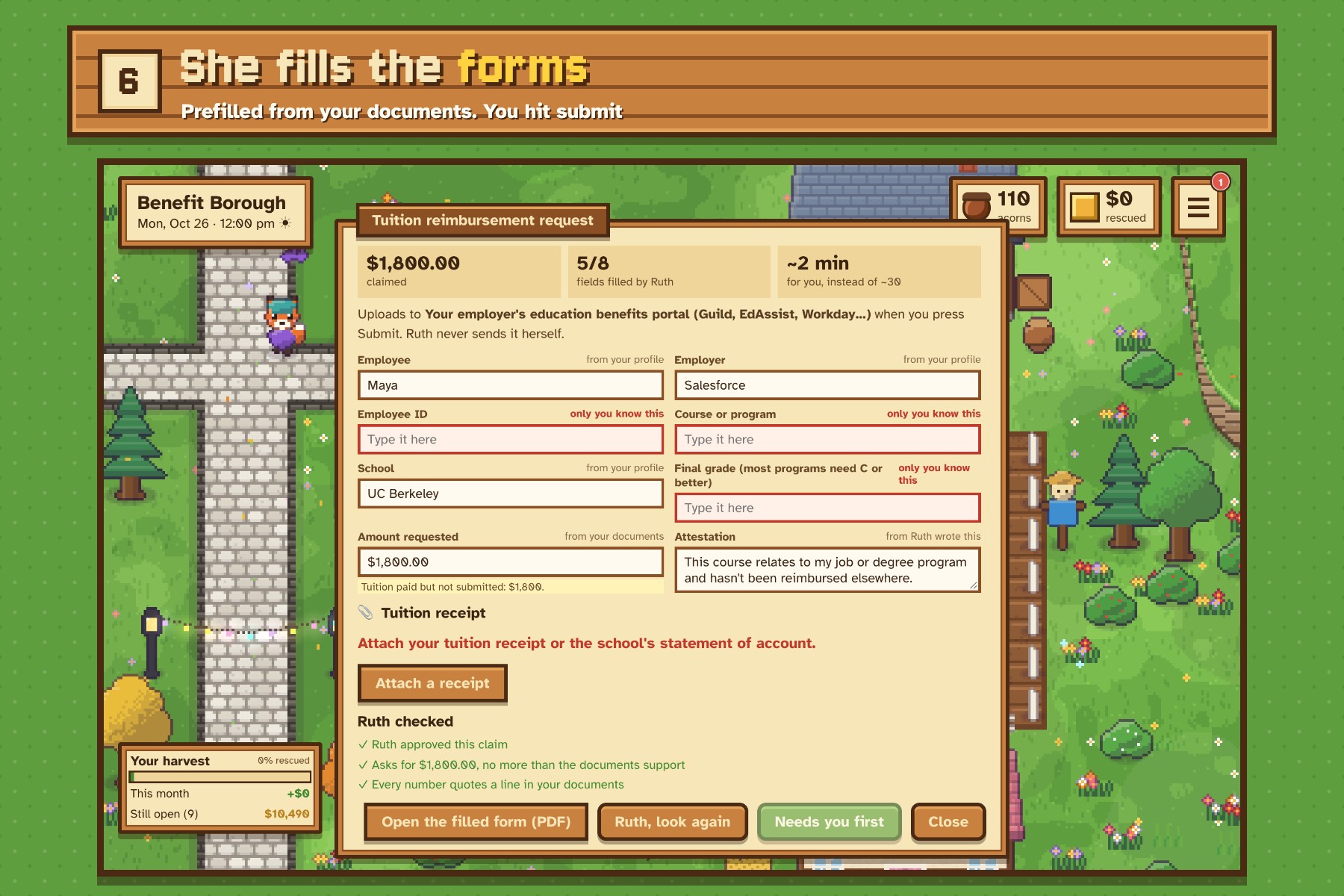
Ruth fills the claim: Our AI agent farm orchestration manager drafts the form (gym reimbursement, tuition, FSA, fee refunds), attaches the matching receipts from your statements, and flags the fields only you can fill. You press Submit; she never sends anything herself.
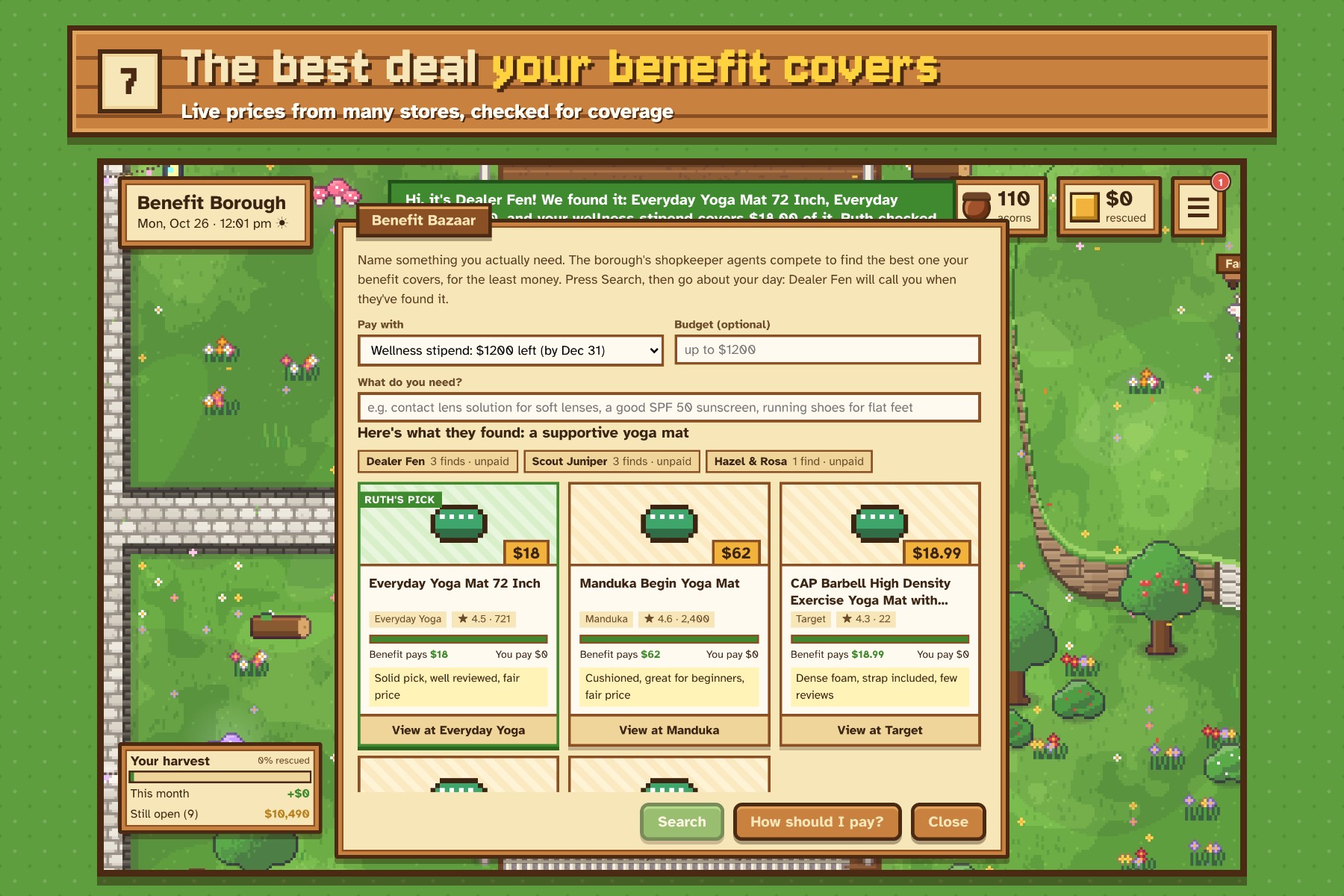
The Benefit Bazaar: Name something you need, for example "a supportive desk chair", and pick an unspent benefit. Shopkeeper agents search live listings from many stores. Ruth checks each offer for coverage, fit and quality, and the shopkeeper calls you when the results are in.
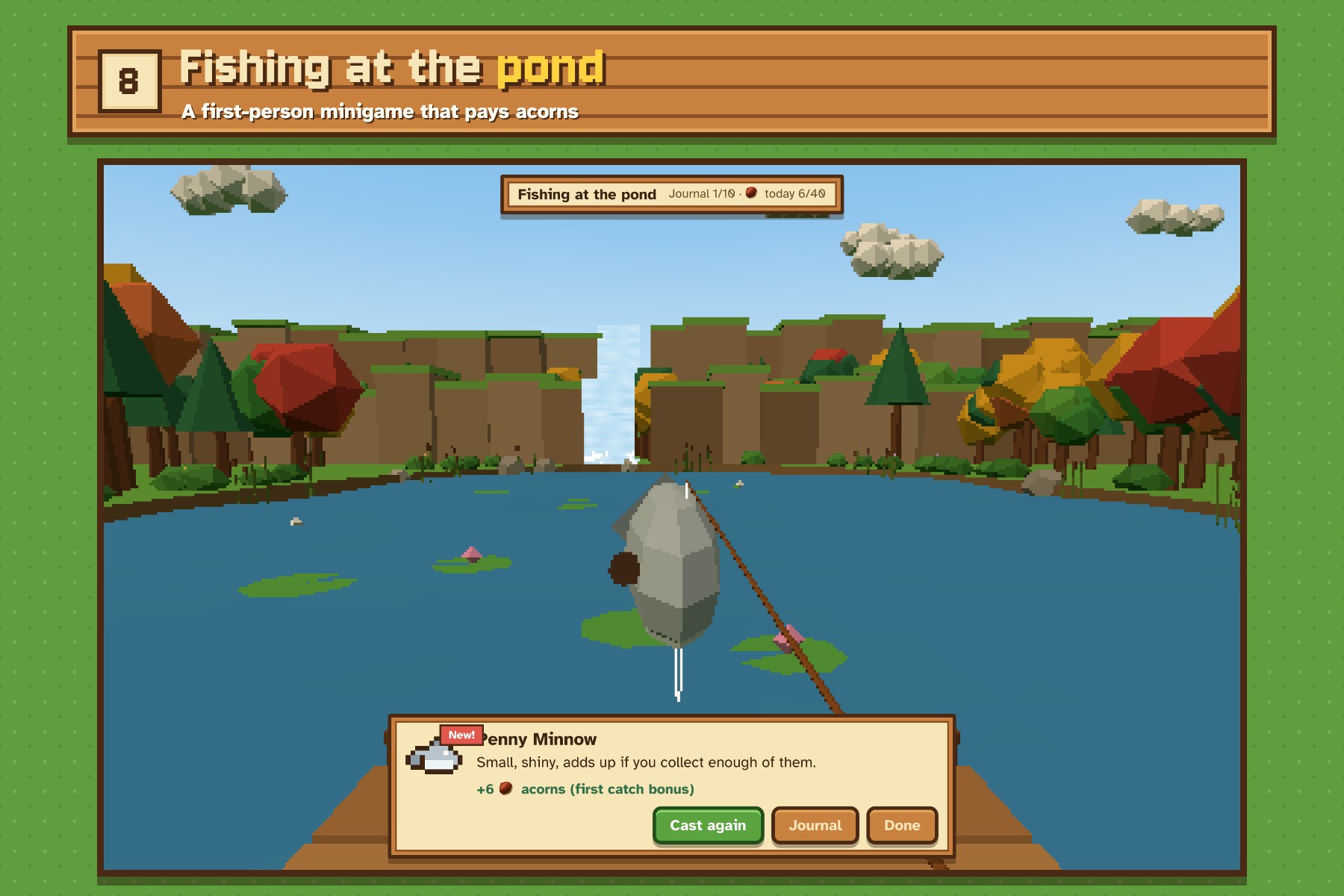
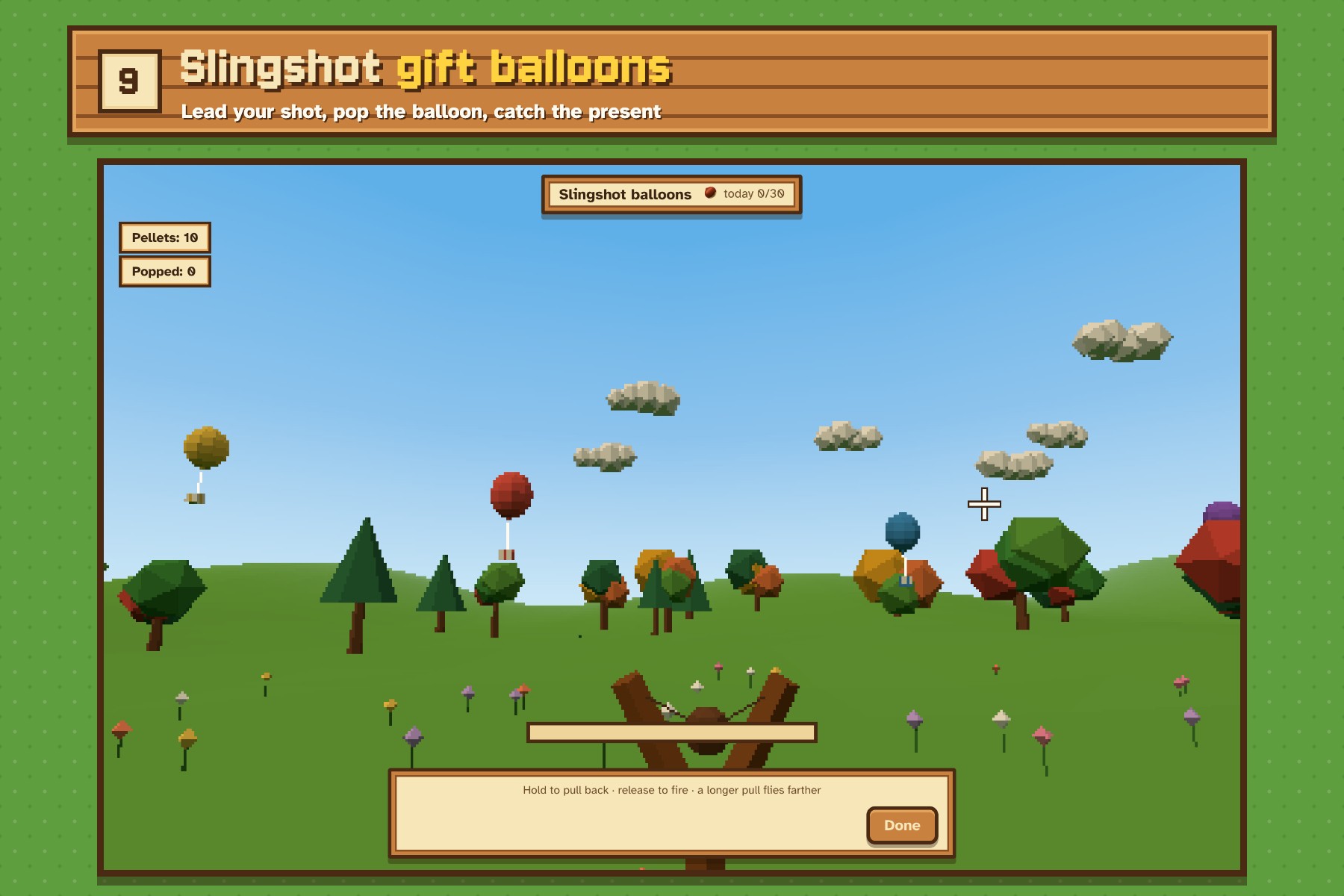
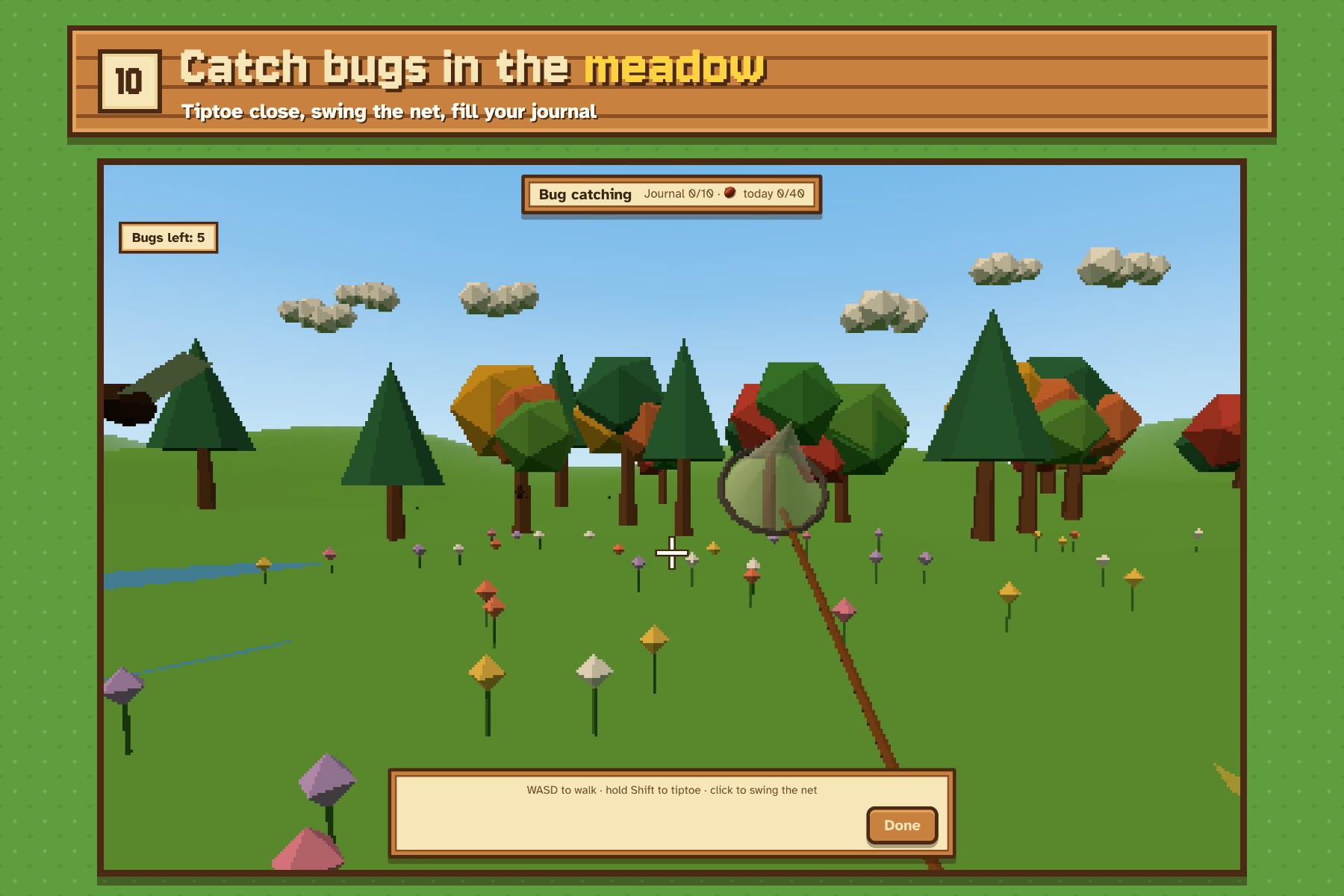
A lively town: Talking villagers with interesting stories that, daily tasks and mini-games with rewards points you can convert to real world prizes, a co-op household, weekly check-ins, and an overnight autopilot that prepares claims while you sleep keeps users engaged with on a regular cadence to check their benefits and get even more value than filing them on your own.
How we built it
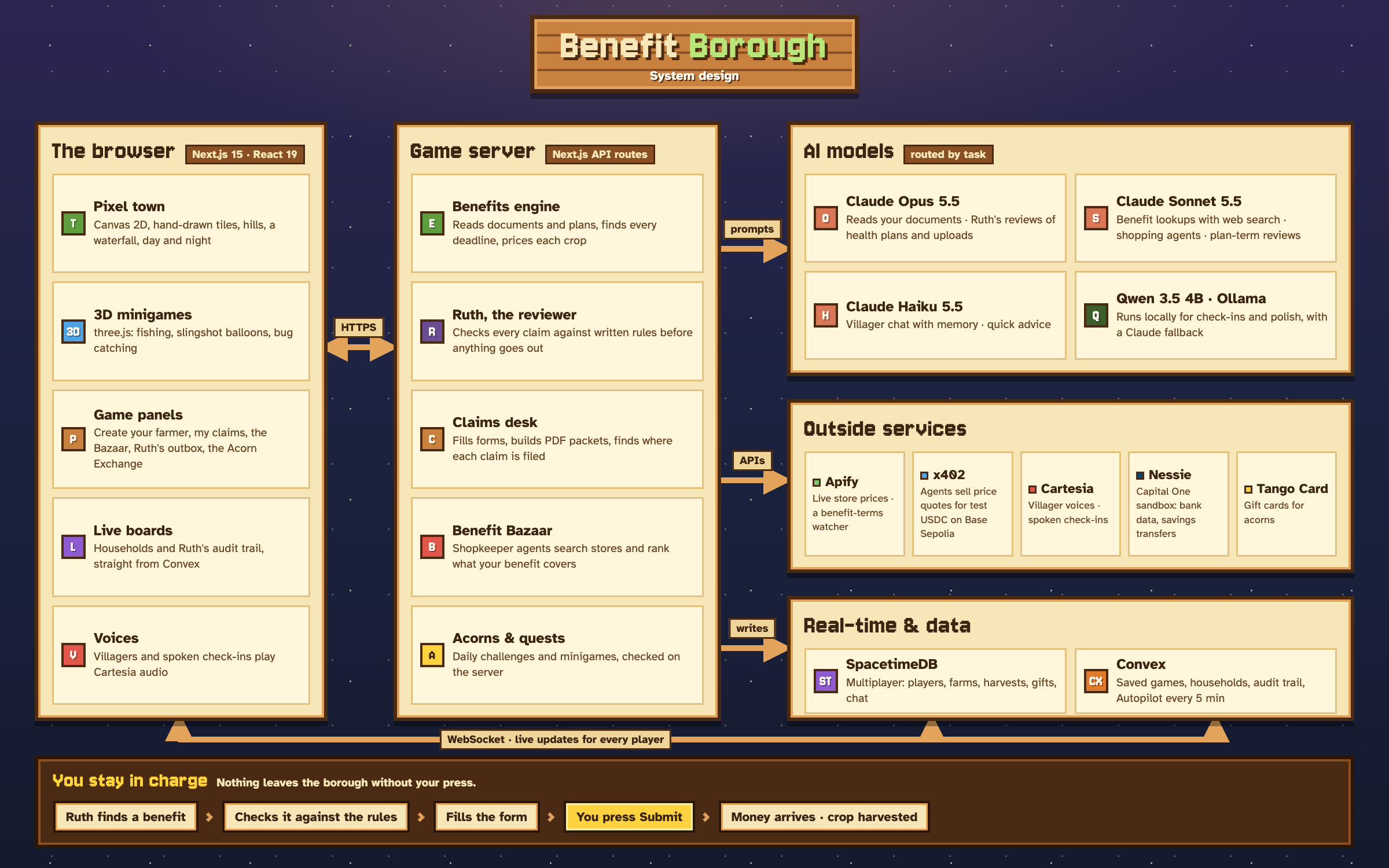
- Next.js + React: the game and its interface, from the town map to the claim forms and shop.
- Canvas 2D: the hand-drawn pixel-art town, villagers and crops.
- three.js: the first-person 3D fishing minigame.
- SpacetimeDB: real-time multiplayer: shared farms, player movement, harvests, gifts and chat.
- Convex: saved progress, shared households, Ruth's audit trail, and scheduled overnight Autopilot runs.
- Claude: the intelligence behind Ruth and the town:
- Opus reads uploaded documents and reviews high-stakes claims, so every number traces back to its source.
- Sonnet powers the shopping agents, routine reviews, and web lookups of your employer's and insurer's benefits.
- Haiku gives each villager a personality for conversation.
- Ollama (Qwen 3.5 4B): a local model for light tasks like polishing claim messages and parsing check-ins.
- Apify: live product listings from many stores, so the shopping agents compare real prices.
- x402 (Base Sepolia): agent-to-agent payments; shopkeeper agents sell their price quotes for USDC.
- Cartesia: villager voices and speech-to-text for spoken check-ins.
- Capital One Nessie: sandbox bank data, and moving rescued money into savings.
Challenges we ran into
Trust depends on every number being right: Every amount the AI pulls from a document must quote the line it came from, or it's discarded. Ruth even rejected our own wording when it sounded like tax advice.
Careful checks made setup slow: Reviewing every benefit with our strongest model took 40 seconds. Now Ruth reads only the relevant document, uses a faster model for routine checks, and remembers past answers.
Search results ignored what each benefit covers: Credits can often be misattributed for example, a lululemon credit returned Old Navy leggings.
A small local model couldn't stay in character: We tried leveraging a small language model for efficient text generation, but it repeated the same greeting every time and didn't have great diversity. We moved conversations to a model that stays in character and gave villagers context about you, so replies feel fresh.
Accomplishments that we're proud of
We turned a chore into a game: Most people never read their benefits fine print because of how dense and boring it is. Here, your benefits have much more user friendly and intuitive interactions, so taking care of it feels like play instead of work.
Human-in-the-loop architecture: Although full automation can be convenient, it can also cause serious problems if untamed. In our application, we built Ruth so she finds the money, fills the forms and shops for you, but nothing is sent or bought without your approval.
Generalizable benefits management: Given the complexity and vast number of benefits to track from employers, health plans, credit cards, travel programs and schools, being able to have it all live in a single interface simplifies the process. Now students, new grads, parents, and professionals all can take advantage of this experience as both an a productivity tool and educational opportunity to learn how to get the most value.
What we learned
Building trust: Gaining user trust is hard but losing it is easy, so building auditable and easy to track systems make it easy for users to trust a tool but also want to adopt it over a complete automation experience that only works sometimes.
Measure before optimizing: The fix for low performance was rarely a bigger or smaller model. It was sending less context and caching what doesn't change.
Building Guardrails: Creating safe environments for agents to explore and create while not taking unexpected actions is a tricky but crucial part of building a reliable agentic application.
What's next for Benefit Borough
Direct submission: Have the application submit to common HR, FSA and insurer portals, so a claim goes from Ruth's draft to filed in one approval.
More plans: State benefits, insurance renewals, more employers' published benefits, and more card and loyalty programs as well as other benefit areas.
Expanding to business partnerships: Given much of the money from these benefits would go unused, incentivizing users to spend it by building partnerships with local and larger businesses to get users preferential deals on the services and items they want is a win for everyone.


Log in or sign up for Devpost to join the conversation.