Inspiration
Scientific figures are evidence. A single protein band in a Western blot can influence how an experiment is interpreted. One of us works in a microbiology wet lab, where Western blots back a huge share of the claims a paper makes. Image duplication turned up in 3.8% of 20,621 biomedical papers even before generative AI (Bik et al., 2016), and paper mills recycle figures across papers. Now AI tools can make a convincing blot in seconds.
We tested Google's SynthID Detector on AI-generated blots. It detected whole AI-generated blots in 10 of 10 test uploads. But an isolated AI-generated band returned “not enough details,” and bands we pasted into otherwise real blots were not detected in four of four tests.
That led us to a broader problem: image manipulation does not always involve generating a new image. The same blot can appear under different protein labels, or a figure can reappear in another paper.
We built Below the Watermark to help researchers and reviewers find those connections and examine the evidence.
What it does
Users upload a scientific image or research paper PDF. The platform:
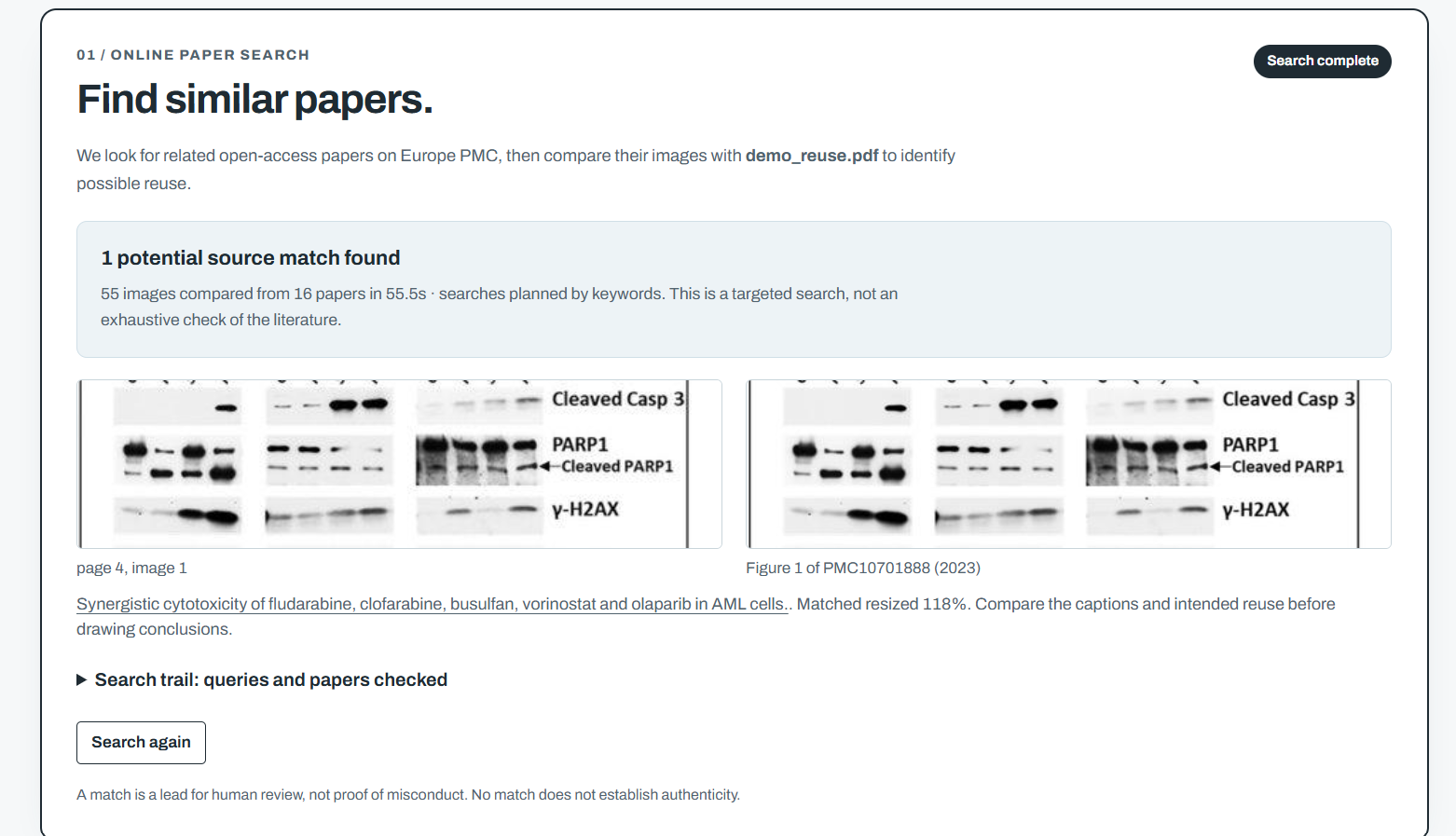
- Automatically searches related papers. A Gemini-powered agent plans Europe PMC searches, retrieves open-access papers, and compares their images with the upload.
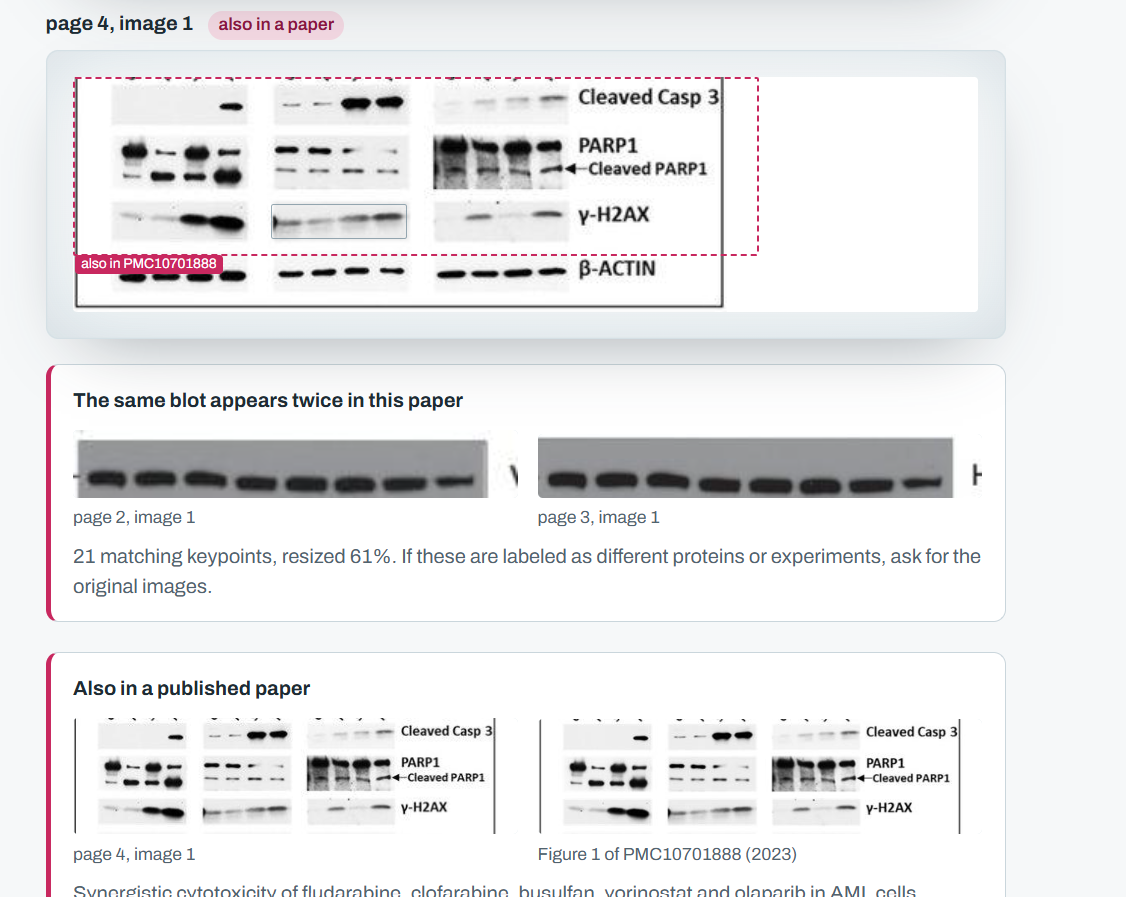
- Finds reuse within a manuscript. It compares extracted images for reused regions, including cropped, resized, re-saved, and mirrored copies.
- Checks published references. Uploaded images are compared against a library of published scientific figures.
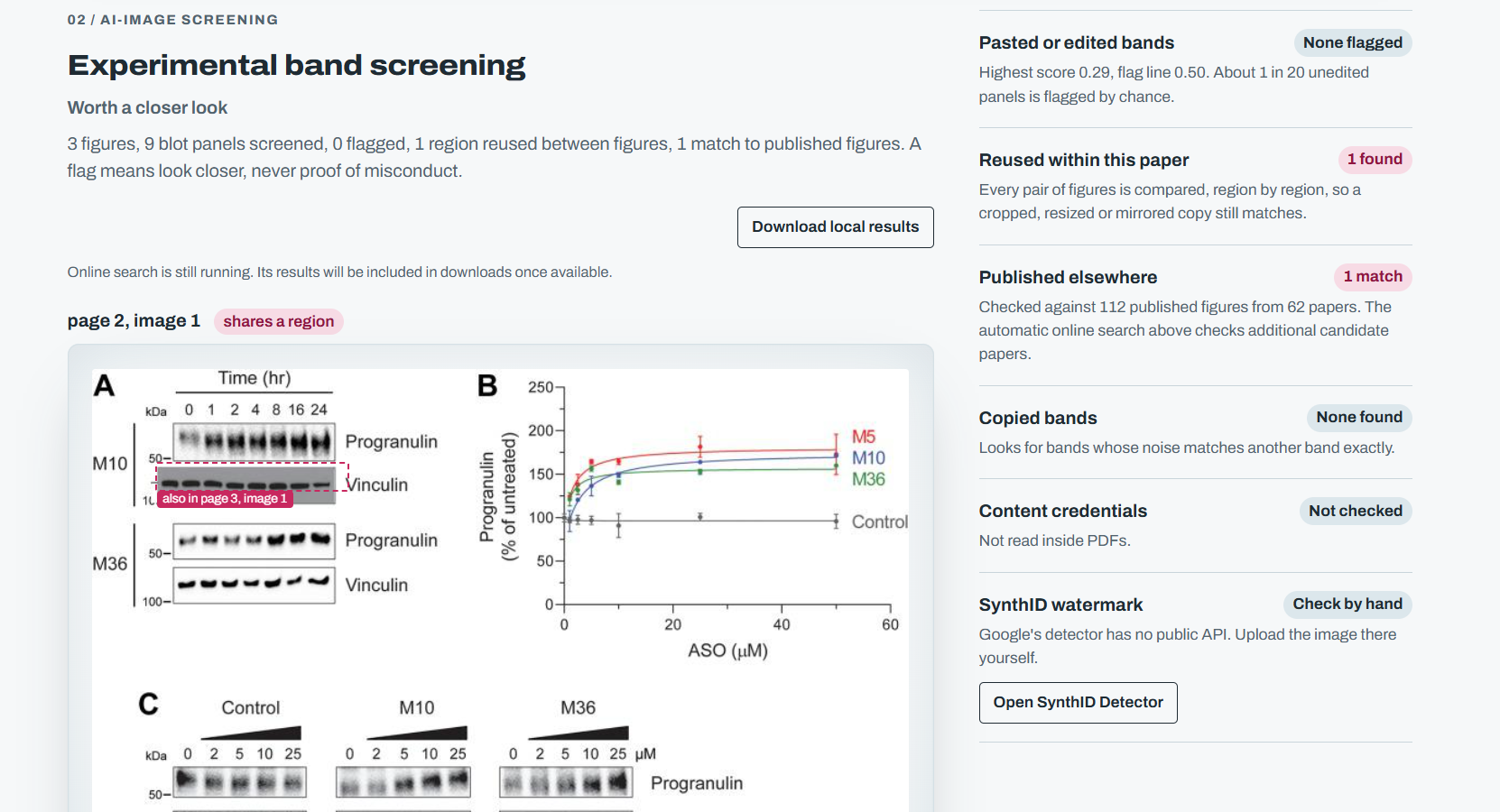
- Examines Content Credentials. It reads available C2PA metadata and reports when a credential declares AI-generated content.
- Screens Western blots. Our experimental V3 CNN flags unusual band regions for closer inspection.
- Exports an evidence report. Reviewers receive side-by-side comparisons, source links, search history, and analysis limitations in a downloadable HTML file.
Matches are leads for human review. Reuse can be legitimate, and a flag does not establish misconduct.
Fresh off the frontier:
Google opened SynthID Detector to the public on October 7, 2026, sixteen days before Gator Hack started. Until then it was waitlist only. It now reads watermarks from Google, OpenAI, NVIDIA, and Kakao, which makes it the closest thing science has to a universal check for AI images. We measured it on the case it wasn’t built for: it caught 10 of 10 whole AI blots but missed 4 of 4 AI bands pasted into real published blots.
The generator on the other side is just as new. Our AI band library was made with Nano Banana Pro (gemini-3-pro-image-preview), released November 20, 2025, and the blots we uploaded to SynthID came from the Gemini app’s Gemini 3 family image tools. So this project pits the newest public defense against the newest generator and shows exactly where the gap is: a single band inside an otherwise real figure.
Gemini is also central to the pipeline itself. A Gemini Flash agent reads the manuscript, plans the Europe PMC searches, and found the source of a lifted figure after checking 4 papers, versus 16 papers for keyword search.
Results at a glance
- SynthID Detector: flagged 10 of 10 whole AI blots, but missed 4 of 4 AI bands pasted into real published blots.
- Duplication: found 110 of 118 reused blot or microscopy blocks (93%), with 0 false matches across 7,140 pairs of untouched published figures.
- Search agent: found the 2023 source of a lifted figure after checking 4 papers, versus 16 papers for keyword search.
- Band CNN (baseline): AUROC 0.703 on 72 held out papers. A flag is a lead for human review, never proof.
How we built it
We used Python and FastAPI for the backend and React for the interactive website.
Our OpenCV matcher combines SIFT keypoints, geometric alignment, and pixel verification. The same comparison method runs within uploaded papers, against our reference library, and on images retrieved by the search agent.
Gemini interprets manuscript context or figure labels and proposes literature searches. The agent retrieves candidate papers through Europe PMC, recording its queries and the papers checked. Keyword planning provides a fallback when Gemini is unavailable.
We use PyMuPDF to extract embedded images from PDFs and C2PA tooling to examine available credentials. SynthID testing was performed manually.
For band screening, we trained a small JAX CNN on real Western blot panels from openly licensed papers and simulated manipulations. We created the edits ourselves and split the dataset by paper to separate training and evaluation.
The deployed model is V3, an experimental proof of concept.
Our team brings together Computer Science and Microbiology, Electrical Engineering, Biomedical Engineering, and Marketing.
Challenges we ran into
Distinguishing copies from look-alikes: Scientific figures share fonts, labels, and chart templates. Masking text-heavy regions and verifying aligned pixels helped prevent unrelated figures from matching.
Finding small reused regions: A reused panel can occupy only a small part of a busy figure. Removing a restrictive keypoint cap improved detection of larger reused blocks.
Handling publication formats: Publisher PDFs contain images at different resolutions from our training data. We adjusted the CNN analysis scale and checked PDF extraction behavior.
Working with external services: Search depends on network availability, model quotas, and retrieved papers. Fallback planning and visible search logs help explain incomplete coverage.
Measuring limitations honestly: Small pasted bands remain difficult to detect. We evaluated missed edits and false alarms rather than relying on convincing-looking heat maps.
Accomplishments that we're proud of
On our controlled duplication benchmark, we found:
- 110 of 118 larger reused blot or microscopy blocks—about 93%.
- 60 of 120 smaller reused strips.
- Zero false matches across 7,140 tested pairs of untouched published figures.
The larger blocks occupied approximately 25–55% of a source figure. These results describe our evaluated datasets, not universal performance.
Live search agent: on our demo manuscript, Gemini planned the Europe PMC searches and the agent found the 2023 source of a lifted figure after checking just 4 papers. Keyword planning alone needed 16 papers and 55 figures to find the same source. This is one run on one manuscript, a demonstration rather than a recall estimate.
On 72 held-out papers, our V3 CNN detected approximately 35% of simulated AI-band edits while flagging approximately 4% of unedited panels, with an AUROC of 0.703. It misses most edits at the main operating threshold, so we present it as a baseline rather than a finished detector.
We also built an open benchmark with known edit locations, an automatic literature-search workflow, and an evidence report that reviewers can inspect directly.
What we learned
Scientific image integrity requires complementary checks. Credentials, watermark detection, image matching, literature search, and experimental band screening cover different cases.
We learned that coverage and error rates belong in the interface. Reviewers need to know what was searched, what was compared, and what was skipped.
A useful integrity tool makes evidence easier to investigate while keeping its limitations visible.
What's next for Below the Watermark
We want to expand the reference library and explore indexing a larger open-access image corpus using HiPerGator.
For band screening, our next steps are broader training data, more AI-image sources, stronger evaluation, and better robustness to resizing and publication processing.
We also want to detect copy-move edits within individual figures and integrate the workflow into journal submission and peer review.
Below the Watermark helps reviewers look closer—because protecting scientific evidence takes more than a watermark.


Log in or sign up for Devpost to join the conversation.