-
-
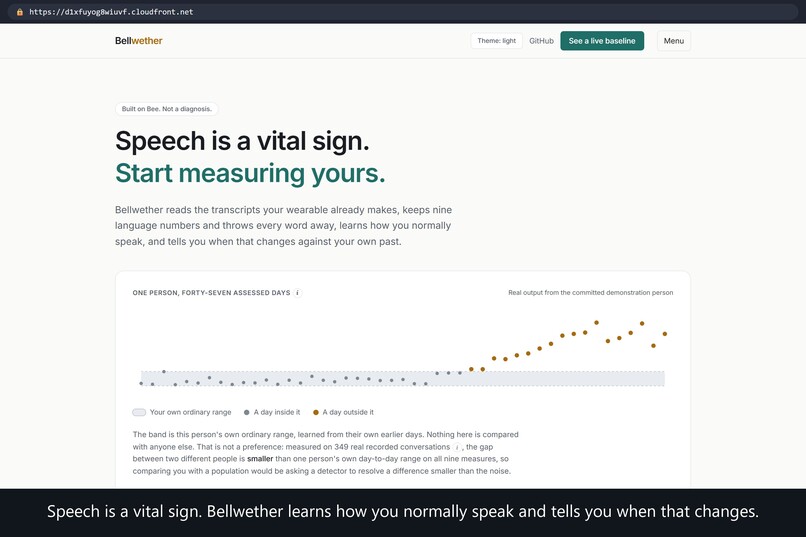
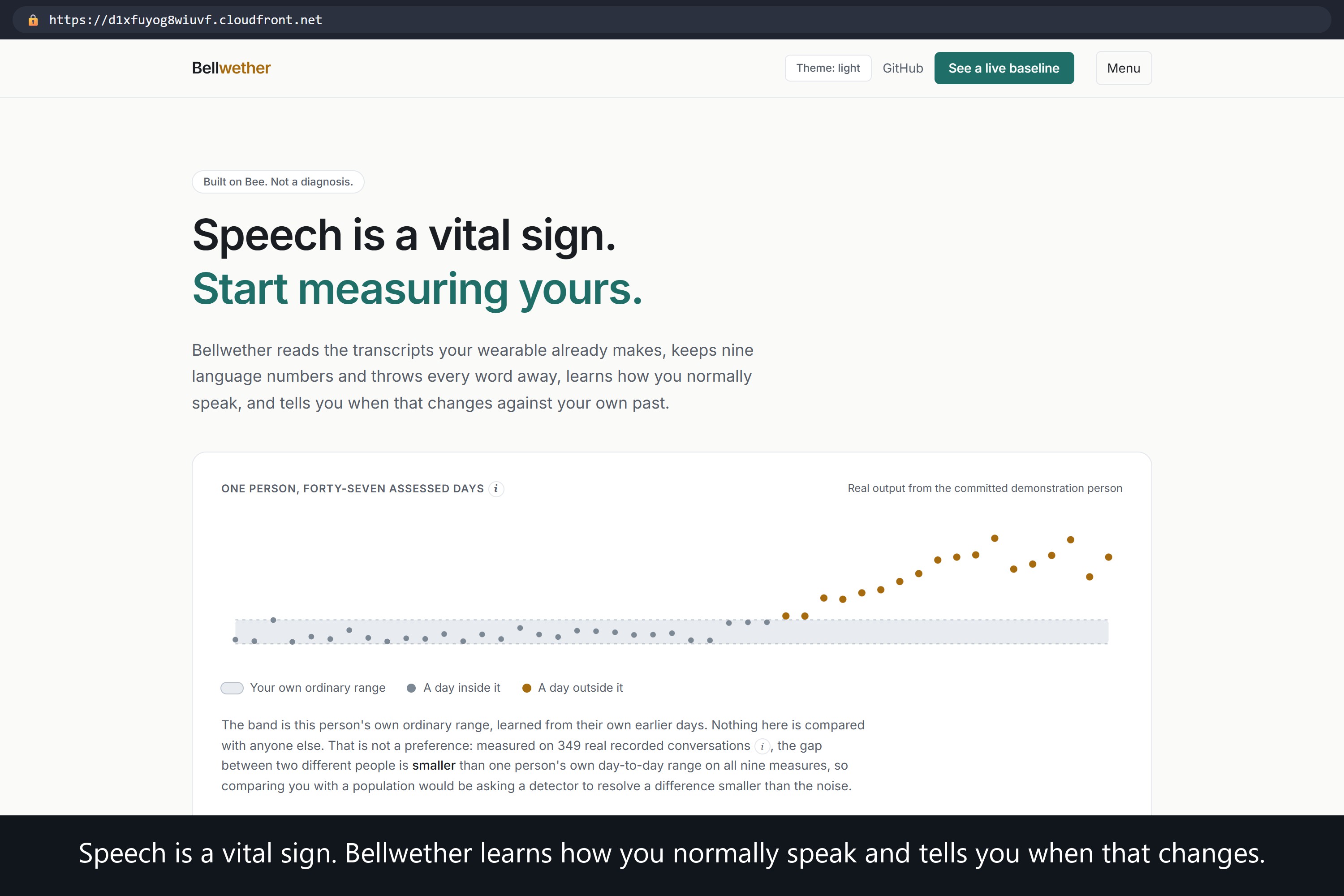
Speech is a vital sign. Bellwether learns how you normally speak and tells you when that changes.
-
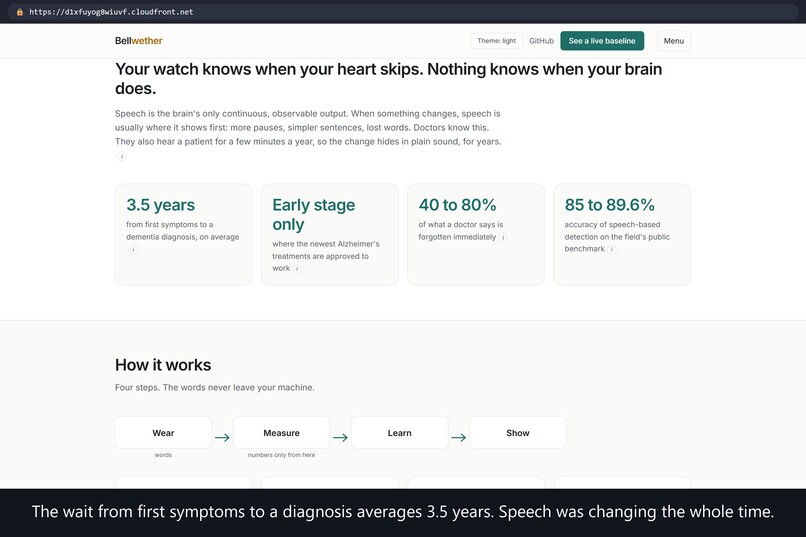
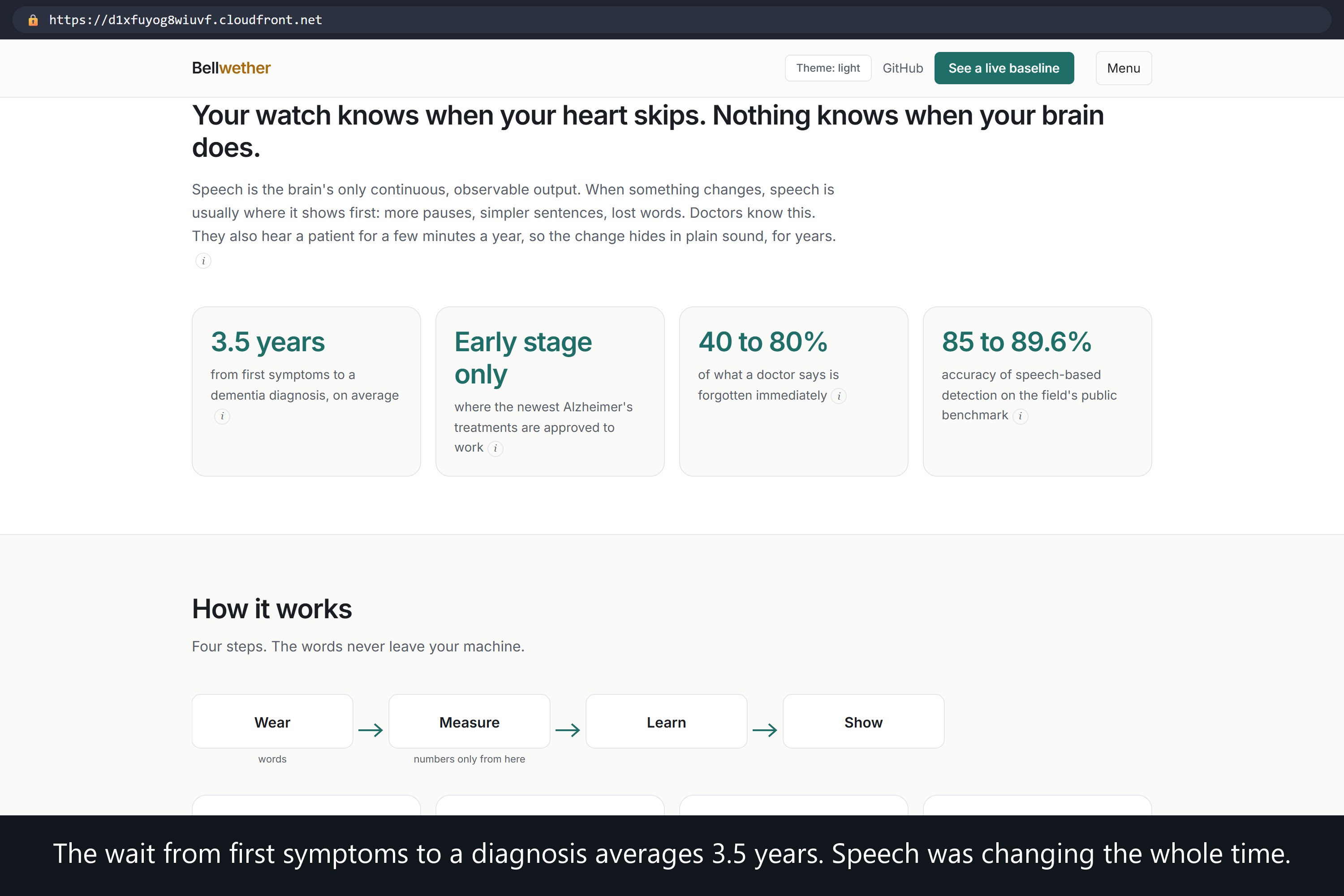
The wait from first symptoms to a diagnosis averages 3.5 years. Speech was changing the whole time.
-
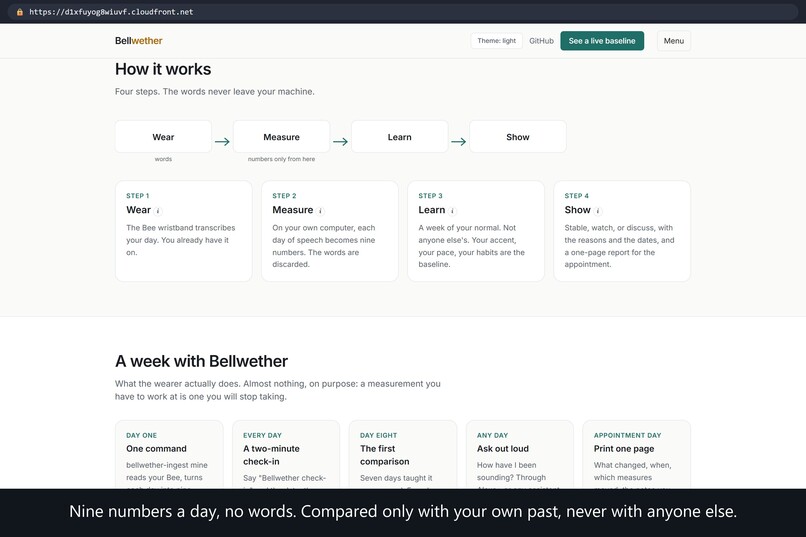
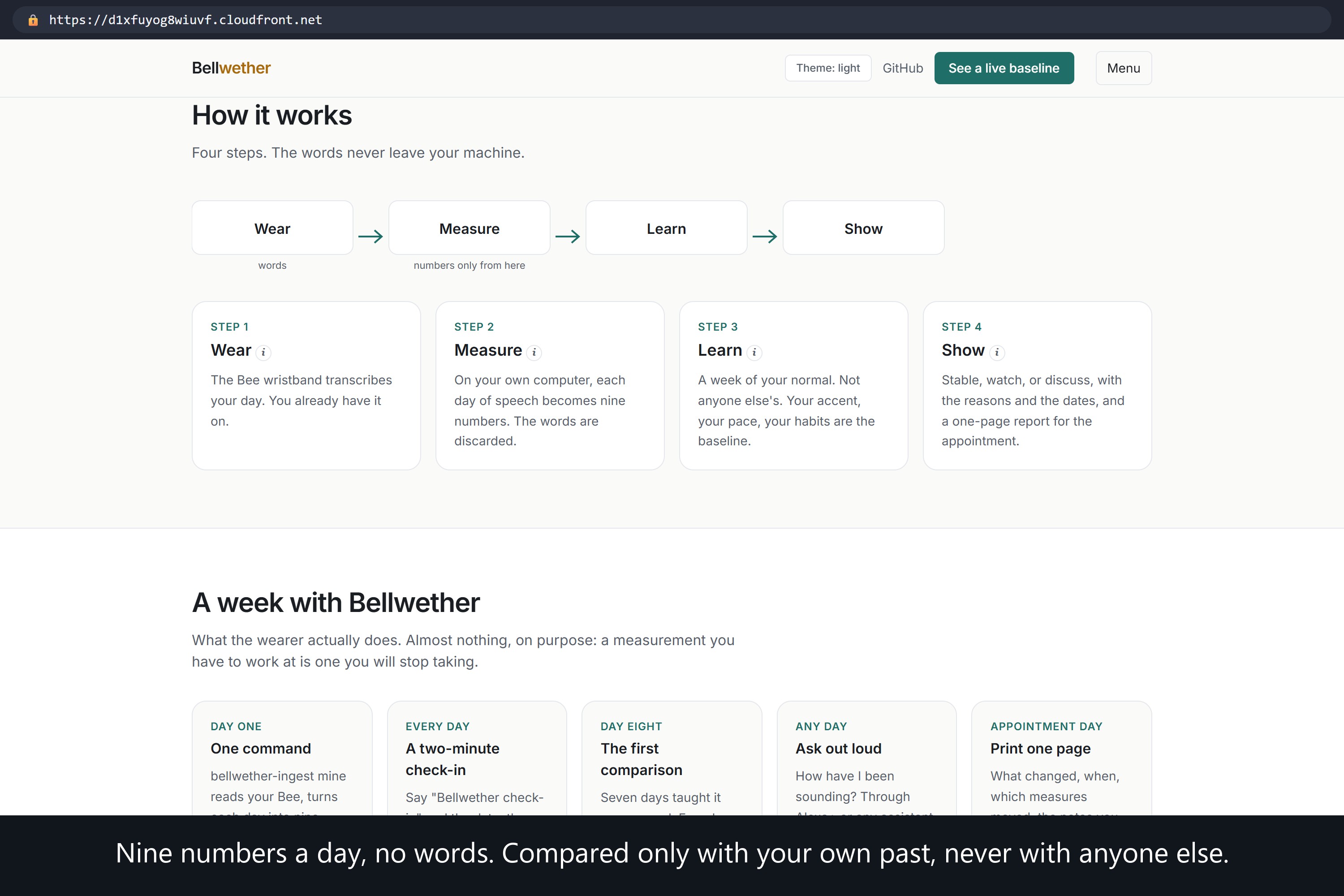
Nine numbers a day, no words. Compared only with your own past, never with anyone else.
-
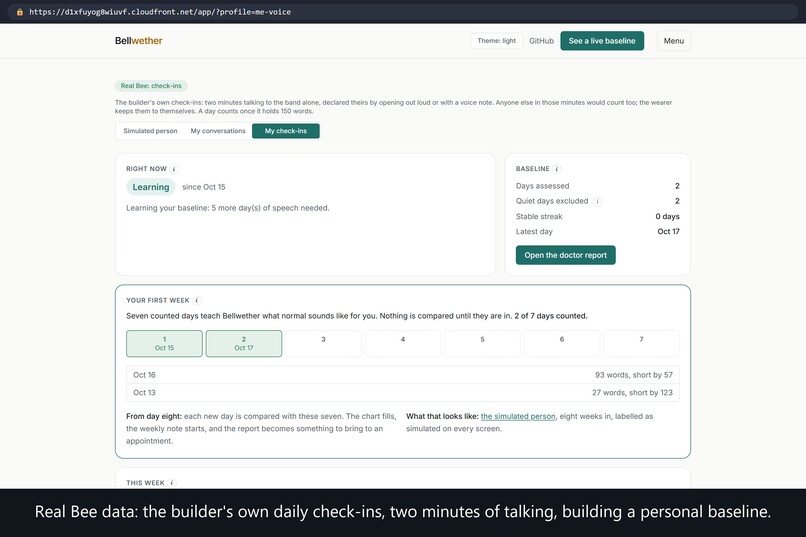
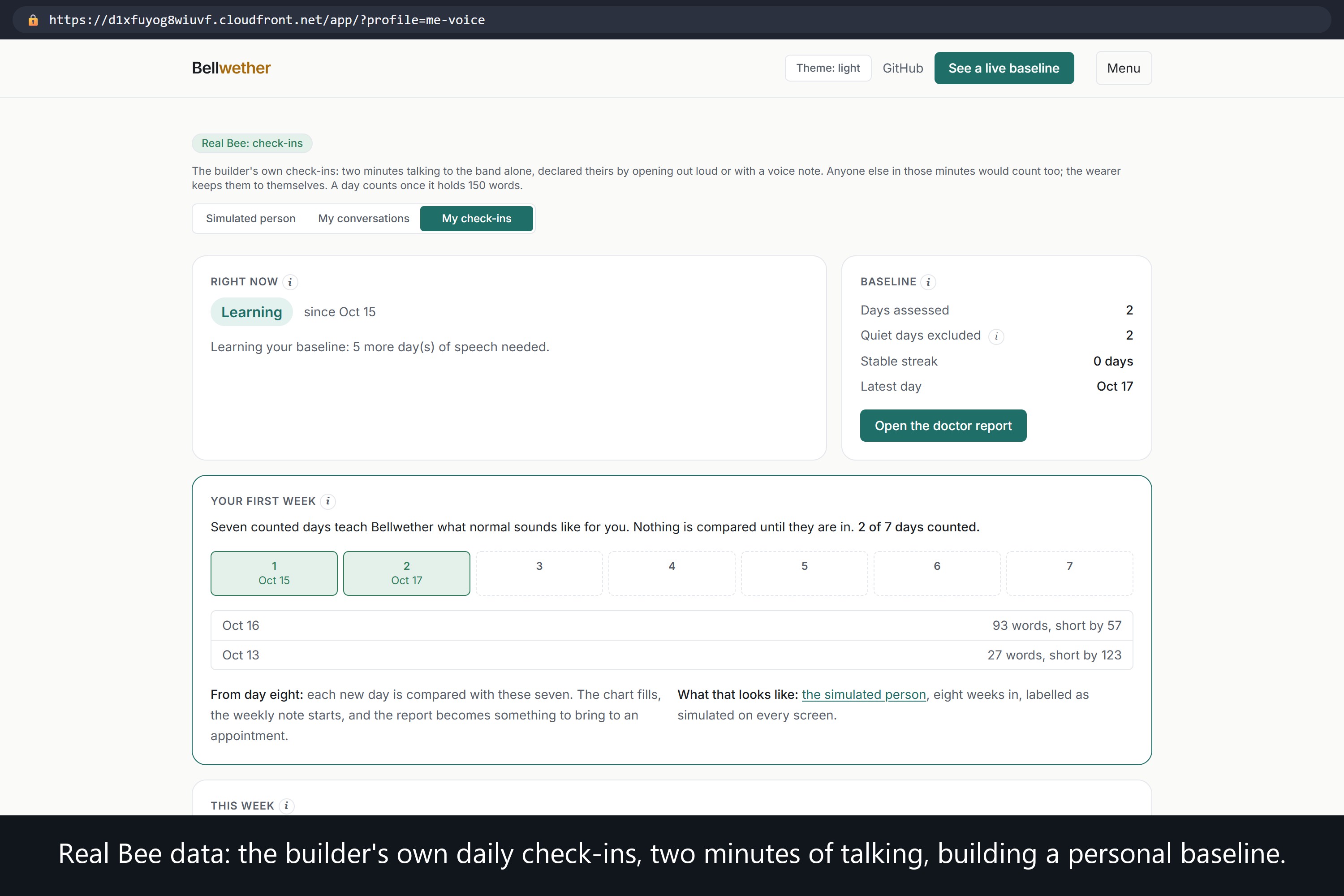
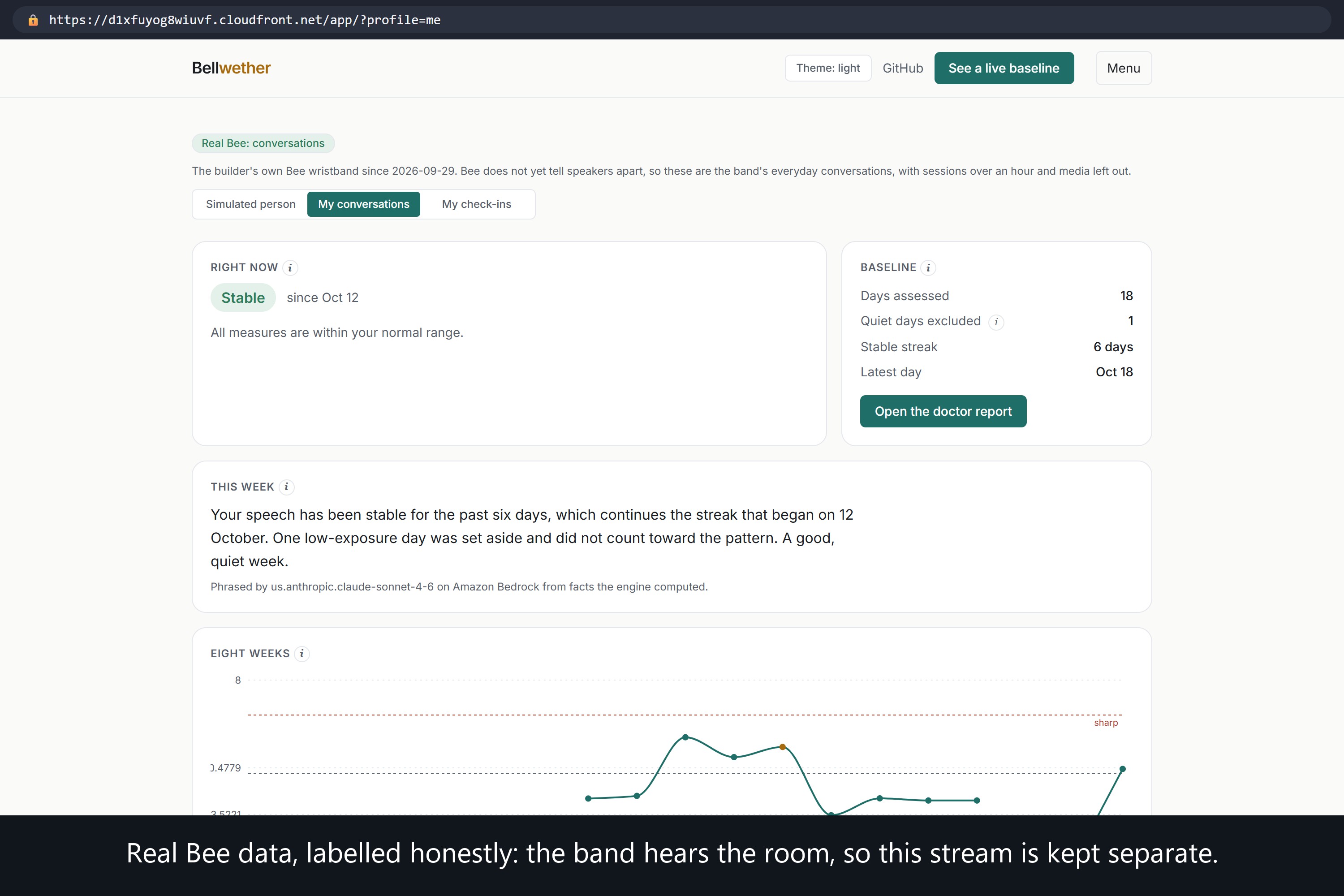
Real Bee data: the builder's own nightly check-ins, seven days counted, the baseline set.
-
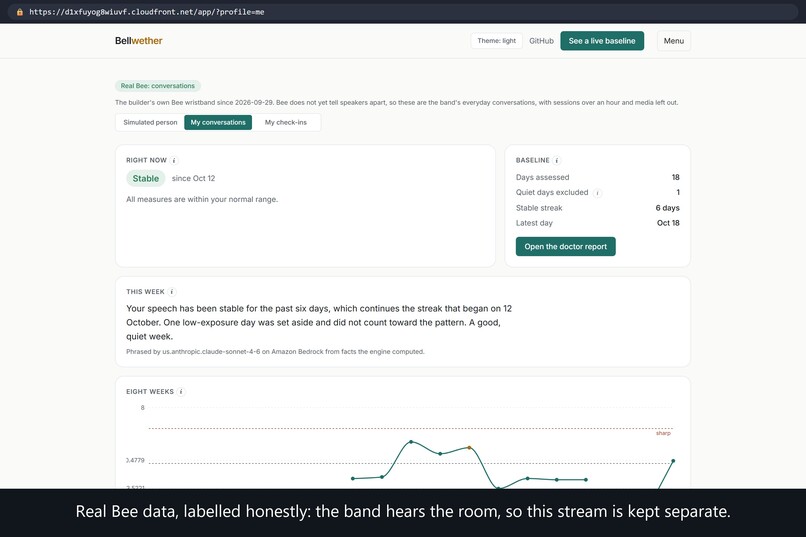
Real Bee data, labelled: the band hears the room, so this stream is kept separate from the check-ins.
-
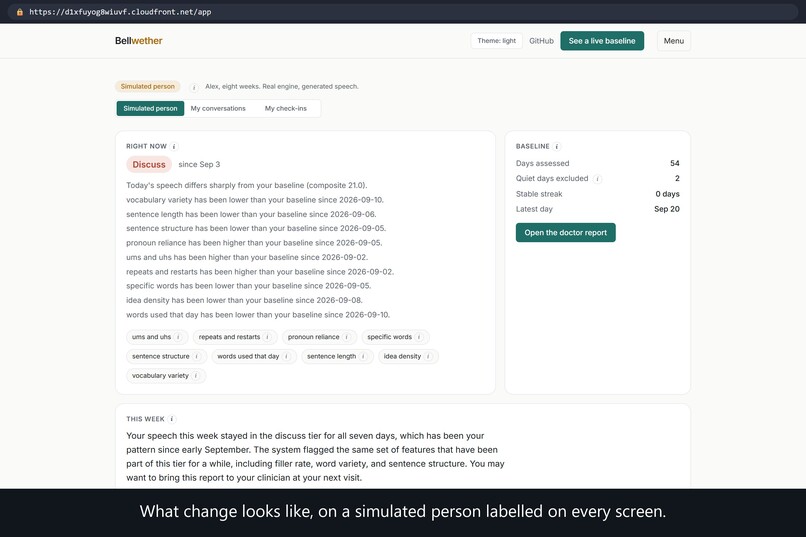
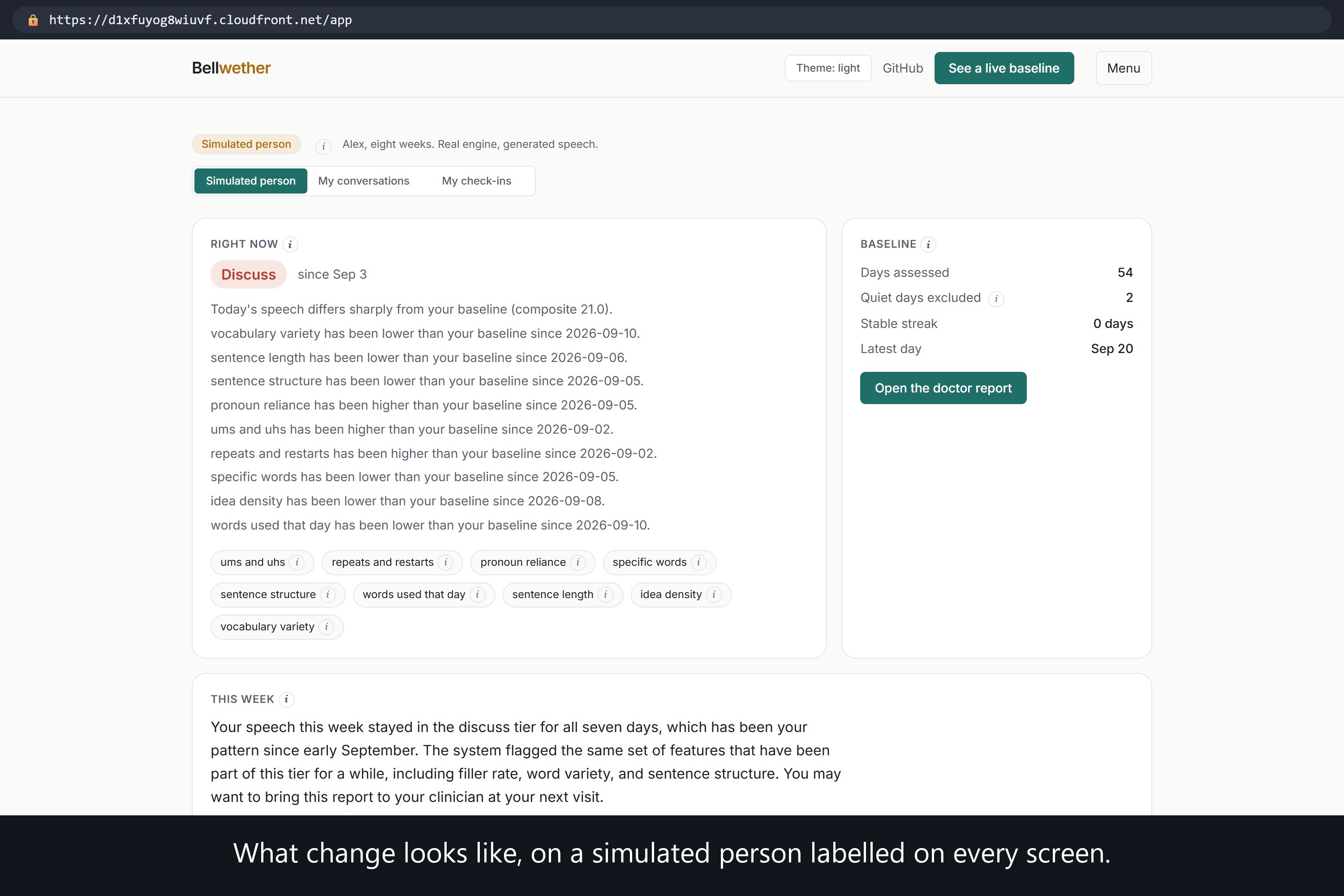
What change looks like, on a simulated person labelled on every screen.
-
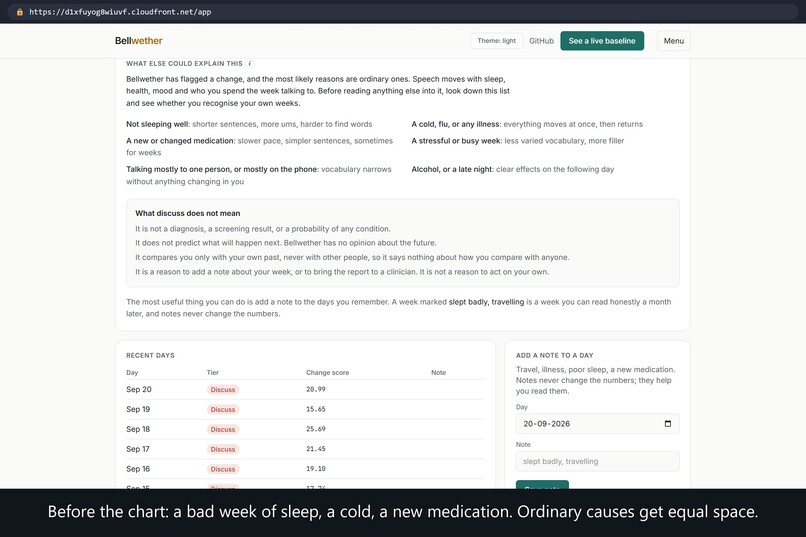
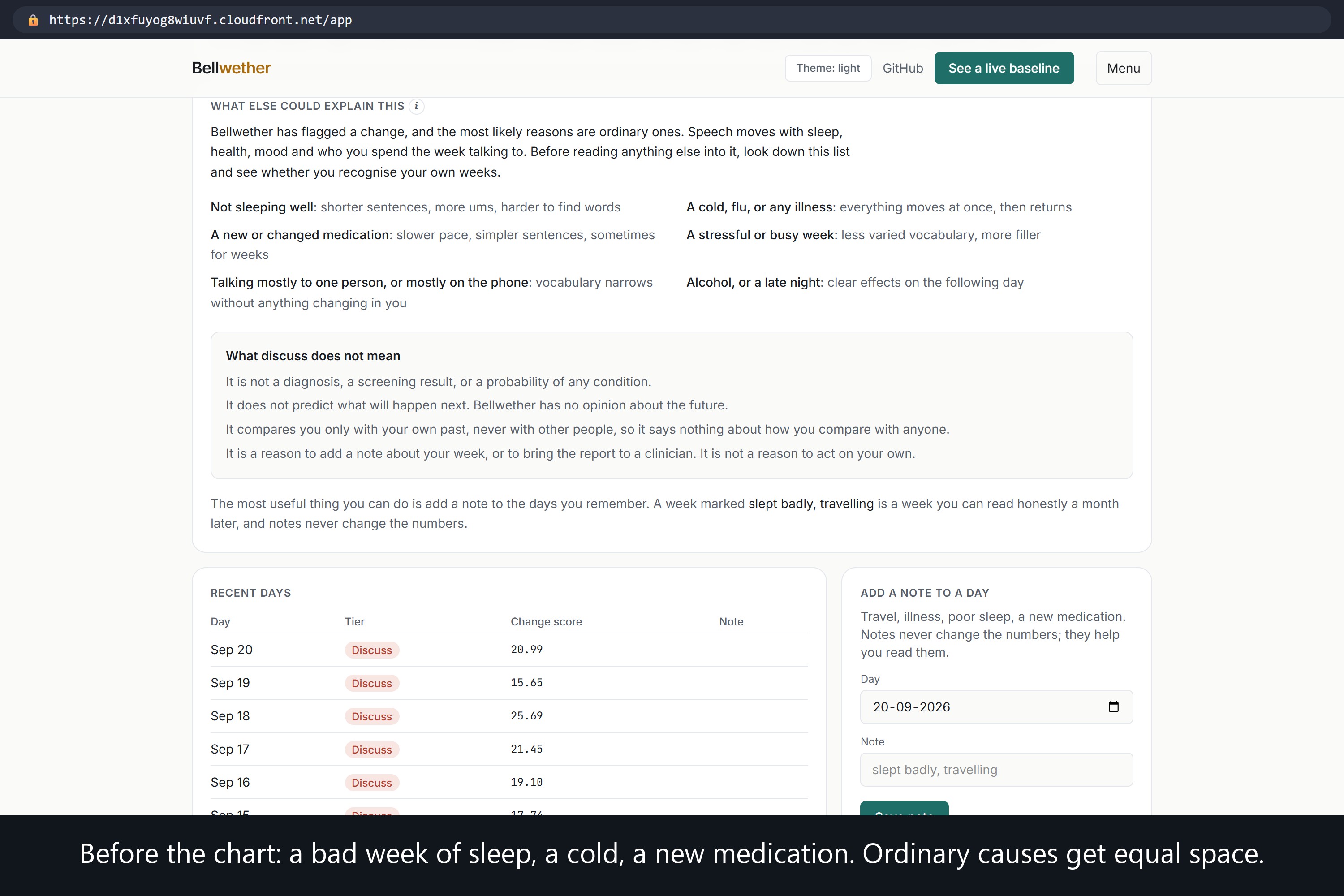
Before the chart: a bad week of sleep, a cold, a new medication. Ordinary causes get equal space.
-
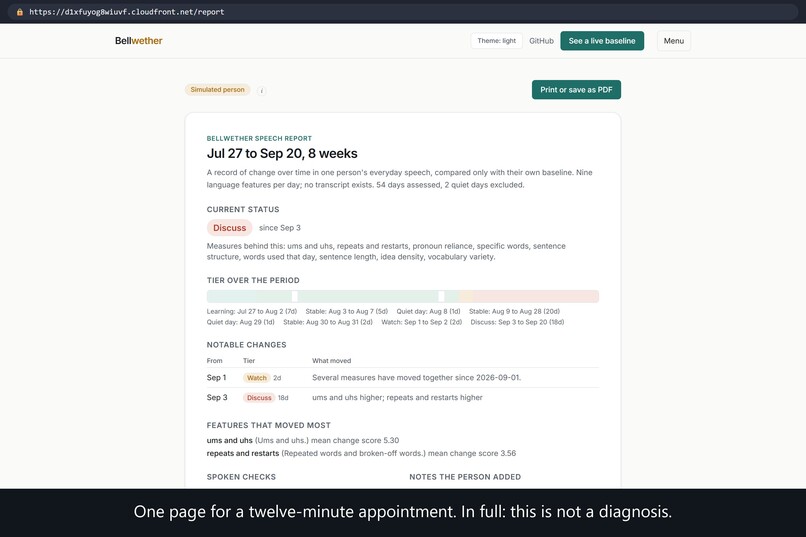
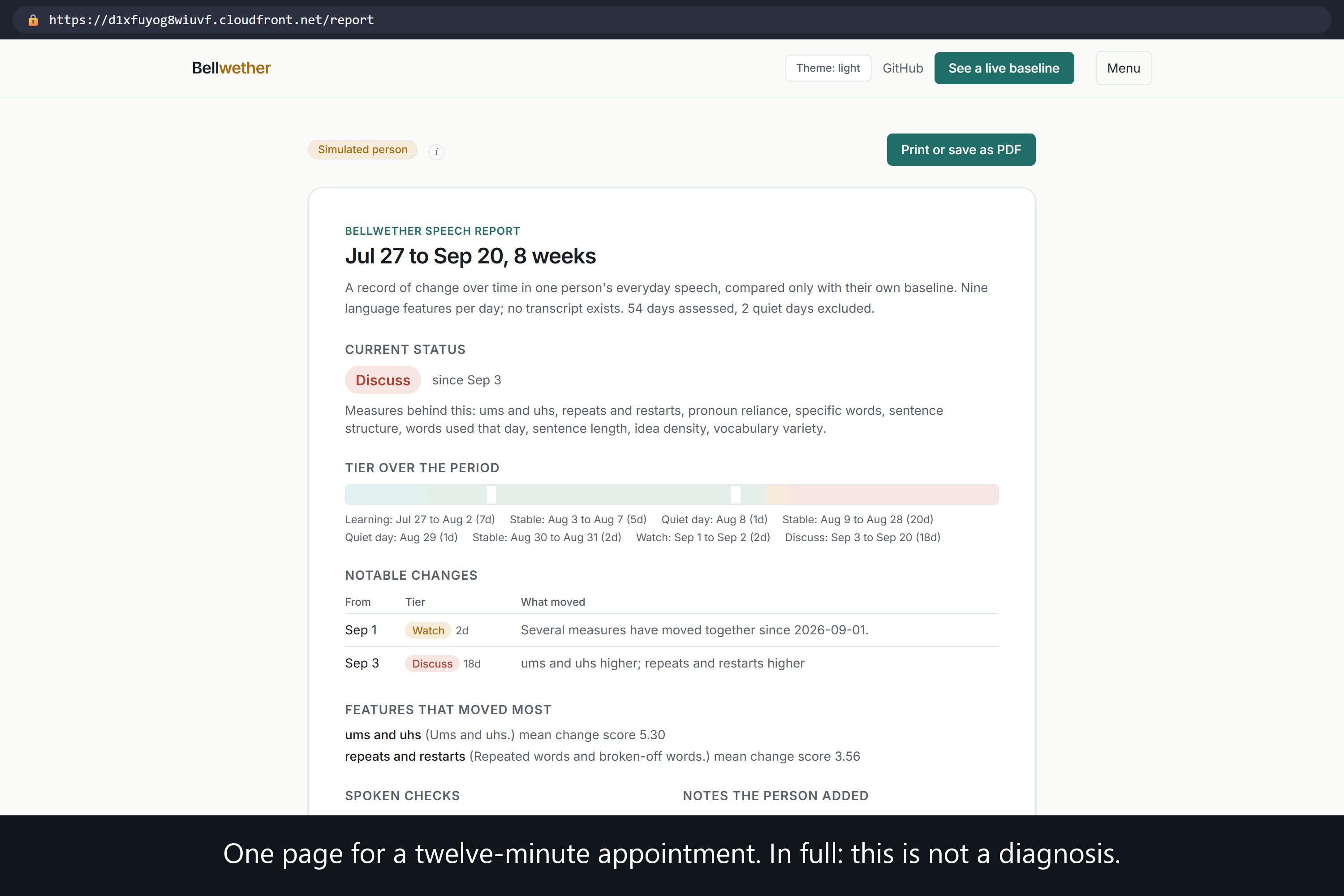
One page for a twelve-minute appointment. In full: this is not a diagnosis.
-
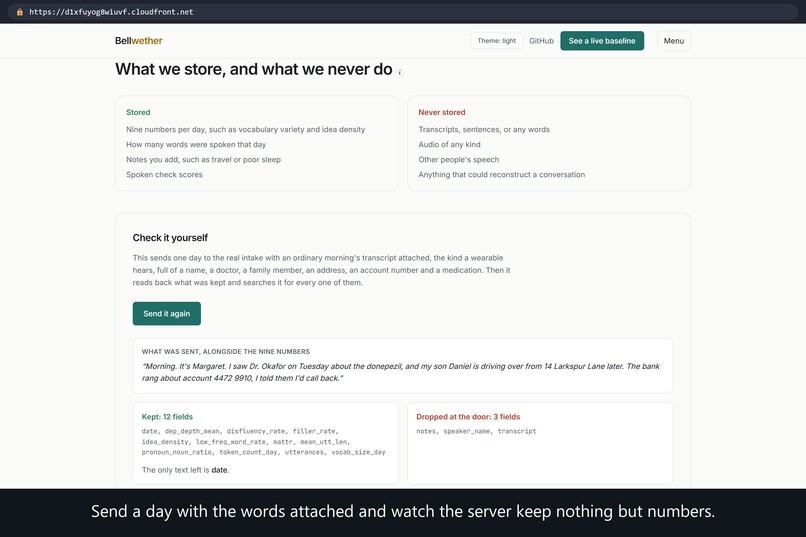
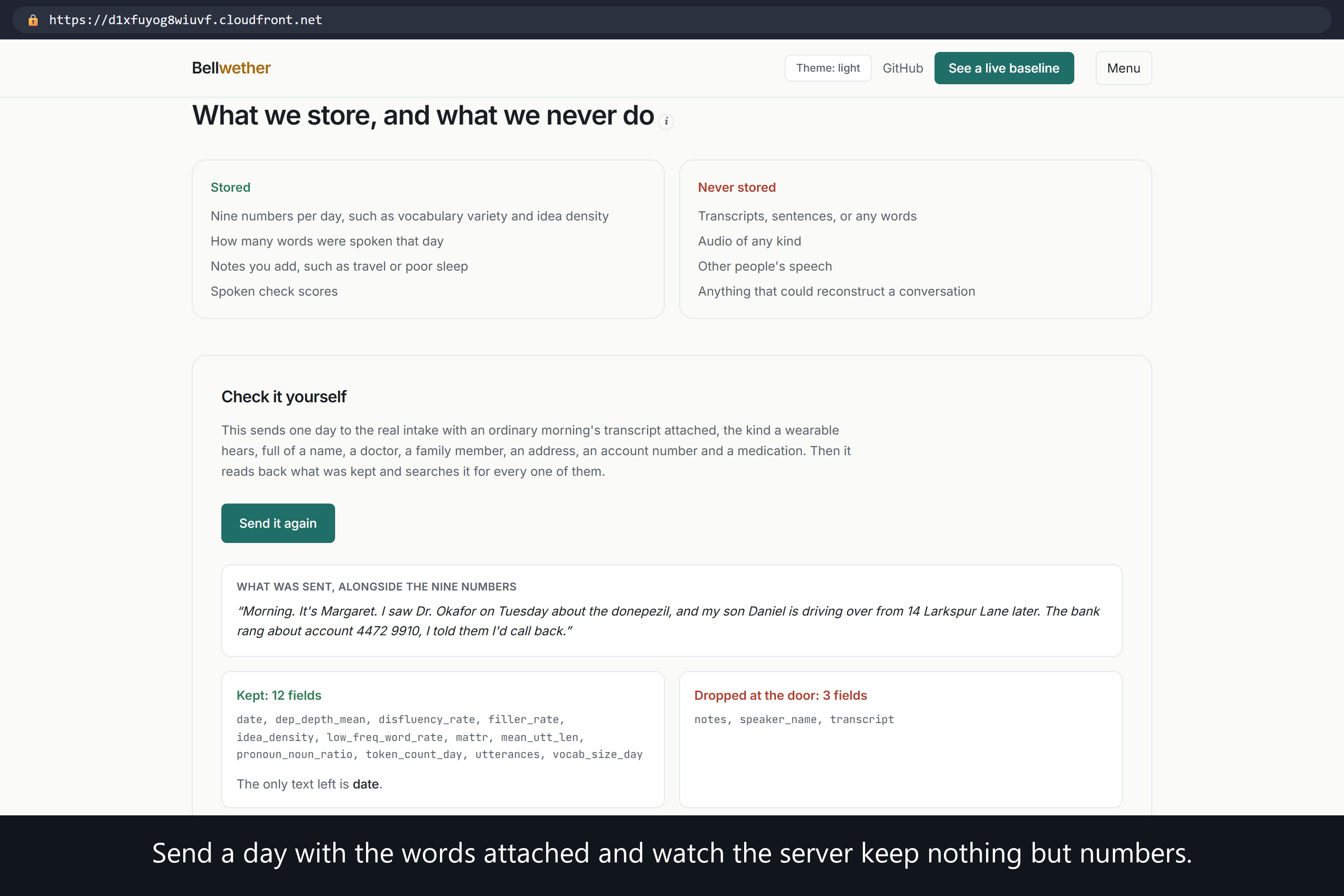
Send a day with the words attached and watch the server keep nothing but numbers.
-
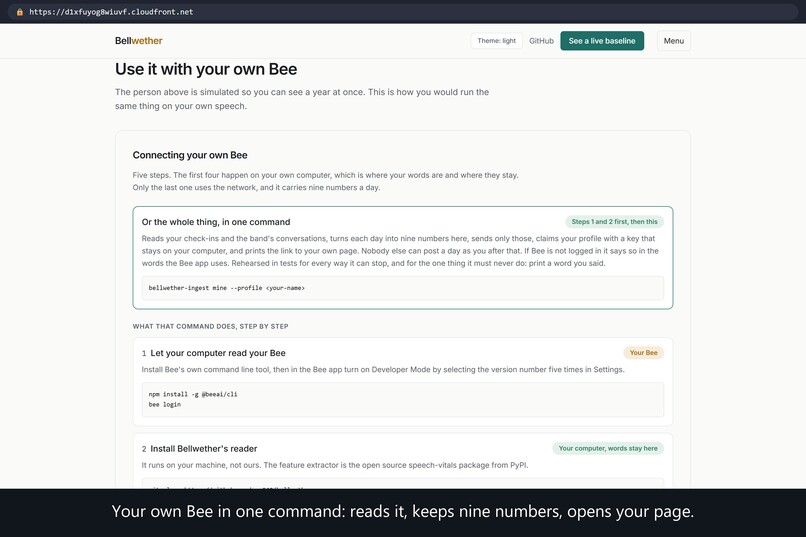
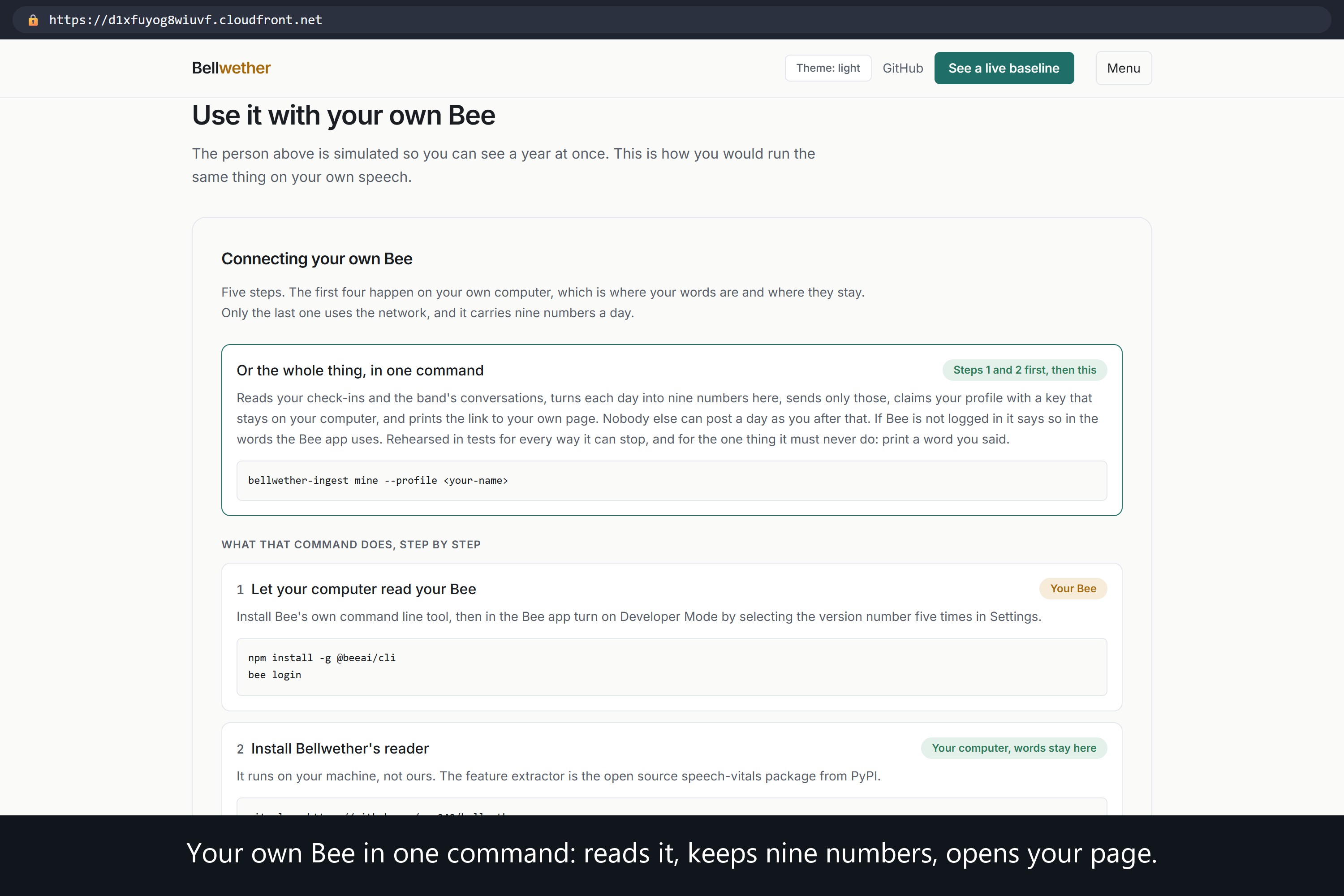
Your own Bee in one command: reads it, keeps nine numbers, opens your page.
-
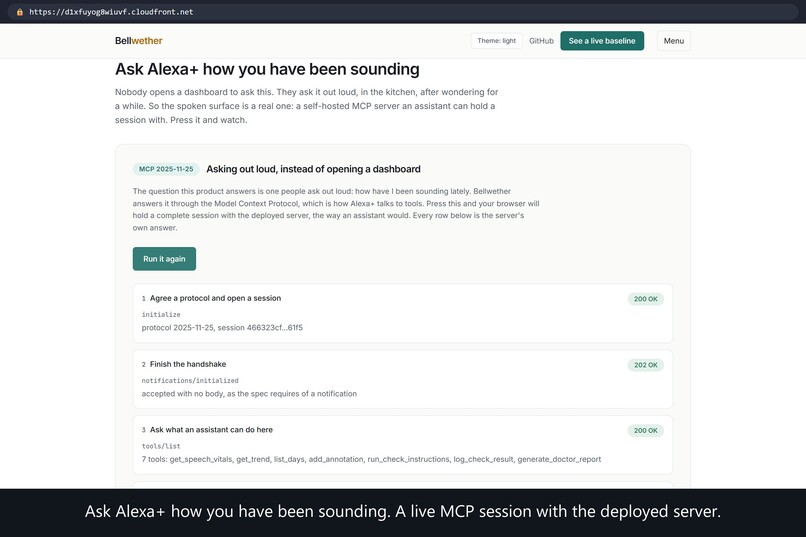
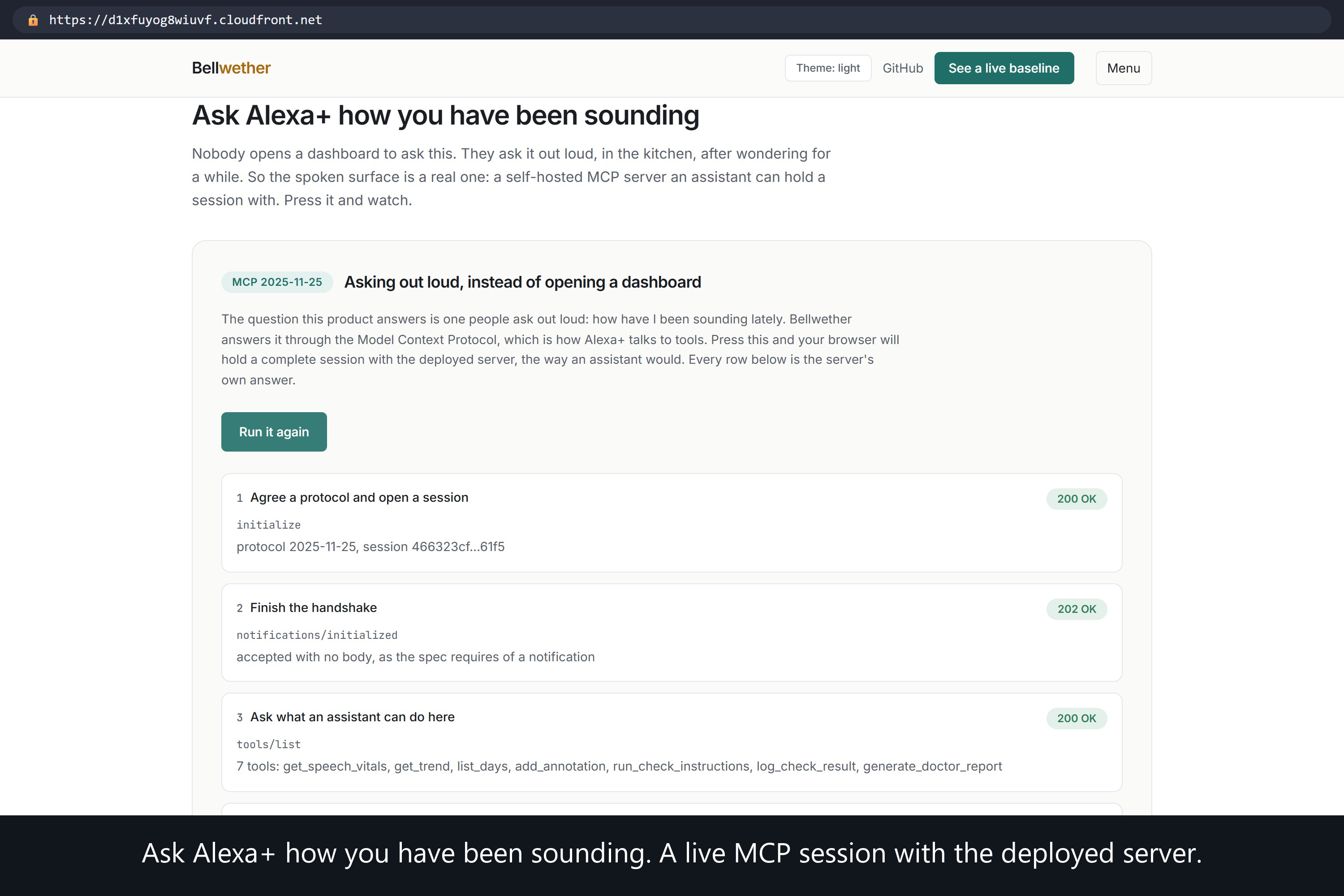
Ask Alexa+ how you have been sounding. A live MCP session with the deployed server.
-
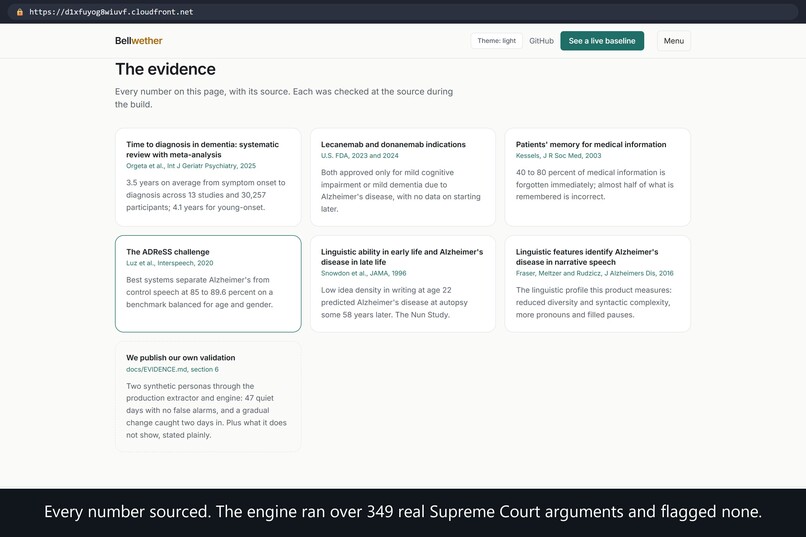
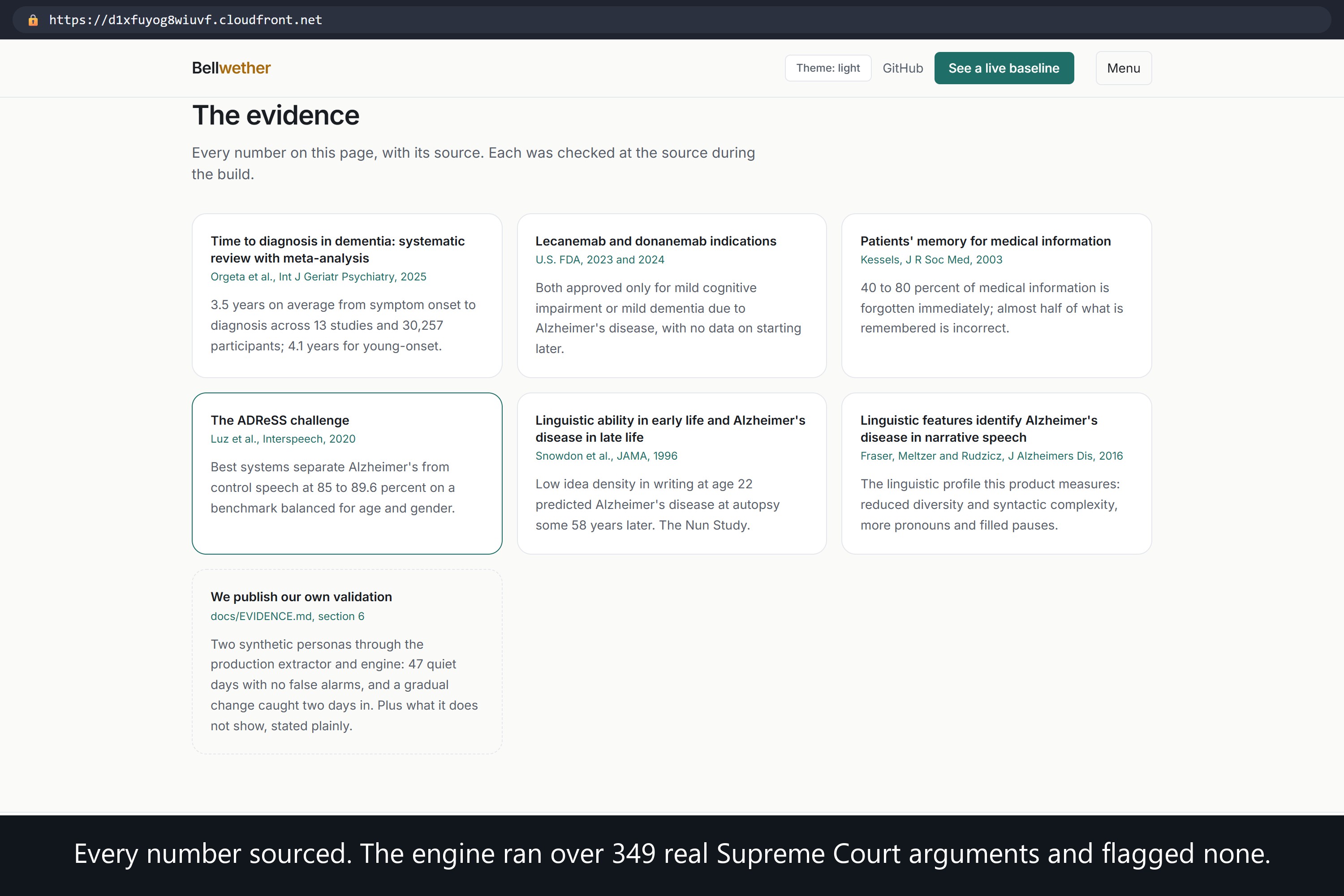
Every number sourced. The engine ran over 349 real Supreme Court arguments and flagged none.
Inspiration
Your watch tracks your heart. What about the way you speak?
Speech is the one thing the brain produces all day that anyone can observe, and when something changes, speech is usually where it shows first: more pauses, simpler sentences, words that will not come. Clinicians know this. They also hear a patient for a few minutes a year.
So the gap is measured in years. Across all dementias, the average time from first symptoms to a diagnosis is 3.5 years [1]. The newest treatments are approved only for the earliest stage [2], which is exactly what that wait skips past. And when the appointment finally happens, 40 to 80 percent of what the doctor says is forgotten straight away [3].
The Bee on a wrist already transcribes its wearer's day. That is the measurement nobody had: everyday speech, every day, for years, with no clinic. We built the thing that reads it without keeping a word.
What it does
Bellwether learns how one person normally speaks and shows them, in numbers they own, when that changes. It never diagnoses.
- Reads your Bee on your own computer. One command,
bellwether-ingest mine, reads your Bee, turns each day into nine language numbers, discards the words, claims your profile with a key that stays on your machine, and opens your page. - Keeps nine numbers a day, never the words. Vocabulary variety, sentence length, sentence structure, pronoun reliance, filled pauses, restarts, rare words, idea density and words used that day. Each has a literature behind it [4].
- Compares you only with your own past. Seven days of check-ins teach it what normal sounds like for you. Every day after is compared with those. It never compares you with anyone else, because on real speech two different people sit closer together than one person's own day-to-day range [5].
- Lets an assistant host the check-in. Every evening the assistant asks three short questions out loud through a speaker, the Bee on your wrist records the answers, and the assistant's own words are removed on your computer before anything is measured. Then it tells you where you stand. This is the Bee beside a speaker in the room, running for real every night on the builder's own band.
- Says one of four things. Learning, Stable, Watch, or Discuss. The most serious word is a verb, not an alarm. Before any chart, it lists the ordinary explanations: a bad week of sleep, a cold, a new medication, fewer people to talk to.
- Gets a second opinion before it tells you anything. When a change is flagged, two agents argue it, one that the change is real, one that an ordinary week explains it, both from numbers the engine computed. A third writes the note you read, and a gate refuses it unless it cites both sides and names no condition.
- Gives you one page for the doctor. What changed, when, which measures moved, plus the questions to bring. Written for a twelve-minute appointment, and for Medicare's Annual Wellness Visit, which already asks for a cognitive assessment and names no single tool [6].
- Answers out loud. A self-hosted MCP server with ten tools and an Agent Skill let Alexa+ or any assistant answer "how have I been sounding lately?" None of the tools can return a transcript, because none exists.
Try it: https://d1xfuyog8wiuvf.cloudfront.net. The dashboard switches between a simulated person, labelled on every screen, and the builder's own real Bee check-ins, seven days counted and the baseline set.
How we built it
- Bee:
apps/ingestis a client of the Bee CLI: conversations, journals,changedwith a saved cursor,stream --json, andtodosfor the reminder when a day is short. A second agent holds Bee's own MCP server beside ours, behind an allow-list that withholds every tool returning speech. - Alexa+: a self-hosted MCP server (spec 2025-11-25, Streamable HTTP) with ten tools, and an Agent Skill. Two of the tools make the assistant the host of the check-in; the Check-in Host speaks them through Amazon Polly while the Bee records.
- AWS: Claude on Amazon Bedrock phrases the weekly note from facts the engine computed, on a ladder of three models with a template as the floor, so a note always arrives. Strands Agents run the check-in, context and second-opinion agents; the second opinion is hosted on Amazon Bedrock AgentCore. AWS Lambda and Amazon DynamoDB hold the nine numbers a day. Amazon S3 and CloudFront serve the site, all from one AWS CDK deploy.
- Open source:
speech-vitalson PyPI (MIT), the nine language features per day with their literature basis; plus a pull request and an issue on Bee's own CLI.
Running cost: about 20 cents a person a month with a spoken check-in every night, 6 cents without, at AWS list prices.
Challenges we ran into
- One person's speech in a room full of voices. The Bee hears everyone, and a personal baseline needs the wearer alone. The check-in answers it: two minutes a day that the wearer opens out loud, or that the assistant hosts, with the host's lines removed by their timing. The ambient stream is kept and labelled as the room's.
- A late check-in is still today's. Timestamps come back in UTC, so an 11:30pm check-in in New York first landed on the next day. The ingest now keys days by the timezone the Bee reports.
- Saying less. The hardest design work was making sure no tier, note or report could read as a diagnosis or as false reassurance. The risk-communication literature governed every word [7].
Accomplishments that we're proud of
- A real person's Bee data on the live site, seven counted days from the builder's own band, with the assistant hosting the check-in every night.
- A privacy claim a visitor can test. Send a day with the words attached and watch the server keep nothing but numbers.
- The engine run over real speech we did not write: 349 Supreme Court argument sessions of eight justices with zero flagged, and 652 presidential press conferences across years with fewer than three percent flagged, clustered on a change of setting. Software behaviour, not medical accuracy, and we say so.
- A contribution to Bee's own CLI, written because we hit the problem.
What we learned
Speech really does carry the signal; the field measured that years ago. Language from people who were still cognitively normal predicted Alzheimer's onset a mean of 7.6 years ahead [8], and about 92 percent of expected mild cognitive impairment cases in US Medicare went undiagnosed [9]. What was missing was a way to measure it every day without a clinic, and a wearable people already buy now does that. The thing that connects daily measurement to a shorter diagnostic delay is a trial nobody has run, so we wrote its protocol instead of inventing a number.
What's next for Bellwether
- A wearer flag from Bee, so every ambient word counts too.
- The pilot: twelve months, forty people, one memory clinic, with endpoints fixed before any data. The protocol is in the repository.
- Pause and articulation measures, if audio access arrives.
Who it is for: someone sixty or older who has started to wonder and wants a record rather than a verdict; the family member who hears it first on the phone; the clinician with twelve minutes. In the two largest recent national surveys, 79 percent of Americans 45 and over would want to know early [10], yet only 14 percent have ever discussed brain health with their physician [11].
Bellwether is a general wellness tool and not a medical device. It does not diagnose, treat, cure, or prevent any disease. Share it with a clinician you trust.
Sources
- Orgeta V et al. Time to Diagnosis in Dementia: A Systematic Review With Meta-Analysis. Int J Geriatr Psychiatry 2025. doi:10.1002/gps.70129
- US FDA. Traditional approval of lecanemab, July 2023; donanemab, July 2024.
- Kessels RPC. Patients' memory for medical information. J R Soc Med 2003. doi:10.1177/014107680309600504
- Fraser KC, Meltzer JA, Rudzicz F. Linguistic features identify Alzheimer's disease in narrative speech. J Alzheimers Dis 2016; Ahmed S et al., Brain 2013; Snowdon DA et al., JAMA 1996.
- ConvoKit Supreme Court corpus (Oyez Project), run in harness/scotus.
- Cordell CB et al. Alzheimer's Association recommendations for operationalizing the detection of cognitive impairment during the Medicare Annual Wellness Visit. Alzheimer's & Dementia 2013. doi:10.1016/j.jalz.2012.09.011
- Spiegelhalter D. Risk and Uncertainty Communication. Annual Review of Statistics and Its Application 2017.
- Eyigoz E et al. Linguistic markers predict onset of Alzheimer's disease. EClinicalMedicine 2020. doi:10.1016/j.eclinm.2020.100583
- Mattke S et al. Expected and diagnosed rates of mild cognitive impairment and dementia in the U.S. Medicare population. Alzheimer's Research & Therapy 2023. doi:10.1186/s13195-023-01272-z
- Alzheimer's Association. American Perspectives on Early Detection of Alzheimer's Disease in the Era of Treatment. 2025 special report, survey of 1,702 adults 45 and over.
- Alzheimer's Association. Brain Health in America. 2026 special report, survey of 3,829 adults 40 and over.
Every claim with its full source: https://github.com/usv240/bellwether/blob/main/docs/EVIDENCE.md
Built With
- agent-skills
- alexa-plus
- amazon-bedrock
- amazon-bedrock-agentcore
- amazon-cloudfront
- amazon-dynamodb
- amazon-polly
- amazon-web-services
- aws-cdk
- aws-lambda
- bee
- bee-cli
- claude
- fastapi
- mcp
- nextjs
- python
- react
- spacy
- strands-agents
- tailwind
- typescript

Log in or sign up for Devpost to join the conversation.