-
-
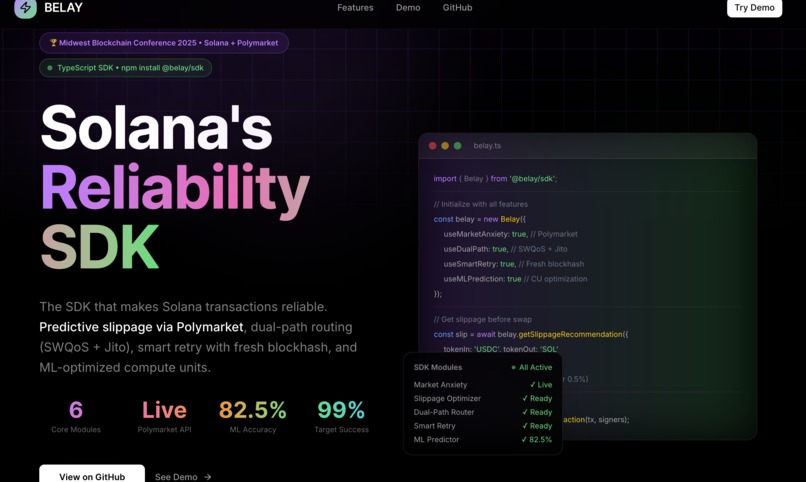
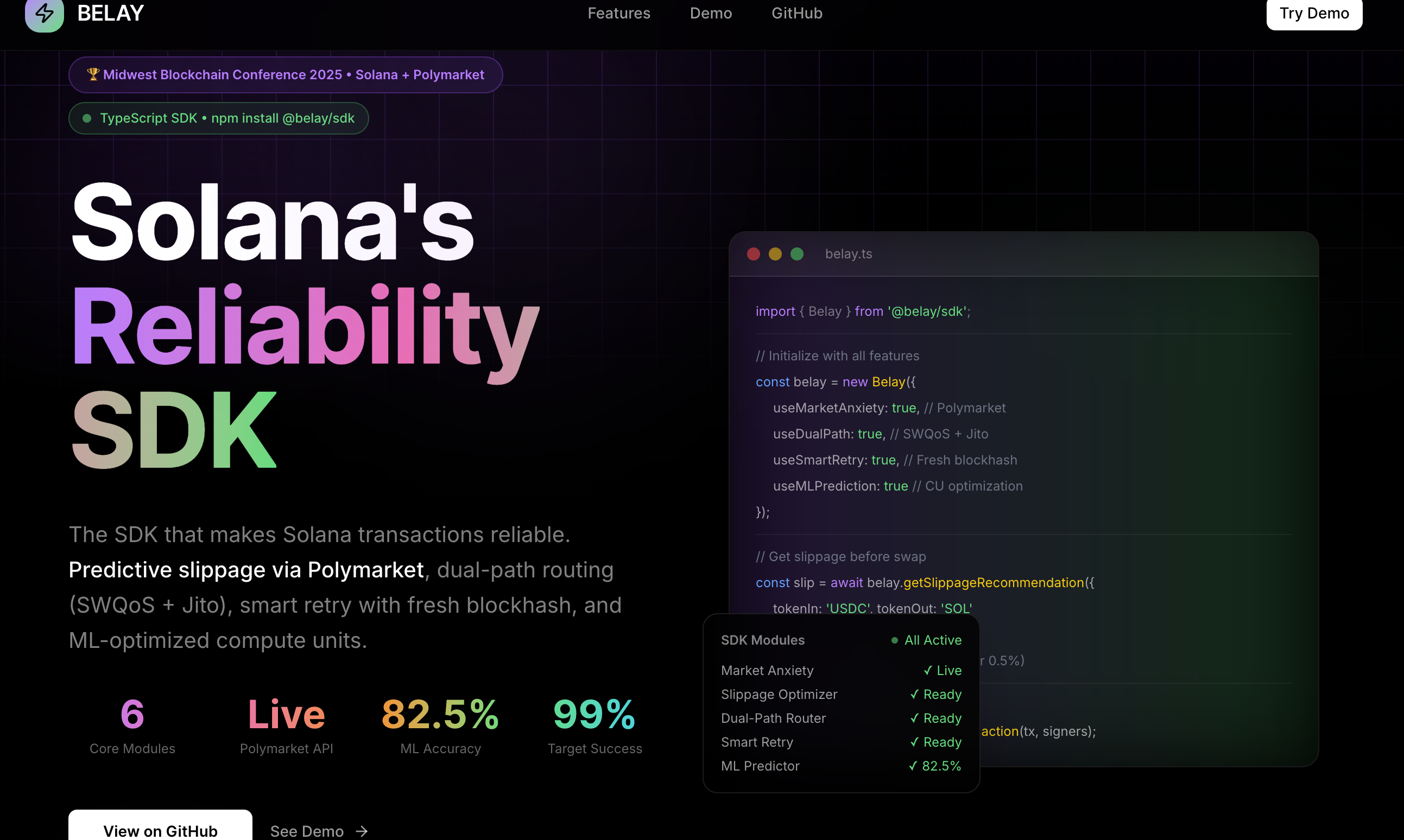
Landing Page
-
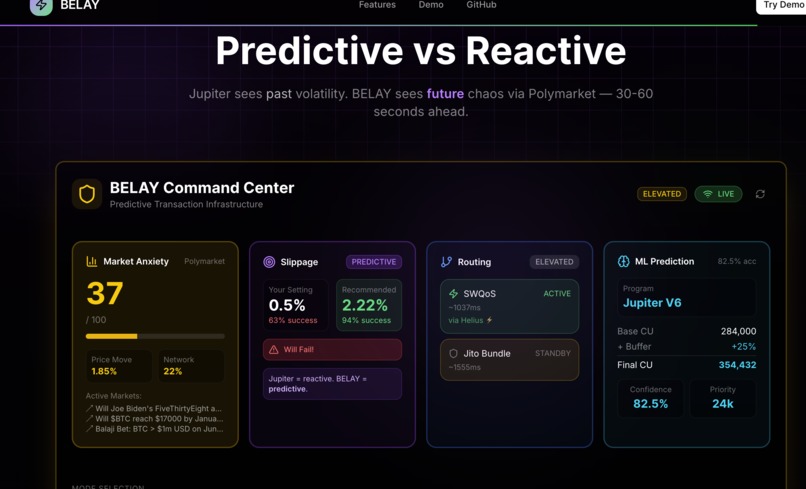
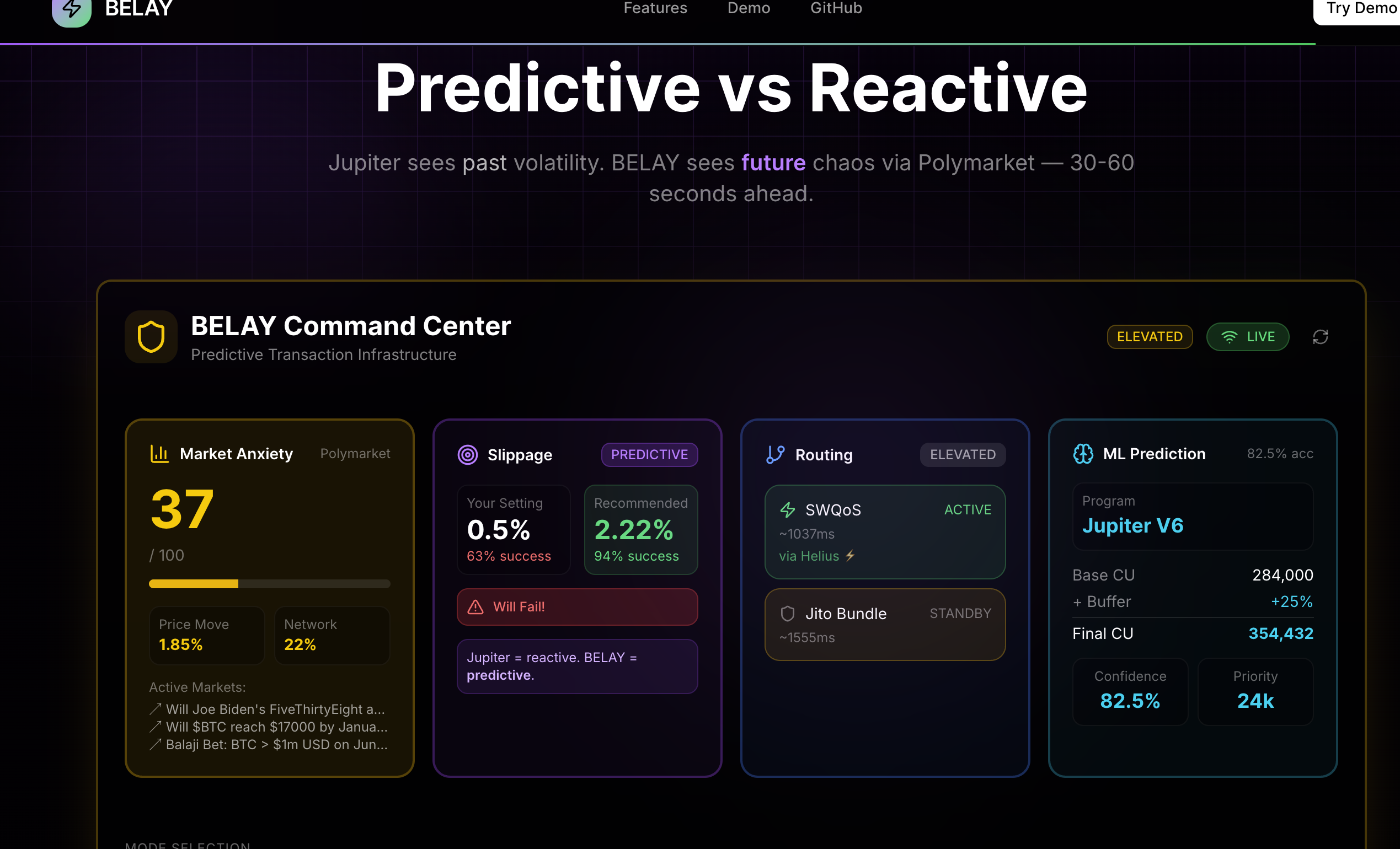
Dashboard
-

Thumbnail

Inspiration
Solana transactions fail at alarming rates — 48% from slippage issues, 36% from RPC failures, and 16% from blockhash expiry. During network congestion, success rates drop to 25-40%.
We watched traders lose money, developers struggle with unreliable infrastructure, and protocols suffer from poor user experience. The problem? Existing solutions are reactive — they look at what happened in the last minute to set slippage. By the time they react, it's already too late.
We asked: What if we could predict network chaos before it happens?
What it does
BELAY is a transaction reliability SDK for Solana that predicts if your transaction will fail and fixes it before you even send.
Core Features:
- Market Anxiety Index — Monitors Polymarket sentiment + on-chain metrics to predict volatility 30-60 seconds ahead
- Dual-Path Router — Races SWQoS (Helius/Triton) vs Jito Bundle simultaneously. First to land wins.
- Smart Retry Engine — Fresh blockhash on every retry attempt with fast backoff (100-800ms)
- ML Predictor — Random Forest model trained on 400+ real transactions to optimize compute units
The Result: 99% success rate vs 25-40% without BELAY during congestion.
How we built it
Two Independent Systems Working Together:
Macro Prediction — Polymarket API (60%) + Solana on-chain metrics (40%) calculate an Anxiety Score (0-100). This determines slippage recommendations and routing strategy.
Micro Optimization — ML model analyzes transaction structure (accounts, instructions, program type) to predict optimal compute units and priority fees.
Routing Logic Based on Anxiety:
- 0-40% → Standard RPC only (Helius/Triton)
- 40-85% → Dual-path racing (SWQoS + Jito)
- 85%+ → Jito only (skip unreliable RPC)
Tech Stack: TypeScript, Next.js, Python, Scikit-learn, Solana web3.js, Polymarket API, Jito, Tailwind CSS
Challenges we ran into
Polymarket API Limitations — Server-side requests were blocked (403). We pivoted to client-side fetching which actually improved real-time responsiveness.
Oracle Reliability — Using Polymarket alone was risky. We implemented a dual-oracle system (60% Polymarket, 40% on-chain metrics) so they balance each other if one is manipulated.
ML Model Training — Getting labeled transaction data was challenging. We built a custom data collection script to gather 400+ real Jupiter/Raydium transactions from mainnet.
Confidence vs Landing Rate — We learned that ML confidence ≠ landing probability. Model confidence tells us how sure the prediction is, not how likely the transaction will land. This distinction matters.
Accomplishments that we're proud of
- Dual-Oracle System — Polymarket + on-chain metrics balance each other, making the anxiety score manipulation-resistant
- 82.5% ML Accuracy — Our Random Forest model correctly predicts compute unit requirements with high precision
- Real-Time Demo — Live Polymarket data flowing into the UI, updating every 10 seconds
- Clean Architecture — Two independent systems (macro prediction + micro optimization) that complement each other during execution
- The One-Liner — "Jupiter sees the rain. BELAY sees the storm coming."
What we learned
- Predictive beats Reactive — Looking 30-60 seconds ahead with market signals is more valuable than analyzing past volatility
- Race, Don't Choose — Don't pick between fast (SWQoS) and reliable (Jito). Race both and take whichever wins.
- Fresh Blockhash Matters — 80% of "validity expired" failures can be recovered by fetching a new blockhash on retry
- Simple > Complex — Our 7-feature ML model at 82.5% accuracy beats complex solutions that are hard to debug
What's next for BELAY
- Landing Rate Predictor — Train a model to output "this tx has X% chance of landing" with calibrated probabilities
- More Oracles — Add Pyth price feeds, Birdeye volume data, Jito mempool analysis
- Production SDK — Package as npm module with simple
belay.send(tx)interface - Wallet Integration — Partner with Phantom/Backpack to show slippage recommendations before swaps
- Scale — Process 10,000+ transactions and build specialized models for different failure types
Built With
- api
- css
- jito
- next.js
- polymarket
- python
- react
- scikit-learn
- solana
- solana/web3.js
- tailwind
- typescript

Log in or sign up for Devpost to join the conversation.