-
-
Thumbnail
-
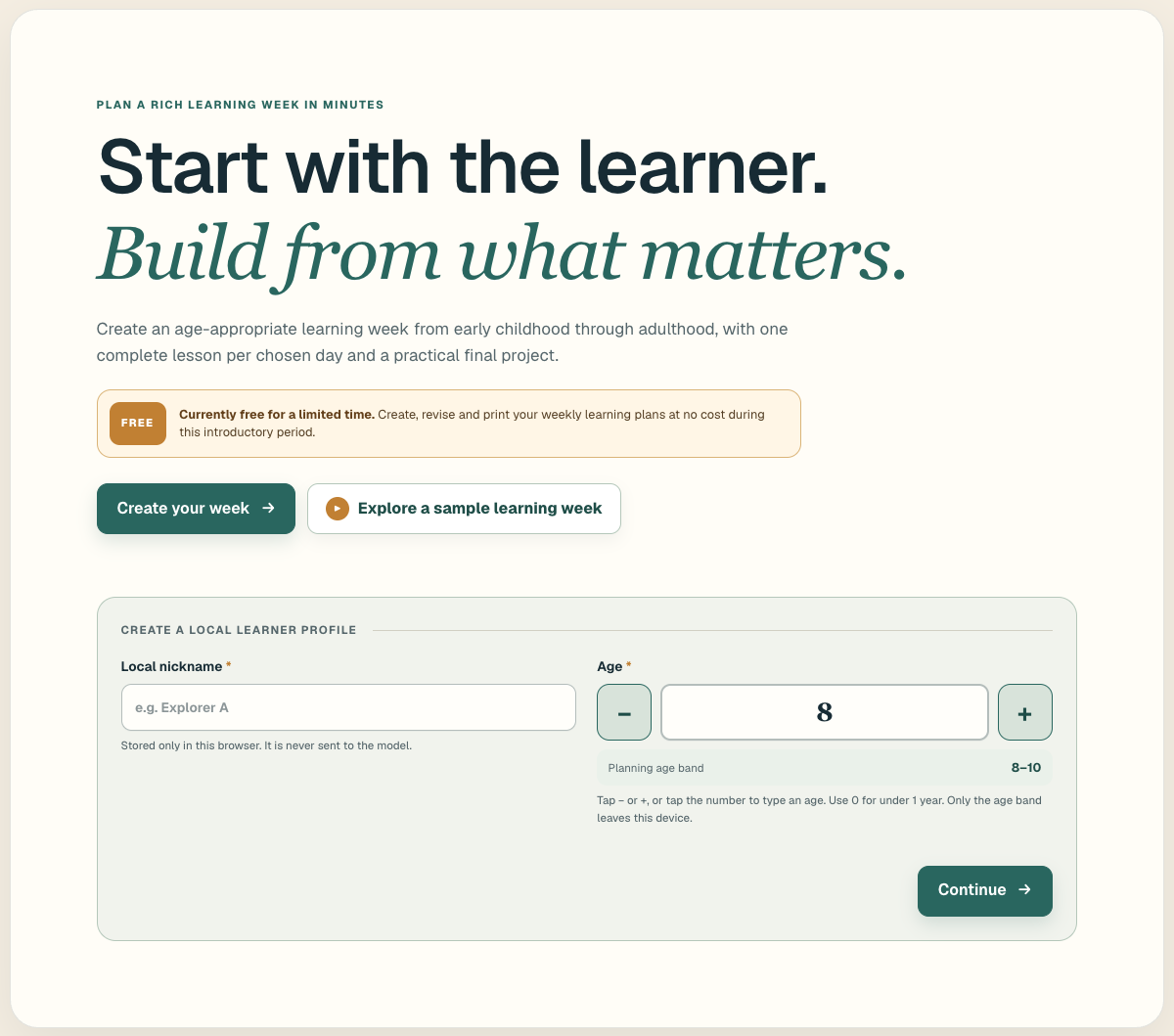
Landing Page
-
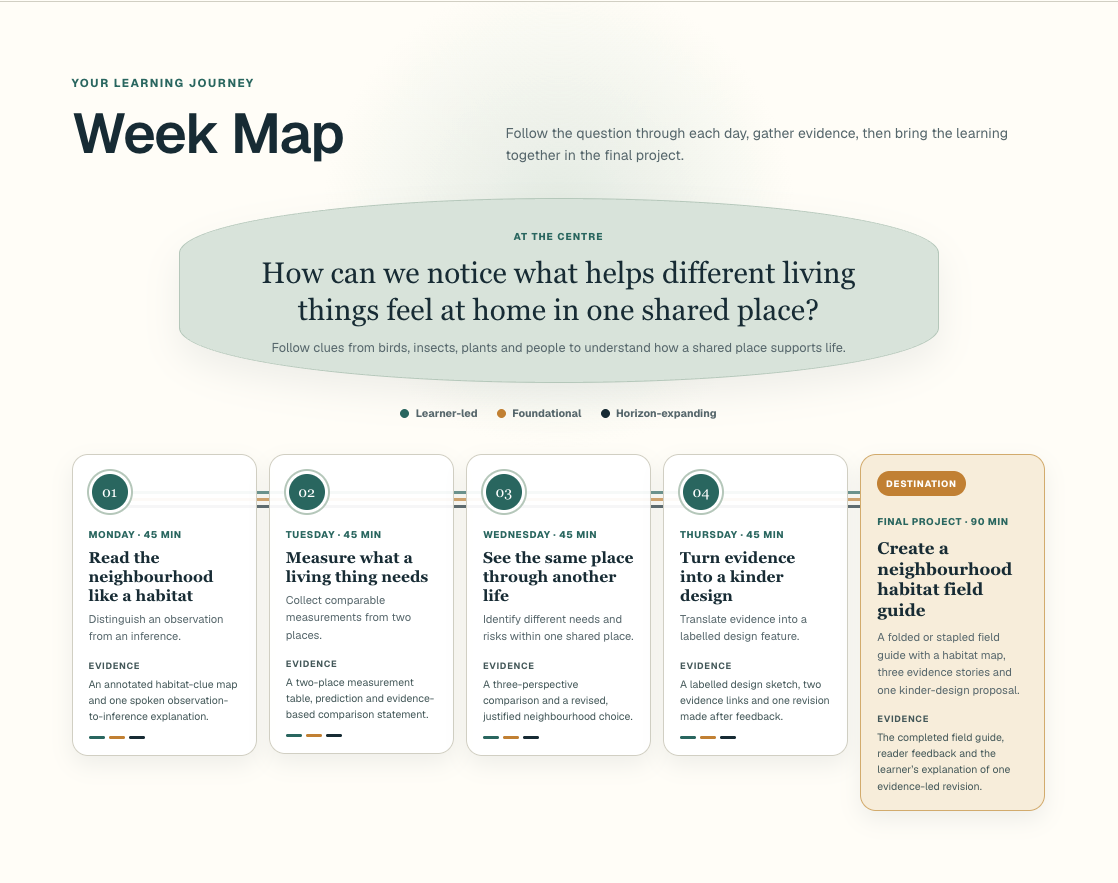
Week Map
-
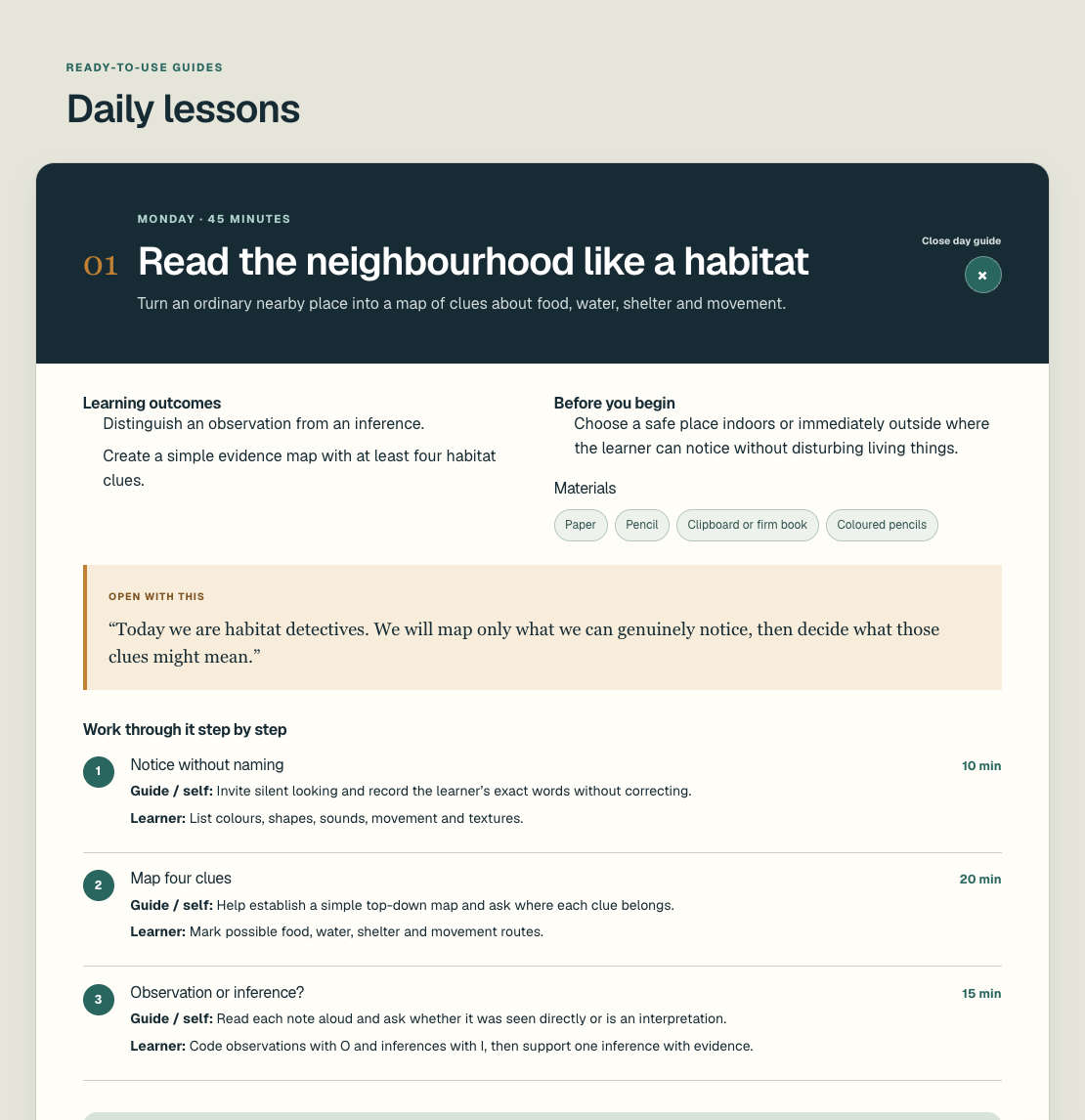
Lesson Plan
-
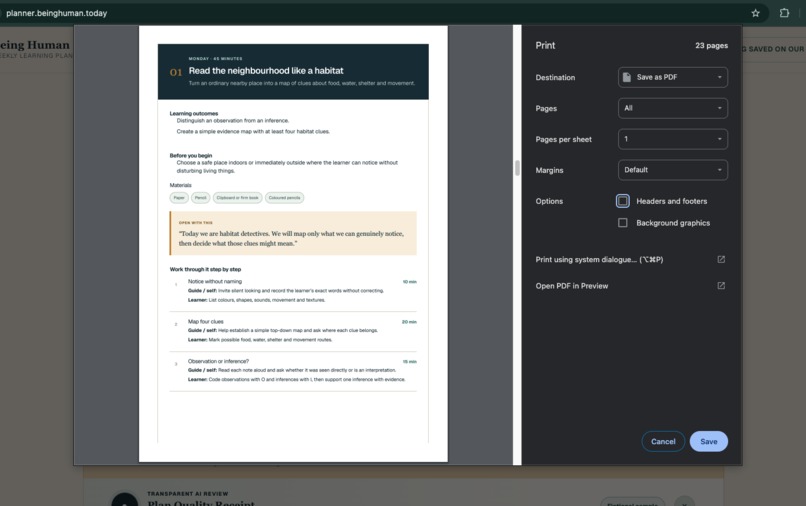
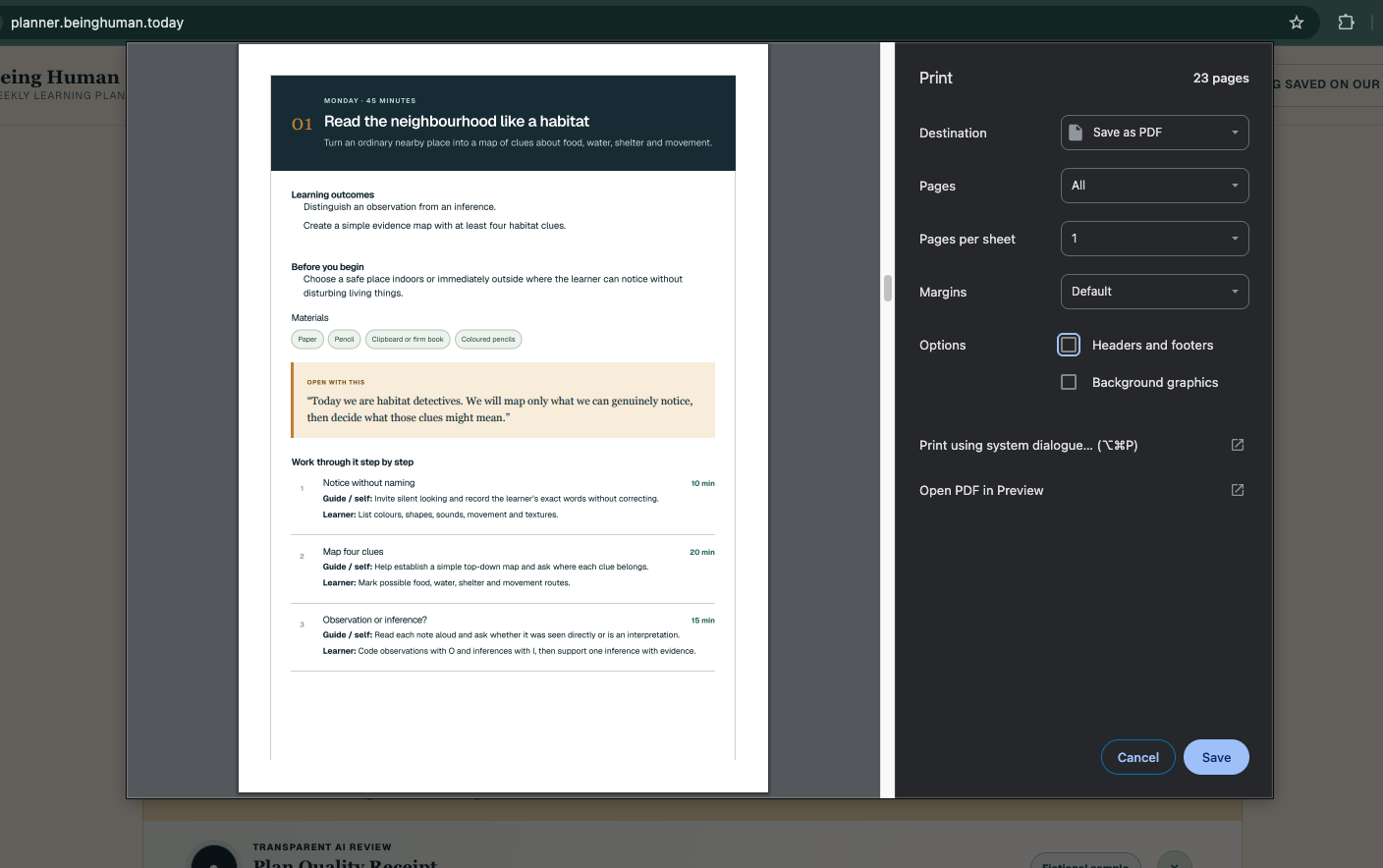
Print Preview
About the Project
The idea behind Being Human
Education should build a learning path around the learner—not place the learner somewhere on a standardised curriculum.
That belief is the foundation of Being Human.
I was inspired to build this project through my experience as a homeschooling parent. Homeschooling offers the freedom to create deeply personal learning experiences, but planning them well is demanding.
A parent may understand:
- what their learner is interested in;
- what they are currently capable of;
- what they want to develop;
- how much time they have available; and
- which materials they can access.
The difficult part is turning that understanding into a coherent learning experience.
Most existing resources still begin with a predetermined curriculum and attempt to determine where the learner should be placed within it. Being Human takes the opposite approach.
It begins with the human.
The learner’s goals, interests, current abilities, circumstances, and available time become the starting point. The learning pathway is then constructed around them.
Being Human is a much larger long-term vision. We are still refining the complete learning framework and building the Human Skills Map, which will eventually connect the foundations, pillars, domains, skills, micro-skills, and knowledge involved in becoming a capable, adaptable, and well-rounded human.
However, I did not want parents to have to wait until every part of that vision was complete before Being Human could help them.
I used Build Week as the motivation to turn the philosophy into something practical and usable now.
Being Human’s Weekly Learning Planner was created to help homeschooling parents, learning guides, educators, and adult learners turn a small amount of context into a detailed, personalised, ready-to-use week of learning.
It is the first practical step towards the wider Being Human vision: a learning system that understands where a learner is now, where they want to go, and what matters to them—and builds the pathway around that individual human.
What the Learning Planner does
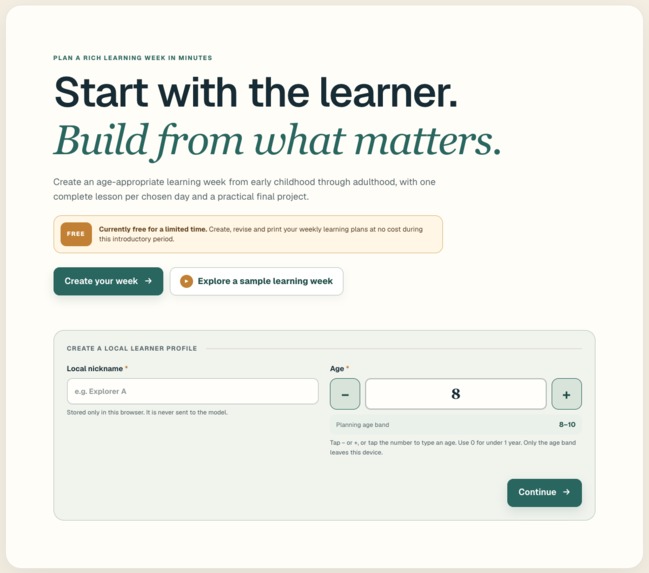
The user begins by entering non-identifying information about the learner, including:
- their age or age band;
- one or two goals for the week;
- their current interests;
- the days available for learning;
- the desired lesson length;
- available household materials;
- learning preferences or accessibility requirements;
- cultural or community context; and
- anything that should be avoided.
Rather than immediately generating one generic response, GPT-5.6 Luna proposes three meaningfully different learning journeys.
Each direction includes:
- a central learner question;
- a concept for each selected day;
- a purposeful final project;
- likely materials;
- relevant Being Human framework connections; and
- an explanation of why the direction suits the learner.
The user can choose one direction, select multiple directions, ask Luna to choose, regenerate the ideas, or skip directly to creating the plan.
This gives the adult meaningful control instead of forcing them to accept the first answer produced by the model.
A genuinely usable learning week
This learning planner is designed to produce more than a list of lesson ideas.
Each completed plan includes:
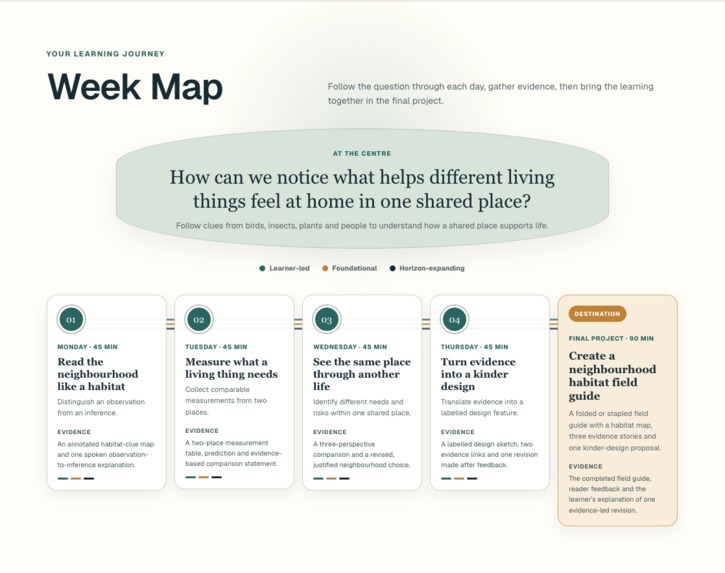
- a visual Week Map showing the overall learning journey;
- learner-led, foundational, and horizon-expanding learning threads;
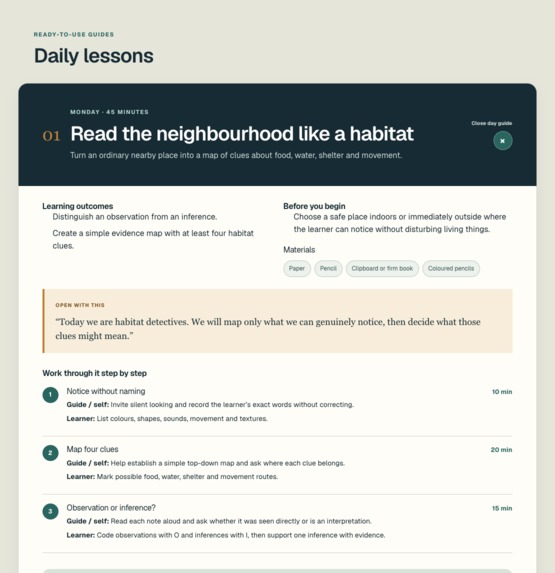
- a complete guide for each selected day;
- adult teaching scripts or adult-learner self-prompts;
- timed, step-by-step activities;
- questions and likely learner responses;
- checks for understanding;
- feedback guidance;
- adaptations for different needs and ability levels;
- relevant safety guidance;
- evidence and reflection prompts;
- a final project that applies learning from across the week;
- suggested printable resources;
- targeted revision tools;
- a transparent Plan Quality Receipt; and
- a printable Week Pack containing the essential materials.
When a goal is recognised as science-based, the plan must include an experiment involving elements such as a prediction, comparison, observation, measurement, recorded evidence, and appropriate safety guidance.
The result is intended to be something a parent can actually teach from—not an outline they must spend several more hours researching and developing.
The Being Human approach
The application is built around the Being Human learning framework.
The framework recognises that education is not simply the accumulation of isolated facts. Meaningful learning connects:
- knowledge;
- practical skills;
- micro-skills;
- personal capabilities;
- relationships;
- wellbeing;
- communication;
- creativity; and
- real-world application.
Luna uses the framework to translate a learner’s interests and goals into a balanced weekly experience.
A week may begin with something the learner is naturally curious about, while quietly strengthening broader capabilities through the activities, discussions, project work, reflection, and evidence collection.
For example, a learner interested in weather may not only study clouds and rainfall. They may also practise observation, measurement, record-keeping, pattern recognition, communication, creative representation, critical thinking, and evidence-based explanation.
This allows learning to remain interest-led without becoming directionless.
The goal is not to abandon structure. It is to create structure in service of the learner, rather than forcing the learner to serve the structure.
How it works
- Start with the learner
The adult enters the learner’s goals, interests, schedule, and relevant context.
- Explore possible learning journeys
Luna proposes three distinct directions rather than immediately selecting one path.
- Choose the best direction
The adult can choose one, select several, ask Luna to decide, regenerate the options, or continue without this step.
- Generate the complete week
Luna creates a detailed weekly plan using strict structured outputs and the Being Human framework.
- Validate the plan
Deterministic checks confirm that the selected days, lesson lengths, required fields, safety rules, and application boundaries have been followed.
- Repair narrow issues
Recoverable problems are corrected without unnecessarily discarding the entire plan.
- Review quality and factual claims
Optional teaching-quality and factual-review passes assess the last safe validated draft.
- Teach, adapt, and print
The user can explore the Week Map, expand individual lessons, revise specific sections, create resources, and generate a printable Week Pack.
How GPT-5.6 Luna is used
GPT-5.6 Luna is central to the runtime product experience.
It is used to:
- propose and rank three distinct learning journeys;
- interpret learner goals and interests;
- connect the week to the Being Human framework;
- generate detailed weekly plans as structured objects;
- create age-appropriate activities and explanations;
- produce adult guide scripts and self-directed prompts;
- design purposeful final projects;
- adapt plans for different learning needs;
- perform narrow repairs when deterministic rules are not met;
- review teaching quality;
- review factual statements;
- revise the whole plan, an individual lesson, or the final project; and
- generate printable resources such as fact sheets, quizzes, planners, observation sheets, and activity pages.
Structured Outputs allow the application to require the level of detail necessary for a usable teaching plan while still giving Luna creative freedom inside each part of the experience.
The application also uses gpt-image-2 to generate visual resources such as diagrams, colouring pages, and activity sheets.
How we built it
The entire application was built in Codex using GPT-5.6 Sol, over multiple rounds of planning, implementation, testing, debugging, and refinement.
Rather than attempting to generate the application from a single prompt, I worked with GPT-5.6 Sol continuously throughout Build Week.
Each round focused on a specific part of the product. I reviewed the results, tested the implementation, identified problems, made product decisions, and directed the next round of work.
GPT-5.6 Sol helped me:
- translate the Being Human philosophy and framework into clear product requirements;
- plan the application architecture;
- create shared Zod schemas;
- implement the Next.js interface;
- build the server-only OpenAI routes;
- create the learning-direction selection experience;
- implement multi-plan generation;
- build the visual Week Map;
- create the Plan Quality Receipt;
- develop the printable resource generator;
- create the Week Pack;
- implement privacy and local-storage utilities;
- add deterministic validation and repair systems;
- create accessibility, schema, route, rendering, and content-evaluation tests;
- diagnose issues found during real product testing;
- run production builds and browser checks;
- manage Git baselines and version history; and
- publish validated changes to the live application.
The application itself uses:
- Next.js 16;
- React 19;
- TypeScript;
- Zod;
- the OpenAI Responses API;
- OpenAI Structured Outputs;
- the OpenAI Moderation API;
- GPT-5.6 Luna;
gpt-image-2;- Server-Sent Events;
- browser
localStorage; - IndexedDB;
- CSS print layouts;
- Git;
- GitHub;
- Vinext, Vite, and Cloudflare tooling; and
- OpenAI Sites hosting.
The application has three main generation endpoints:
/api/directionsgenerates three ranked learning directions;/api/planmanages plan generation, revision, validation, repair, and review; and/api/resourcegenerates printable lesson and project resources.
The generation pipeline combines model reasoning with deterministic controls, including:
- input schema validation;
- privacy-pattern detection;
- input moderation;
- strict structured generation;
- selected-day validation;
- lesson-duration validation;
- safety and scope checks;
- checks for invented taxonomy identifiers;
- checks for unsupported curriculum-compliance claims;
- automatic narrow repairs;
- output moderation;
- teaching-quality review;
- factual review; and
- the Plan Quality Receipt.
This combination allows Luna to generate creative and personalised learning experiences while the application remains structured, predictable, inspectable, and safe.
Although GPT-5.6 Sol was used to build the entire application, the key product decisions remained human decisions.
These included:
- beginning with the learner rather than a standardised curriculum;
- making the experience adult-facing;
- keeping learner information local wherever possible;
- allowing optional model reviews to be skipped;
- presenting several possible learning directions;
- preserving adult control over the final pathway;
- refusing to silently fall back to another text model;
- avoiding external-resource searches in the current version; and
- creating a calm learning workspace rather than school administration software.
GPT-5.6 Sol made it possible for me, as someone new to Codex, to design, build, test, and refine a complete working application across multiple iterations.
However, human direction, judgement, taste, and persistence remained essential throughout every round.
Privacy and responsible use
Being Human is designed for adults to use when planning learning.
Learner profiles and generated plans are stored locally in the browser. Exact ages and local nicknames remain on the device. Generation requests use anonymised age bands and planning text that the user confirms is non-identifying.
The application also rejects obvious patterns such as:
- email addresses;
- phone numbers;
- street addresses; and
- URLs.
Users are clearly instructed not to enter real names, diagnoses, school information, contact details, or other identifying information.
Every plan is presented as an AI-assisted draft requiring adult judgement regarding accuracy, suitability, safety, and local requirements.
Design
The interface is designed to feel like a calm home-learning workspace rather than school administration software.
Its visual language uses:
- warm ivory;
- deep ink;
- muted teal;
- ochre;
- sage;
- generous spacing; and
- rounded cards.
The Week Map leads with the learner’s central question and makes the overall journey understandable before presenting the full teaching detail.
Preparation and framework mapping are collapsible, each daily guide expands independently, and resources are placed inside the relevant lesson or project.
The generation wait is also treated as part of the product experience.
A pinned progress panel remains visible while the main interface introduces the Being Human framework and explains what is happening. When the plan is complete, a prominent action appears both at the top of the page and inside the progress panel.
The interface includes:
- keyboard navigation;
- visible focus states;
- accessible labels;
- live status announcements;
- large touch targets;
- responsive layouts;
- reduced-motion support; and
- dedicated print styling.
Challenges
Starting with an application that was too large
We originally began Build Week by building a much larger Being Human application.
The goal of that application was to understand a learner’s current state, identify where they wanted to go, map their goals to relevant skills and micro-skills, reveal meaningful gaps, and generate an adaptive pathway through the complete Being Human framework.
As development progressed, it became clear that we would not be able to complete that full experience within the hackathon timeframe—at least not to the polished and genuinely usable standard we wanted.
The larger application also depends on two key enablers that are still being developed:
- the completed Being Human learning framework; and
- the complete Human Skills Map.
Rather than submitting a broad but unfinished prototype, we made the difficult decision to stop and start again.
We selected one narrow but valuable experience from the larger application: turning a learner’s goals, interests, circumstances, and available time into a complete weekly learning plan.
This allowed us to build and polish an end-to-end product that parents can genuinely use now, while still demonstrating the central Being Human philosophy.
The original application has not been abandoned. It remains the end goal for Being Human, and we intend to build it once the framework development and skill mapping are sufficiently complete to support it properly.
Making a long AI task feel trustworthy
Generating a complete learning week and reviewing it takes time.
Early versions appeared frozen even when the server was still working. We introduced:
- streamed server milestones;
- honest estimated progress;
- a pinned progress panel;
- useful reading content during generation; and
- an explicit completion button.
The application does not automatically move the user away when generation finishes.
Balancing structure and creativity
A detailed schema creates reliable outputs, but it can also magnify small model inconsistencies.
We added:
- schedule normalisation;
- semantic checks;
- narrow repair prompts;
- retry handling; and
- deterministic validation.
This preserves creative teaching ideas while ensuring the final structure remains usable.
Preventing checks from destroying good work
Earlier versions could reject an otherwise strong plan because of a small wording issue or an incomplete optional review.
The pipeline was redesigned so that:
- narrow issues are repaired;
- optional review failures do not destroy the plan;
- the last safe validated draft is preserved; and
- incomplete checks are recorded transparently.
Supporting learners of every age
The application supports learners from early childhood through adulthood.
This required more than changing vocabulary.
Age guidance affects:
- the form of the activity;
- the expected independence;
- lesson pacing;
- the role of the adult;
- the type of evidence collected;
- the complexity of the questions;
- safety requirements; and
- the design of printable resources.
Producing useful printable materials
Browser printing introduced several challenges, including page breaks, blank pages, resource dimensions, and conflicting print states.
These were addressed through isolated print modes, content-specific layouts, and verified page rules.
Building while the wider framework is still evolving
The complete Being Human framework and Human Skills Map are still being developed.
One of the challenges was determining which parts of the larger vision needed to exist now and which could remain future work.
Rather than trying to complete the entire framework and platform during Build Week, I focused on creating a valuable standalone experience that still demonstrated the core philosophy.
The Weekly Learning Planner uses the current framework to create practical, personalised weeks today, while leaving room for the broader skills map, learner progression, long-term evidence, and pathway features to be added later.
Learning to work effectively with Codex
I began the hackathon as a novice Codex user, having installed the new ChatGPT application specifically for Build Week.
I initially found trying to manage several tasks at once overwhelming. The most effective approach was to focus on one clearly defined piece of the application at a time, test it, and then move to the next task.
This made development slower in some places, but it also gave me a clearer understanding of what was being built and allowed me to apply human judgement at every stage.
Accomplishments
Being Human became a complete working product rather than a simple generation demonstration.
The finished experience includes:
- a public application with no login required;
- an instant fictional sample;
- three distinct learning directions;
- multi-week generation;
- detailed plans across all supported age bands;
- automatic experiments for science-based goals;
- streamed generation progress;
- skippable review stages;
- transparent quality receipts;
- targeted AI revisions;
- persistent lesson and project resources;
- image and document resource generation;
- a printable Week Pack;
- device-local learner profiles and history;
- mobile support;
- keyboard navigation;
- reduced-motion support;
- dedicated print styling; and
- automated success, recovery, and failure tests.
What I learned
The best use of AI in education is not to remove every human decision.
It is to give the human better options.
Parents and learning guides benefit from seeing several possible pathways and choosing which one best fits their learner. That creates a collaborative relationship between the adult and the model rather than asking the adult to accept a single opaque answer.
I also learned that reliability does not come from one successful model call.
It comes from combining:
- structured generation;
- deterministic validation;
- narrow repair;
- moderation;
- model review;
- transparent progress;
- graceful fallbacks; and
- human judgement.
Progressive disclosure also proved critical. The content became much more usable once the Week Map, collapsible guides, targeted resources, and printable pack gave the information a clear hierarchy.
I learned that narrowing the scope of a project does not mean abandoning the larger vision.
Beginning again was a difficult decision after already investing time in the larger application. However, focusing on one complete experience allowed us to produce something more polished, understandable, and useful than a partially completed version of the entire platform.
The Weekly Learning Planner is not a replacement for the wider Being Human application. It is the first useful component of it.
I also learned that a large vision does not need to be complete before it can begin delivering value.
The full Being Human framework and Human Skills Map will take time to develop properly. Build Week forced me to identify the smallest part of that vision that could stand on its own and genuinely help someone today.
Most importantly, I learned that even when working with the latest AI tools, human direction and taste are still essential.
AI can help create and implement possibilities at extraordinary speed. It still needs a clear philosophy behind it.
For Being Human, that philosophy is simple:
The learner should not be fitted into the learning system. The learning system should be built around the learner.
Potential impact
Being Human is intended for adults who want to provide personalised learning but do not have hours to convert an idea into a complete teaching sequence.
It can help them:
- move from learner interest to purposeful learning more quickly;
- teach confidently without formal teacher training;
- connect daily activities into a coherent journey;
- adapt learning without rebuilding the entire week;
- use ordinary household materials;
- collect authentic evidence through conversation, observation, creation, and application;
- compare several possible learning pathways; and
- retain control over the final learning experience.
The wider opportunity is to make learner-centred education more accessible.
Personalised education should not require every parent or learning guide to become a full-time curriculum designer.
AI can help carry the planning burden while allowing the learner’s humanity—their interests, needs, goals, abilities, relationships, and circumstances—to remain at the centre.
The Weekly Learning Planner is only the beginning.
As the Human Skills Map is completed, Being Human could help learners and their guides understand:
- which capabilities they are already developing;
- which skills and micro-skills support their goals;
- where meaningful gaps may exist;
- how different interests connect across the framework;
- what evidence demonstrates real capability;
- which pathways could be explored next; and
- how learning can remain balanced without becoming standardised.
What’s next
The next steps for Being Human include:
- testing the planner with homeschooling families, educators, and adult learners;
- continuing to refine the Being Human learning framework;
- completing and validating the Human Skills Map;
- returning to the development of the larger Being Human pathway application;
- developing human-reviewed benchmark plans across different ages and contexts;
- creating a clearer evidence loop from one week into the next;
- connecting completed learning experiences to skills and micro-skills over time;
- helping learners assess their current capabilities and identify meaningful next steps;
- improving accessibility through assistive-technology testing;
- adding optional trusted-source support with citations;
- expanding printable resource layouts;
- adding resource-editing controls;
- completing a formal privacy and data-retention review; and
- developing safe sharing and export options that preserve the local-first model.
The long-term vision is for Being Human to understand where a learner is now, where they want to go, and what matters to them—and then help construct a living, adaptable learning pathway around that individual human.
The completed framework and Human Skills Map will be key enablers of that vision. Once they are sufficiently developed, the work will continue on the larger application we originally set out to build.
Built with
- OpenAI Codex
- GPT-5.6 Sol
- OpenAI Responses API
- GPT-5.6 Luna
- OpenAI Structured Outputs
- OpenAI Moderation API
gpt-image-2- Next.js 16
- React 19
- TypeScript
- Zod
- Server-Sent Events
- Browser
localStorage - IndexedDB
- CSS print layouts
- Vinext
- Vite
- Cloudflare tooling
- OpenAI Sites hosting
- Git
- GitHub
Testing instructions for judges
No account or login is required.
Full generation path
Use non-identifying information such as:
- Local nickname: Weather Maker
- Age: 8
- Goal: Observe weather patterns and explain one conclusion using evidence.
- Interests: Clouds, drawing, and making simple tools.
- Days: Monday–Thursday
- Duration: 45 minutes
- Materials: Paper, string, tape, cups, and recycled cardboard.
Then:
- Confirm the privacy reminder.
- Select Choose a week direction.
- Build the first-ranked direction as one complete week.
- Follow the generation progress.
- When complete, select View my learning week.
- Expand a daily guide and inspect its script, steps, questions, and adaptations.
- Generate one suggested Luna text resource, such as a fact sheet.
- Try a targeted revision such as:
Use fewer materials and make this more hands-on. - Check out the print friendly view at the top of the page
Generation and resource creation make live model calls and may take over a minute. The progress interface remains visible throughout.
Do not enter real names, contact details, diagnoses, addresses, or school information.
Built With
- codex
- git
- github
- gpt-5.6-luna
- gpt-5.6-sol
- gpt-image-2
- next.js
- openai-api
- react
- sites
- typescript
- zod


Log in or sign up for Devpost to join the conversation.