Inspiration
We were inspired by a simple concern: justice may take time, but evidence may not.
CCTV footage can be overwritten, digital records can disappear, witnesses may become unavailable, medical conditions can change, and physical locations can be altered before a case reaches its next hearing. We wanted to build something that helps authorized legal teams notice these risks early, without trying to replace human judgment.
What it does
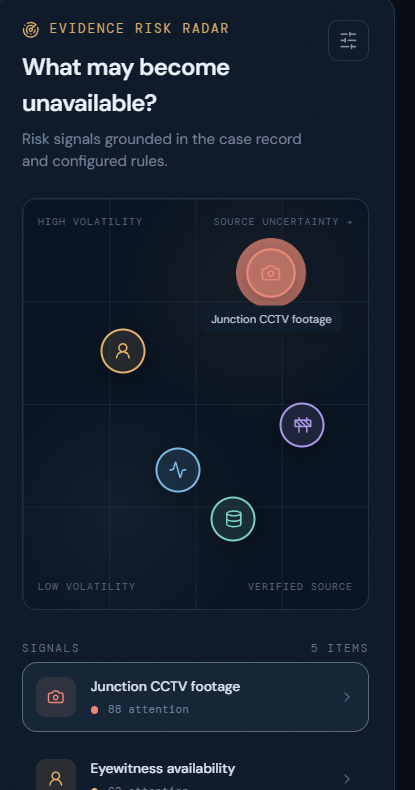
BeforeItFades reviews case information and identifies evidence that may become unavailable over time.
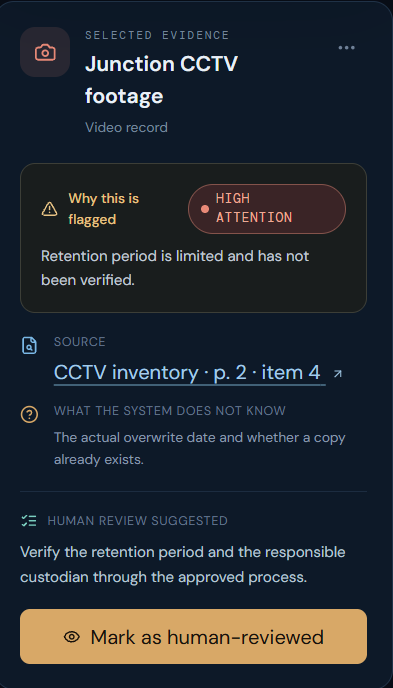
For each alert, it shows:
- Why the evidence was flagged
- The original source record
- What information is still unknown
- How the risk may change over 30, 90, or 180 days
- A practical checklist for human review
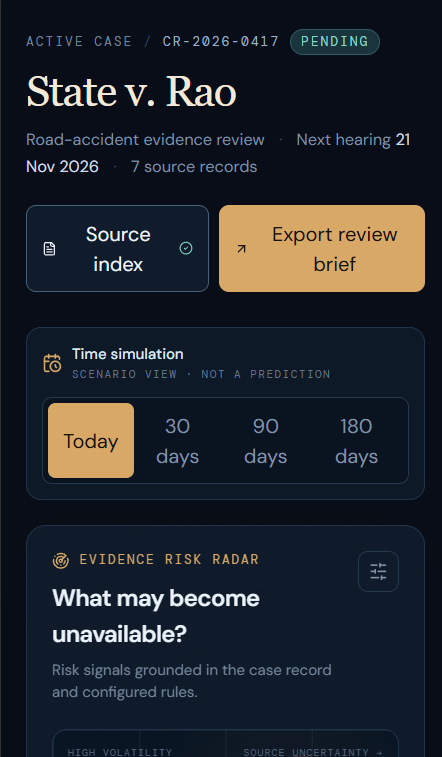
Our prototype uses a fictional road-accident case involving CCTV footage, an eyewitness, medical records, an accident site affected by construction, and vehicle telematics data.
BeforeItFades does not decide guilt, evaluate witness credibility, predict judgments, or recommend court orders. It only helps authorized humans understand what may be lost before a case is heard.
How we built it
We built BeforeItFades as a responsive React and TypeScript web application.
The main interface includes:
- An Evidence Risk Radar
- Source-linked alert explanations
- Time-based scenario simulation
- An Evidence Library
- A human-review preservation checklist
- A provenance and review-history panel
The prototype uses transparent risk signals instead of presenting unexplained legal predictions. Each signal is connected to a source record and includes uncertainty where information is missing.
We used AI-assisted development tools for ideation, implementation support, debugging, and documentation. We reviewed, tested, and customized the final implementation ourselves. The case data in the demo is synthetic. Challenges we ran into
The biggest challenge was building a legal technology tool without making it appear to replace legal professionals.
We had to be careful with the language used in the interface. For example, the system should say that a witness’s availability requires review, not that the witness is unreliable. It should show that CCTV retention is unverified, not claim that the footage will definitely be deleted.
We also had to balance simplicity with explainability. A judge or court staff member should be able to understand why an alert appeared without reading a technical explanation. This led us to connect every alert to its source, rule, uncertainty, and review status.
Another challenge was designing a convincing prototype within limited time. Instead of trying to build a complete court-management system, we focused on one clear workflow: case → risk → source → time simulation → human review → preservation checklist.
Accomplishments that we're proud of
We are proud that BeforeItFades turns an abstract problem into a clear and demonstrable workflow.
The prototype:
- Makes evidence-loss risk visible at a glance
- Links alerts to their original sources
- Shows uncertainty instead of hiding it
- Simulates different time horizons
- Creates an actionable human-review checklist
- Preserves a review history
- Works across desktop and mobile layouts
- Clearly separates decision support from judicial decision-making
We are especially proud of the safety boundary. BeforeItFades does not try to decide the case. It helps protect the information needed to understand the case later.
What we learned
We learned that explainability matters more than making a system sound intelligent.
In a legal setting, an alert is only useful when a reviewer can answer three questions:
- Why did this alert appear?
- Which source supports it?
- What does the system still not know?
We also learned that responsible AI design is not just about adding a disclaimer at the end. Human review, source provenance, uncertainty labels, and restricted actions need to be part of the product itself.
Finally, we learned that a focused prototype can be more convincing than a large system with too many unfinished features.
What's next for BeforeItFades
The next version would add secure authentication, role-based access, persistent case storage, and real document upload.
We would also like to add:
- AI-assisted extraction from PDFs and scanned records
- Configurable retention and preservation rules
- Reviewer comments and team assignments
- Secure document storage and audit logs
- PDF export for internal review briefs
- Jurisdiction-specific workflows
- Pilot testing with legal-aid organizations and court innovation teams
Before any real-world deployment, the system would need privacy review, security testing, institutional approval, and validation with authorized legal professionals.
Our long-term goal is to help legal teams identify preservation risks earlier while keeping every important decision with a human.
BeforeItFades does not decide the case. It protects the case from time.
Built With
- ai-assisted
- css
- data
- deployment
- design
- development
- elevenlabs
- hosting
- legal
- react
- rule-based
- typescript
- web
- webdev


Log in or sign up for Devpost to join the conversation.