-
-
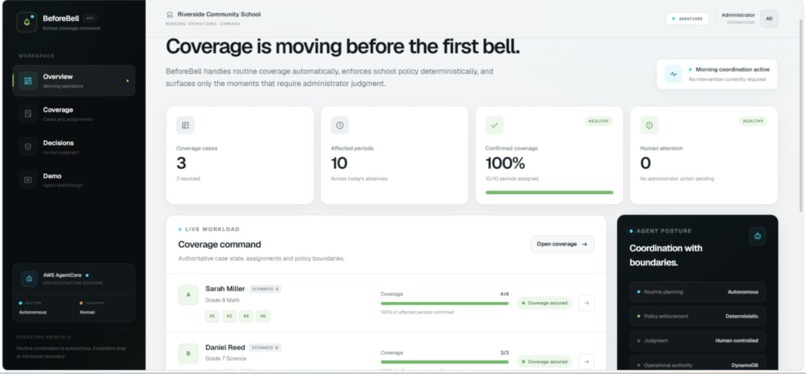
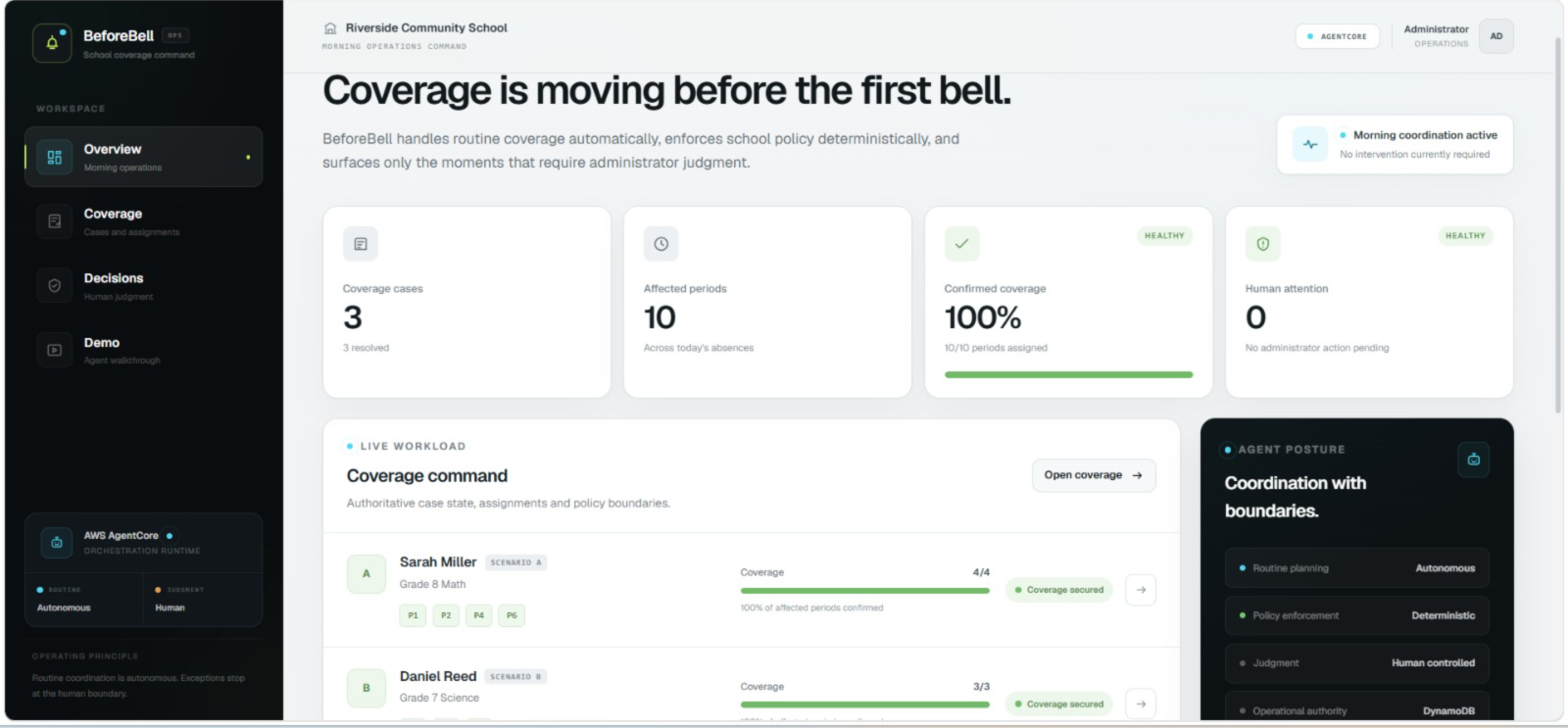
Healthy baseline: 100% confirmed coverage with no administrator attention required.
-
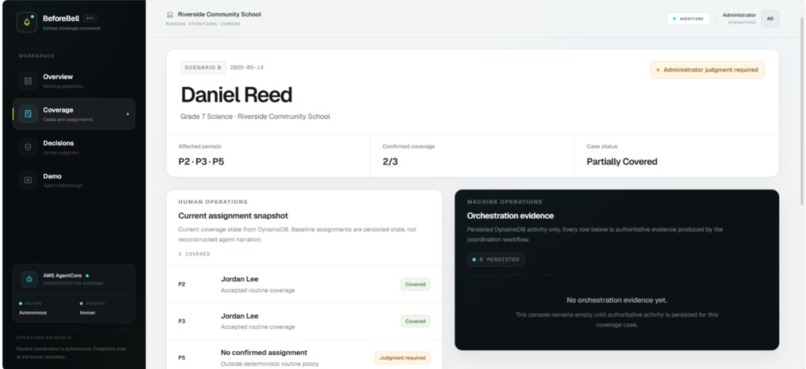
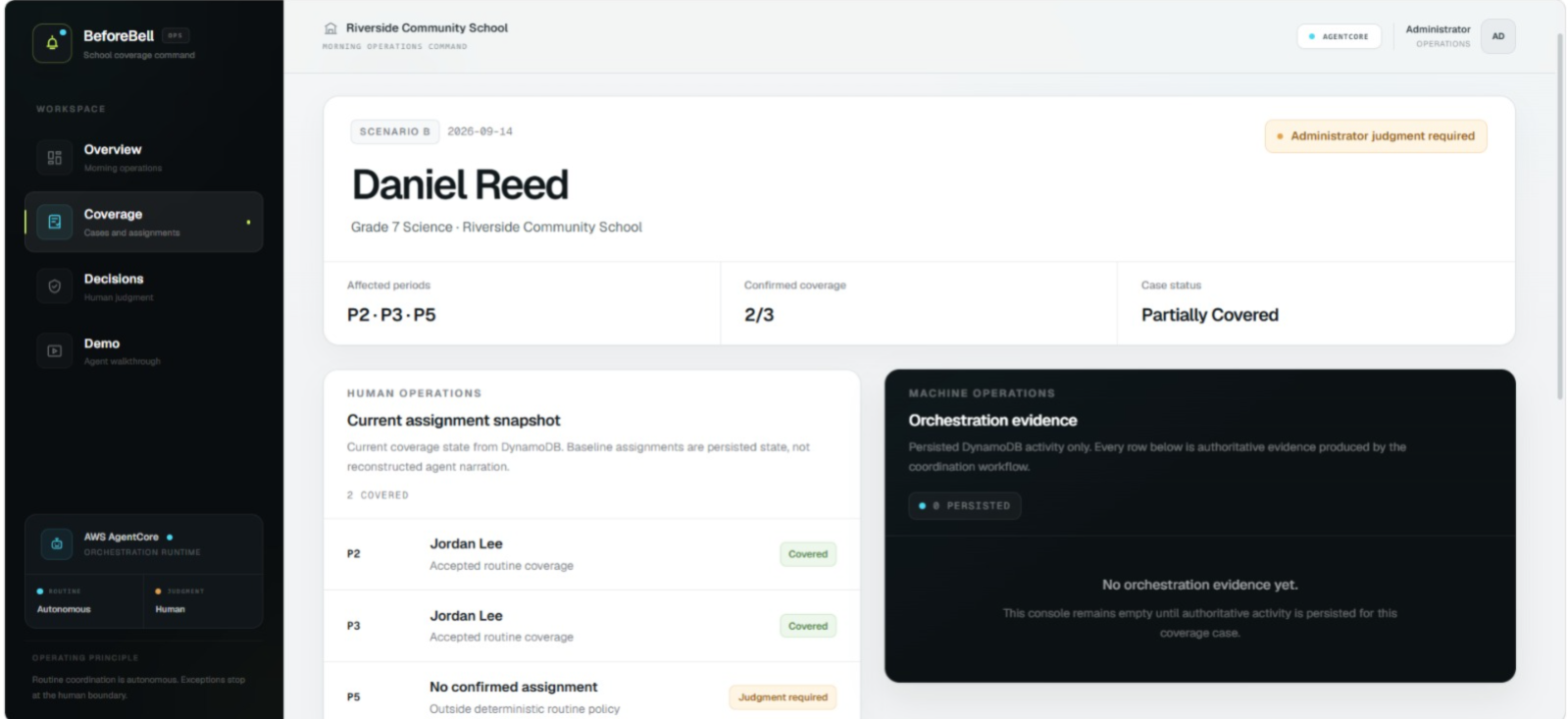
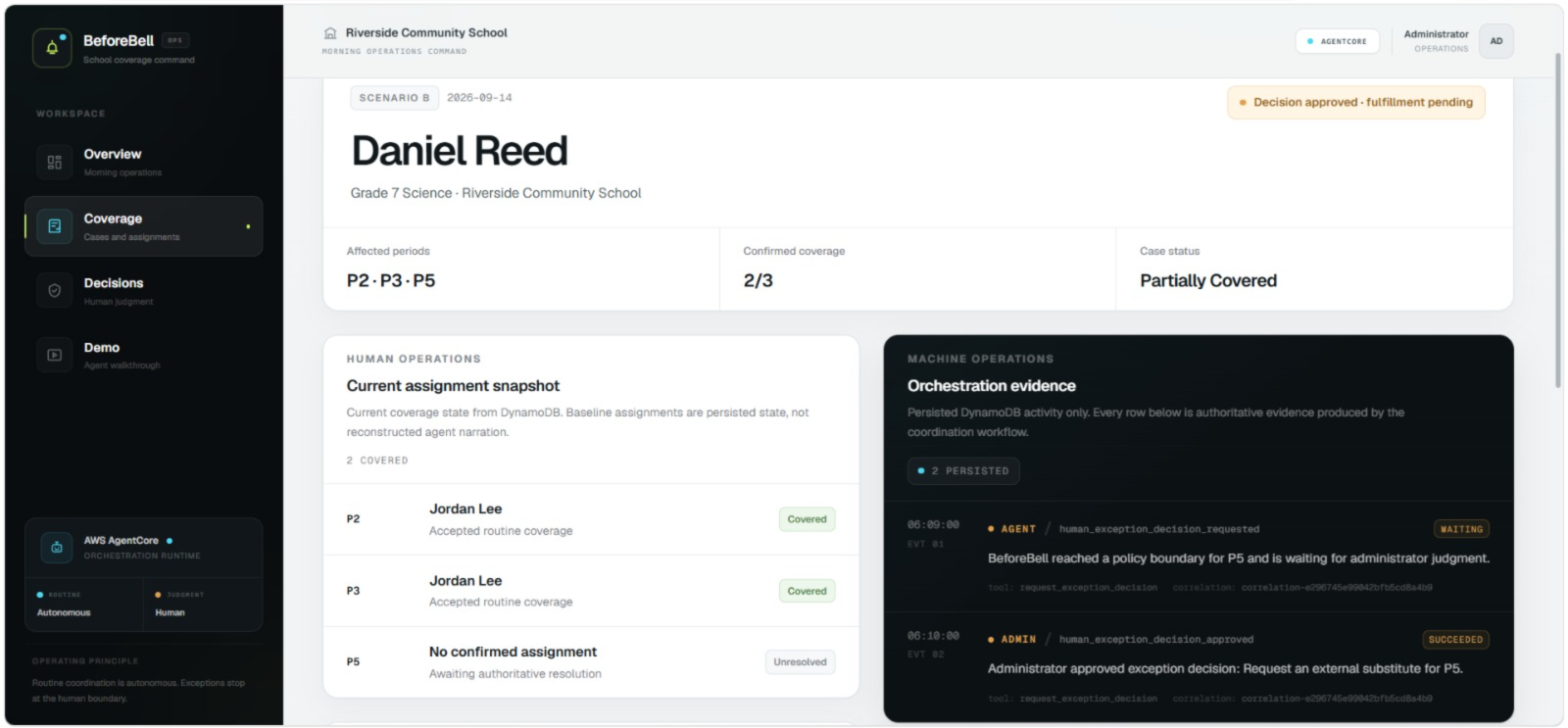
Scenario B begins: Daniel Reed is 2/3 covered, while P5 remains outside deterministic routine policy.
-
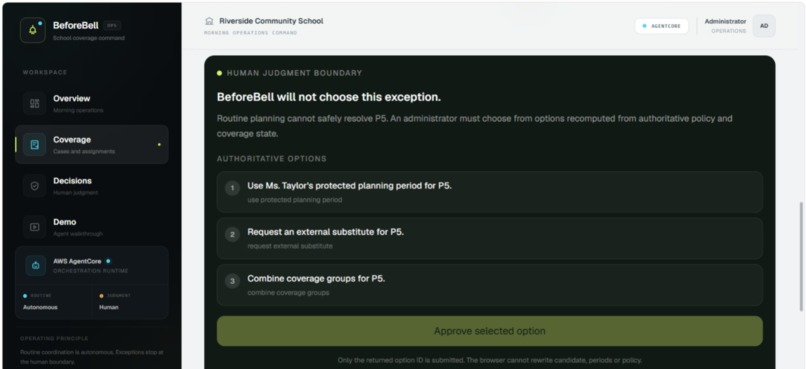
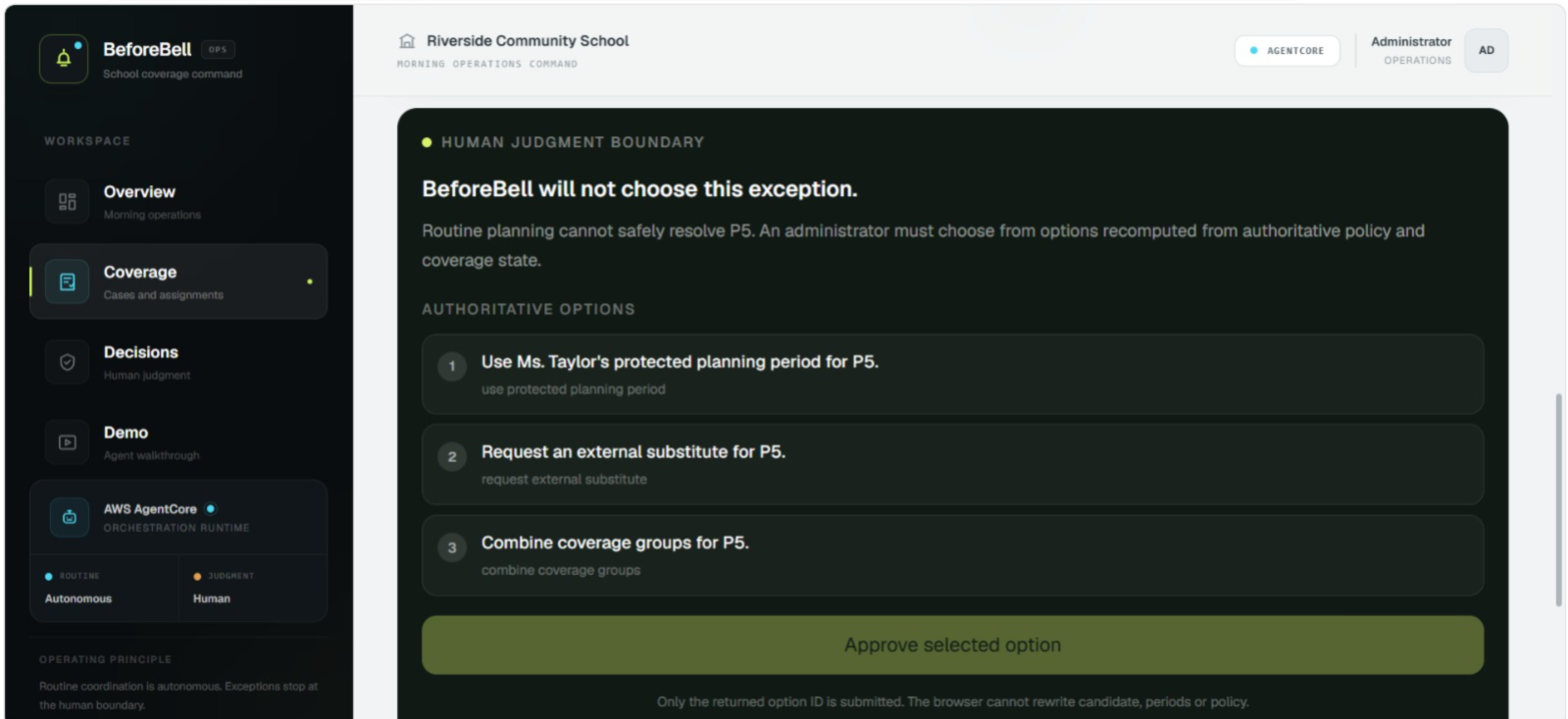
Human judgment boundary: BeforeBell stops and presents only policy-authorized options to the administrator.
-
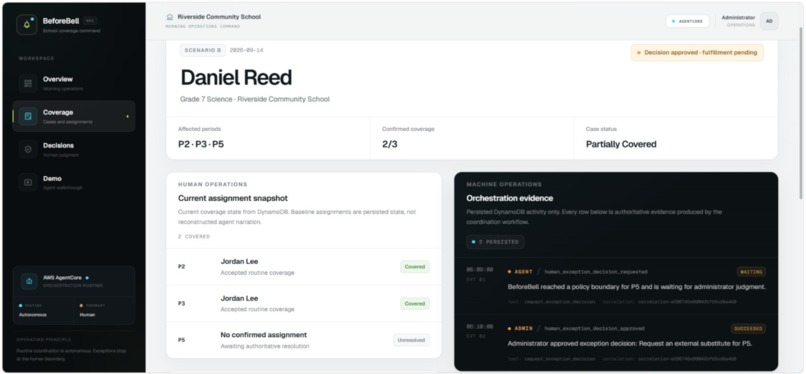
Approval is not execution: the decision is approved, but P5 still has no confirmed assignment.
-
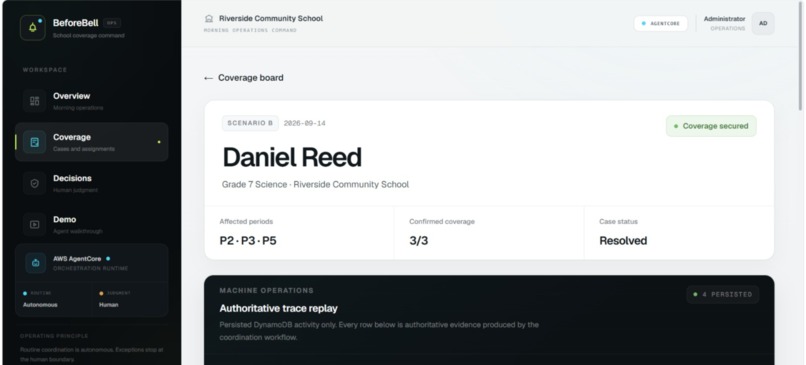
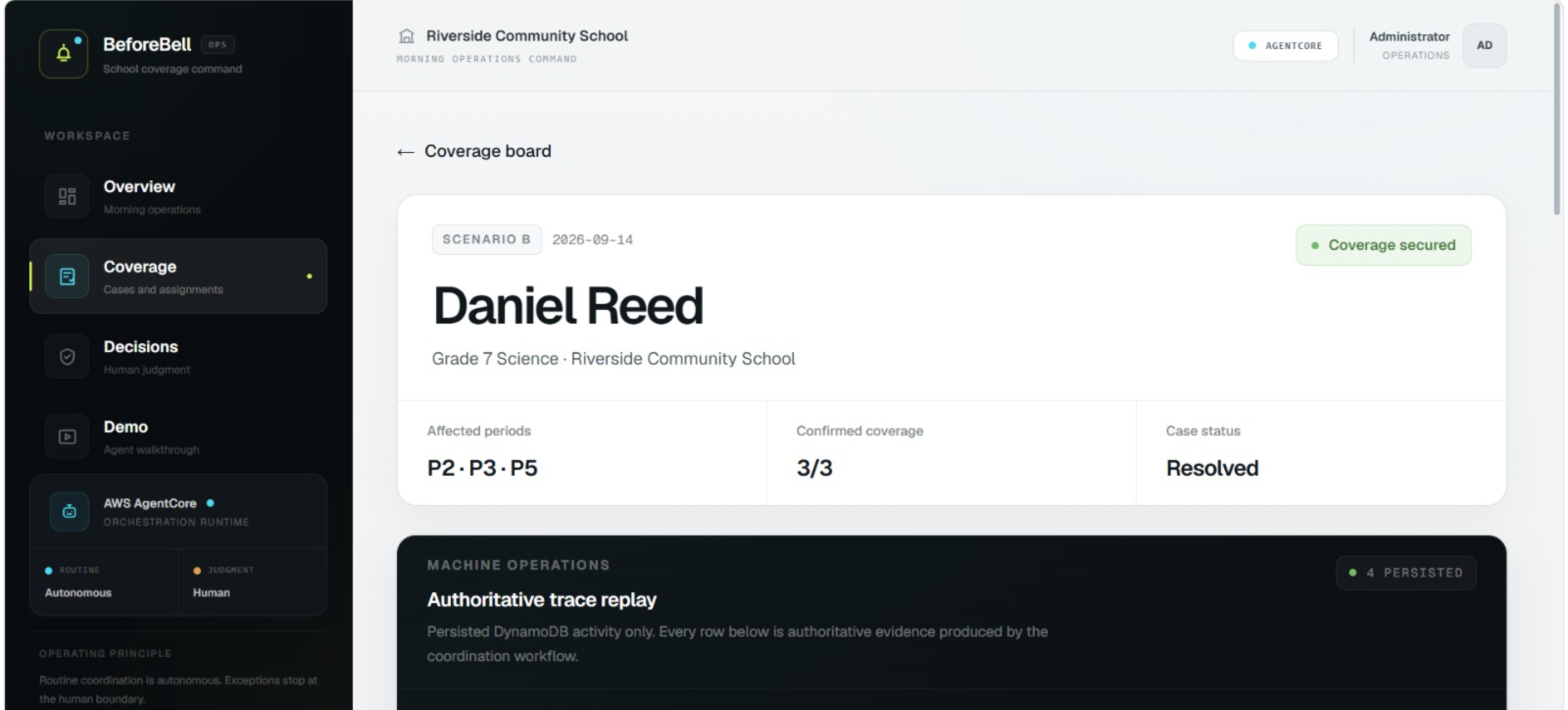
Trusted fulfillment completes the work: P5 is assigned, coverage reaches 3/3, and the case resolves.
-
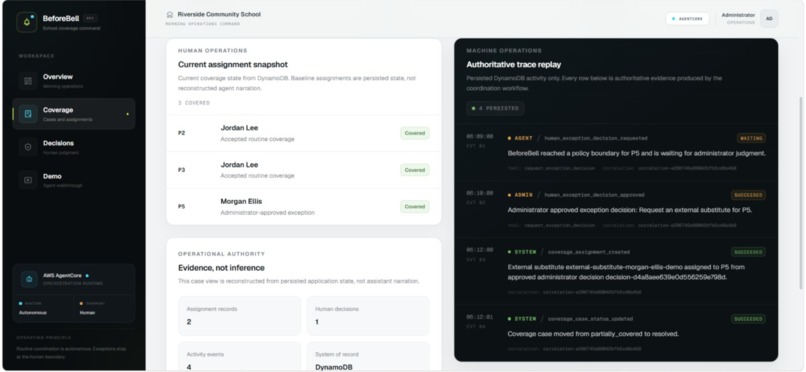
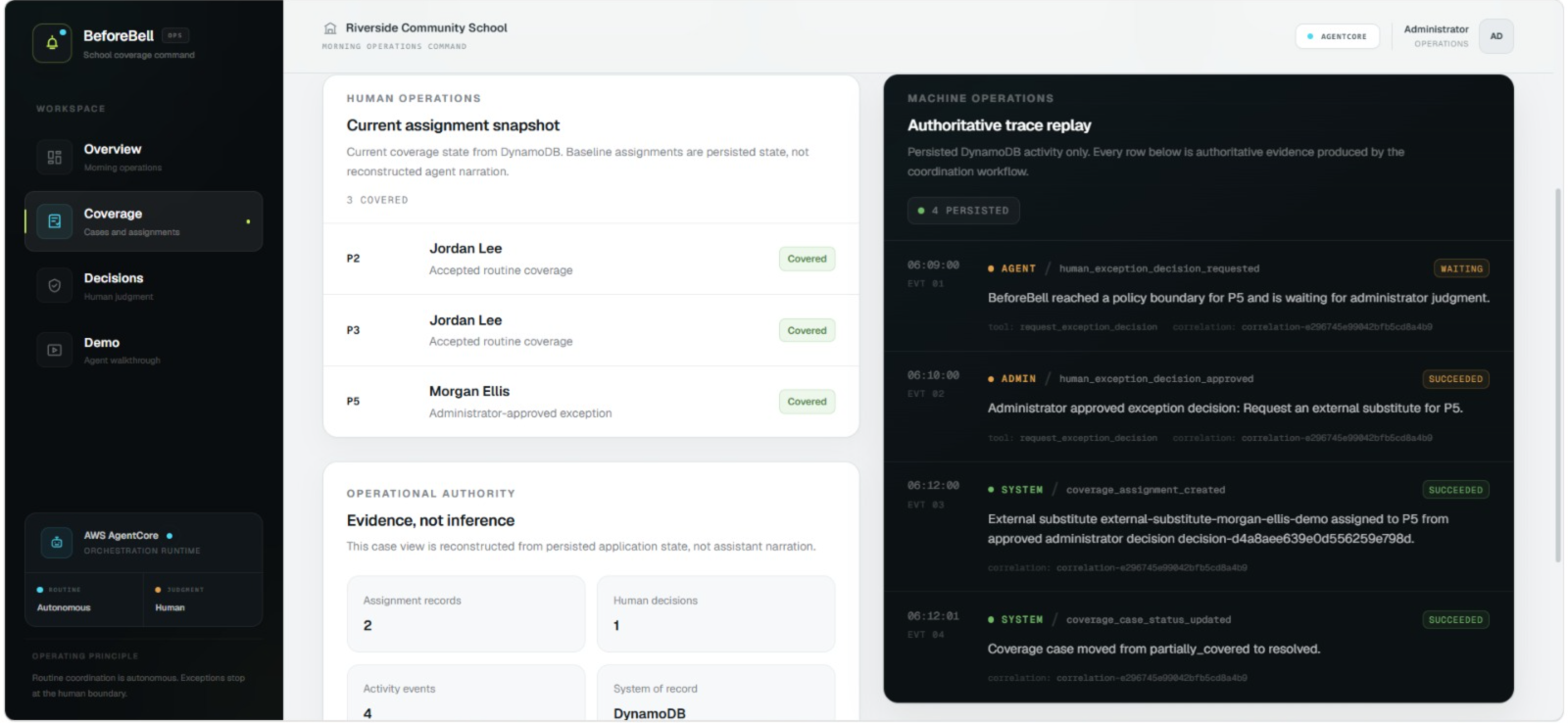
Authoritative DynamoDB trace: agent request → admin approval → assignment creation → case resolution.
Inspiration
A teacher calling in absent before the school day starts sounds like a simple problem until you think about everything that has to happen afterwards.
Someone has to work out which periods are affected, find teachers who are actually available and eligible, avoid timetable conflicts, respect protected planning periods, confirm the coverage, and know when the situation has gone beyond what should be decided automatically.
All of that is happening while the school day is getting closer.
The problem is not that administrators cannot make these decisions. It is that they often spend some of their most time-sensitive morning minutes coordinating routine work before they can get to the decisions that genuinely need them.
And the effects spread beyond the administrator. Students still need coverage, teachers should not casually lose protected planning time, and unresolved absences can disrupt an entire school morning.
That led to the principle behind BeforeBell:
Safe routine decisions happen automatically. Judgment stays human.
BeforeBell is a school-operations agent built to handle the coordination around those people, without pretending that every decision should be handed over to AI.
Potential impact
The problem BeforeBell addresses is not just a hypothetical school workflow.
In October 2024, 50% of U.S. public-school leaders told the National Center for Education Statistics that their school felt understaffed.
Among schools operating with at least one teaching or non-teaching staff vacancy, 42% reported an increased need to use teachers outside their intended duties, while 43% reported increased use of non-teaching staff outside their intended duties.
Substitute availability remains a major constraint too. RAND's American School District Panel found that half of surveyed U.S. school districts still reported a considerable shortage of substitute teachers in fall 2023.
There is also evidence of what happens when normal substitute coverage fails.
In a detailed study using data from a large urban school district, uncovered teacher absences were handled by splitting students into other classrooms about 37% of the time, using another teacher during a prep period about 35% of the time, and having an administrator cover the class about 12% of the time.
Those fallback options look remarkably similar to the exact pressure BeforeBell is designed around: protect planning periods, avoid unnecessary disruption to other classrooms, find safe coverage when possible, and involve an administrator when routine options are no longer enough.
BeforeBell does not claim to solve teacher or substitute shortages.
It targets the coordination pressure those shortages and everyday absences create.
The goal is narrower and measurable:
Find safe coverage quickly, preserve teachers' protected time whenever routine policy allows, reduce unnecessary administrator involvement, and keep unresolved periods visible until coverage actually exists.
Sources: National Center for Education Statistics School Pulse Panel, 2024–25 Staff Vacancies (October 2024); RAND, Staffing, Budget, Politics, and Academic Recovery in Districts: Selected Findings from the Fall 2023 American School District Panel Survey; Liu, Loeb, and Shi, More Than Shortages: The Unequal Distribution of Substitute Teaching (Education Finance and Policy, 2022).
What it does
BeforeBell handles teacher-absence coverage from the moment a case appears through to actual resolution.
For routine cases, it can identify affected periods, evaluate eligible teachers, check availability and workload, avoid conflicts, enforce school policy, create safe assignments, and keep the case moving without waiting for an administrator to approve something the system already knows is allowed.
But when the workflow reaches something school policy cannot safely decide automatically, BeforeBell stops.
It does not ask the language model to improvise an exception.
The live Strands workflow pauses and brings in an administrator with a bounded set of permitted options.
That is where one of the most important rules in BeforeBell comes in:
Approval is authorization, not execution.
If an administrator approves an external substitute, BeforeBell does not immediately mark the class as covered.
The administrator has decided what the school is willing to do.
The system still has to prove that it actually happened.
Until trusted fulfillment confirms the substitute and creates the assignment, the affected period remains visibly unassigned.
That lets BeforeBell distinguish between:
- what the agent proposed;
- what the administrator authorized;
- what the system actually executed; and
- when the case truly became resolved.
Every important step is also preserved as evidence rather than reconstructed later from AI narration.
A concrete example
The centerpiece scenario follows a synthetic absence case for Daniel Reed, a Grade 7 Science teacher who needs coverage for P2, P3, and P5.
BeforeBell safely handles P2 and P3 through normal school policy.
P5 is different.
The available internal option would require crossing a protected planning boundary.
BeforeBell does not decide that the rule is inconvenient and continue anyway.
Instead, the workflow stops and asks the administrator to choose from permitted options, including:
- using a protected planning period;
- requesting an external substitute; or
- combining coverage groups.
Those options are intentionally meaningful because they resemble the kinds of tradeoffs schools can face when normal substitute coverage is unavailable.
The administrator chooses the external substitute path.
But P5 still has no confirmed assignment.
That is intentional.
Only when trusted fulfillment later confirms Morgan Ellis for P5 does BeforeBell create the assignment and move the case to resolved.
The evidence therefore shows four separate moments:
- the agent requested human judgment;
- the administrator approved a permitted option;
- trusted fulfillment created the assignment;
- the case moved from partially covered to resolved.
That difference is central to BeforeBell.
It is not just an AI system recommending what someone could do.
It is an agentic workflow capable of performing real operational work while keeping human judgment and actual execution separate.
Why BeforeBell is different
Teacher-absence coverage itself is not the invention behind BeforeBell.
Schools already have timetables, staffing rules, substitute processes, and people capable of deciding who should cover a class.
The part I wanted to rethink was how much of that coordination an autonomous agent should be allowed to complete before human authority is genuinely required.
BeforeBell is not intended to be another chatbot sitting beside an administrator and suggesting possible substitutes.
It is also not trying to automate every decision simply because an AI model is available.
The system is built around a different operating model:
Automate routine coordination end to end, and stop exactly where judgment begins.
For routine cases, BeforeBell can carry the workflow from an absence through candidate evaluation, policy checks, assignment, and persisted evidence without requiring an administrator to approve something the system already knows is safe.
But when the workflow reaches a policy boundary, the agent deliberately loses authority.
It stops.
A human makes the judgment call.
And even then, the human decision does not magically become operational truth.
Approval is authorization, not execution.
The administrator decides what the school is willing to do.
Trusted fulfillment still has to prove that the approved action can actually happen before BeforeBell changes authoritative assignment state.
That creates three distinct responsibilities:
- The agent coordinates the work.
- The human owns exceptional judgment.
- Trusted fulfillment proves that the authorized action actually happened.
The AI model can reason about the workflow.
It cannot simply decide what becomes true.
That separation between autonomy, judgment, and execution is the central idea behind BeforeBell.
How we built it
BeforeBell deliberately separates agent orchestration, school policy, human judgment, trusted fulfillment, and authoritative evidence.
The web application is built with Next.js and TypeScript.
The agent is built with the Strands Agents SDK and deployed through Amazon Bedrock AgentCore Runtime, so the agent runs in a hosted AWS environment rather than remaining a local demonstration.
The Strands agent coordinates the workflow and can use Amazon Bedrock for reasoning, but it is not the school-policy engine.
Deterministic BeforeBell tools enforce rules such as:
- candidate eligibility;
- availability and workload;
- timetable conflicts;
- protected planning periods;
- assignment safety;
- workflow invariants; and
- permitted state changes.
When those rules determine that routine automation should stop, the Strands workflow reaches a real human-in-the-loop interruption.
The administrator then chooses from the options the workflow permits.
Afterward, trusted fulfillment performs the approved action and revalidates it before final state is changed.
Amazon DynamoDB is the system of record for cases, assignments, policies, human decisions, and workflow evidence.
The responsibility boundary is therefore:
- Strands Agents SDK coordinates the workflow.
- Amazon Bedrock AgentCore Runtime hosts the agent.
- Deterministic application logic protects school policy.
- Humans own decisions that genuinely require judgment.
- Trusted fulfillment performs authorized operational actions.
- DynamoDB records what actually happened.
The model can help decide what to do next.
It cannot simply decide what becomes true.
Challenges we ran into
The hardest part was not getting an agent to produce a reasonable coverage answer.
AI models can already do that well.
The harder question was:
Which decisions should the agent never be allowed to make by itself?
A school-coverage workflow contains several different kinds of responsibility.
School policy determines what routine actions are allowed.
Administrators own exceptional judgment.
A trusted provider or fulfillment step may need to confirm that an approved option is actually available.
And the application owns the final assignment state.
Combining all of those into one generic "agent decision" would have made the implementation much simpler, but much less trustworthy.
Another challenge was keeping approval separate from execution.
It was easy to build a workflow where an administrator clicked an option and the UI immediately looked resolved.
We deliberately prevented that.
Authorization is recorded first.
The affected period stays unassigned.
Only successful trusted fulfillment is allowed to create the assignment.
We also had to make sure the agent workflow, application state, and evidence surfaces agreed with one another.
The UI therefore reads authoritative state from DynamoDB rather than treating the agent's narration as proof that something happened.
Evidence, not inference.
Accomplishments that we're proud of
We are especially proud that BeforeBell is not just a chatbot wrapped around a school scenario.
It performs an end-to-end operational workflow while keeping explicit boundaries around what the agent, deterministic software, administrators, and trusted fulfillment are each allowed to do.
The current build includes:
- a working Strands agent;
- deployment on Amazon Bedrock AgentCore Runtime;
- deterministic coverage and school-policy tools;
- real human-in-the-loop interruption and resume;
- separate authorization and fulfillment stages;
- DynamoDB-backed state and workflow evidence;
- a hosted web application;
- a live operational evidence view;
- three end-to-end synthetic demo scenarios; and
- 27 automated test files with 186 tests.
Those tests cover areas including eligibility, planning, conflicts, assignment safety, exception handling, idempotency, persistence, human decisions, trusted fulfillment, reconciliation, and end-to-end workflow behavior.
One result summarizes the system particularly well:
Administrator approval cannot silently become an assignment.
That distinction is visible in both the UI and the persisted evidence.
What we learned
The biggest lesson was that useful AI autonomy is not about giving the model permission to make as many decisions as possible.
It is about giving each part of the system the right responsibility.
The model helps reason.
The agent coordinates.
Deterministic software protects rules that should always remain predictable.
Humans own judgment.
Trusted fulfillment makes authorized actions real.
DynamoDB preserves the evidence.
Separating those responsibilities made BeforeBell safer, but it also made the system easier to understand.
We also learned that evidence matters just as much as orchestration.
An agent saying "done" is not the same thing as the application being able to prove what happened, who authorized it, when execution occurred, and what the authoritative state became afterwards.
How we would measure real-world impact
BeforeBell currently uses synthetic school, teacher, timetable, and absence data, so we are not claiming measured real-world time savings yet.
A real-school pilot would let us test the product against concrete operational outcomes such as:
- time from absence intake to confirmed coverage;
- percentage of routine periods resolved without administrator intervention;
- number of administrator actions required per absence case;
- number of protected planning periods consumed for coverage;
- percentage of affected periods still unresolved when the school day begins;
- failed or conflicting assignment attempts;
- time between authorization of an exception and confirmed fulfillment; and
- percentage of cases whose final state can be reconstructed from persisted evidence.
Those measurements matter because success for BeforeBell should not simply mean that the agent produced a good answer.
Success should mean that routine coordination became faster and required less human intervention without weakening school policy, teacher protections, or accountability.
What's next for BeforeBell
The next stage would be connecting the same workflow to real school systems and operational providers, including:
- real timetable and staff integrations;
- secure absence intake;
- automated staff notifications and coverage offers;
- configurable school-specific policies;
- external substitute-provider integrations;
- durable resumable workflow recovery across runtime instances;
- production monitoring and audit tooling;
- multi-school and district tenancy; and
- reporting on recurring coverage pressure and staffing patterns.
The broader opportunity also goes beyond teacher absence.
Schools contain a lot of repetitive coordination work where people are moving information between systems even though their judgment is only genuinely needed at certain moments.
BeforeBell's long-term goal is therefore simple:
Remove routine coordination from administrators without removing administrators from the decisions that require judgment.
BeforeBell — school coverage, handled before the first bell.
Built With
- amazon-amplify
- amazon-bedrock
- amazon-bedrock-agentcore
- amazon-dynamodb
- amazon-web-services
- next.js
- node.js
- react
- strands-agents
- typescript

Log in or sign up for Devpost to join the conversation.