Inspiration
The first substantive thing a language model told us about this project was that it could not be built. Asked to research a question, a model will talk itself into an answer — and a confident answer about what a home will be worth is exactly the kind of answer nobody can check and everybody acts on.
We decided that was the specification rather than the obstacle. Instead of building a model that answers carefully, we built a system in which the model is not permitted to answer at all. It may look. It may not conclude.
The person we built it for is specific: someone deciding whether to buy or sell, surrounded by people who are certain and cannot show their work. The agent, the forum, the relative, the chatbot — each will tell you what happens next, and none will hand you anything you can check. What this gives back instead is narrow and checkable: a real event, its source, and what the city's own sales records did in the twelve months after it. You decide.
And because the system shows the route it took rather than the answer it reached, two runs can be compared. Two conclusions cannot be usefully compared: they either agree or they do not, and you learn nothing about why. Two routes can be read side by side. That is a property of showing the reasoning instead of the verdict, and it is not available to any system whose output is an answer.
New York housing is where we proved that, not what we set out to build. The method asks two things of a domain and nothing else: official records that can be traced back to the body that published them, and an outcome that can be measured against a dated event. Housing has both in quantity, and it has the property that makes a demonstration honest — anyone can check the answer against the city's own data rather than against our word for it. Employment, inflation, energy, transport, public health all meet the same two conditions on paper. None of them is built here, and we are not going to claim they work until one of them does. What we can say is that the shape of the thing is not about houses: it is about any decision where the useful help is not a forecast but a traceable record of what followed last time.
What it does
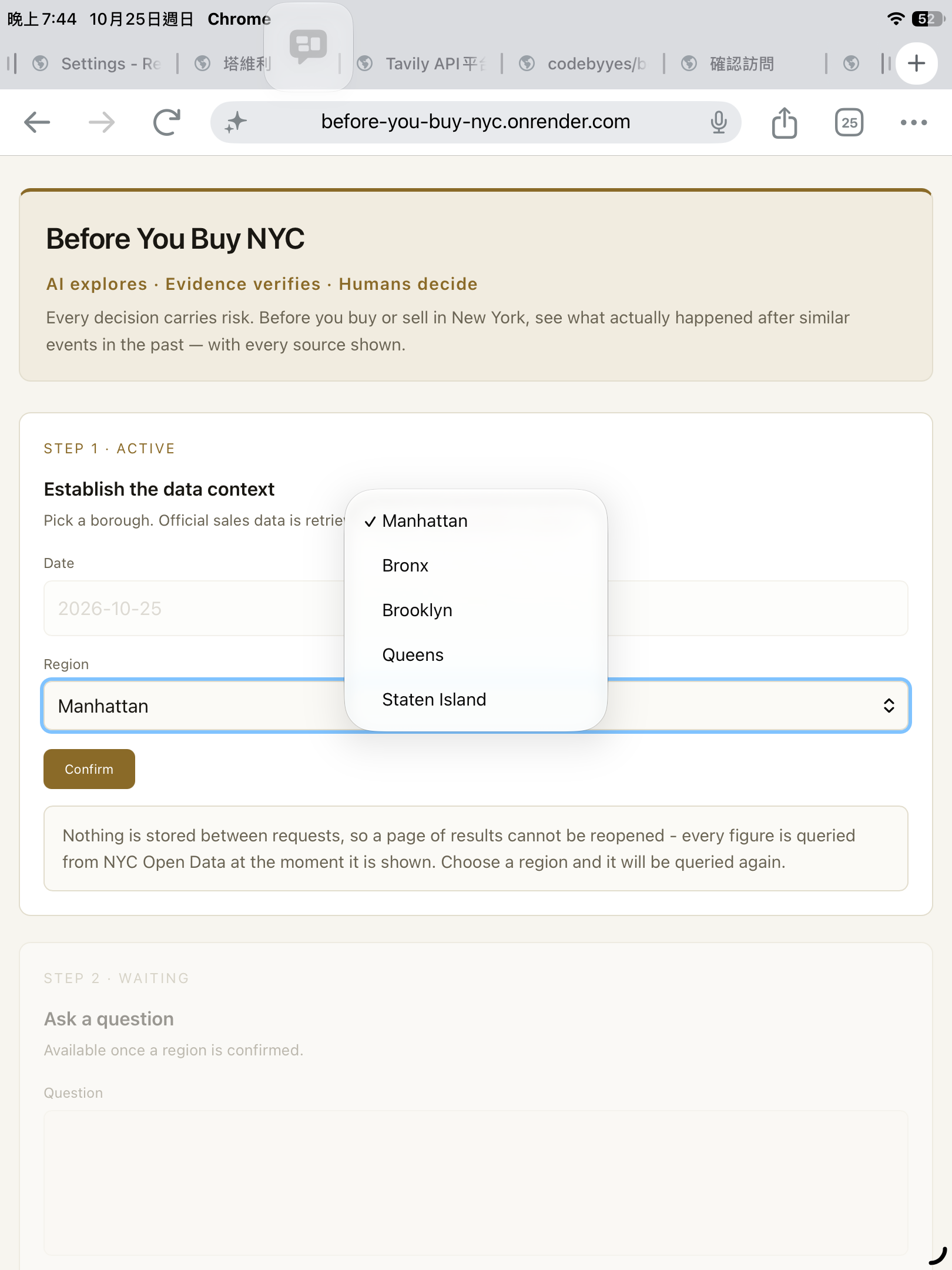
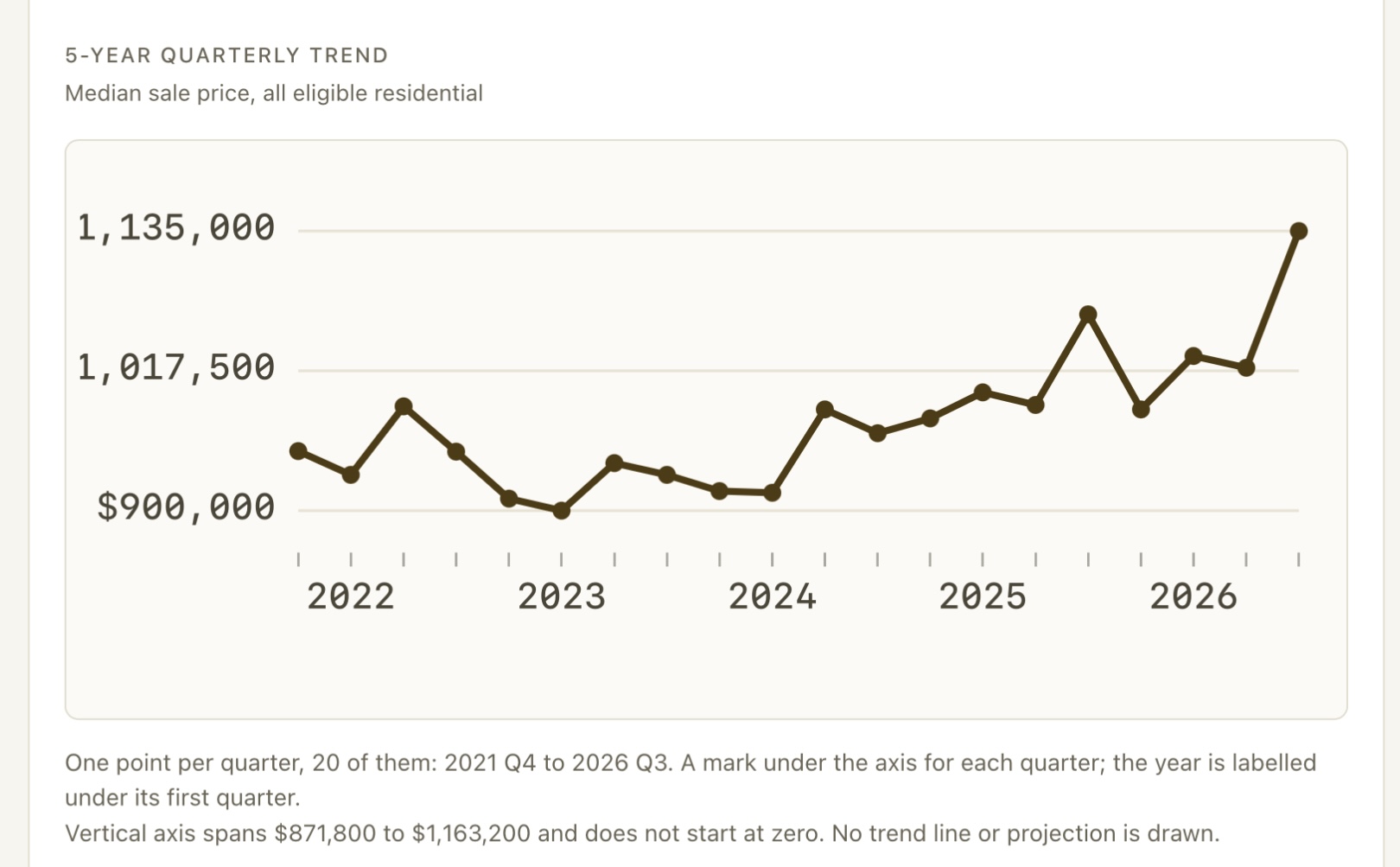
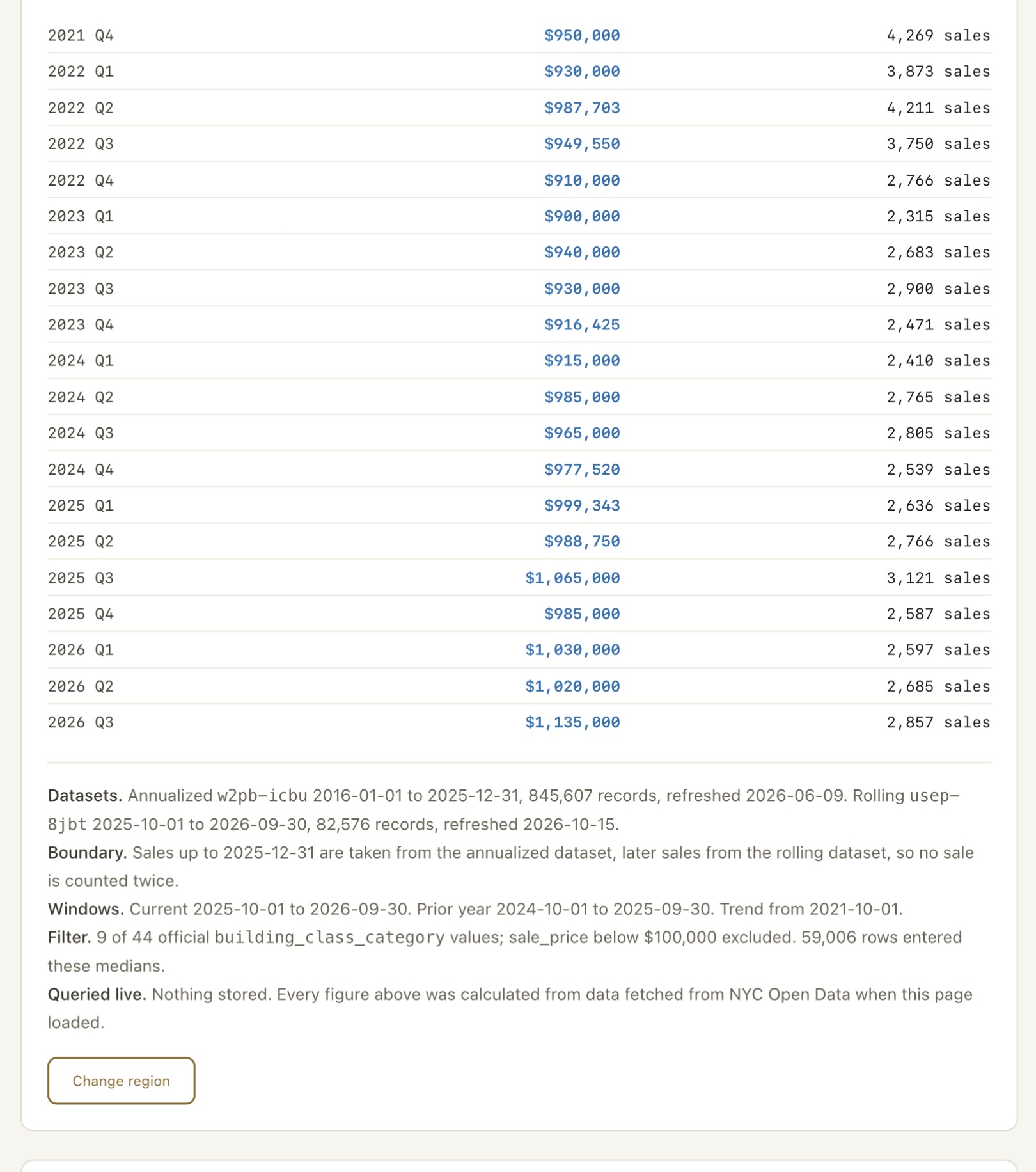
You pick a New York City borough and see its market context — median sale price by official property class, transaction counts, year-on-year change, and five years of quarterly medians, all computed from the city's own sales records at the moment the page loads.
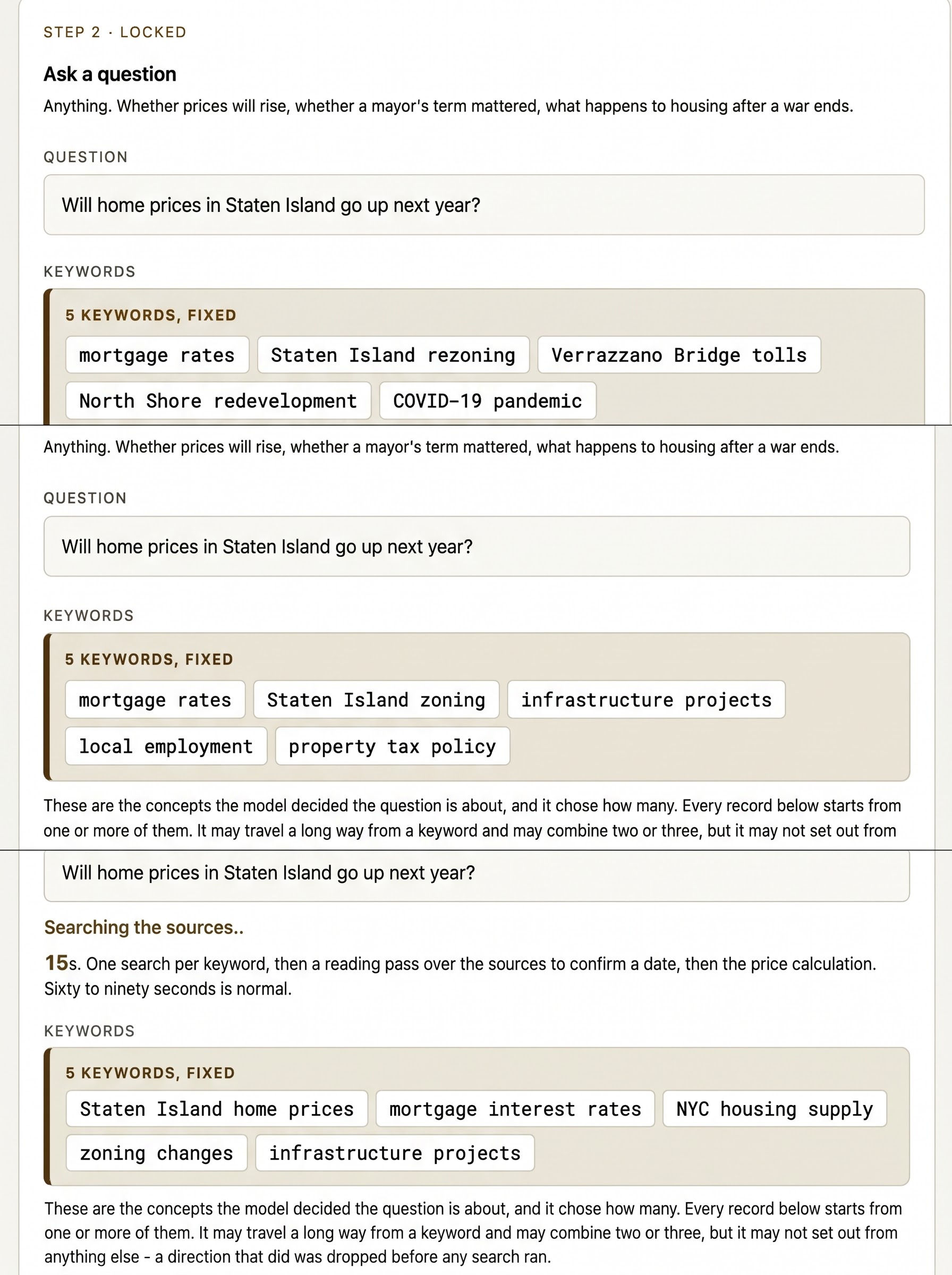
Then you ask anything. "Does tech hiring affect Brooklyn home prices?" "Will prices in Staten Island go up next year?" "I've noticed more people wearing black lately — does that have anything to do with home prices?"
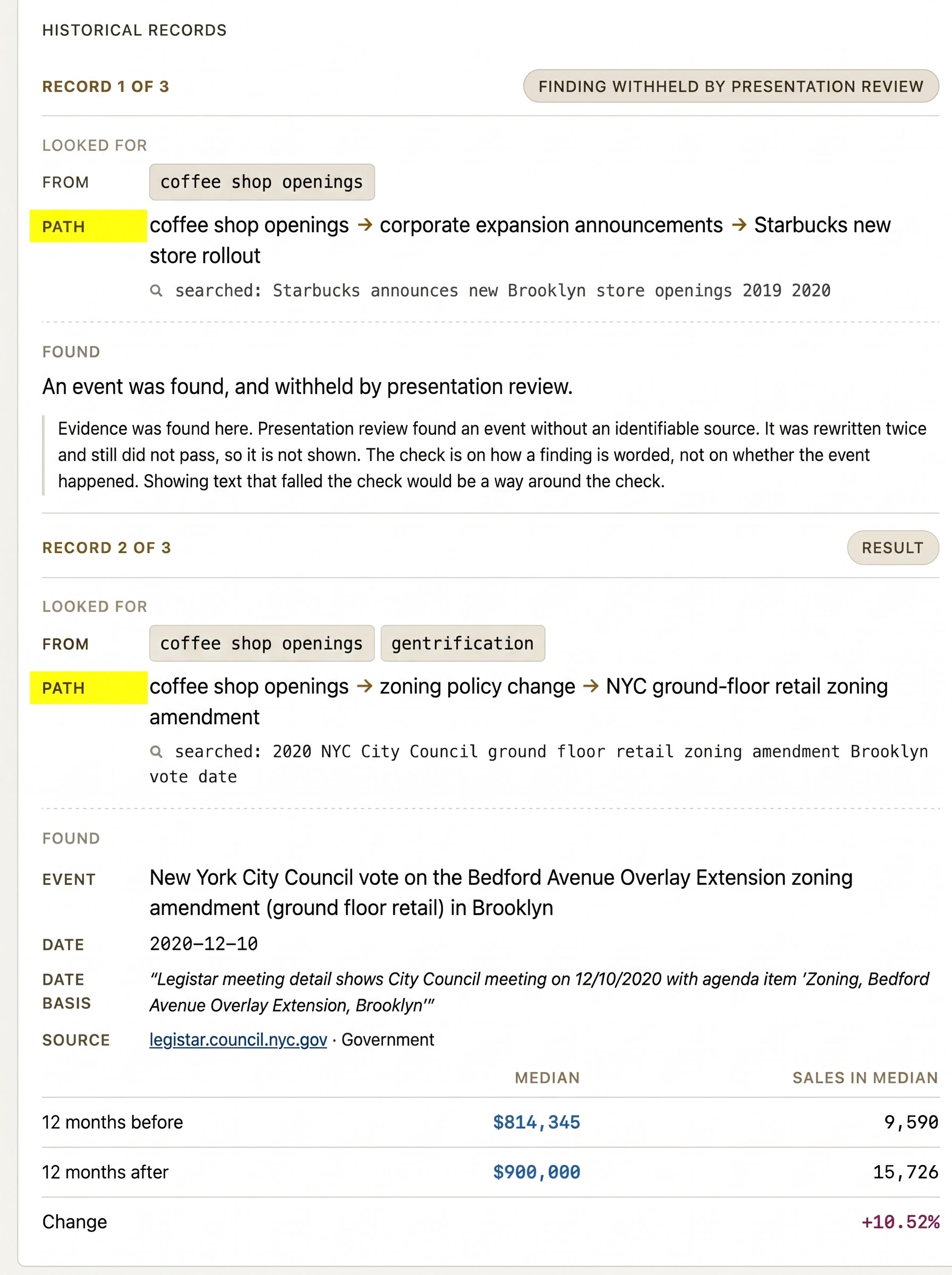
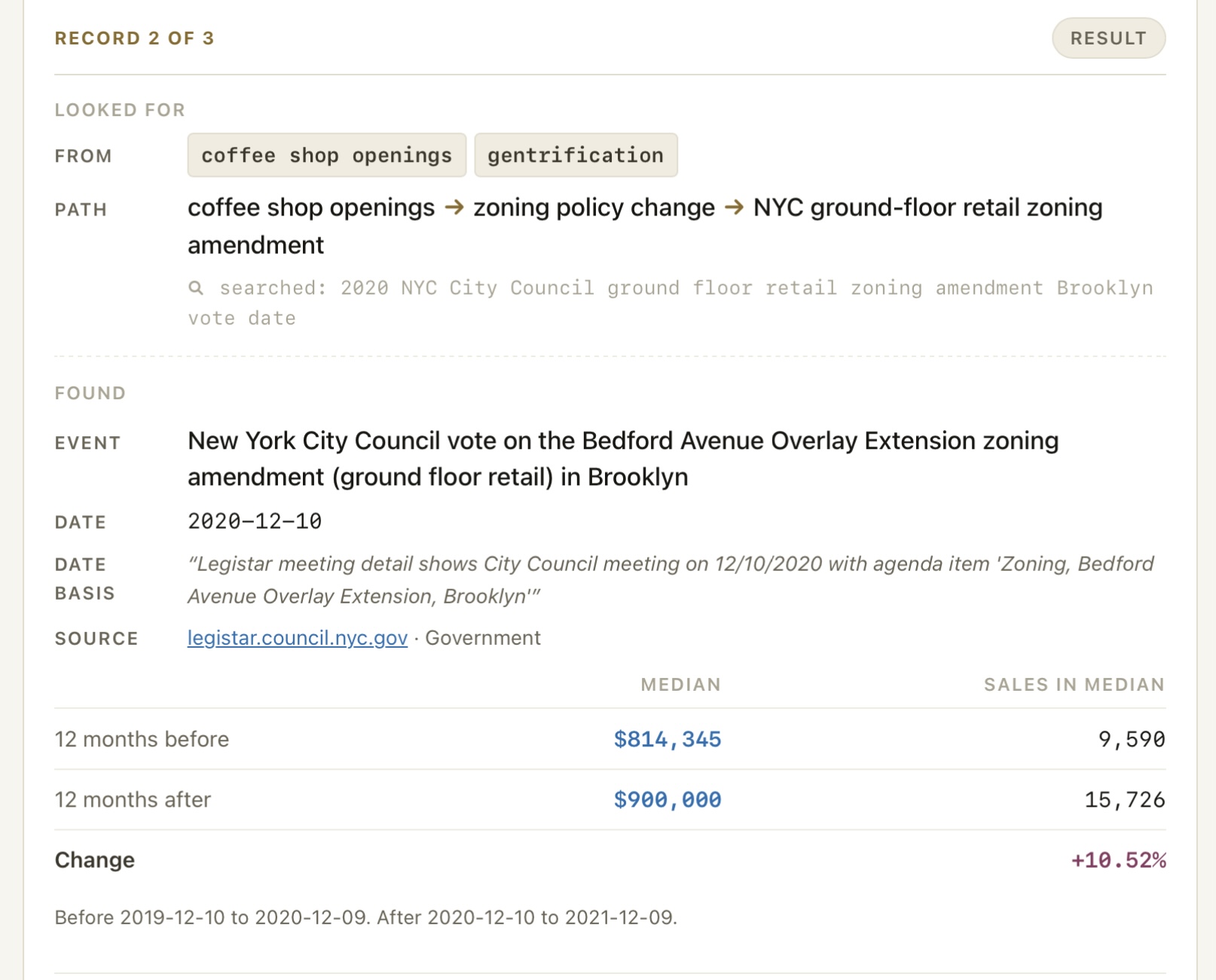
The system names the concepts your question is about, searches authoritative sources for specific dated events reachable from those concepts, confirms each event's date against its own source, and measures the median sale price in the twelve months before and after that date.
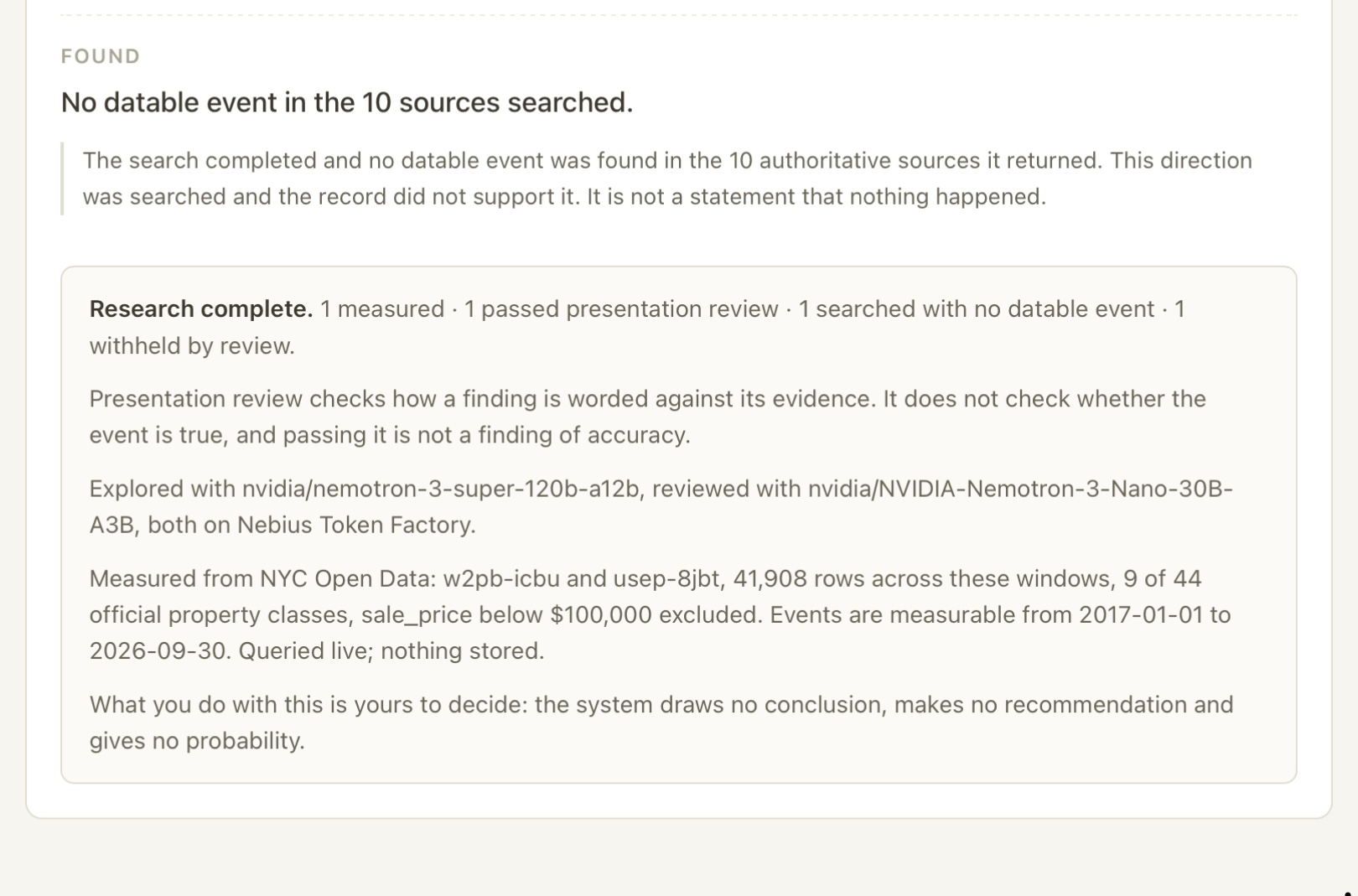
Then it stops. It does not tell you whether to buy.
The route is on the page, and it was written before the search ran. For each direction the model first writes down the path it intends to take, from one of its own keywords to the kind of event it expects to find, as terms joined by arrows:
coffee shop openings -> zoning policy change -> NYC ground-floor retail zoning amendment
black clothing       -> protest participation -> George Floyd protests June 2020 NYC
This is not a chain of thought. A chain of thought is a model's account of its own insides, produced after the fact and different every time you ask. A route here is a commitment: stated before the search, with the keywords it starts from then locked in code, its wording run through the same review as the finding, and left standing on the page whether or not the search supported it. A direction that went looking and found nothing still shows you where it went.
The refusals are the product, and all four are enforced in code rather than requested in a prompt:
- No causal claims. A finding worded as cause is sent back for rewriting, and withheld if it does not change.
- No model arithmetic. No model receives the sales data, and no figure on the page was produced by a model. The only numeric thing a model hands back is one ISO date read out of a source document.
- No wandering. The concepts named at the start are fixed in code. A research direction setting out from anything else is discarded before any search runs.
- No failure dressed as a finding. An exhausted quota, an unreachable service and a blocked finding each have their own state and their own wording. None is ever displayed as "nothing happened".
Every direction ends in one of five states, and all five have occurred against live data: a measured result, a search that found no datable event, research that could not be completed, an event that is real but older than the data can measure, and a finding withheld by review.
How we built it
Two NVIDIA Nemotron models on Nebius Token Factory, doing different jobs, and the second one's job is to hold a ruler against the first one's sentence.
nvidia/nemotron-3-super-120b-a12b explores: it names the concepts, sets the
research directions, and later reads search results to date an event against
its source. nvidia/NVIDIA-Nemotron-3-Nano-30B-A3B reviews: it reads each
measured finding as a reader would meet it and answers five fixed questions
about how it is worded — never about whether it is true.
Its entire output is a verdict — PASS, or FAIL and the numbers of the
questions that failed. Four tokens. It never rewrites anything and never gives
a reason. What goes back is the finding's own sentence, handed to the
Explorer along with which line it crossed, under an instruction ending
you are changing how this is said, nothing else. A finding may be rewritten
twice; still failing means it is withheld, with its failure category named and
the blocked text not shown.
So this is not one model policing another. It is a model being shown what it just wrote. The concern it answers is not that the Explorer lies — it is that a capable model is good at making a sequence sound like a cause and evidence sound like it carries more than it does. Two of the five questions are aimed exactly there. Truth is checked elsewhere, and not by a model at all: no source, no publication, enforced in code. Asking a second model whether something is true would only be guessing twice.
One OpenAI-compatible endpoint serving both is what made the split practical: assigning the narrow review job to a small fast model cost one line of configuration rather than a second integration.
The isolation is structural. explorer.py holds the only code that talks
to the model endpoint. evidence.py calls through it to date an event and
contains no arithmetic of its own. main.py computes every figure on the
page and never calls a model. The sales rows are read, filtered and reduced
to a median entirely inside the module that has no path to a model.
The keyword lock lives in parse_plan(), not in a prompt. A rule that
lives only in an instruction is a rule the next model gets to reinterpret.
Tavily is called live, once per research direction, at advanced depth against an allowlist of 21 authoritative domains. At default quality the search returned betting sites and cryptocurrency news for a housing question.
Data is two NYC Department of Finance datasets read over Socrata on every request. Nothing is cached, nothing is stored, and the page prints each dataset's refresh date, the row count that entered the medians, and the filter applied.
Flask is the only installed dependency. No front-end framework, no charting library, no vendor SDK, no database. The chart is hand-written SVG. The project has to stay live through judging, and every dependency is a thing that can move underneath a redeploy.
Challenges we ran into
This project was built entirely from an iPad. One of us cannot read code and has no computer; the other is an AI that cannot see the deployed site. That is not a colourful detail, it is the constraint that shaped the engineering:
- Every decision had to be explained in plain language before it could be made, and written down afterwards — which is why the repository carries a handover document, a state document and a model-behaviour log alongside the code.
- The only way to verify anything was a screenshot, so the page had to state its own provenance: dataset ids, refresh dates, row counts, the filter, the measurable range, and which models ran. Those lines exist because of how this was built, and they are the same lines a judge needs.
- Reading on a tablet is why a 10px label in the palette's lightest grey was found to be invisible, and later why 36 of 40 type sizes on the page turned out to be below 13px against a 16px default.
Five bugs were structural rather than careless, and they share one shape:
a step was asked to obey a constraint nobody had told it about. The dating
step had never received the search term, so it was asked to find a date
rather than the right date — and every document contains dates, which is how
a filename reading as-of-august-1-2010 was once reported as an event in
Brooklyn. The Explorer had never received the region or the market, so "why
does autumn sell best" came back as UK retail and Amazon Prime Day, and the
pipeline measured Brooklyn house prices around Prime Day 2022 with a source,
a date basis and two medians attached. The Reviewer was wired with a token
budget sized for its answer rather than for the reasoning in front of it, and
returned an empty string with no error.
Accomplishments we're proud of
The gate blocks real findings, and we have watched it happen. On the question "Does tech hiring affect Brooklyn home prices?" the Amazon HQ2 record failed on a claim stronger than its evidence, was rewritten twice, and was withheld. Asked outright whether Staten Island prices will rise next year, the system produced no forecast at all and the gate blocked two of five directions — one of them for containing exactly what the question invited: a conclusion, prediction, recommendation or probability.
It finds paths a checklist would not contain. From the keyword "black
clothing" it reached Black Lives Matter protests -> George Floyd protests
New York City June 2020, a real event with an AP source and a quoted date.
Asked about extreme weather elsewhere in the country, it raised "migration" as
a concept of its own — a word that appeared nowhere in the question — and
built migration -> Puerto Rican evacuees -> NYC shelter announcement.
It also invents events, and the architecture catches that too. The same run produced a "Black Dress Code boutique, Williamsburg, March 2019" that does not appear to exist. It found no source, so it never reached the reader as a historical claim. A model asked to name something specific will produce a plausible name rather than stop; the design's answer is that the model may explore freely but may not assert freely.
What none of that proves. A gate that blocked three findings is a gate that worked three times, not a gate that cannot be passed — and the reviewer is itself a language model, checking wording rather than truth. The lock, the file split and the review are three different kinds of guarantee with three different strengths, and the strongest of them is the one that is not a model at all: a figure computed in Python from official rows cannot be talked into being something else. We designed defences. We have not demonstrated that they cannot fail, and a project about claims not outrunning evidence should not be the one to blur that line.
What we learned
Question shape drives the model's reasoning depth more than capability does. Two questions, same evening, same borough, same model: "Does a hurricane hitting Florida affect home prices in the Bronx?" produced five one-step directions that were really a list of hurricanes. "Does extreme weather elsewhere in the country affect Bronx home prices?" produced three-step chains with mechanisms. Give the model a bridge and it walks the bridge; leave the gap and it builds one. A single question tells you about that question, not about the model.
Research paths can be compared; conclusions cannot. Because the keywords and their reasoning paths are shown rather than hidden, two models given the same question can be set side by side and the difference inspected — the way you would consult two independent advisors rather than averaging them. This system does not yet run that comparison; what it does is make it possible, which systems that present only an answer cannot.
A satisfying answer and a checkable one are different products. Asked the same question, a general assistant returned a confident, well-organised answer citing a study — accurate, as it turned out, but it took two further lookups to establish that. Ours returned a government URL and the sentence the date came from, one click from verification. The honest trade is that ours often reads as plainer. A direction that was searched and found nothing is most of what a run produces, and we show every one of them. That is not an unpolished result; it is the result.
We nearly wrote two claims we could not support. An outside reading caught the README saying one module was the only one that calls a model, when the code shows otherwise, and saying no model is ever shown a price, when the dating step reads news pages that quote them. Both were restated at the width they actually hold. A system built to stop claims outrunning their evidence cannot describe itself in a document that does exactly that.
What's next
Saved analyses, so research paths accumulate. Nothing is stored between sessions today, which means paths cannot be compared across questions or across models. Every observation above was recorded by hand because the system does not record itself. This is the first thing a second version should fix, and it is what makes the multi-model comparison above an experiment rather than an argument.
Neighbourhood granularity. A rezoning affecting a few blocks is currently measured against the median for a whole borough. The datasets carry the columns; this version does not use them.
A control group. The change after an event is not compared against the citywide market over the same period, so an event that merely coincided with a general rise will show the general rise.
Scope is a choice, not a ceiling. One city and one domain is deliberate. All five boroughs were enabled without touching the pipeline — adding a region changes the dataset, not the application logic. Real estate is the first application because it has reliable official records and an outcome that can be measured against a dated event; any domain meeting those two conditions fits the same method.
What would carry over is a sequence, not a codebase: ask a question, declare a traceable route before searching, verify each piece of evidence against its own source, measure the outcome in deterministic code that no model touches, review the resulting claim for what it says rather than whether it is true, and publish the failures and the incomplete runs alongside the findings. What would have to be rebuilt for every new domain is everything underneath that: the data interface, what counts as an event, how an outcome is measured, and the constraints particular to the field.
So the goal was never to re-skin a property tool across industries. It was to find out whether that sequence holds. It has been implemented and tested in one domain, and claiming more than that is precisely the thing this project refuses to do.
We are not showing you the limits of what this can do. We are showing you, as clearly as possible, how it works.
Built With
- css3
- flask
- github
- html
- javascript
- nebius-token-factory
- nvidia-nemotron
- nyc-open-data
- py
- render
- socrate
- svg
- tavily

Log in or sign up for Devpost to join the conversation.