-
-
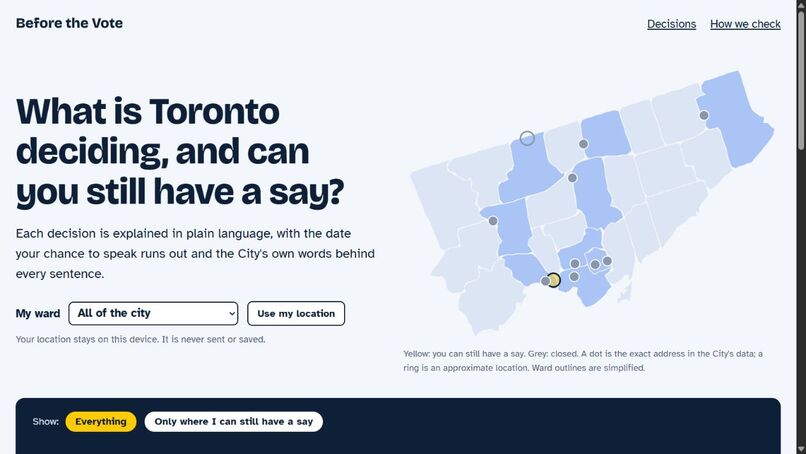
Explore Toronto’s municipal decisions on a ward map and see where you can still have a say.
-
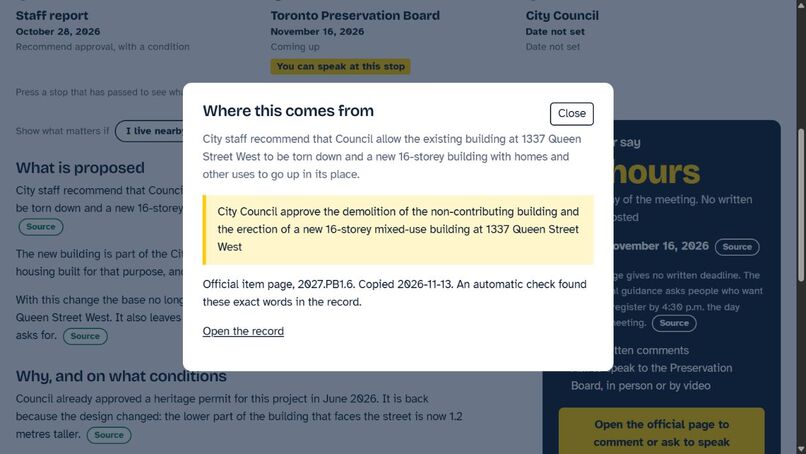
Check the City’s exact words behind each plain-language explanation.
-
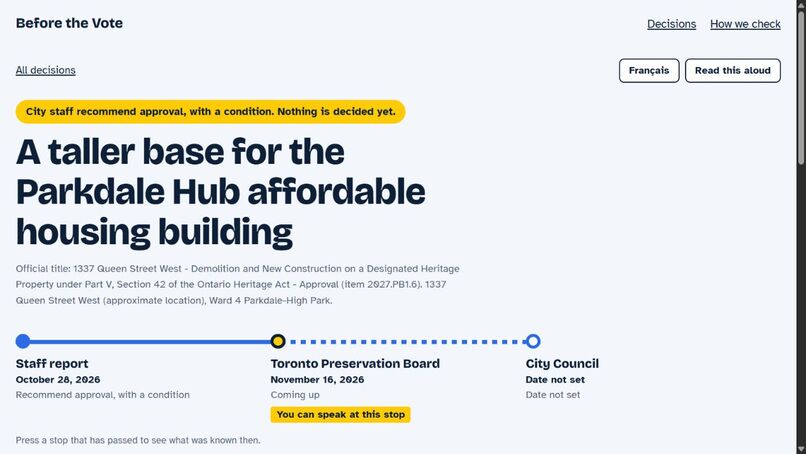
Follow a proposal from staff recommendations through upcoming meetings and the final Council decision.
-
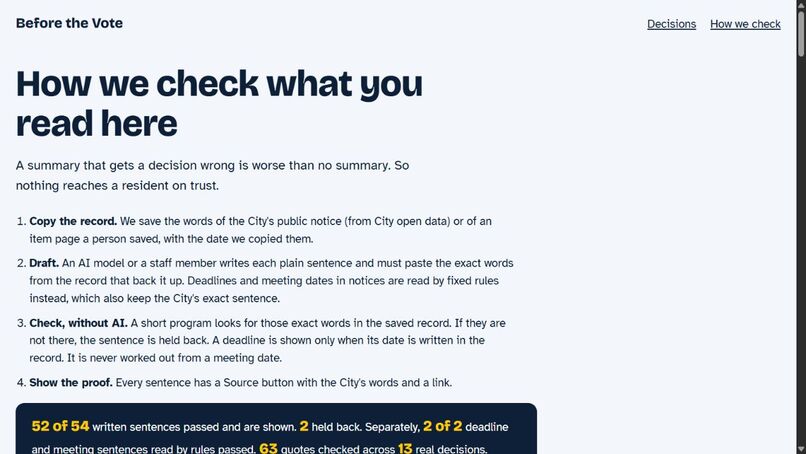
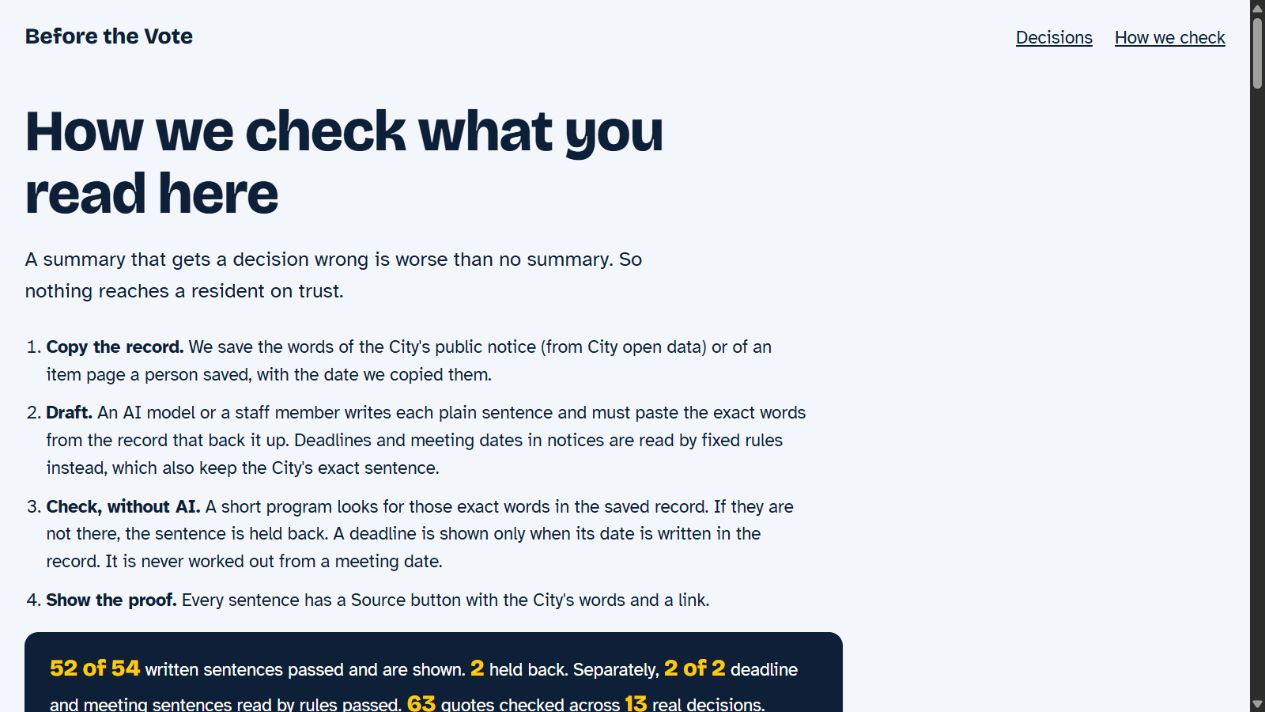
See how summaries are checked against public records before they reach residents.
Inspiration
Toronto item 2024.NY15.4 proposed three towers and 960 homes at 1875 Steeles Avenue West. The City's page titles it "Decision Report - Approval" and marks it "Adopted". It was refused. Staff recommended approval, community council changed course after 13 letters and 9 speakers, and Council adopted the refusal.
If the official record can be read backwards, residents don't stand a chance. The challenge brief said it plainly: most people learn about a decision after their chance to speak has passed, and a summary that gets a decision wrong is worse than no summary. We wanted a tool built around that window to act, where nothing reaches a resident on trust.
What it does
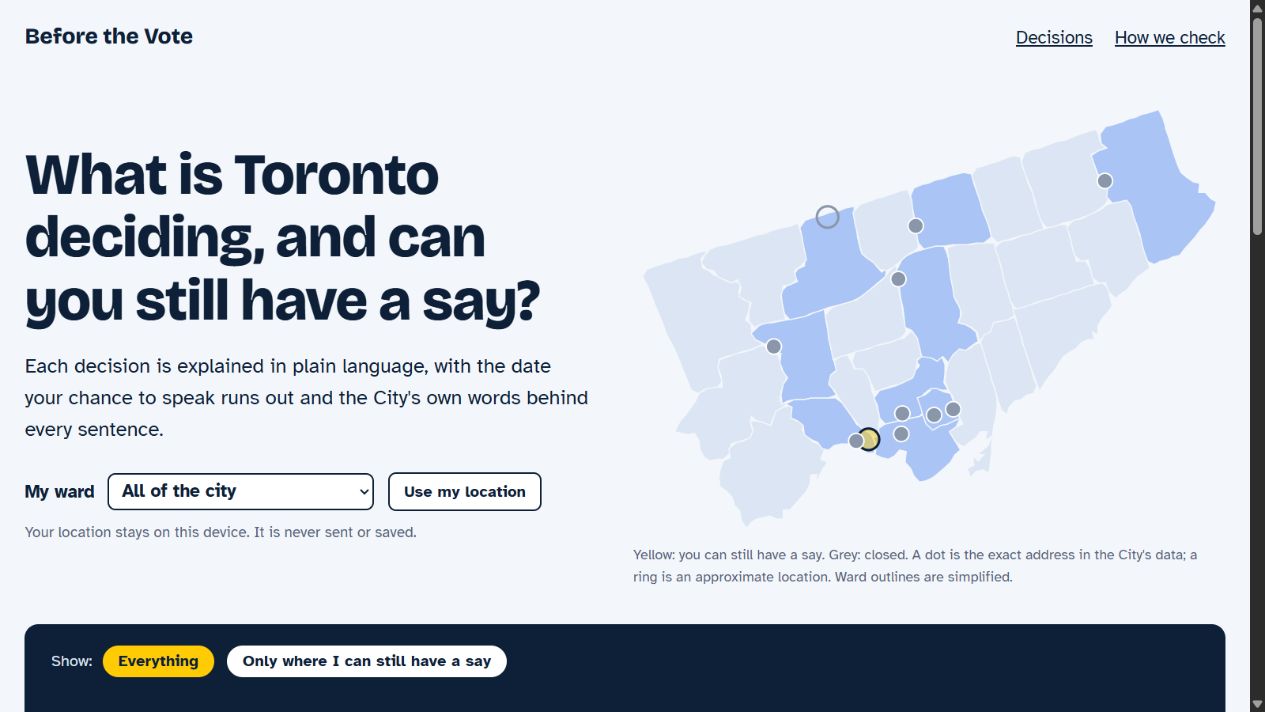
- Departures board: real Toronto decisions sorted by how long you still have to have a say.
- Is this near me? A ward map drawn in the browser, plus "use my location". Your location never leaves your device.
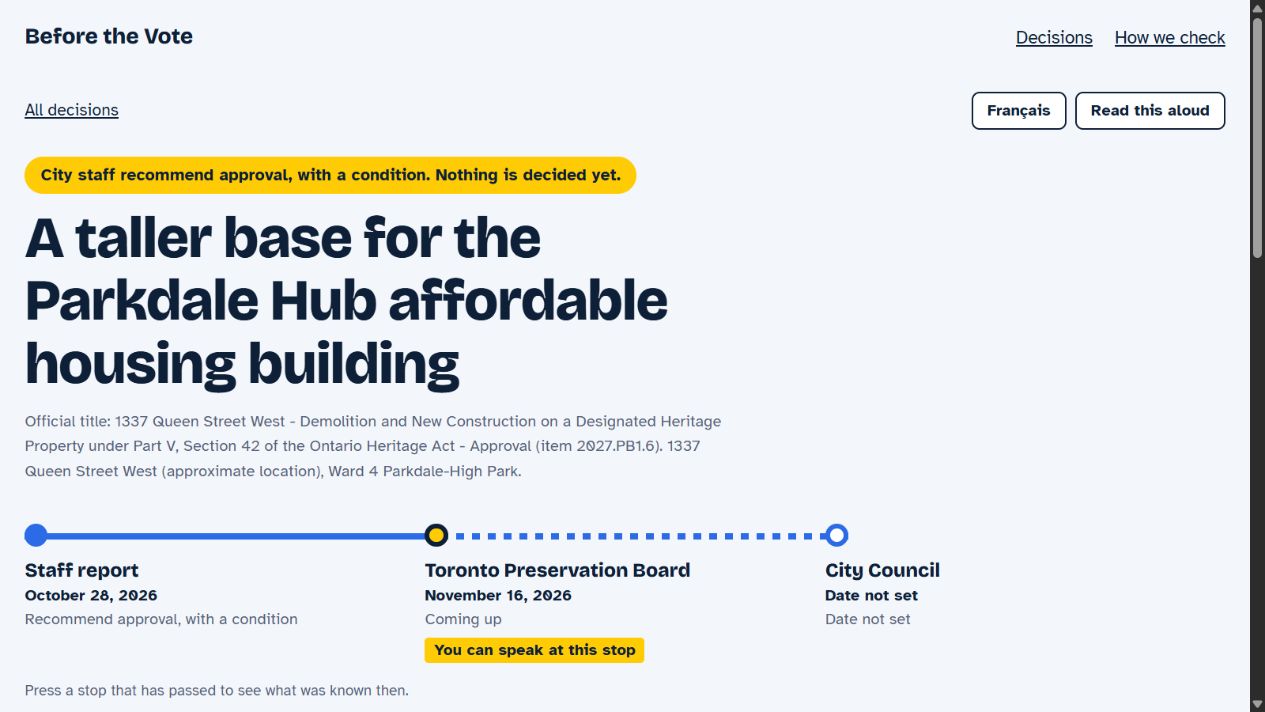
- The Decision Line: each decision shown as a line of stops (staff report → committee → Council), marking the last stop where residents can speak. Press a past stop to see the decision as it stood then.
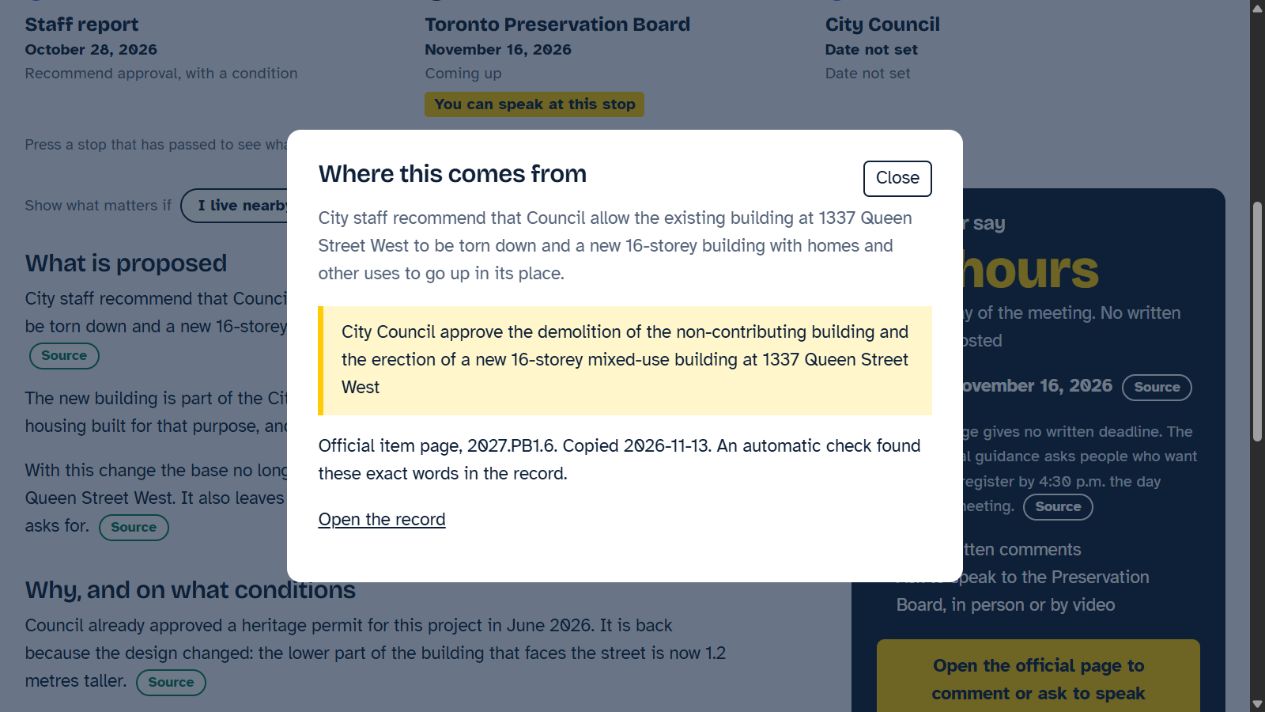
- Plain language with receipts: every sentence has a Source button showing the City's exact words, the document and the date we copied it.
- What changed, how they voted, who spoke up: amendments between stages, recorded votes from the City's open data, and counts of letters and speakers. We count them; we don't store names.
- Help to act: a countdown to the written deadline, a calendar reminder, a link to the City's own comment form, a warning that commenters' names are published, a printable notice for neighbours who are offline, read-aloud and French.
- Live: every 3 hours it re-reads Toronto Open Data, adds new public notices, re-checks every sentence and republishes.
How we built it
- Pipeline (Python):
- Reads Toronto Open Data (Public Notices, the council voting record, ward boundaries) and agenda item pages that staff save from a browser.
- Fixed rules (no AI) fill in the stops, dates, wards, documents, deadlines and counts.
- An AI model (DeepSeek via OpenRouter) drafts plain sentences, and each one must come with the exact words it relies on.
- The check:
verify.pynormalises text and requires the quote to appear word for word in a dated copy of the record. A failed sentence is held back. A deadline is shown only if its day, month and year are written in a verified quote, so a meeting date can never become a deadline. Stage results and votes only show if the sentence behind them passed. - Website: static HTML, CSS and JavaScript with no framework and no server. It uses a custom SVG ward map, the native
<dialog>element, Web Speech and iCalendar files. - Automation: a GitHub Actions job refreshes, tests and publishes to GitHub Pages every 3 hours. It commits only when the City's record actually changes.
- Tooling: we built with AI coding assistants (Claude and Cursor), credited in
CREDITS.md.
Challenges we ran into
- The City's item pages block automated downloads. Rather than work around that, we switched the live feed to Toronto's Open Data API, which is built for programs. Item pages now come only from copies a person saves.
- The record misleads. Status words like "Adopted" or "Carried" don't tell you the outcome, so our change notes never repeat them as results.
- AI quotes don't always match. The model sometimes paraphrased the City's words, and those sentences were held back. That's the check doing its job.
- Messy data. One notice's coordinates in the open data pointed across the city, outside the community council named in the notice. We now refuse to pin it and say why.
- Our own bugs, found by clicking through: the page reader picked up the City website's footer links as "background documents", and new notices briefly said "the time to comment has passed" when no meeting had been set yet.
Accomplishments that we're proud of
- 13 real decisions live: 3 agenda items and 10 current public notices across 9 wards.
- 56 plain-language sentences drafted, 54 passed the word-for-word check. The AI drafted 26, of which 25 passed.
- We planted a deliberately false sentence ("City Council approved the application") on the refused Steeles item. The check caught it.
- The votes in the City's open data match the ones we entered by hand: 1–4 and 4–1.
- 96 automated tests run on every refresh, and the site works with no accounts, cookies or tracking.
What we learned
- Explaining one decision means stitching together several records. The deadline, the meeting, the amendments and the votes all live in different places.
- Using AI well here meant making it show its sources and checking them with plain code, not trusting it to be right.
- Small wording choices matter: "no meeting set yet" and "the time to comment has passed" send residents in opposite directions.
- Open data with one shared item number across notices, agendas and votes would make tools like this cheap for every city.
What's next for Before The Vote
- A pilot with a clerk's office, with staff review tools and a way for residents to report an error.
- Automatic discovery of agenda items, and summaries of long staff reports.
- Reviewed translations for Toronto's most-used languages.
- Readers for other agenda systems (eSCRIBE, Legistar, CivicWeb), so other municipalities can adopt it.
- Alerts when a decision you follow moves to its next stop.
Built With
- ckan-data-api
- claude
- css3
- cursor
- deepseek-chat
- geolocation-api
- github-actions
- html5
- icalendar
- javascript
- openrouter
- pypdf
- python
- requests
- svg
- toronto-open-data
- web-share-api
- web-speech-api
