Inspiration
Family stories vanish because nobody asks, and nothing captures the places they happened in. For someone living with early dementia, the memories are not gone. They are hard to reach, and the apps meant to help are passive: you have to already know what to search for, which is exactly the thing that has become difficult.
We wanted the right memory to come back at the right moment, in the right place. So we stopped thinking about an app you open, and started thinking about a place you can stand in again.
What it does
Before I Forget turns a grandparent's spoken memory into a place you can walk into, and brings it back when it matters.
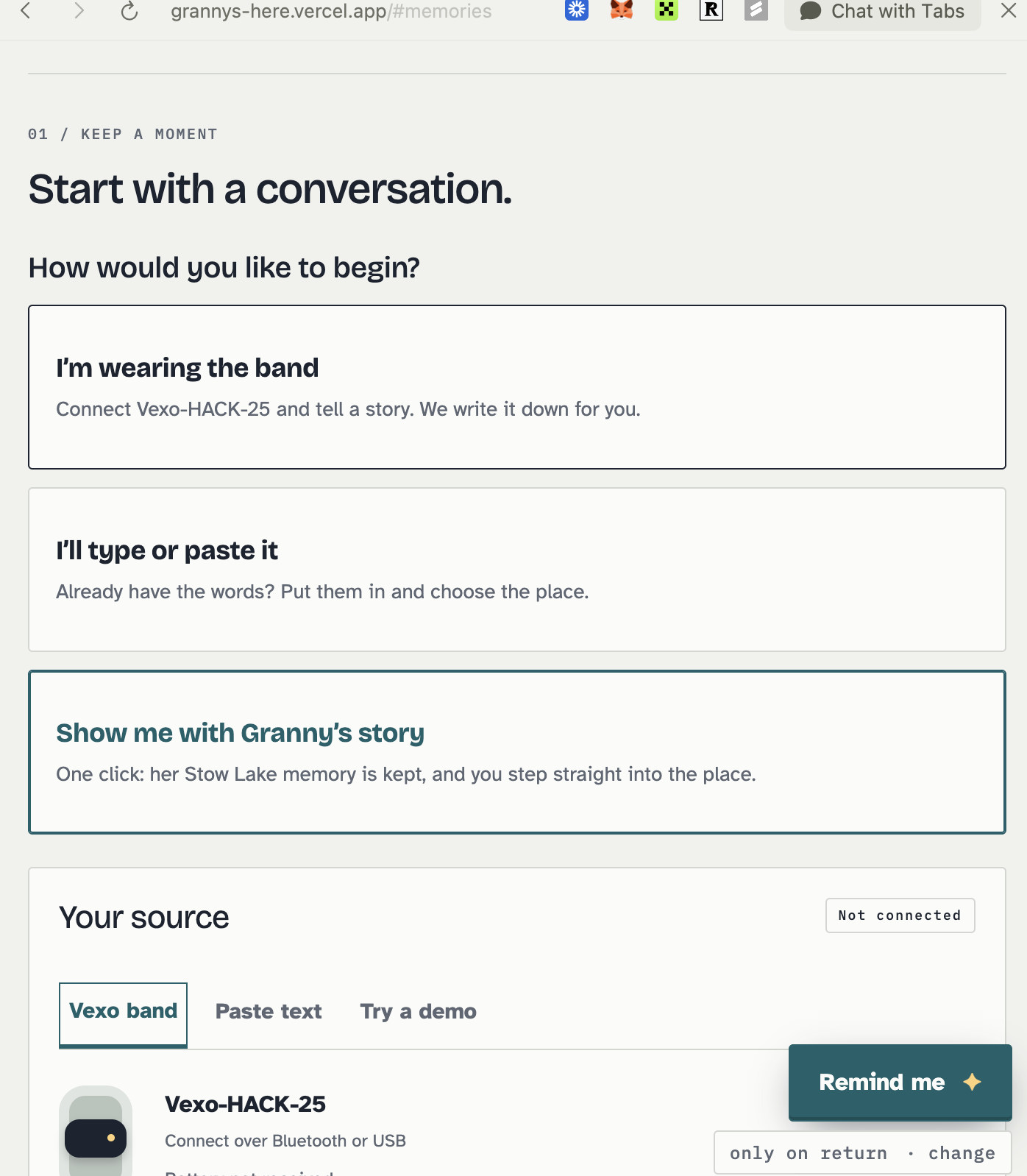
- She talks. Wearing the Vexo band, she tells a story the way she always has. The audio streams over Bluetooth and is written down live.
- It becomes a memory. The words are kept with the place they belong to, word for word. Nothing is invented.
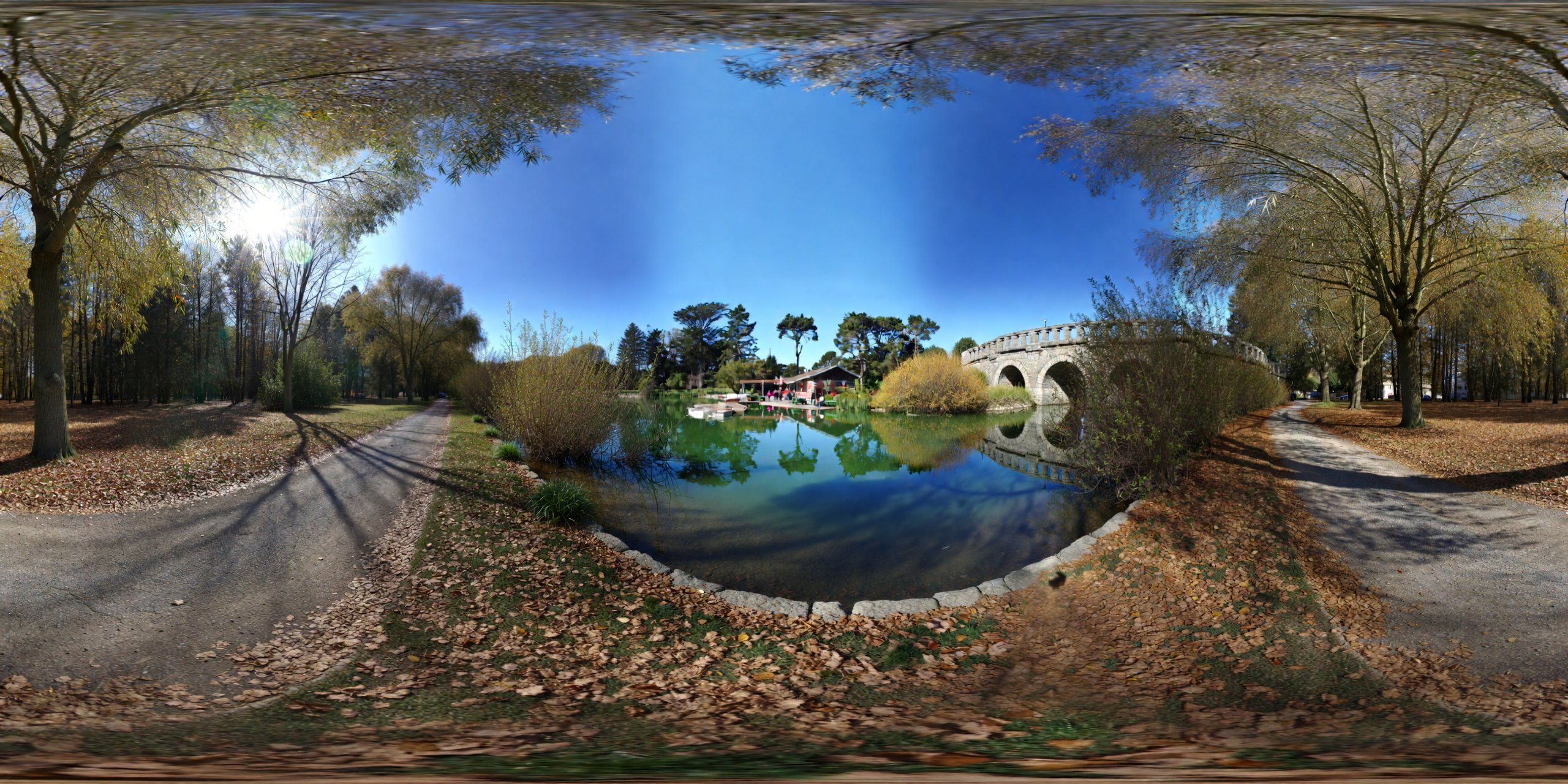
- The place is built from her words. The moment a memory is kept, World Labs builds a walkable 3D world from the transcript, and it is rendered on the page itself. No hand written prompt and no photo needed: a story about a kitchen, a church or a bakery becomes somewhere you can look around.
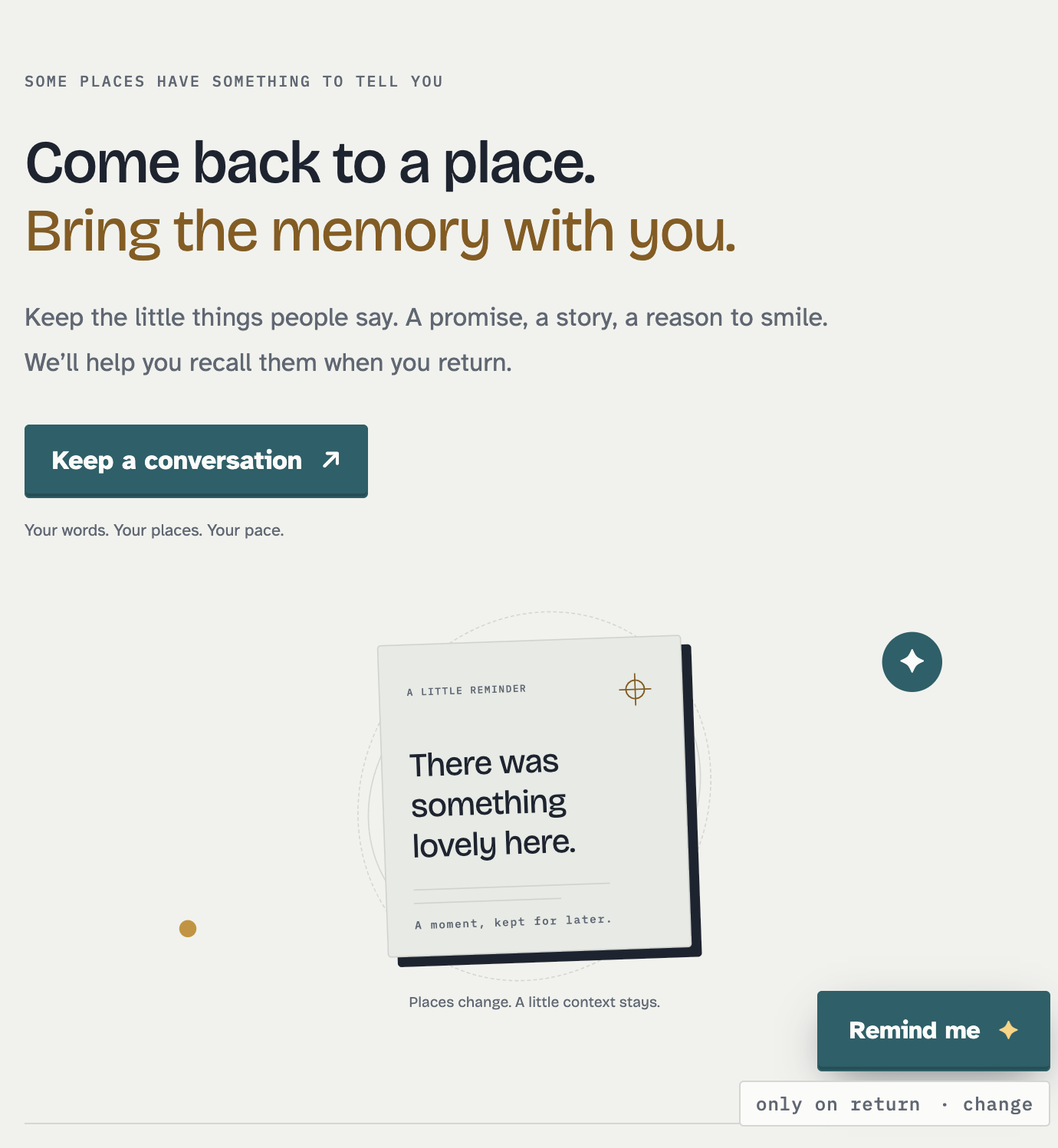
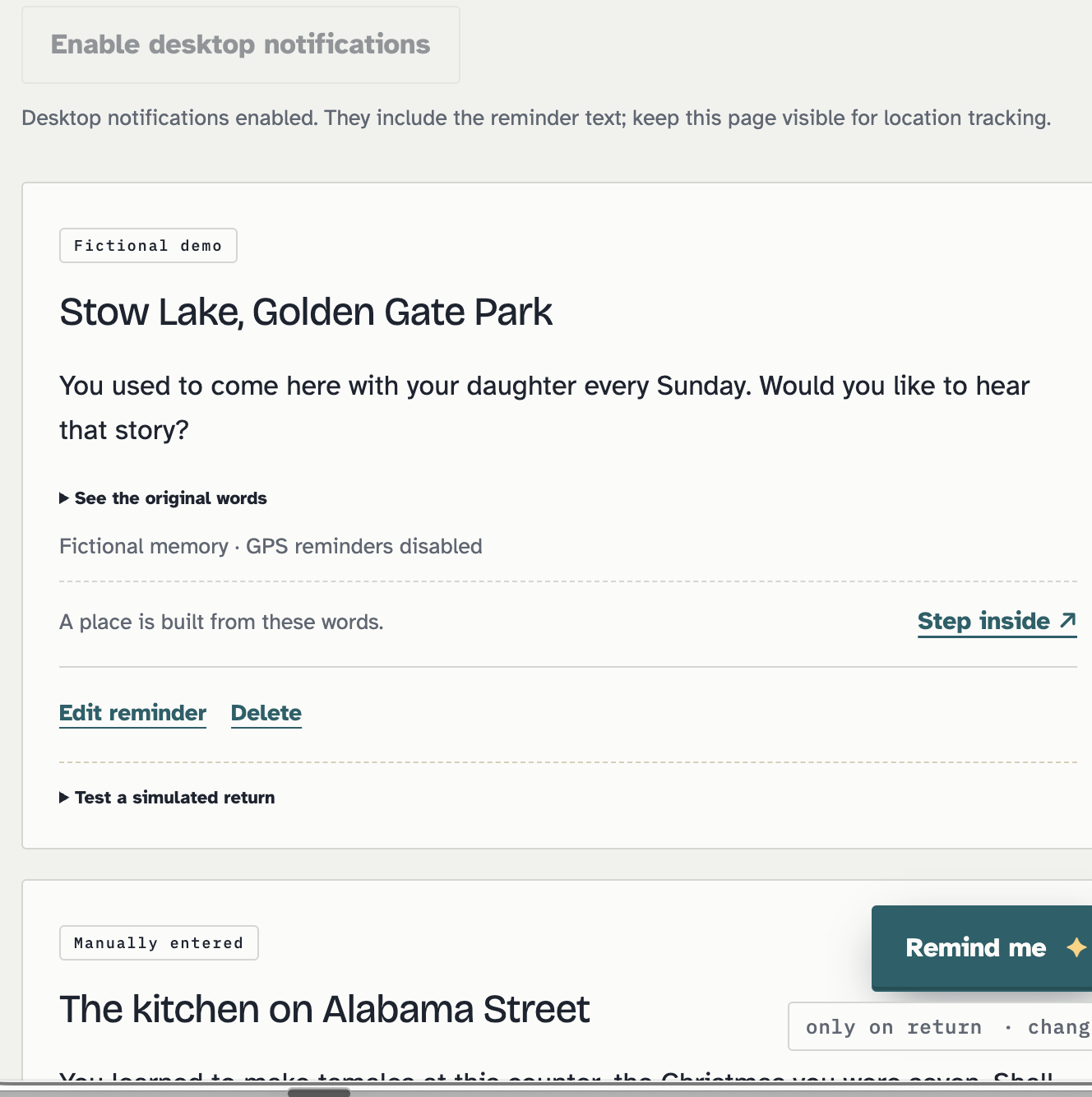
- It comes back to her. When she returns to that place, a reminder opens with a gentle invitation and the place beneath the words. Reminders also arrive now and then on a timer, and a Remind me button is one tap away on every screen, phone included.
- The family decides what surfaces. Nothing is offered automatically until it is approved, and memories about loss, illness or conflict are never auto triggered, approved or not.
It works on a first visit, on any device: four memories and their built places are already there to try, and one click keeps Granny's Stow Lake story and steps straight into it.
How we built it
- Vexo Open band over Web Bluetooth for the microphone, taps and light.
- Deepgram for live speech to text in the browser.
- World Labs Marble generates the 3D world from the transcript (and a reference photo when there is one). Spark, World Labs' own Gaussian splat renderer, draws it inside our page with three.js.
- Vercel hosts the site plus three serverless functions that keep the World Labs key server side and proxy the splat so the page fetches it same origin.
- Plain HTML, CSS and ES modules. No framework, no build step. 47 automated tests on the capture, location and reminder logic.
- Type chosen for the people it is for: Atkinson Hyperlegible, drawn for low vision readers, with Bricolage Grotesque and IBM Plex Mono.
- A Python pipeline alongside (capture, process, place_to_world, demo) drives the band locally, with OpenAI for the structured memory and ElevenLabs for a narrator voice.
Challenges we ran into
Most of our time went on things the documentation did not tell us.
- The world API returns no video. It returns Gaussian splats, a mesh, a panorama and a hosted link. We rebuilt around the splat and render it ourselves.
- The world page cannot be embedded. It sends X-Frame-Options: DENY. We found that by reading the headers, not at demo time.
- Sharing can only be set at creation. There is no update endpoint, so our first world was permanently private. We regenerated it public and checked it in a signed out browser.
- The image prompt is an object, not a string, the live API names fields differently from the docs, and inline images are capped at 10 MB.
- The band refuses light commands while its microphone is on, so the hardware's own blue light is the listening indicator. We could not override it, and should not.
- The band records Ogg Opus, not WAV, and our .gitignore would have committed a real person's voice to a public repository. Caught and fixed.
- One Bluetooth connection at a time. A band held by one tab is invisible to everything else. We lost an hour to this before reading the rule properly.
Accomplishments that we're proud of
The safety model is enforced in three independent places, and we tested the awkward case rather than the easy one: a memory that is approved and sensitive still reads "The band will never offer this."
The 3D world genuinely comes from her words. For Stow Lake the photograph fixed the lake and the boathouse, and her transcript added the stone bridge the photo does not show. For the kitchen and the church there was no photo at all. The counter under the window and the jacaranda on the church steps came out of the sentences.
And it works on a first visit, on any device, with nothing to set up.
What we learned
Read the headers, not the marketing. Half of our real blockers were findable in minutes with one request and a careful read of a schema, and each would have been fatal at 5:40pm.
Design for the actual reader. We threw out a cream and serif look that read as machine made, chose a typeface drawn for low vision eyes and 17px body text, and rewrote the form to ask "What do you call this place?" instead of "Latitude".
What's next for Before I forget
A push that wakes a locked phone: a service worker, a push server, and home screen install on iPhone. Real GPS on a phone instead of a laptop. Her own recorded voice playing inside the place. And a caregiver view that shows which memories still bring her joy, so families can stop offering the ones that do not.
