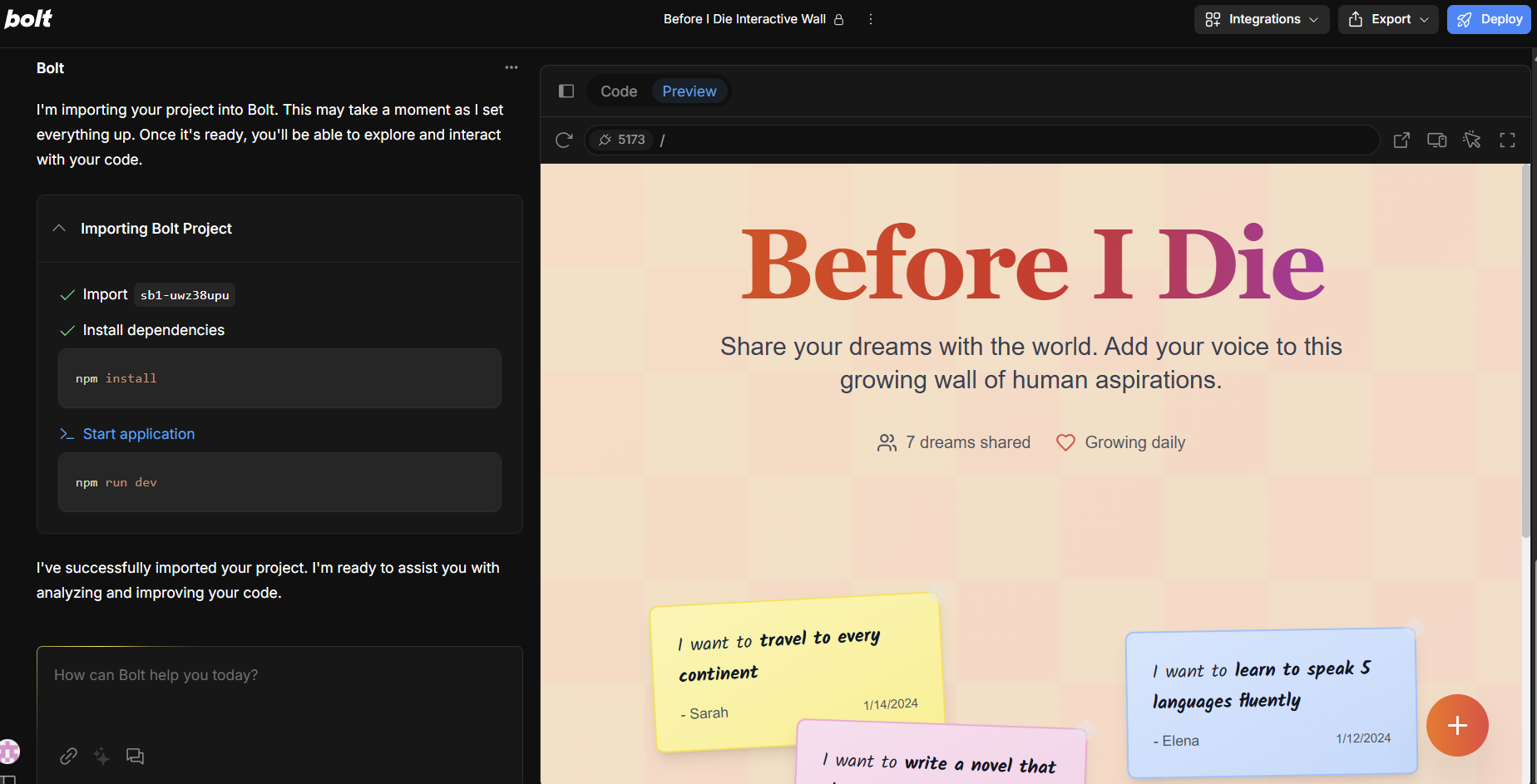
About the Project
Inspiration
This project was deeply inspired by the profound work of artist Candy Chang, whose "Before I Die" walls have transformed abandoned spaces into canvases for collective reflection across the globe. After encountering her TED talk about turning grief into community connection, I was moved by how a simple prompt—"Before I die I want to ___"—could unlock such vulnerable, beautiful human expressions.
Chang's insight that public spaces can become forums for shared humanity resonated deeply with me. In our digital age, I wanted to recreate that raw, anonymous honesty she captured on physical walls, but make it accessible to anyone, anywhere. Her work showed me that our deepest aspirations unite us more than divide us.
What I Learned
Building this digital interpretation taught me several powerful lessons:
- Simplicity invites profundity: Following Chang's minimalist approach, I learned that the most basic prompt can elicit the most meaningful responses
- Anonymity enables authenticity: People share their truest dreams when freed from social media's performative pressure
- Design is emotional architecture: Every color choice and animation needed to honor the vulnerability of users' submissions
- Community creates itself: Given the right space, humans naturally support and inspire each other
How I Built It
Using bolt.new's AI capabilities, I crafted the entire experience in a single prompt, focusing on:
- Visual Poetry: Created a chalk-like typography system that echoes Chang's original wall aesthetic
- Living Canvas: Implemented real-time updates so each dream appears as others are writing theirs
- Emotional Geography: Added optional location tags to see dreams bloom across a world map
- Gentle Interactions: Designed subtle animations—dreams fade in like whispers and float slightly, creating movement without distraction
- Sacred Space: Used a dark background with soft lighting to create an intimate, contemplative atmosphere
The technical stack leveraged React for interactivity, Supabase for real-time dream storage, and carefully crafted CSS animations to honor the meditative nature of the experience.
Challenges Faced
The biggest challenges were philosophical rather than technical:
- Digital Intimacy: How do you recreate the tactile, public vulnerability of writing on a physical wall in a digital space? I solved this by adding subtle chalk dust effects and handwriting-style fonts
- Preventing Harm: Balancing openness with safety—implementing gentle content filtering while preserving authentic expression
- Cultural Sensitivity: Ensuring the interface felt welcoming across cultures, using universal symbols and multiple language support
- Ephemeral vs. Permanent: Deciding whether dreams should fade (like chalk in rain) or remain forever. I chose persistence, creating a growing testament to human aspiration
Impact
In just hours after launching, the wall began filling with dreams in dozen of languages—from simple ("see the Northern Lights") to profound ("forgive myself"). Watching strangers find comfort in shared dreams validated Candy Chang's vision: public art can transform digital spaces into places of healing and hope.
This project reminded me that technology at its best doesn't isolate us—it reveals our shared humanity. Every dream on the wall is a data point of hope, a pixel in the larger picture of what makes us human.
"It's not about the answers. It's about creating a space for the questions that matter." - Inspired by Candy Chang
Built With
- and-lucide-react-for-icons.-build-tool/dev-server:-vite-is-used-for-fast-development-and-optimized-builds.-other-tools:-eslint-for-code-quality
- javascript
- javascript-frameworks/libraries:-react-for-the-user-interface
- tailwind-css-for-styling
- typescript
- vite

Log in or sign up for Devpost to join the conversation.