-
-
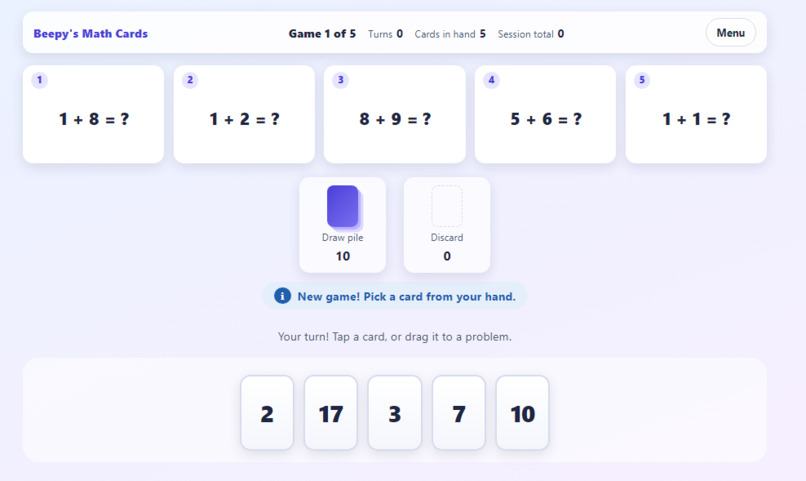
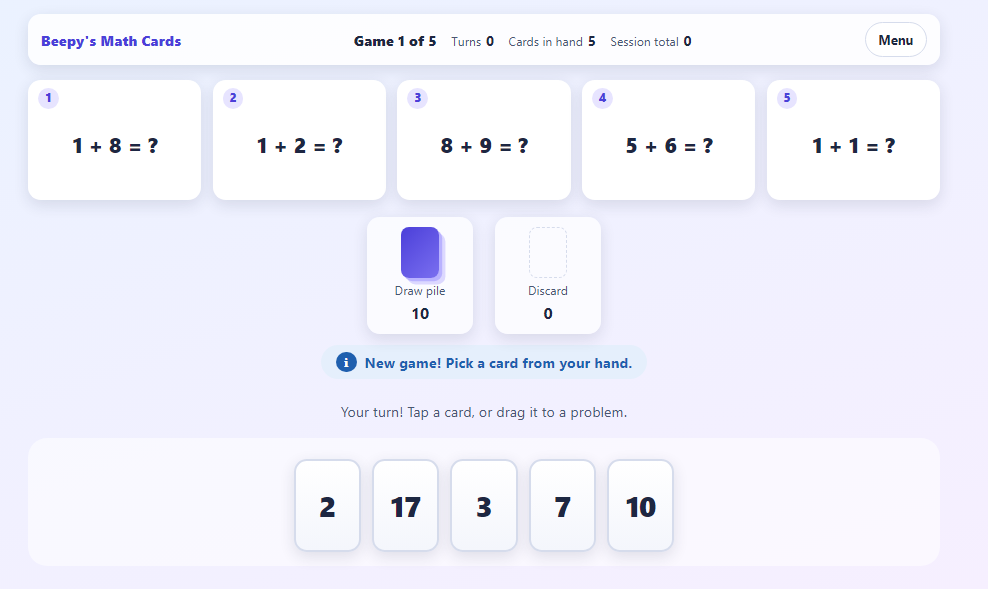
Beepy's Math Cards — Solitaire mode showing addition problems, answer cards, and game controls.
-
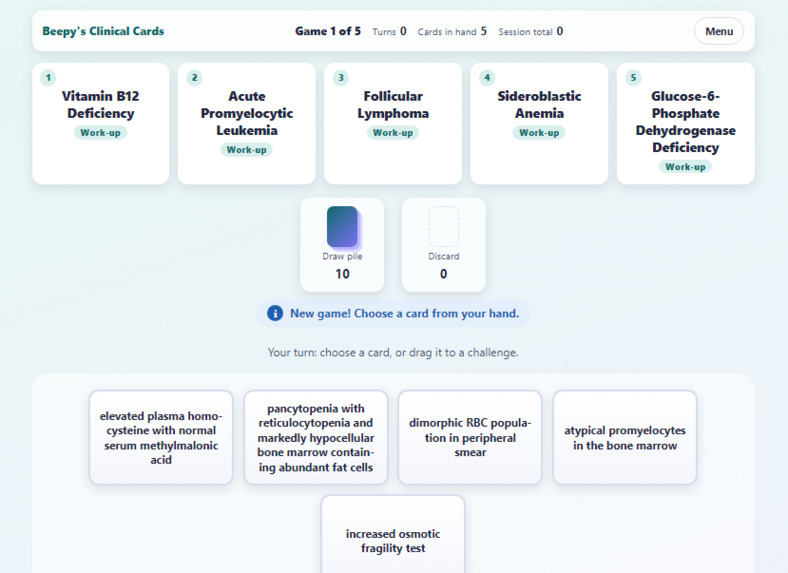
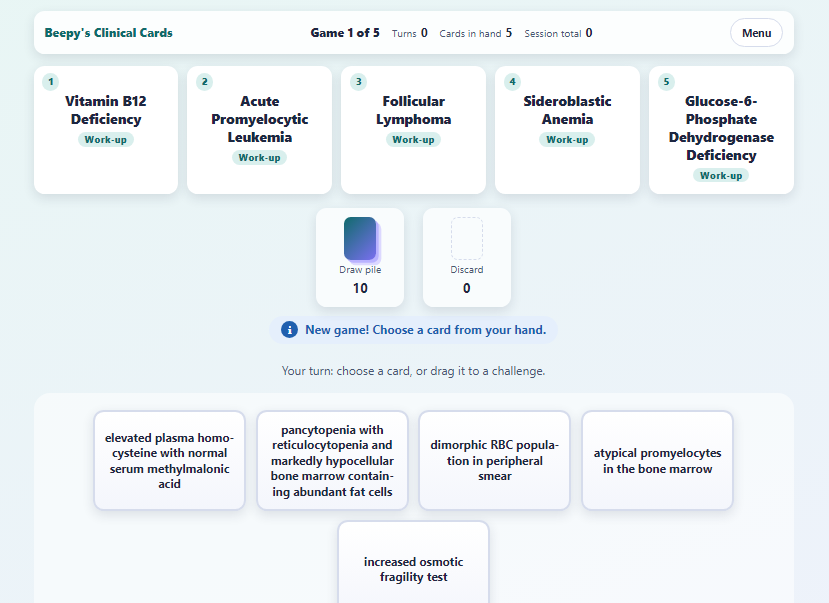
Beepy's Clinical Cards — Solitaire mode showing hematologic diseases and high-yield clinical fact cards.
Inspiration
Beepy Card Engine grew from my interest in making educational practice more engaging through interactive card games. Beepy originated as a character in an earlier educational game concept, but this Kiroween 2026 project is a new implementation developed with Kiro.
My goal was to demonstrate that one reusable game engine could support educational applications for very different audiences: elementary school students learning mathematics and medical students preparing for licensing examinations.
What it does
Beepy Card Engine powers two browser-based applications:
Beepy's Math Cards helps second-grade students practice addition by matching answer cards to arithmetic problems.
Beepy's Clinical Cards helps medical students reinforce high-yield disease associations. Its initial content includes 16 hematologic disorders with physician-authored educational material.
Both applications offer two gameplay modes:
- Solitaire: Players complete educational challenges independently.
- Player vs. Beepy: Players compete against a computer opponent using a shared board, strategic discards, challenges, and penalties.
The two applications use the same underlying game mechanics while presenting different educational content.
How I built it
I developed the project using Kiro's specification-driven workflow.
I designed a reusable game-engine architecture and two separate applications that share its core functionality. I used Kiro to translate my detailed game rules into implementation specifications, generate application code, and build automated tests.
The repository includes six Kiro specifications, steering instructions, development records, and the source code for both applications.
Development included iterative testing and debugging, with 2,390 automated tests passing during final verification.
Challenges I faced
One major challenge was designing game rules that would work consistently across two very different educational subjects.
The engine needed to prevent duplicate cards, ensure valid answer relationships, manage drawing and discarding, enforce penalties, and support a computer opponent.
Another challenge was ensuring the clinical content remained educationally accurate. As a physician, I authored and reviewed the disease facts and their relationships rather than relying entirely on automatically generated material.
Accomplishments
I completed two playable educational applications using one shared engine, with Solitaire and Player vs. Beepy modes available in both.
Both applications are publicly deployed, and I have made the complete source code available on GitHub.
What I learned
This project demonstrated the value of specification-driven development for translating complex educational game rules into reusable software.
I learned how Kiro's structured workflow could help me organize development, test game mechanics, and document implementation decisions.
What's next
Future development may expand the mathematics content beyond addition and introduce additional medical subjects.
I also envision a dedicated Clinical Cards Teaching Edition with more focused disease review and tutoring features.
Another potential enhancement is a Player vs. Player mode, allowing two human players to compete using the same shared game engine.
These enhancements would depend on available resources and opportunities for further development.
My long-term goal is to make Beepy Card Engine a flexible foundation for educational games across multiple subjects.
Built With
- eslint
- github
- kiro
- netlify
- node.js
- npm
- prettier
- typescript
- vite
- vitest
