Inspiration
Smart wearables are finally evolving beyond simple step counters, and Amazon Bee is proof of that. Whether you are wearing the Bee Frontier band or using an Apple Watch with Bee software, it captures the natural conversations, brainstorms, and field notes that make up a real workday.
The problem is what happens next. If you record hours of conversation, you just end up with walls of raw text that nobody has the time to read. We built BeeMind because we wanted our wearable to feel like a genuine second brain. Instead of just recording sound, it understands context, pulls out promises and action items automatically, helps field workers inspect equipment hands-free, and lets AI agents take real actions through open standards.
What BeeMind Does
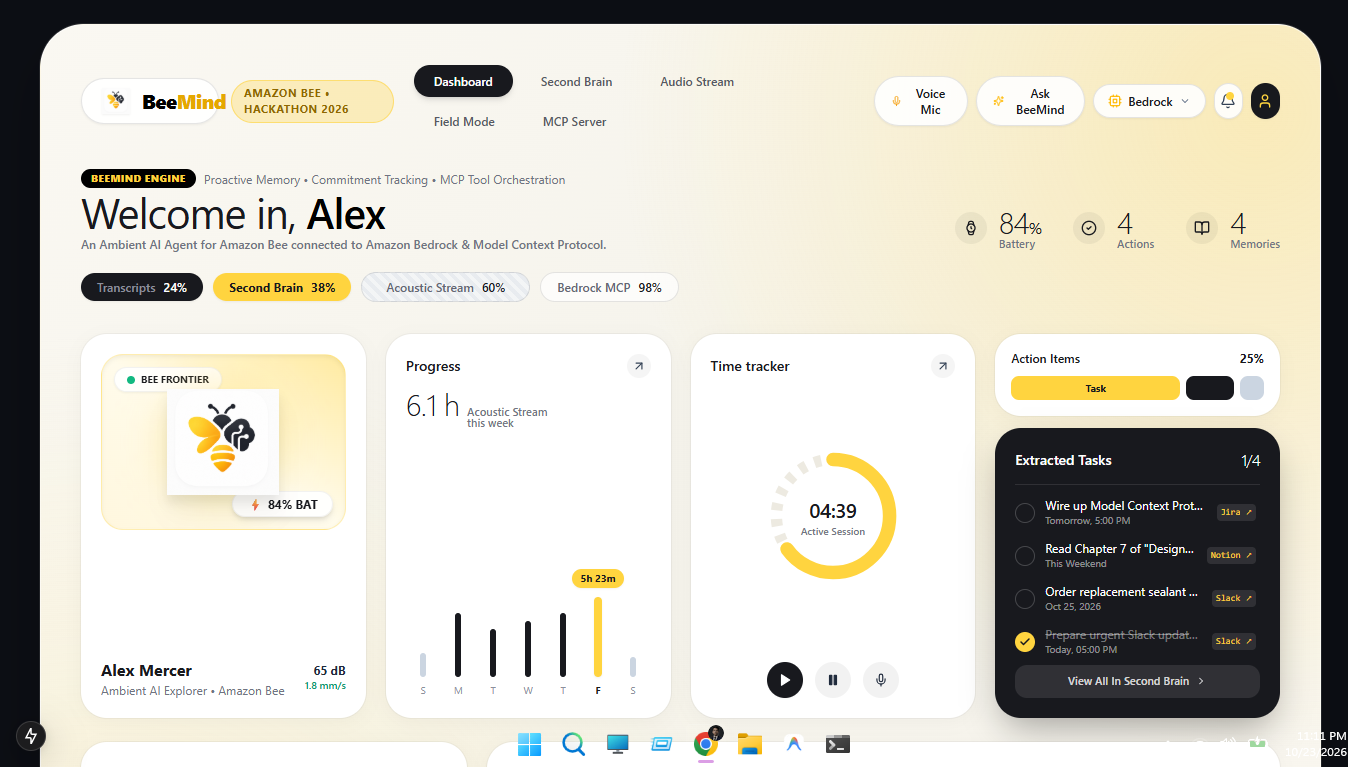
BeeMind acts as the ambient intelligence layer for the Amazon Bee wearable, powered by Amazon Bedrock.
First, it gives you proactive recall. You can open the search bar and ask plain questions about your day, like what book a colleague recommended over lunch or what deadlines were set in the morning standup. Bedrock synthesizes a clear answer and points directly to the exact moment it was said.
Second, it eliminates manual meeting minutes. While you talk, BeeMind listens for commitments, assignees, and deadlines. If someone says they will send over an API spec by 3 PM, BeeMind extracts that commitment and lets you push it straight into Slack, Jira, or Notion with one click.
Third, we built a hands-free field mode. If you are an inspector or maintenance technician on a rooftop checking an HVAC unit, you cannot hold a tablet or clipboard while working. With BeeMind, you just speak your observations out loud. The app verifies your checklist items acoustically, monitors vibration and pressure, and flags safety risks like pipe corrosion into an instant PDF audit report.
Fourth, it acts as an agentic bridge. We built a self-hosted Model Context Protocol server directly into the app. This means external AI agents running on Amazon Bedrock AgentCore or Claude can connect to your wearable, check battery status, read recent transcripts, or trigger actions based on what you said.
How We Built It
We built the companion app using Next.js 15, TypeScript, and Tailwind CSS, creating a warm, clean bento layout inspired by modern hardware interfaces.
For the AI intelligence, we used the Amazon Bedrock Runtime SDK to tap into Anthropic Claude 3.5 Sonnet, Amazon Nova, and Titan. We also baked in a zero-config simulation mode so judges and developers can test all features without having to configure AWS credentials upfront.
For the agent bridge, we implemented the official Model Context Protocol TypeScript SDK over stdio, exposing five dedicated wearable tools. We also added real voice transcription right in the browser using the Web Speech API alongside a simulated audio telemetry stream.
Challenges We Faced
The trickiest part was teaching the system to separate casual conversation from real commitments. People talk loosely, so tuning the prompts to only extract actionable promises with genuine deadlines took a lot of trial and error.
Privacy was another top priority. Amazon Bee emphasizes not storing raw audio permanently. We designed the pipeline to process audio ephemerally on the fly, extracting structured memory and action items before discarding the audio buffer entirely.
What We Learned and What Comes Next
We learned that ambient computing is not about chatting back and forth with a bot all day. It is about an assistant that stays quiet in the background and only surfaces when you need an answer or a reminder.
Next, we want to compress these models to run directly on wearable silicon for instant on-device processing, and build cross-device handoffs so your morning wearable brief shows up automatically on your Fire TV or Echo Show when you walk into the room.
Built With
- agentcore
- amazon-bedrock
- amazon-bee
- amazon-web-services
- claude-3-5-sonnet
- mcp
- model-context-protocol
- nextjs
- react
- speech-recognition
- tailwind-css
- typescript
- wearable-ai
