-
-
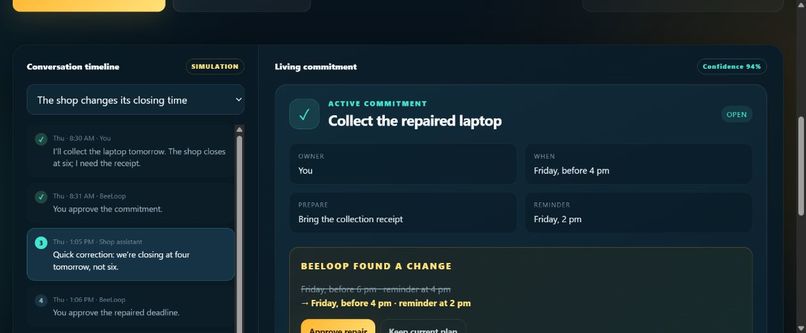
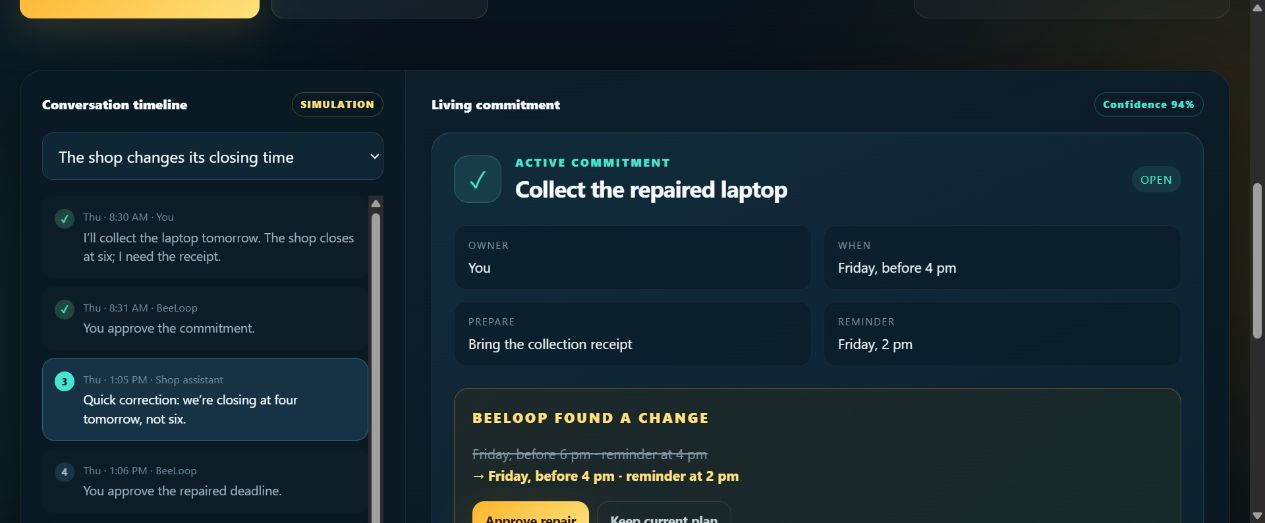
BeeLoop turns conversation changes into living, reviewable commitments.
-
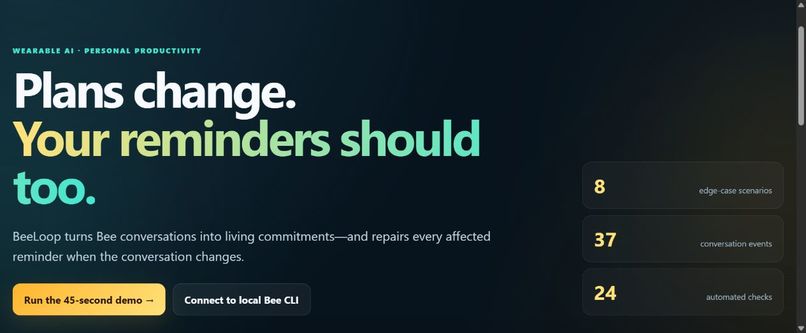
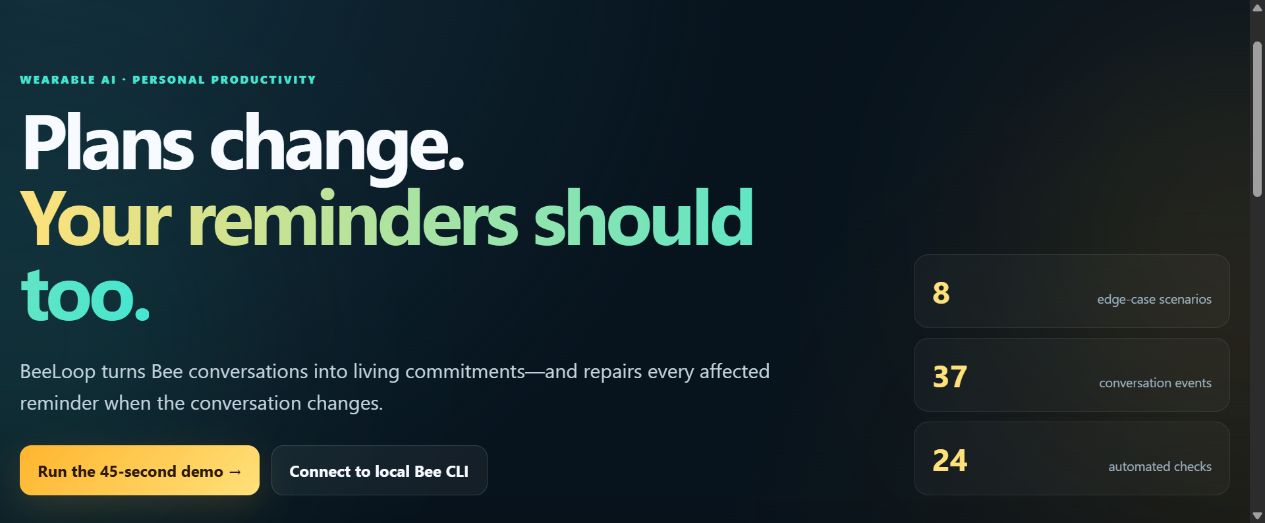
A later correction is linked to the original plan before stale reminders can survive.
Inspiration
The most damaging productivity failures are not forgotten conversations—they are changed conversations that existing tools fail to reconcile. A dentist appointment moves from Tuesday to Thursday, a pickup owner changes, or a deadline is renegotiated. The old reminder survives, the correction lives somewhere else, and a small mismatch becomes a missed appointment or broken promise.
BeeLoop is built around one idea: a correction should repair the entire commitment, not create another disconnected note.
What it does
BeeLoop turns conversation-derived plans into living commitments. Each commitment keeps the person, action, time, place, confidence, and source context that created it. When a later conversation changes a detail, BeeLoop:
- Links the correction to the original commitment.
- Creates a new version instead of silently overwriting history.
- Finds every affected reminder or action.
- Proposes one clear repair.
- Requests confirmation when the change is uncertain or consequential.
Example: “My dentist moved Tuesday at 3 to Thursday at 11.” BeeLoop recognizes a correction—not a second appointment—and repairs the dependent reminder without leaving a stale duplicate behind.
Why Bee
Bee captures useful context at the moment plans are made, without forcing people to open an app and retype what was just said. BeeLoop adds the reliability layer customers need: it reasons across conversations over time so the latest confirmed intent becomes the single source of truth.
This directly addresses a likely trust-breaking wearable failure: “Bee remembered the first plan, but not the correction.” BeeLoop makes Bee feel dependable when real life changes.
How I built it
BeeLoop is a lightweight, inspectable event pipeline:
- Bee ingestion: an official Bee CLI adapter imports processed conversational data through
@beeai/cli/lib. - Commitment extraction: normalizes who, what, when, where, confidence, and provenance.
- Change detection: classifies each event as new, duplicate, clarification, correction, completion, or cancellation.
- Dependency repair: propagates an approved correction to connected reminders and action items.
- Human review: presents a compact before/after card whenever confidence is low or consequences are meaningful.
- Audit trail: preserves every version so users can understand and undo a change.
The prototype is a dependency-free browser experience backed by deterministic JavaScript logic and an automated Node.js test suite.
Prototype and validation
The interactive demo covers 4 everyday scenarios and 21 conversation events: appointment rescheduling, owner reassignment, preparation changes, completion, cancellation, and unrelated plans. 13 automated behavioral checks pass and verify that accepted corrections update the intended commitment without creating stale or duplicate actions.
Because this machine is not authenticated to a Bee account, the submitted preview uses clearly labeled, privacy-safe synthetic Bee-compatible events. The live Bee CLI adapter is implemented in the public repository, but the demo does not claim that its sample events came from a physical Bee device.
Challenges
The hardest problem is not extracting a date—it is deciding whether a sentence creates a new plan or modifies an existing one. BeeLoop addresses that with identity matching, confidence thresholds, source provenance, and explicit confirmation for ambiguous changes.
A second challenge is trust. Silent automation feels magical until it is wrong. BeeLoop makes important changes visible, explains what triggered them, and keeps them reversible.
What I learned
A useful wearable assistant must do more than remember. It must maintain the user's intent as reality changes. Reliability comes from combining ambient context with transparent state management and carefully placed human control.
What's next
Next I would validate the adapter with authenticated Bee-processed data on compatible hardware, expand multilingual correction patterns, add calendar/task connectors, and run opt-in field tests measuring stale-reminder reduction and correction acceptance.
Built With
- amazon-bee
- bee-cli
- css3
- html5
- javascript
- node.js


Log in or sign up for Devpost to join the conversation.