Inspiration
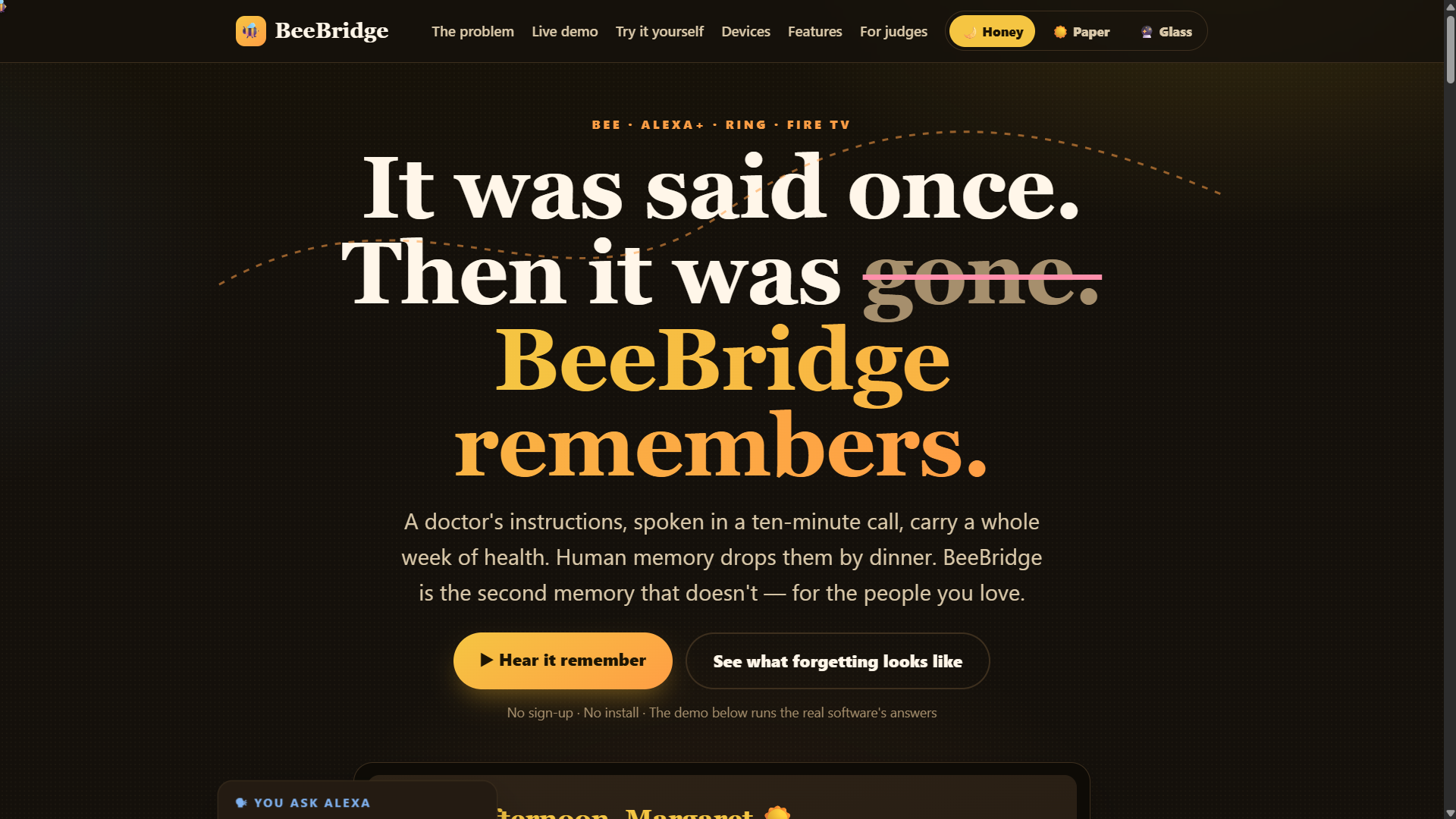
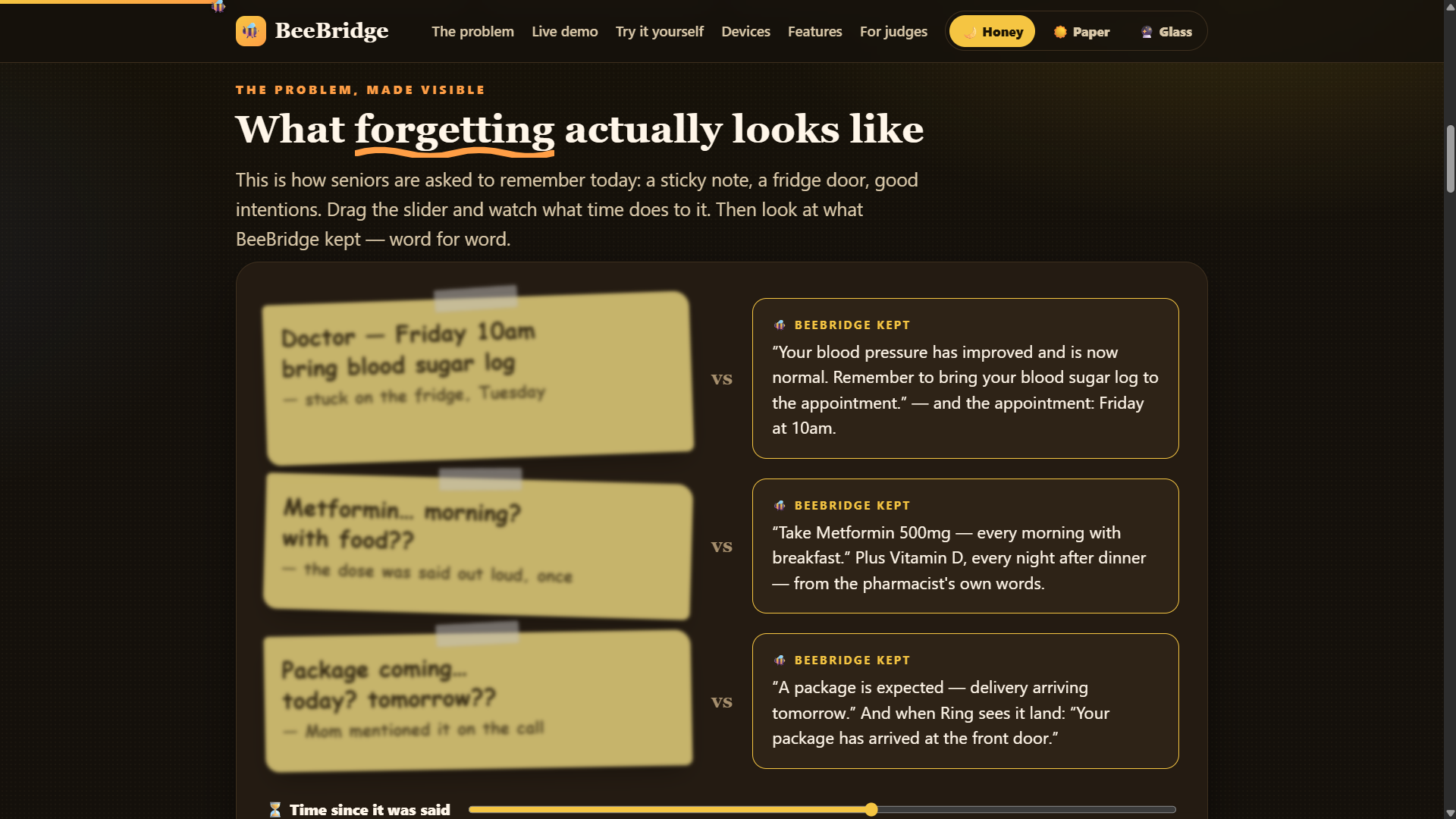
One in three older adults leaves a doctor's appointment unsure what was actually said. Medication doses, follow-up dates, "bring your blood sugar log" — spoken once, gone by the time they're home. Caregivers hear the same story everywhere: the information existed, it was just never captured.
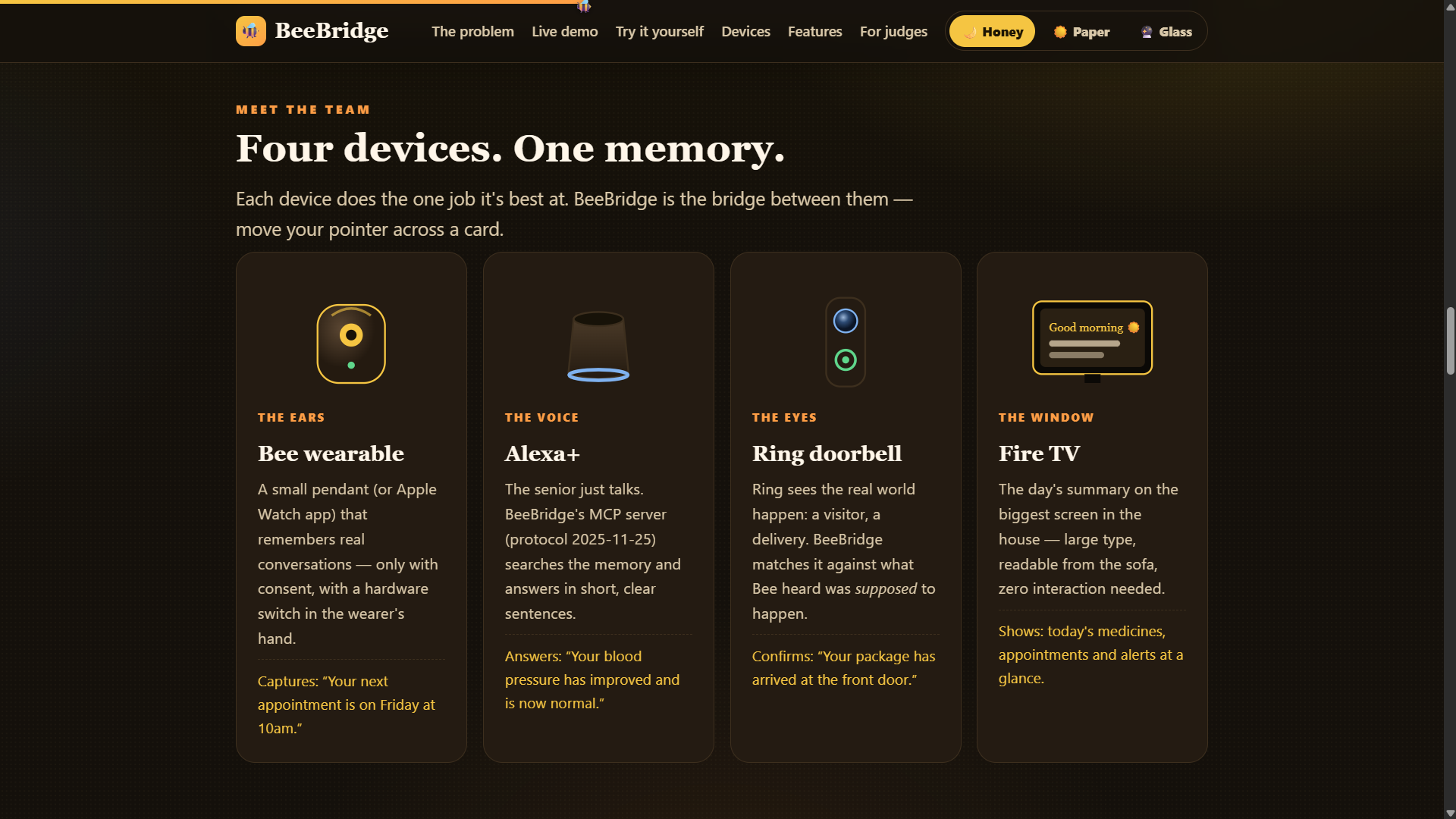
When Amazon put Bee — a wearable designed to "remember the moments that matter" — together with Alexa+ and Ring in one hackathon, the shape of the answer was obvious. Bee already hears the conversation. What was missing is a bridge: turning what Bee captured into something a senior can ask, in plain language, from the sofa. Users already report Bee quietly becoming essential for people with hearing loss and ADHD. We built BeeBridge to bring that same second memory to seniors and the people who care for them.
What it does
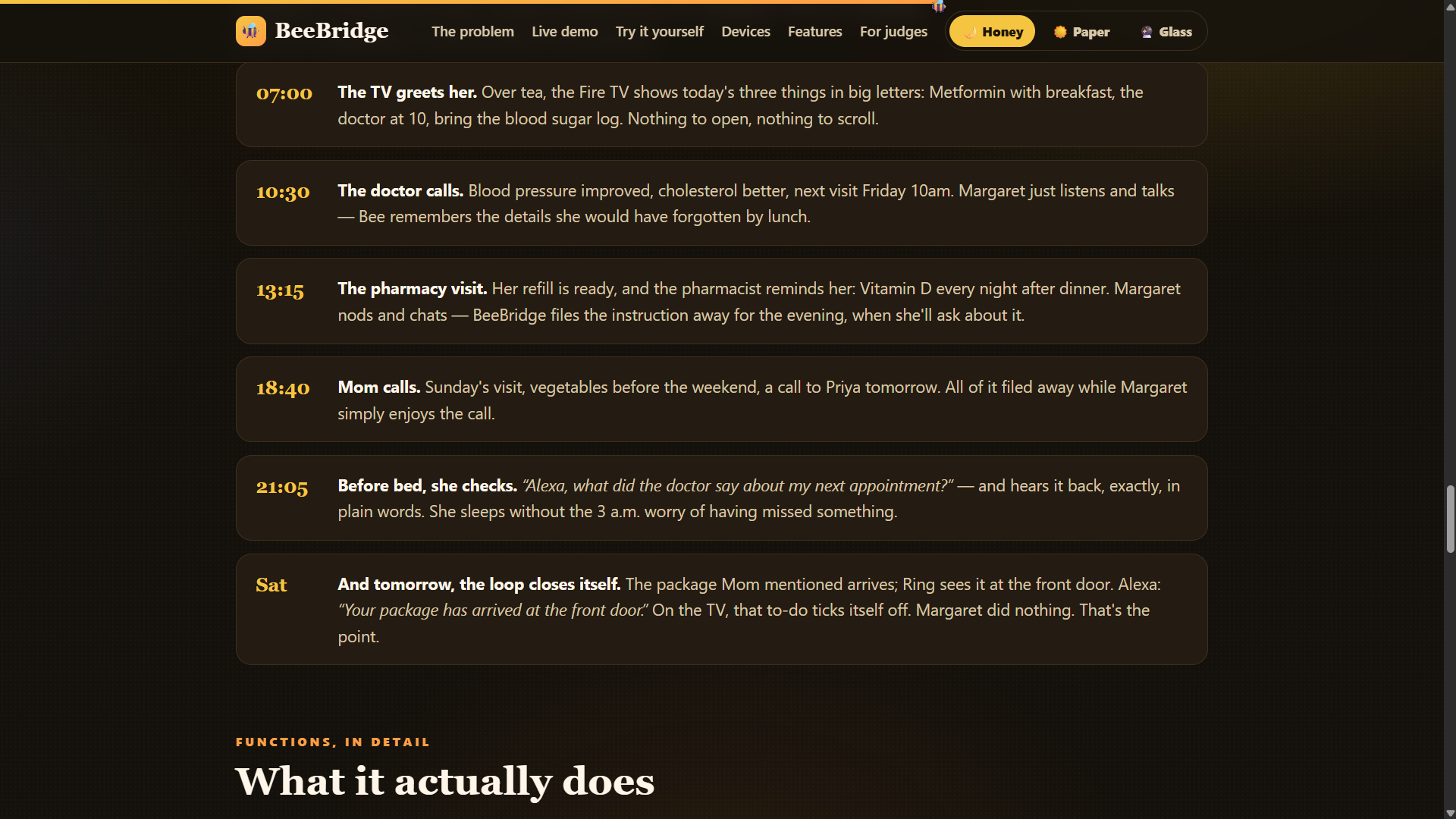
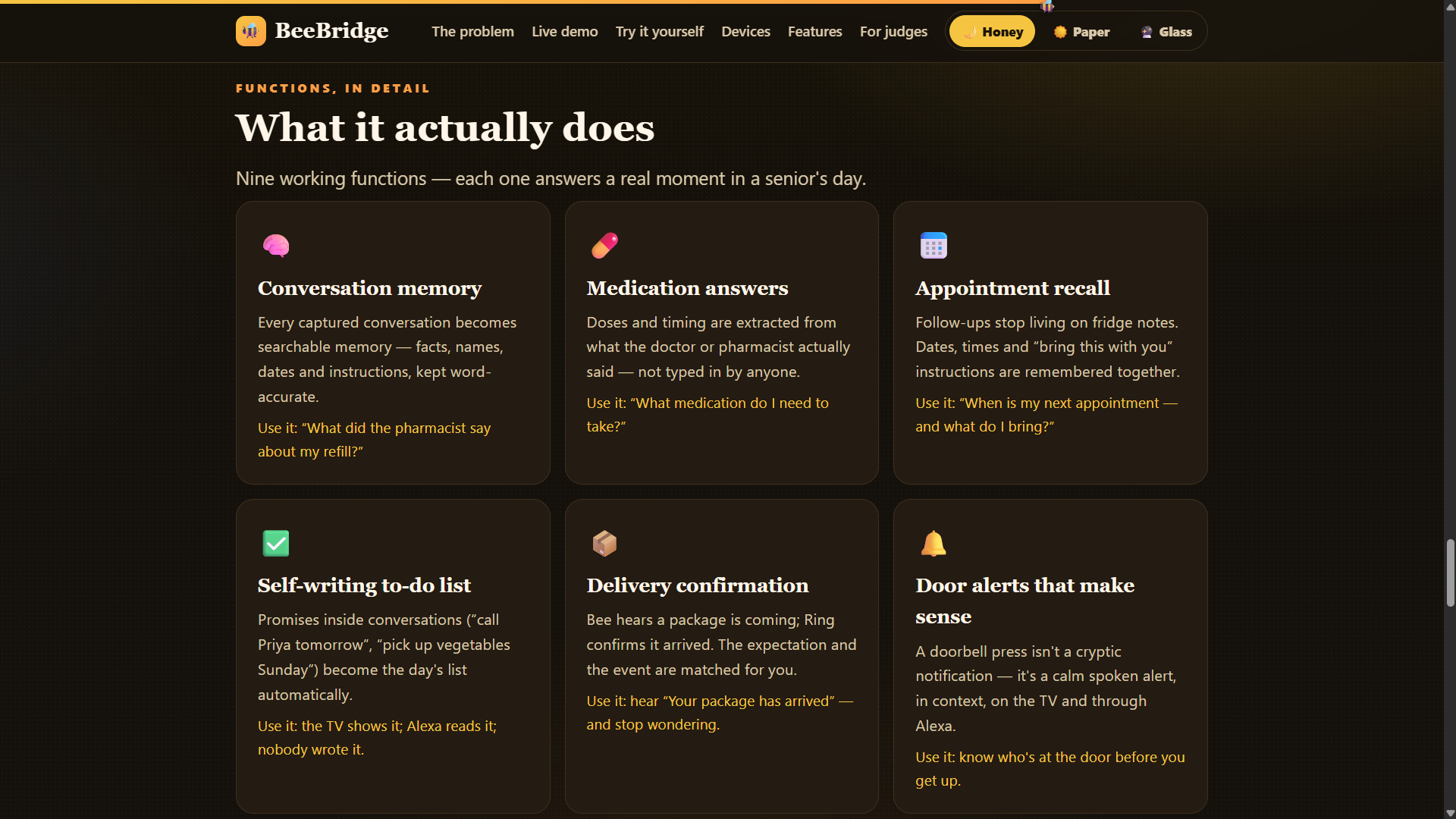
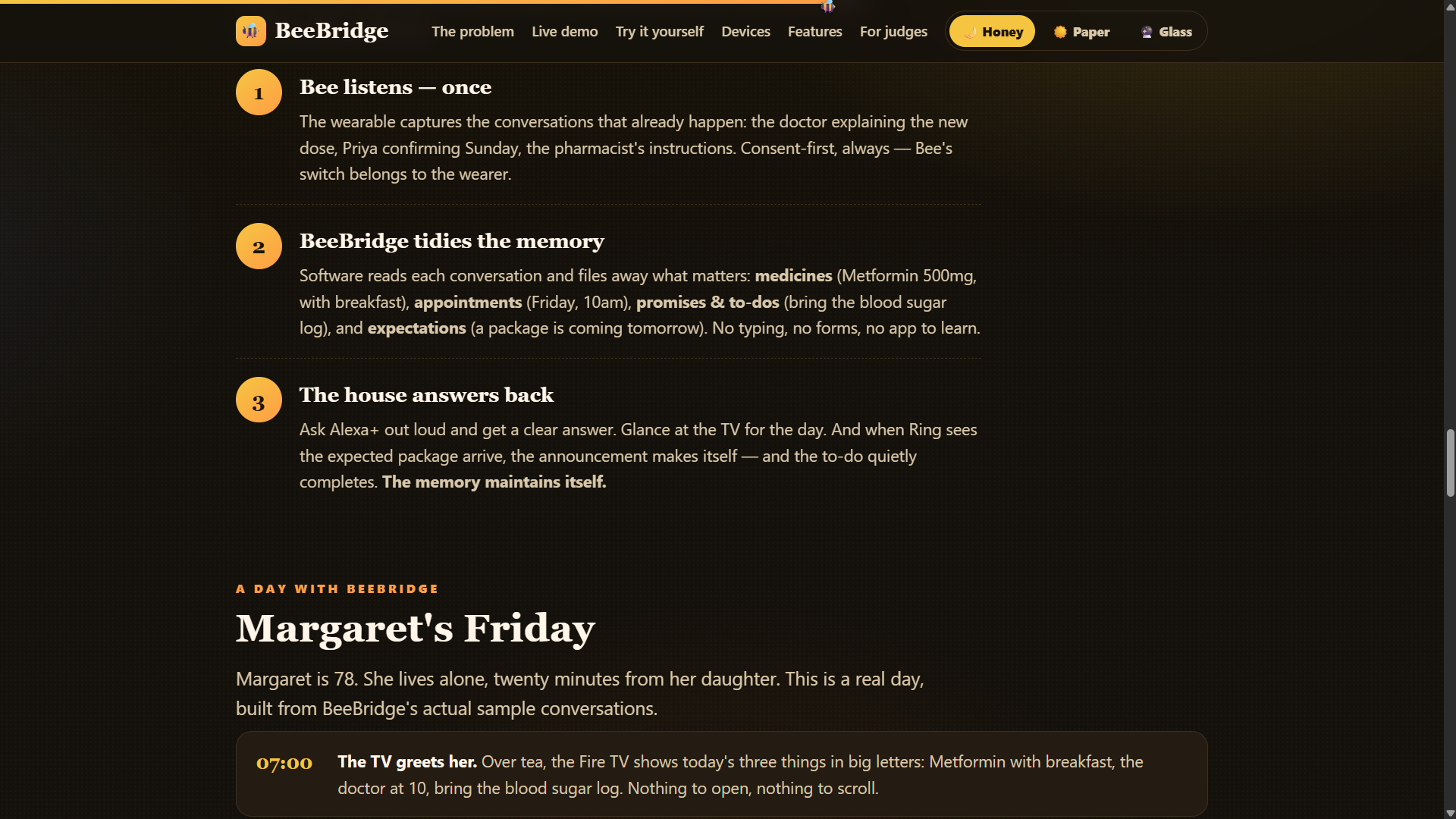
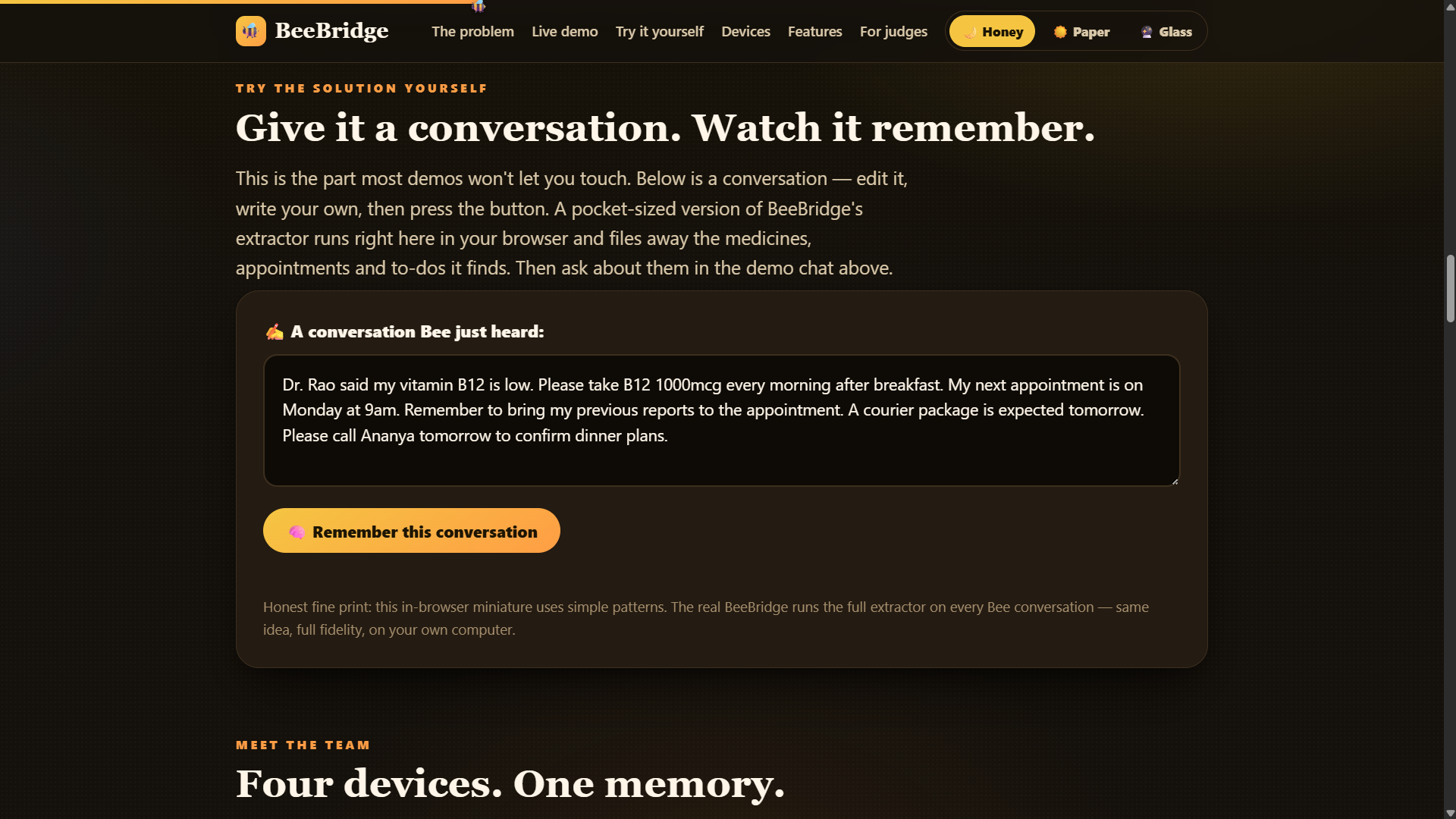
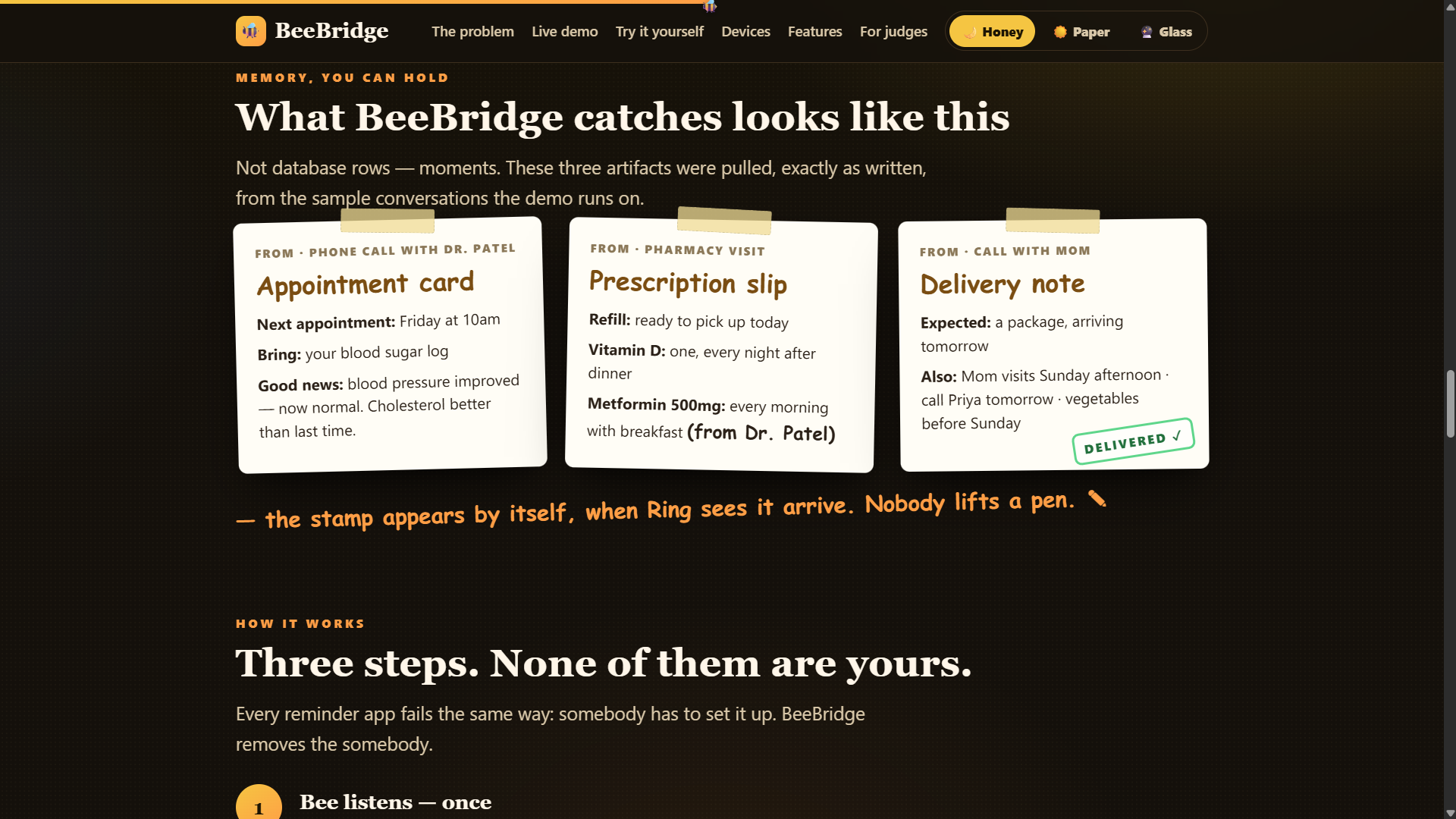
BeeBridge is a voice-driven memory companion. A Bee wearable (or Bee on Apple Watch) captures real conversations — a doctor's instructions, a family call, a pharmacy visit. BeeBridge syncs that data through the Bee CLI and Bee MCP, then extracts structured memory: health facts, medication schedules, appointments, and to-dos.
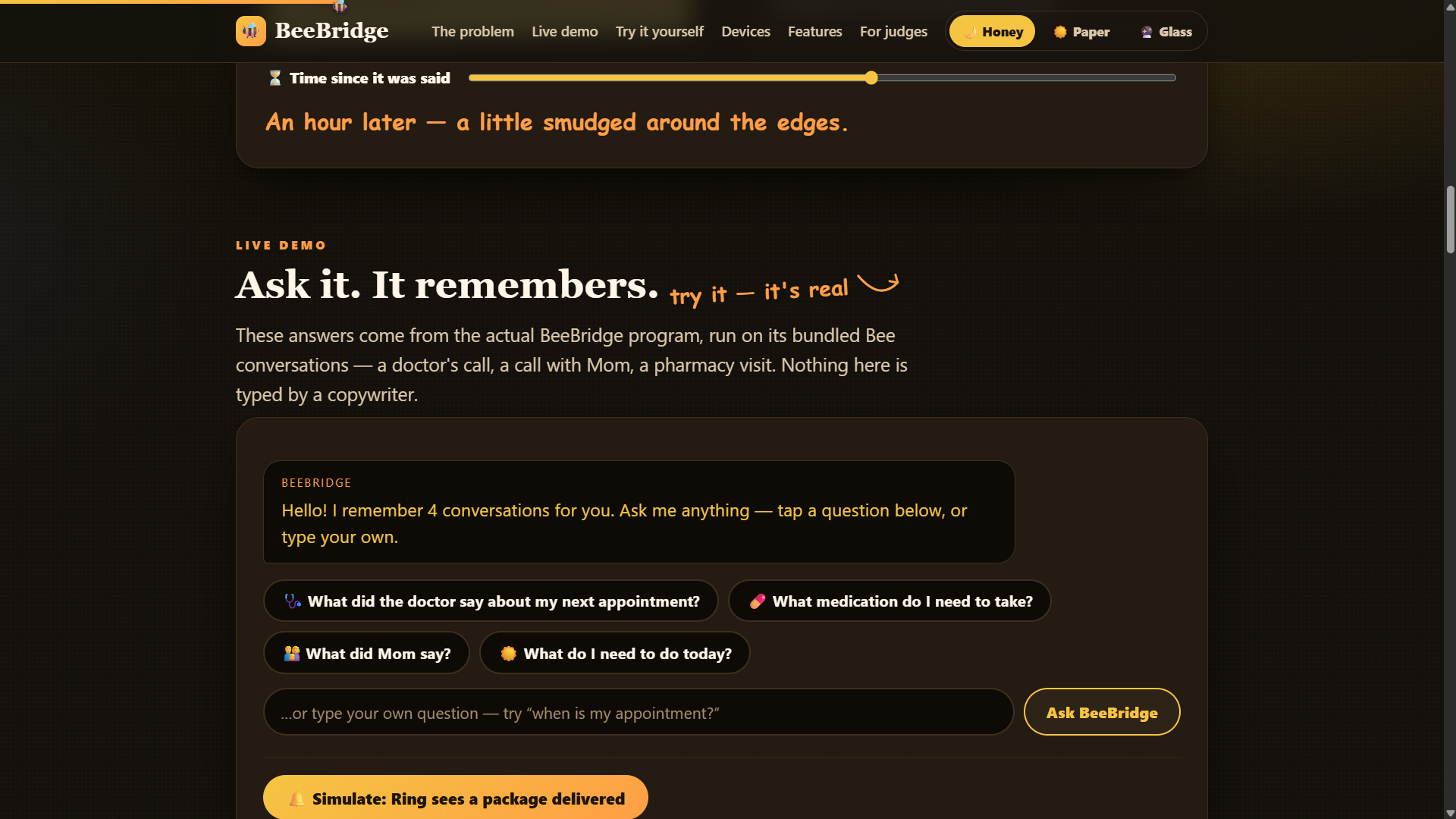
Then the senior just asks, through Alexa+:
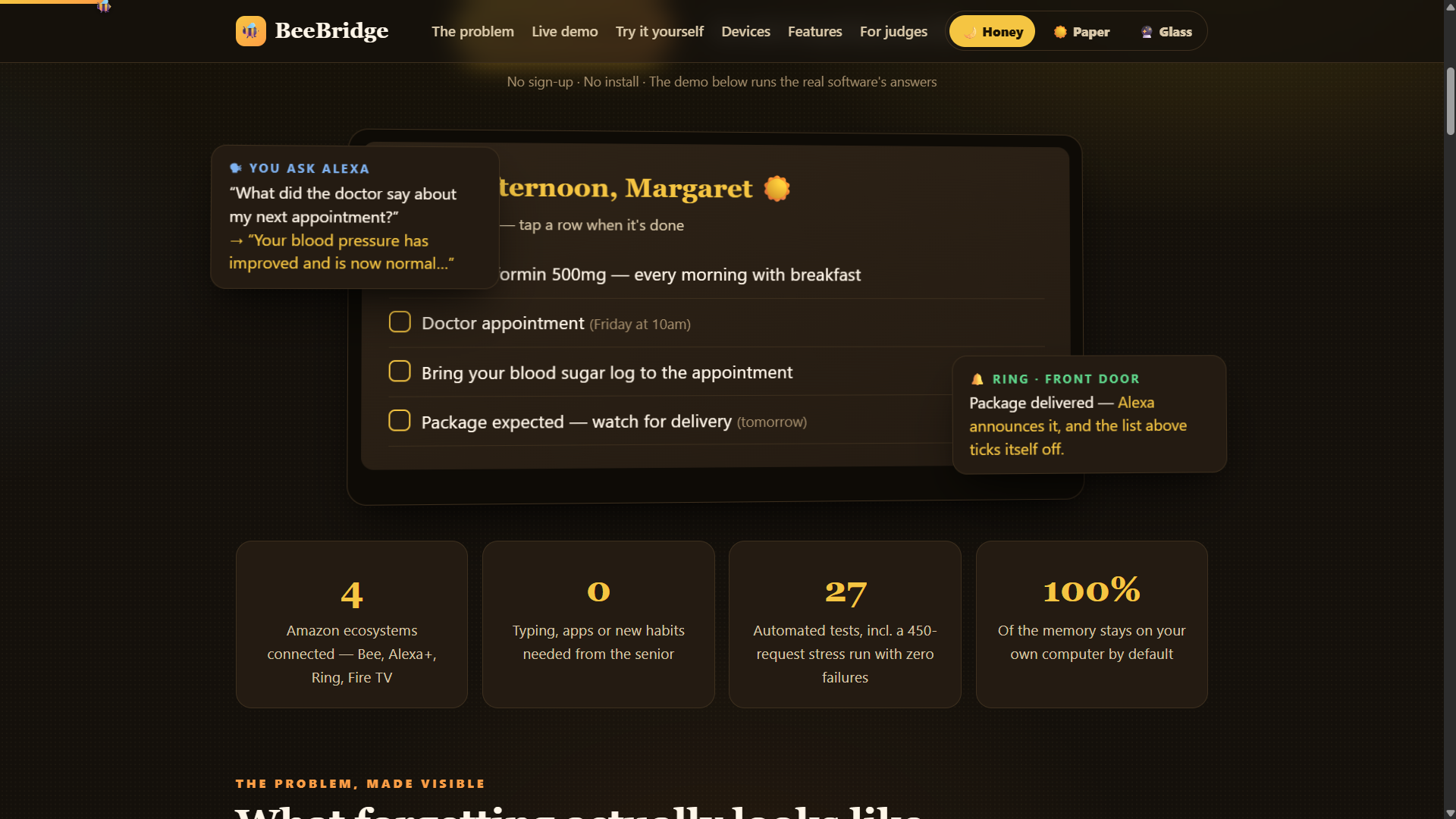
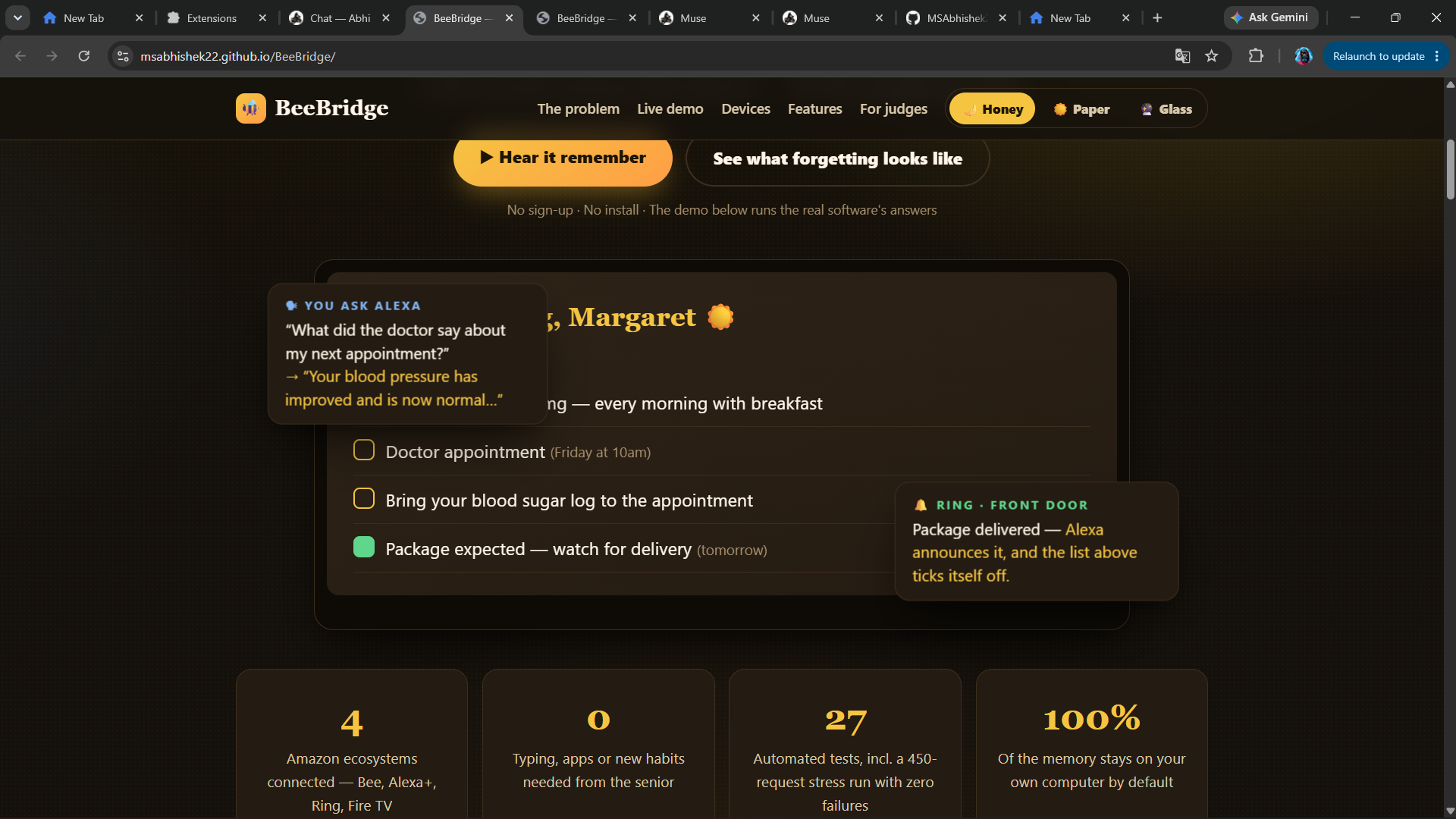
- "Alexa, what did the doctor say about my next appointment?" → "Friday at 10 a.m. Your blood pressure has improved and is now normal. Remember to bring your blood sugar log."
- "What medication do I need to take?" → Metformin 500 mg with breakfast, Vitamin D after dinner.
- "What did Mom say?" → a clear summary of the family call.
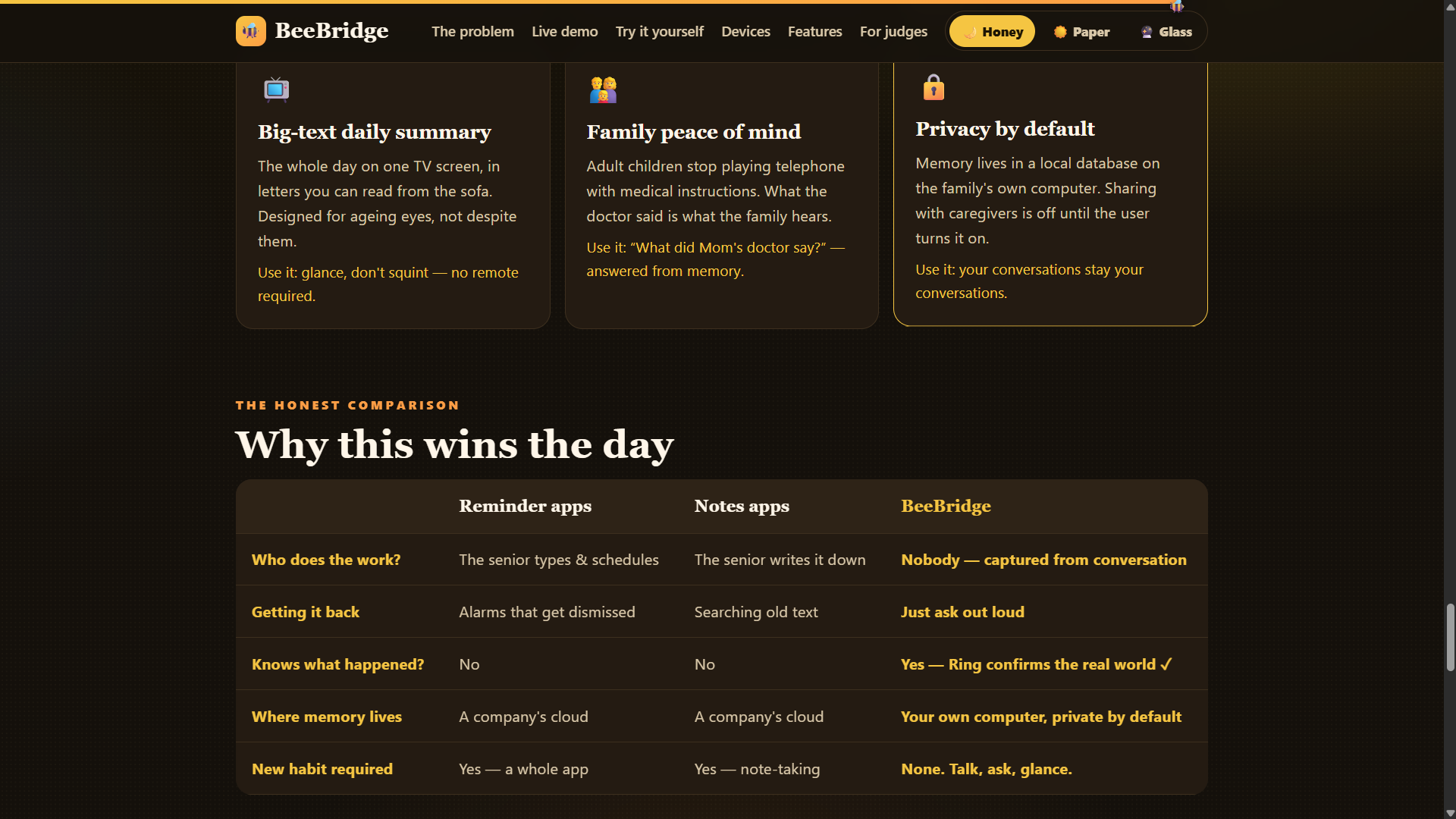
Ring completes the loop between expecting and happening: when Bee heard "a package is expected tomorrow" and the Ring doorbell later sees it arrive, Alexa announces "Your package has arrived" — and the to-do completes itself. Doorbell and visitor events become caregiver-style alerts on a large-text Fire TV summary screen designed to be read from across the room.
How we built it
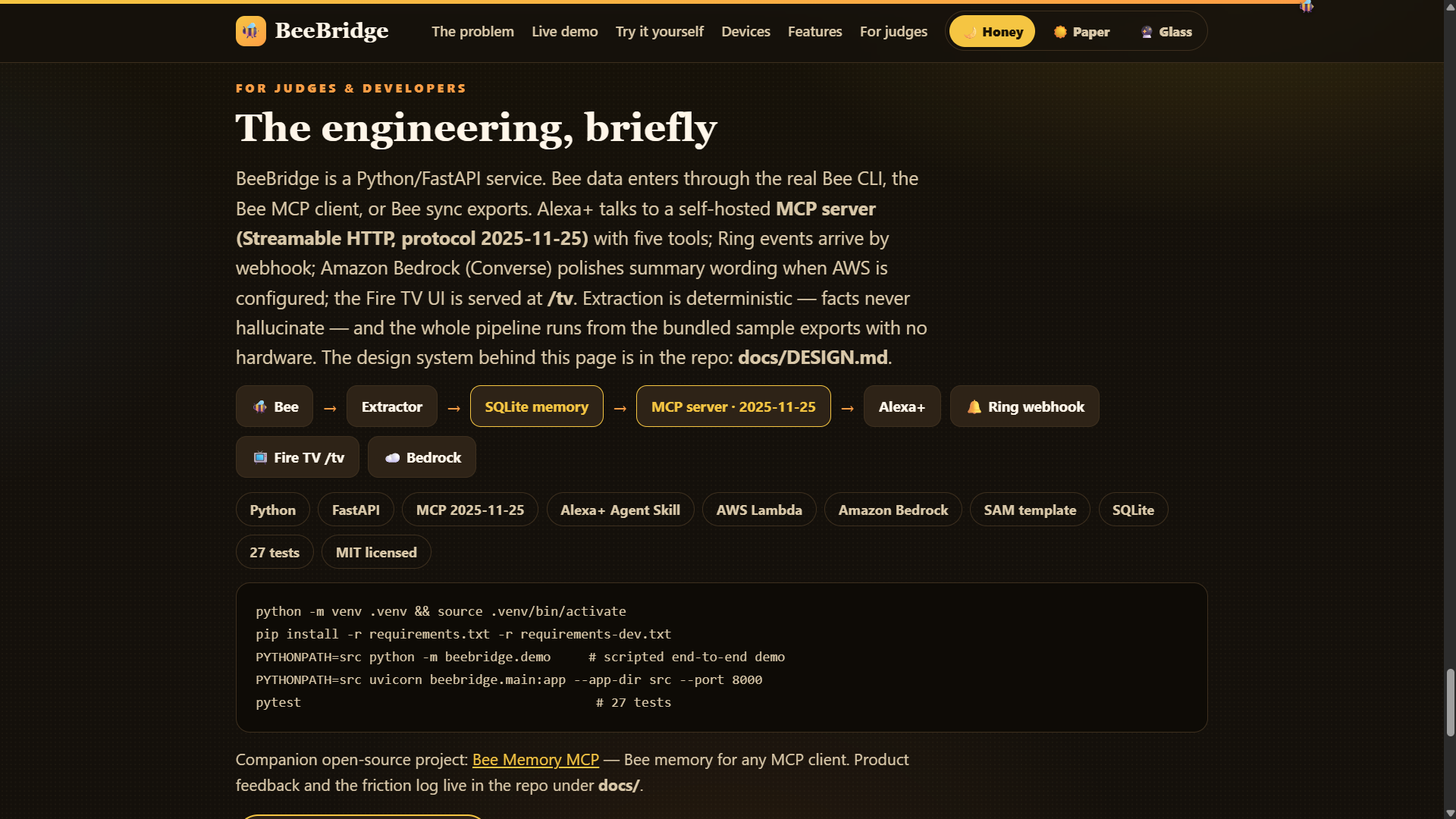
BeeBridge is a Python/FastAPI service with four Amazon integrations, all exercised in code:
- Bee (data source): a Bee client that runs the real Bee CLI (
bee sync,bee today), speaks to Bee's MCP server, and ingests Bee sync exports — so the same pipeline runs on live Bee data or the bundled sample exports. - Alexa+ (primary track): a self-hosted MCP server implementing spec 2025-11-25 over Streamable HTTP, exposing five tools (
beebridge_ask,beebridge_today,beebridge_todos,beebridge_sync_bee,beebridge_ring_simulate), plus an Agent Skill definition, a classic Alexa skill package, and a Lambda handler — so the experience works on both Alexa+ paths. - Ring: an event model and webhook (doorbell, motion, person, package delivery) with expectation-matching logic against Bee memory.
- AWS Builder: Amazon Bedrock (Converse API) rephrases summaries into short, senior-friendly sentences with names, dates, and doses preserved; a SAM template (Lambda + API Gateway + DynamoDB) defines the hosted deployment.
Memory lives in a local SQLite store — private by default, on the user's machine, not ours. The extraction engine is deterministic (no LLM in the critical path), so answers are stable, testable, and work offline; Bedrock only polishes wording when AWS is configured.
And we tested it the way judges will: 27 automated tests, a clean-room run from a fresh clone of the public repo, and a live stress test — 300 question requests plus 150 MCP calls fired concurrently with zero failures.
Challenges we ran into
- Bee's export layout isn't a single published schema, so our Bee client normalises both JSON and markdown exports into one conversation model (this became a friction-log entry with a concrete suggestion).
- Alexa+ documentation is split between the Agent Skill and MCP worlds. We shipped both paths — the MCP server as primary, a classic skill package as backup — rather than betting the submission on one interpretation.
- Our own stress test caught a real concurrency bug: the shared database connection threw errors under parallel load. We serialised store access and added a thread-safety regression test. A routing bug (questions mentioning both "doctor" and "medication" answered only half) got the same treatment — found by tests, fixed, regression-locked.
- Designing for an 80-year-old is unforgiving: default answer wording was too dense, so we moved to short sentences, exact names and times, and 24px+ text on the TV screen.
Accomplishments that we're proud of
- A complete, working loop across four Amazon surfaces — Bee → Alexa+ → Ring → Fire TV — not a mockup: every integration is real code a judge can run from the README in two minutes.
- A spec-exact MCP server (protocol 2025-11-25) that any MCP client can talk to, verified live, including version negotiation and error handling.
- Testing discipline we'd defend in review: 27 tests, two genuine bugs found and fixed by the test process, and a stress run with zero failures.
- Privacy treated as a feature: Bee records only with consent, memory stays local by default, and nothing is shared with caregivers unless the user turns it on.
- A companion open-source project, Bee Memory MCP (MIT), that makes Bee memory queryable by any MCP client — because ambient memory shouldn't be locked inside one app.
What we learned
- MCP is the right glue. One protocol carried Bee's data in and Alexa+'s questions out; tool descriptions did the work that intent plumbing used to.
- Deterministic first, LLM second is the right architecture for vulnerable users: the facts must never hallucinate, so extraction is rule-based and testable, and the model only improves phrasing.
- Accessibility is a design constraint, not a theme. Sentence length, font size, and "answer the question that was actually asked" mattered more than any feature we added.
What's next for BeeBridge: A Memory Companion for Seniors
- Validate with a physical Bee device and real senior users, and tune extraction against real-world transcripts.
- Proactive medication confirmation ("It's 8 a.m. — time for Metformin") via Alexa routines, with caregiver sharing strictly opt-in.
- Ship the hosted deployment from the included SAM template so families can run BeeBridge without a developer in the house.
- A native Fire TV app and Echo Show cards for the daily summary.
- Pilot with a caregiver community and publish the results — what seniors actually ask their memory is research worth sharing.


Log in or sign up for Devpost to join the conversation.