-
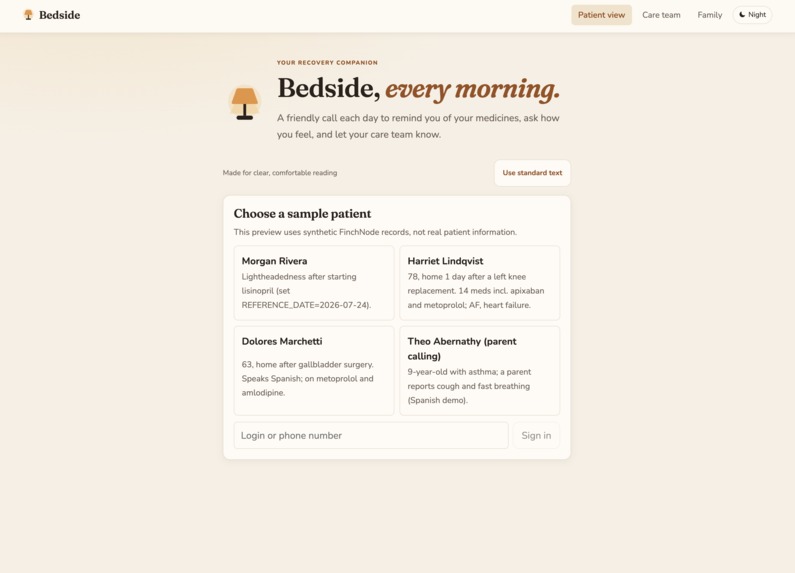
Bedside home page
-
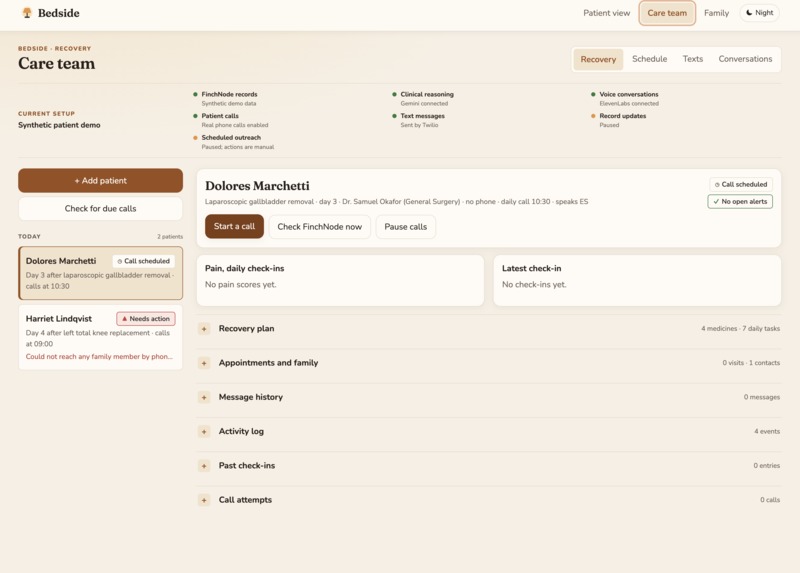
Bedside care team page
Inspiration
The riskiest days after surgery happen at home. An older patient leaves the hospital with a dozen medications, a stack of instructions they heard while groggy, and nobody checking in until a follow-up visit two weeks later. That gap is where blood clots, wound infections, missed blood thinners and falls go unnoticed, often until they become an ER visit or a readmission.
The tools meant to cover that gap all wait for the patient to act: a portal to log into, an app to open, a chatbot to ask. Older patients are the least likely to do any of those. When we talked with the FinchNode team, their challenge to us was simple: don't build another chatbot. Build something proactive that actually gets things done.
So we flipped the direction. Bedside doesn't wait to be asked. It calls you.
What it does
Bedside is a recovery companion a hospital prescribes at discharge.
- Enrollment from the health record. A nurse picks the patient's record from FinchNode. Bedside reads their medications (with dosing times), conditions, allergies and baseline vitals, and builds a daily recovery plan. For example: on apixaban + aspirin → watch for bleeding; heart failure → weigh daily; kidney disease → never suggest ibuprofen.
- A call every morning. Bedside phones the patient, with no app and no login. An ElevenLabs voice agent reminds them which medicines are due, then runs a short check-in in their language.
- It acts before hanging up. Deterministic rules turn the answers into actions: alert the care team, book a follow-up visit on the clinic calendar, text and call a family member, or text a link to a camera vitals check. If the patient doesn't pick up after three tries, the family gets a "please check on Mom" call.
- Contactless vitals. A 30-second front-camera recording estimates heart rate and respiratory rate (rPPG), compared against that patient's own baseline from FinchNode.
- Clinician dashboard. Flags come first, followed by an English SOAP summary of every call, the pain trend, the plan, every message sent, and a plain-language log of everything Bedside did.
Bedside is not a diagnosis tool: it never tells a patient they have a condition. It reminds, asks, measures and escalates.
How we built it
- Frontend: React + TypeScript + Vite. It includes a big-button patient app (incoming-call screen, mute, large text, day and night modes), a camera check-in page, a family page, and the care-team dashboard.
- Backend: Python + FastAPI + SQLite. A scheduler places daily calls, retries missed ones and watches call outcomes.
- Voice: an ElevenLabs Conversational AI agent with 11 webhook tools (get_daily_briefing, record_checkin, book_appointment, notify_family, record_family_response, and more). The patient and conversation IDs come from dynamic variables, never from the model.
- Records: FinchNode's normalized patient records drive the plan. Signed records.updated webhooks (sandbox records.advance) trigger a call when medications change.
- Reasoning: an LLM (Gemini, or Claude when configured) with structured outputs for symptom triage, plan personalization and clinician summaries. It always runs after a deterministic red-flag layer.
- Calling channels: one codebase, three channels. Relay handles in-app calls and messages, Twilio handles real phone calls, or calls can ring in the web app.
Contactless vitals (rPPG + respiratory rate)
MediaPipe Face Landmarker runs in the browser, so video never leaves the device. Each frame becomes a few numbers: the mean RGB of skin patches on the cheeks and the bridge of the nose (well-perfused skin that hair and brows don't cover), the nose-bridge position, and facial blendshapes.
On the server, heart rate comes from CHROM, the chrominance method of de Haan and Jeanne. The RGB trace is cut into 1.6-second windows that overlap by half. Each window is normalized, Cn(t) = C(t) / mean(C), and projected onto two chrominance axes that cancel most of the change caused by motion and lighting:
X = 3·Rn − 2·Gn Y = 1.5·Rn + Gn − 1.5·Bn
Both are band-passed to 0.7–3.5 Hz (42–210 bpm) and combined:
S = Xf − (σ(Xf) / σ(Yf)) · Yf
Each window is weighted with a Hann window and added back into the full trace. The result is band-passed again, and the heart rate is the spectral peak:
HR = 60 × (the frequency with the most power in S between 0.7 and 3.5 Hz)
Respiratory rate is extracted from two signals in the 0.1–0.8 Hz band (6–48 breaths/min): the subtle vertical motion of the head with each breath, and the breathing-driven variation in the green channel. We keep whichever has the sharper spectral peak, and give a bonus when the two agree within 3 breaths/min.
Every reading carries a signal quality index (SQI). For heart rate:
SNR = 10 × log10(power near the peak f0 (±0.1 Hz) and its harmonic 2f0 (±0.2 Hz) ÷ all other power in the band) SQI_HR = (0.6 × clip((SNR + 6) / 12) + 0.4 × c) × q_face × q_light × q_motion
Here c measures how consistent the estimate is across sliding 10-second windows. Low-SQI readings are treated as missing data, and the patient is asked to retake with better light; they are never shown a number we don't trust. A high-confidence reading is interpreted against the patient's record (for example, "HR 112 vs. a typical 74 across 10 visits, on metoprolol"). A normal reading never cancels a red-flag symptom.
Challenges we ran into
- The record didn't have everything. By design, FinchNode is read-only, with no family contacts, no surgical history and no scheduling. So we capture the discharge episode and family contacts (with consent) at enrollment, and run our own clinic calendar.
- Safety can't depend on the model. Emergencies (chest pain, trouble breathing, stroke signs, self-harm, in English and Spanish) are caught by deterministic rules first. During testing, "hi I'm dying" slipped past the rules. The LLM layer caught it, but our family-call hook only fired on the rules path. We fixed it so every route to "call 911" also calls the family, with de-duplication.
- Should the bot call 911 itself? We decided no. A server-placed 911 call shows the wrong location, can't answer a dispatcher's questions, and false alarms send real ambulances. Instead, Bedside tells the patient to call 911 and immediately calls their family with the address on file.
- Real-world signal quality. Our first live heart-rate capture scored SQI 0.49 against a 0.5 cutoff. We gave heart rate its own threshold (0.4); mid-confidence readings are shown but never used to raise urgency. We also flag atrial fibrillation, since an irregular rhythm undermines camera estimates.
- Telephony is full of sharp edges. ElevenLabs requires flash/turbo v2 voices for English agents. Calls bridged through Twilio need μ-law 8 kHz audio, while the browser needs 16 kHz PCM, so we run a separate phone copy of the agent. Twilio's trial blocks several call parameters, so we poll for call outcomes instead.
- Flaky upstreams. The LLM API returned intermittent 503 errors at peak times, so we added retries and a fallback chain of models, plus rule-based fallbacks if every model is down.
Accomplishments that we're proud of
- A full loop that acts, not just talks: call → check-in → care-team alert → booked visit → family called, all before the patient hangs up.
- Safety-critical logic lives in code, covered by 113 automated tests. They include red-flag detection, the rPPG pipeline on synthetic signals with known rates, scheduler retries, and webhook signature verification.
What we learned
- Proactive beats reactive for the people who need care most. The best interface for an 80-year-old is a phone that rings.
- Intelligence includes knowing when not to trust your own data. A quality score that says "retake" is more valuable than a confident wrong number.
- Ground everything in the record. Generic advice is easy; "take your apixaban, and tell me if you see unusual bruising" is what actually helps.
- Integrating real infrastructure (voice, telephony, health records) is mostly about the unglamorous details: audio formats, webhooks, retries and consent.
What's next for Bedside
- Validate rPPG accuracy against a pulse oximeter across lighting conditions and skin tones, and measure respiratory-rate error.
- Read vitals directly from the video call itself (Relay delivers the patient's camera frames to the agent).
- Partner with emergency-data services (such as RapidSOS) to share location and context with 911 the right way.
- Pilot with a care team and measure missed complications and readmissions.

Log in or sign up for Devpost to join the conversation.