Inspiration
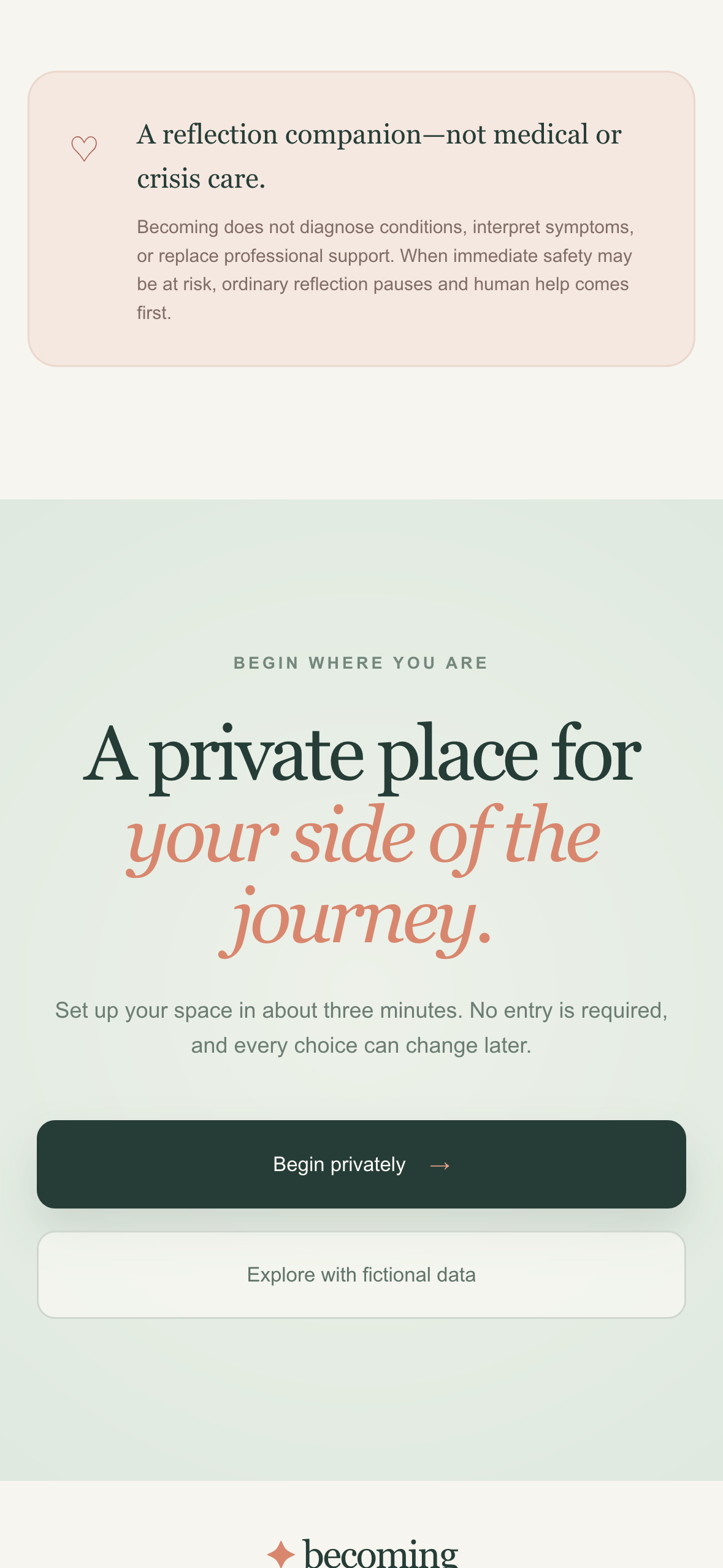
Most pregnancy and postpartum apps track the baby, symptoms, appointments, or milestones. Far fewer focus on the person becoming a mother.
Pregnancy and postpartum can reshape identity in ways that are difficult to describe. A person may feel grateful and disconnected, supported and less independent, deeply changed and still eager to recognize herself. These experiences rarely fit into a mood score or a simple “better versus worse” trend.
We created Becoming for the moments when someone asks:
- What still feels like me?
- What has changed?
- What have I lost, regained, or discovered?
- What made a difficult moment easier?
- How is my identity being expressed differently now?
The idea behind Becoming is simple: motherhood is not only a physical or emotional transition. It is also an identity transition.
The name reflects that identity is never a finished state. Becoming does not ask users to return to their “old self,” recover on a fixed timeline, or become an ideal version of a mother. It gives them a private space to notice who they were, who they are, and who they are becoming.
Our guiding insight was:
Most pregnancy apps track the baby. Becoming helps the mother remain visible to herself.
What it does
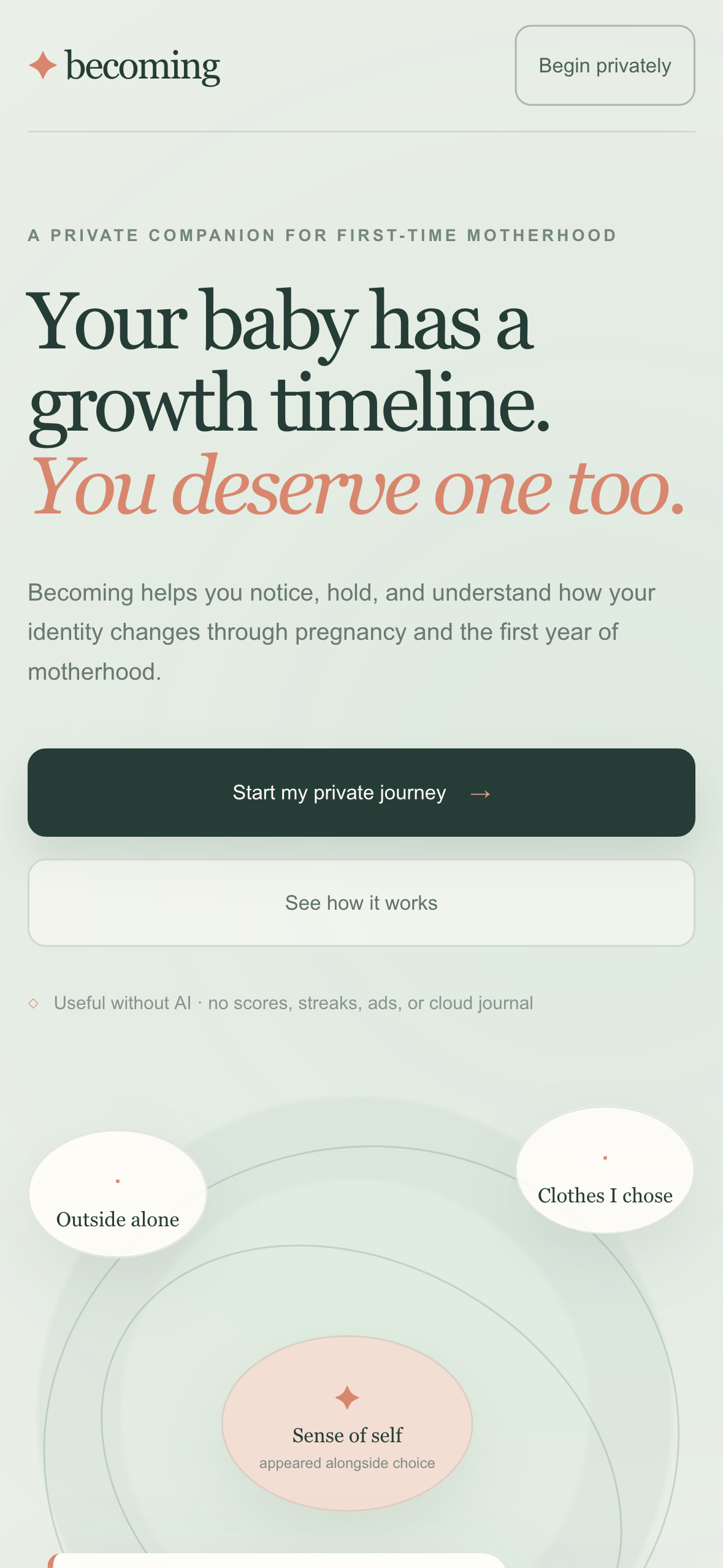
Becoming is a privacy-first AI identity companion for pregnancy and postpartum.
It helps users capture meaningful moments, control how those moments may be used, and discover explainable relationships between identity, experience, context, choice, and support.
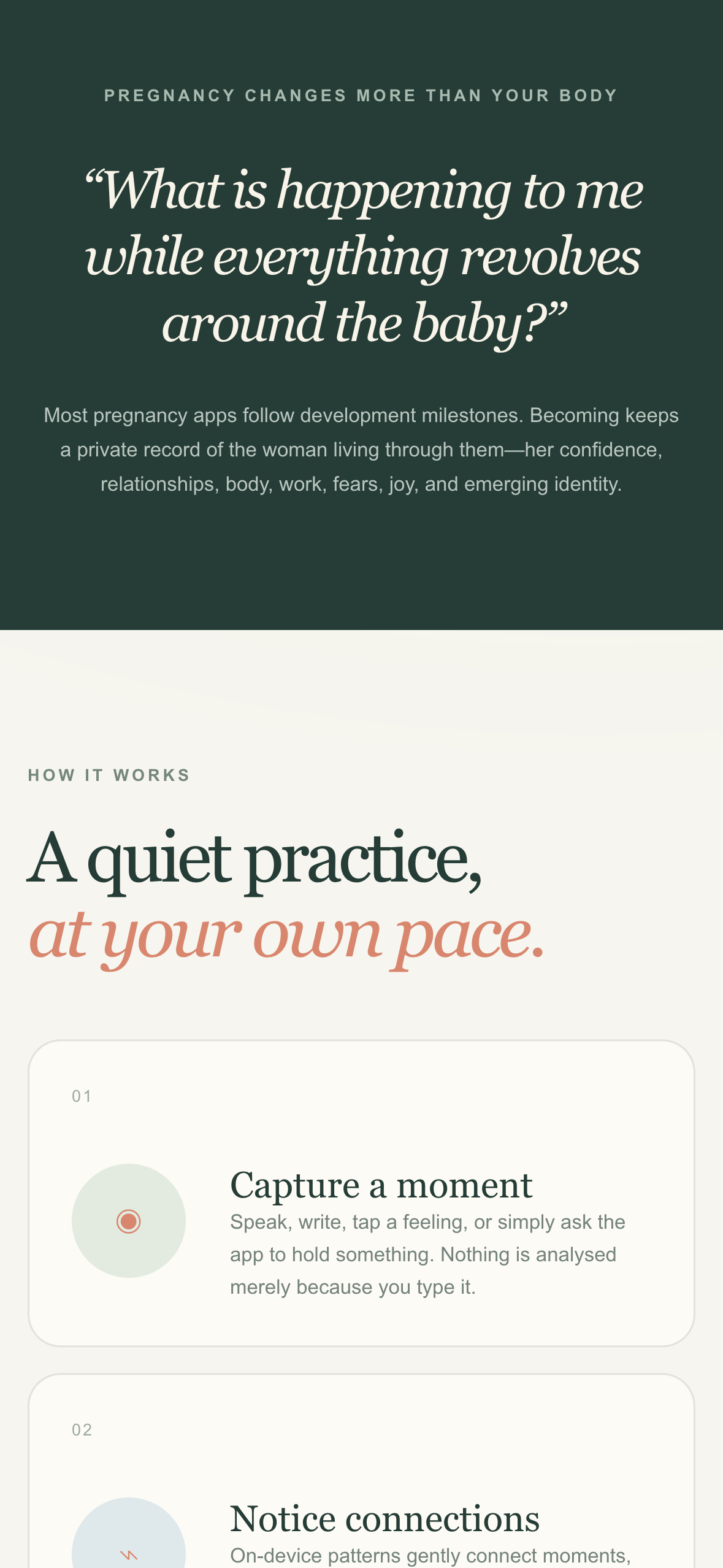
The core experience follows one clear loop:
- Capture a moment
- Choose how privately it should be held
- Decide whether it may contribute to future reflection
- Discover a tentative identity connection
- Inspect, correct, rename, or remove that interpretation
A user might record:
“I wore something that felt like me today.”
On its own, that moment is not treated as proof of anything. Over time, similar moments may reveal a relationship between personal choice, clothing, independence, confidence, or feeling recognizable to oneself.
Becoming does not simply count repeated words or produce a generic summary. It looks for relationships such as:
- A personal choice reinforcing independence
- Practical support making time alone possible
- Creativity coexisting with exhaustion
- Confidence appearing alongside moments of self-expression
- Accepting help enabling rather than reducing autonomy
Every interpretation is presented as tentative and explainable. Users can see which moments contributed, what information was excluded, and whether the relationship came from selected themes, language patterns, or both.
The product includes:
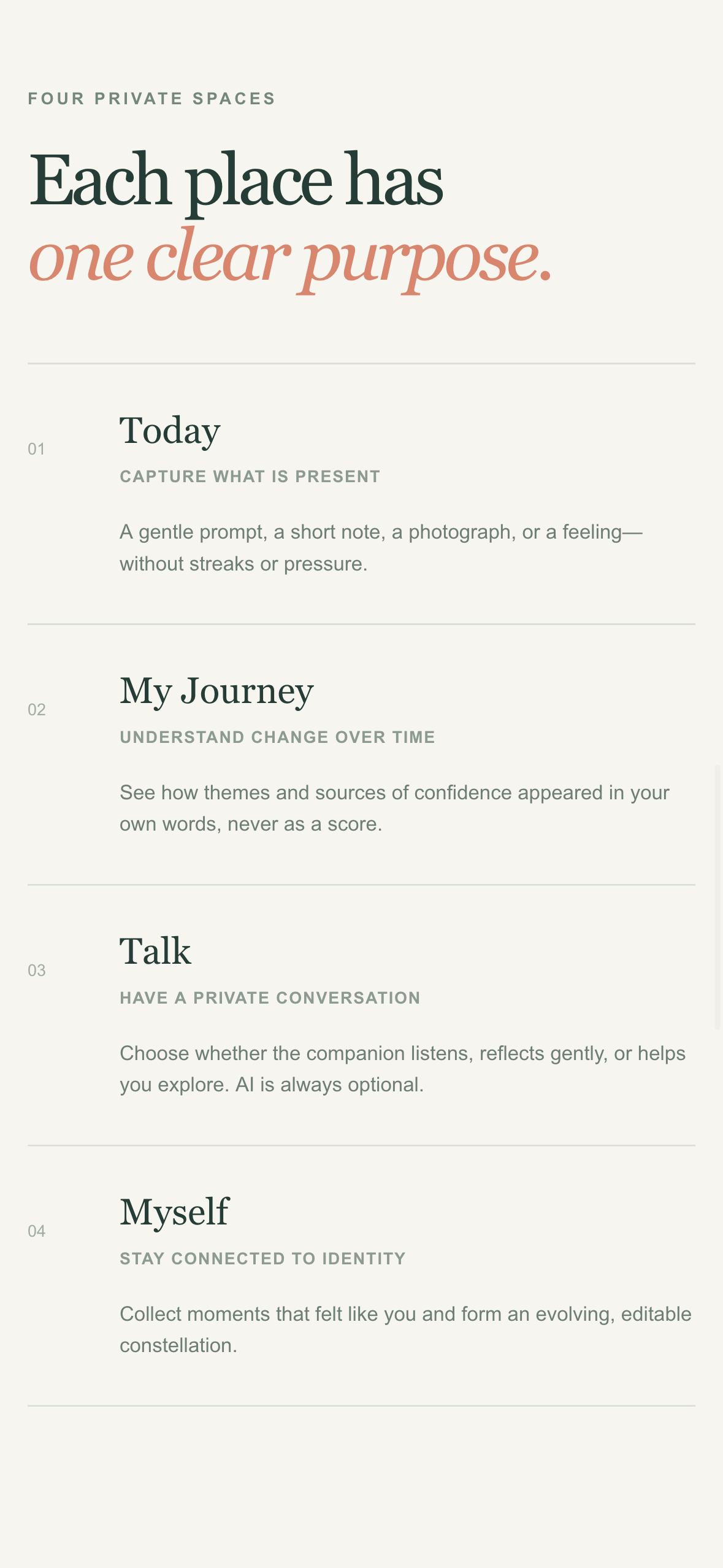
Private journaling
Users can create text entries, short voice recordings, emotional moments, and “This felt like me” moments.
Each entry can be:
- Held only in the current tab
- Stored in an encrypted device vault
- Marked incognito and excluded from patterns
- Marked “Just hold this” so it is never analyzed or resurfaced
“Just hold this” is an important part of the product philosophy. Not every experience should become insight, personalization, or product material.
Explainable identity connections
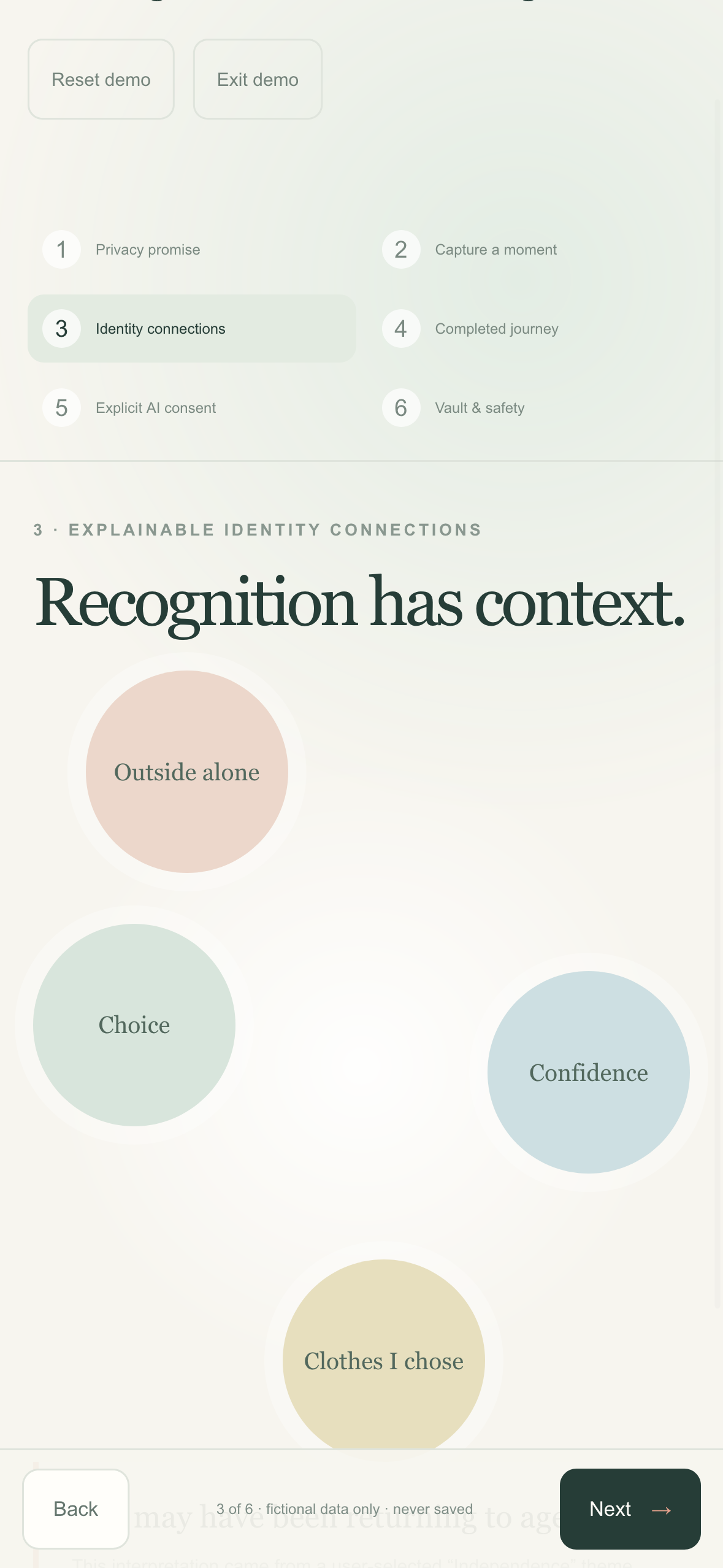
Eligible moments can contribute to an evolving identity constellation.
Instead of presenting fixed labels or wellness scores, Becoming uses cautious relationship language such as:
- “Often appeared alongside”
- “May have reinforced”
- “Coexisted with”
- “Made possible”
- “You may have been returning to”
Users remain the authority on their identity. Every connection can be inspected, corrected, renamed, or removed.
My Journey
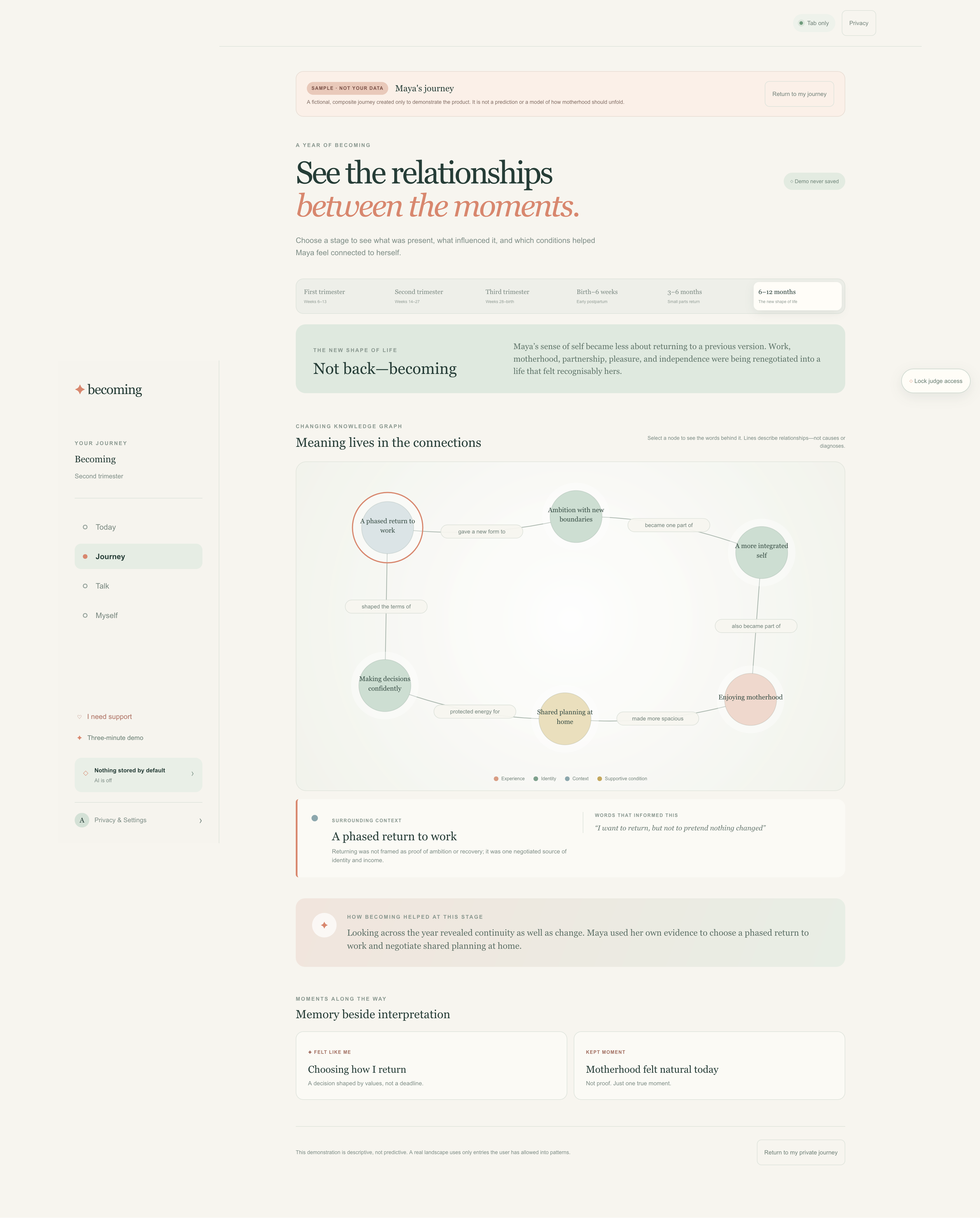
The journey view shows how identity themes and relationships change across pregnancy and postpartum.
Rather than reducing the experience to a two-dimensional mood trend, it shows how the same identity need can appear differently over time.
For example, independence during pregnancy may be expressed through personal choice. After birth, it may be expressed through accepting support that makes time alone possible.
Talk companion
The companion supports three response modes:
- Just listen
- Reflect gently
- Help me explore
Conversations are ephemeral and are not automatically added to the journal.
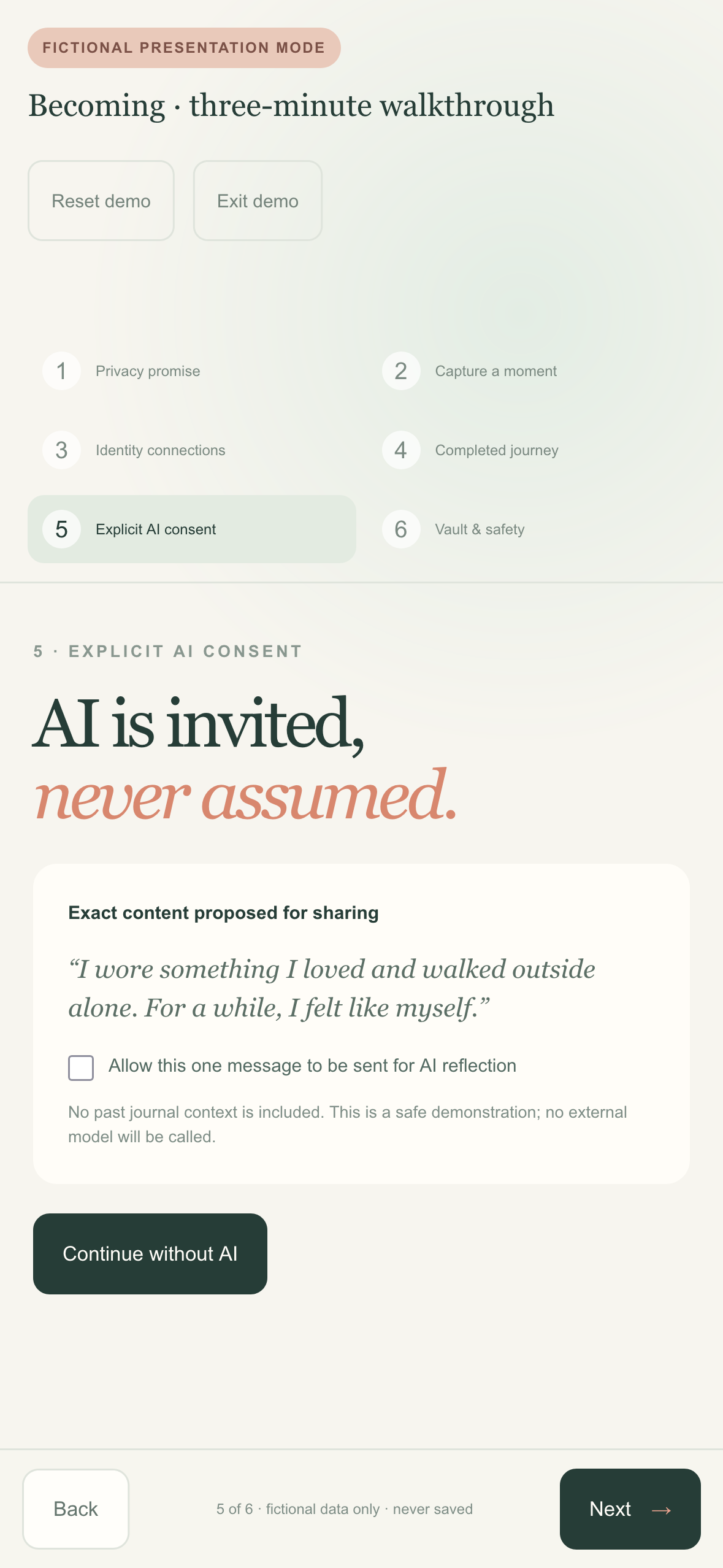
The app works without AI through on-device responses. Optional AI reflection requires explicit permission for the current message, and permission to use past journal context is requested separately.
Safety and support
When serious-harm language is detected, Becoming immediately leaves the normal journaling or companion experience.
It offers calm guidance toward emergency, professional, or trusted-person support and can help prepare a message. It does not diagnose, score risk, or claim to replace human care.
How we built it
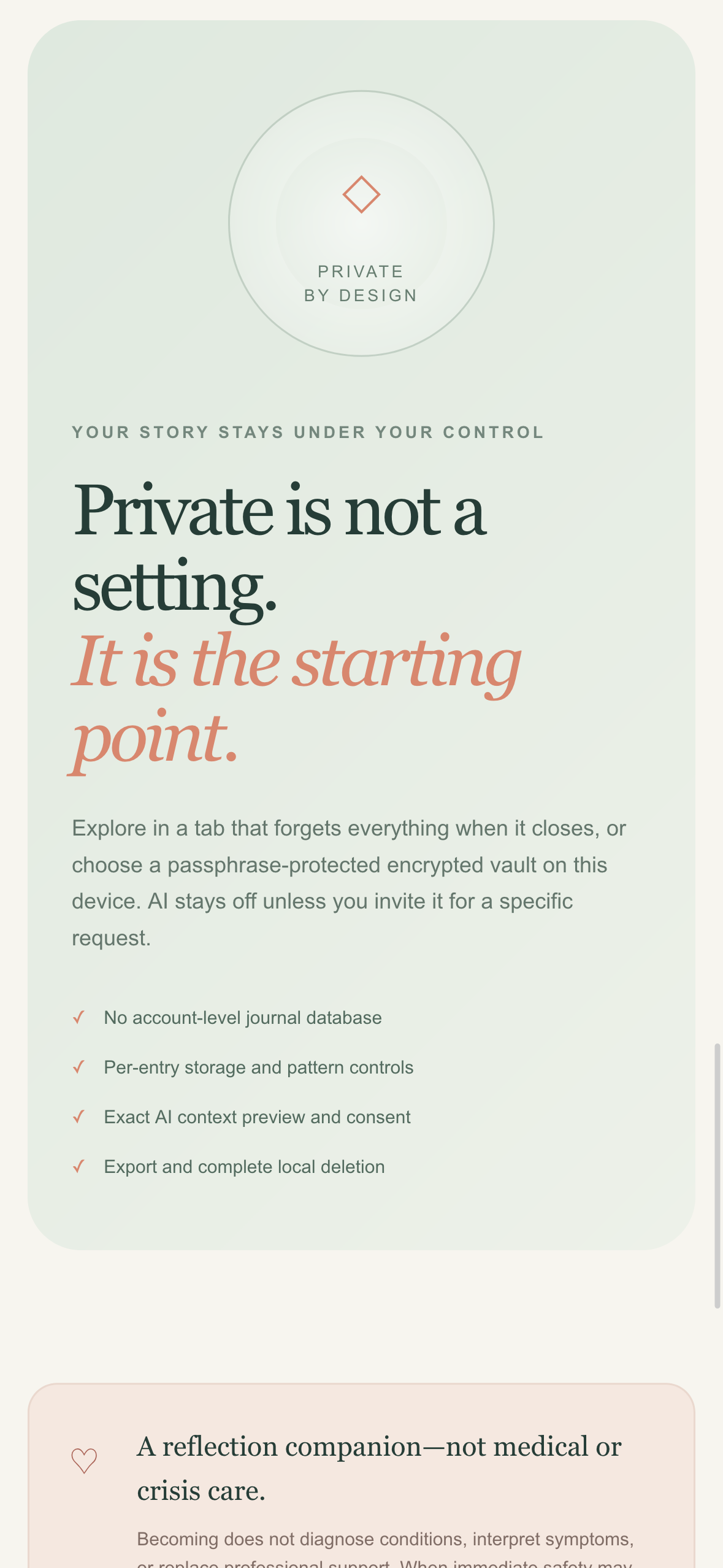
We built Becoming as a local-first application because the product handles highly personal reflections.
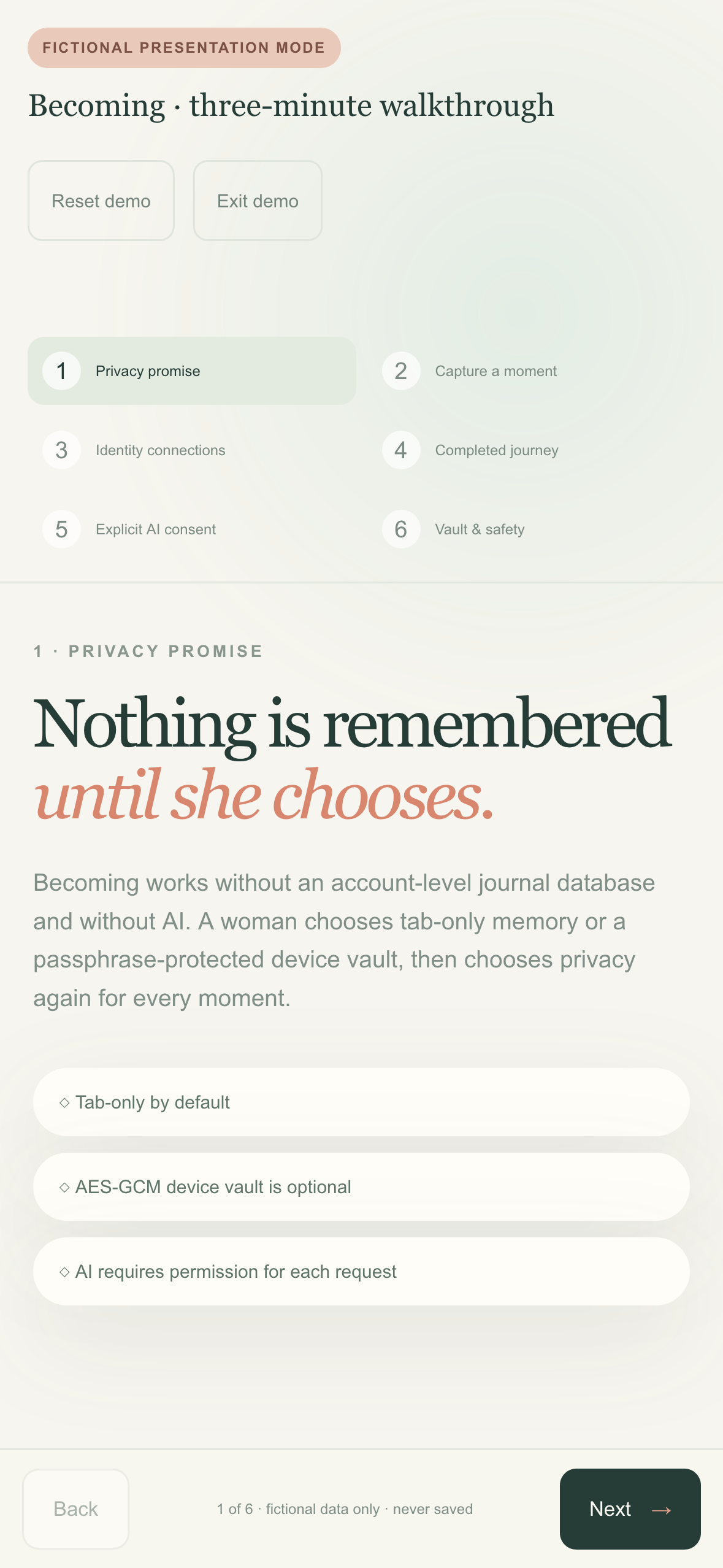
The app supports two primary storage modes:
- Tab-only mode, where entries remain in memory and disappear when the session ends or the page reloads
- Encrypted device storage, where entries are protected inside a vault using AES-GCM encryption and a passphrase-derived key
The passphrase is never stored or uploaded. The vault can lock automatically or manually, and decrypted journal data is removed from active application state when it locks.
We designed privacy as part of the data model rather than as a single settings toggle. Every entry carries rules that determine whether it can:
- Persist beyond the current session
- Enter pattern analysis
- Be resurfaced later
- Appear in a monthly reflection
- Be included in optional AI context
Before any analysis or reflection occurs, entries are filtered through these eligibility rules. Incognito and “Just hold this” entries are excluded before pattern generation, not removed afterward.
We used GPT-5.6 as an identity relationship interpreter rather than a general-purpose chatbot.
Its role is to help transform fragmented natural-language moments into tentative, structured relationships among:
- Identity
- Experience
- Context
- Choice
- Support
- Change over time
For example, users may never explicitly write the word “independence.” They may instead describe choosing their own clothes, taking time alone, returning to work, asking for help, or making a decision for themselves. GPT-5.6 helps identify those relationships while attaching each interpretation to evidence and expressing uncertainty.
The application remains functional without an external model. AI is disabled by default, on-device responses remain available, and the demo uses simulated AI behavior so judges can evaluate the consent flow without sending data to an external service.
We also separated fictional demo data from real user state at the storage, analysis, and interface levels. The completed sample journey demonstrates the long-term value of the product without requiring judges or users to disclose personal experiences.
Codex accelerated implementation across the codebase. We used it to inspect existing components, implement user flows, refactor repeated logic, improve responsive behavior, connect privacy states, and create consistent empty, locked, consent, and error states.
GPT-5.6 contributed to product reasoning, privacy modeling, interaction language, explainability, and safety boundaries. We retained responsibility for deciding what the product should and should not do, reviewing generated code, testing behavior, and rejecting suggestions that conflicted with the product’s principles.
Challenges we ran into
Making AI useful without making it intrusive
The biggest challenge was creating meaningful AI functionality without assuming permanent access to the user’s journal.
Many AI products ask for broad permission once and continue using personal context afterward. We wanted every AI interaction to be understandable at the moment it happened.
This led us to separate two decisions:
- May AI process this specific message?
- May it use selected past context?
The user can continue without granting either permission.
Distinguishing interpretation from fact
Identity is personal and context-dependent. A system should not tell someone who they are based on a few journal entries.
We had to design language that could be meaningful without implying psychological certainty. That meant avoiding statements like:
“You are becoming more independent.”
Instead, Becoming says:
“Moments involving personal choice often appeared alongside language about independence.”
The distinction is subtle but essential.
Making every AI insight explainable
A polished summary is not enough for a product handling sensitive reflections.
We needed each relationship to answer:
- Which moments contributed?
- What was excluded?
- What kind of signal created the connection?
- Can the user correct it?
- Can it be removed?
This required treating explainability and correction as core product behavior rather than optional details.
Respecting experiences that should not be analyzed
Some journal entries are written because the user needs somewhere to place them, not because they want them interpreted.
Designing “Just hold this” challenged a common product assumption that all stored data should eventually improve personalization. We chose to let the user explicitly prevent an experience from becoming product material.
Building a credible safety boundary
The companion needed to feel warm without presenting itself as a therapist or encouraging dependence.
Serious-harm language also had to interrupt the ordinary experience reliably, even if AI was disabled or unavailable. The result needed to be calm and direct without diagnosing the user or creating false reassurance.
Balancing scope with depth
Becoming includes journaling, encryption, identity visualization, companion conversations, safety support, and a multi-stage sample journey.
The challenge was avoiding a collection of disconnected features. We refined the experience around one central product loop: capture a moment, control its privacy, discover a relationship, and keep the user in control of the interpretation.
Accomplishments that we're proud of
A privacy model users can actually see
Privacy is not hidden in a policy or settings screen.
At the moment of writing, users can decide:
- Whether an entry survives a refresh
- Whether it is encrypted
- Whether it contributes to patterns
- Whether it may reappear
- Whether it can be included in AI context
This makes privacy an interaction, not just a promise.
“Just hold this”
We are especially proud of this feature because it represents the product’s values in one simple action.
A user can express something without allowing the application to summarize, analyze, resurface, or learn from it.
Explainable and correctable AI
Every AI-assisted identity connection is grounded in visible evidence.
The user can disagree with the system, rename an interpretation, remove a connection, or decide that the relationship should not exist.
The product does not claim authority over the user’s identity.
A useful experience without AI
Becoming does not become empty when AI is turned off.
Users can still journal, use the companion’s on-device modes, view their timeline, collect “felt like me” moments, use the encrypted vault, and explore the fictional sample journey.
The sample completed journey
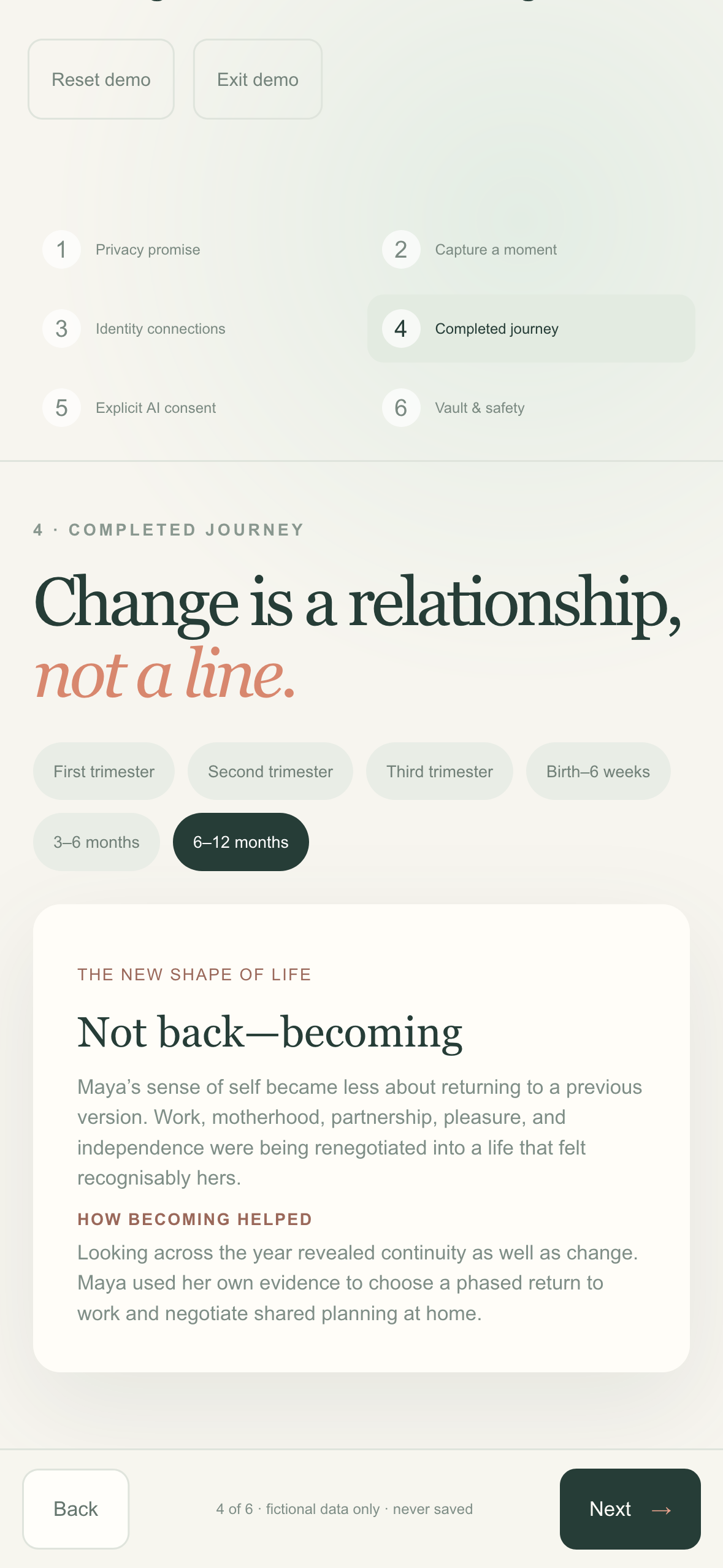
The fictional journey shows how identity can evolve from the first trimester through 12 months postpartum.
It demonstrates that the same identity theme can be expressed differently as context changes, while remaining completely separate from the user’s real journal.
A clear stopping point for technology
We are proud that Becoming does not always try to continue the conversation.
When serious-harm language is detected, it stops ordinary reflection and redirects the user toward human support.
The product knows when to reflect, when to ask permission, and when to step aside.
What we learned
We learned that the most important AI design question is not only:
“What can the model infer?”
It is also:
“What has the user allowed the model to see, and should this experience be interpreted at all?”
We learned that privacy must exist at the data, interface, and language levels. Encryption matters, but so does explaining whether an entry will persist, reappear, enter analysis, or leave the device.
We learned that identity cannot be represented well through frequency alone. The most meaningful patterns often exist in relationships.
A moment involving clothing may not be about clothing. It may be about choice, confidence, recognition, autonomy, or continuity with a pre-motherhood self.
We also learned that accepting support and maintaining independence are not necessarily opposites. Context can make an identity possible rather than weaken it. This is why Becoming focuses on relational language such as “made possible” and “coexisted with.”
We learned that explainability is especially important when AI is used in emotionally sensitive settings. Users should be able to see why the system formed an interpretation and should be able to correct it without friction.
Finally, we learned that engagement is not always the right success metric. Becoming does not use streaks or missed-check-in warnings because the goal is not daily compliance. The goal is to be useful and trustworthy when the user has something meaningful to hold or understand.
What's next for Becoming
Our next priority is validating the product with people across different pregnancy and postpartum stages.
We want to test:
- Whether privacy choices are immediately understandable
- Whether identity interpretations feel accurate and respectful
- Whether users feel comfortable correcting the system
- Whether the language avoids clinical or overly certain conclusions
- Whether “Just hold this” creates a meaningful sense of control
- Whether the safety interruption feels calm and appropriate
We also plan to deepen the identity reasoning system.
Future versions will better distinguish among:
- The experience itself
- The identity need expressed through it
- The context surrounding it
- The support that made it possible
- How the same identity appears differently across stages
We want to make interpretation correction more powerful, allowing users to rename themes in their own language, merge related ideas, reject a relationship, and teach the system what a moment meant to them.
We also plan to expand local AI capabilities so more relationship extraction and reflection generation can happen on-device without sending journal content to an external service.
Additional work includes:
- Stronger encrypted archive import and recovery
- User-controlled weekly and monthly reflections
- More accessible voice-entry workflows
- Broader language support
- Culturally adaptable prompts
- Region-aware support resources when location is explicitly provided
- Structured usability and accessibility testing
- More comprehensive verification of privacy, vault, consent, and exclusion guarantees
The long-term goal is not to build an AI that tells mothers who they are.
It is to create a private, consent-based system that helps them recognize patterns in their own words, question those interpretations, and define for themselves who they are becoming.

Log in or sign up for Devpost to join the conversation.