-
-
Meet Beckett: an agentic communication coach that helps people navigate difficult workplace conversations inside Slack.
-
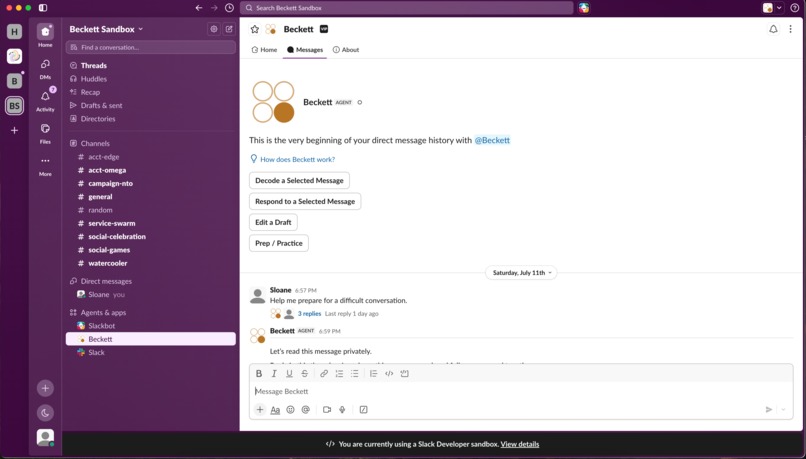
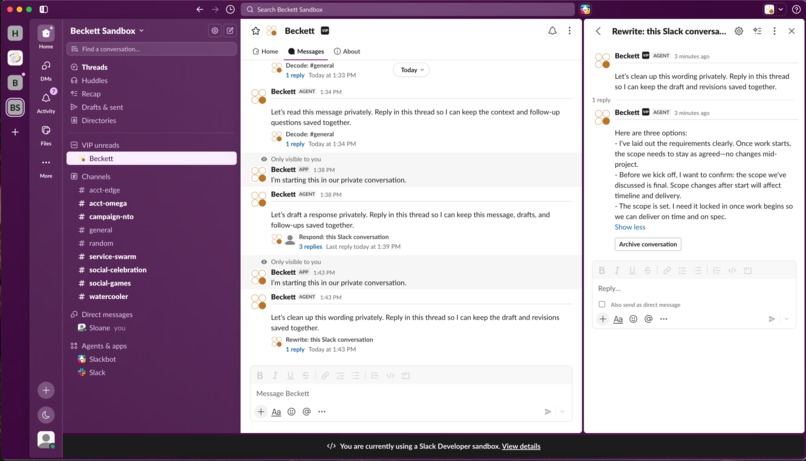
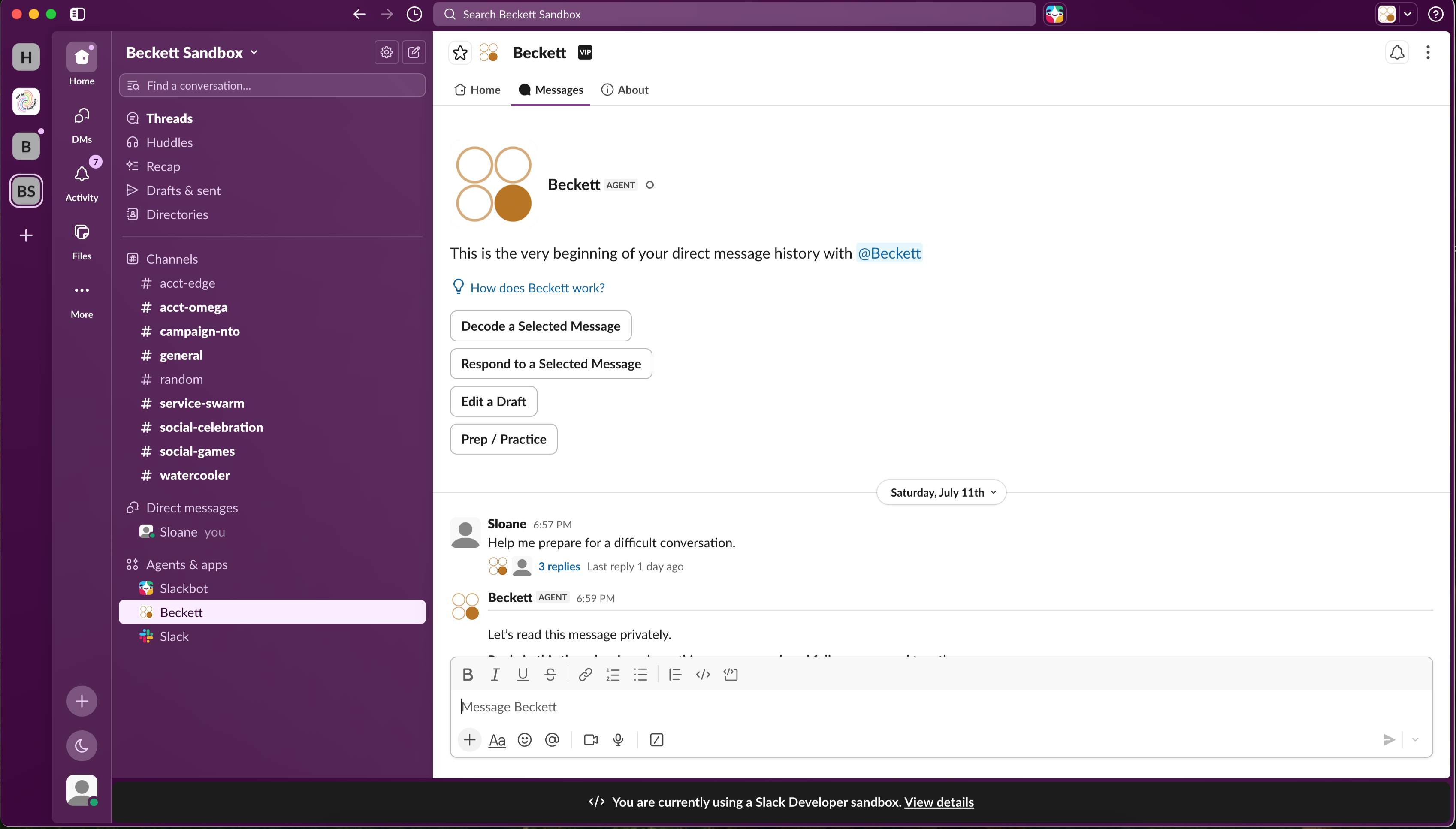
Start with Decode, Respond, Rewrite, or Prep—four focused ways to get communication support without leaving Slack.
-
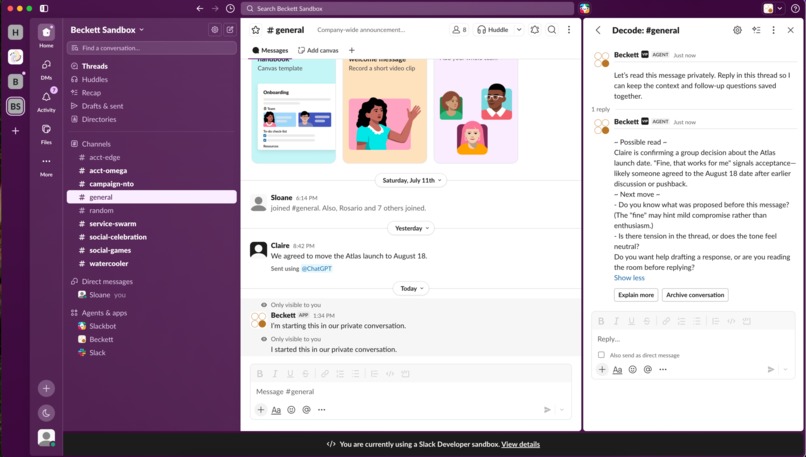
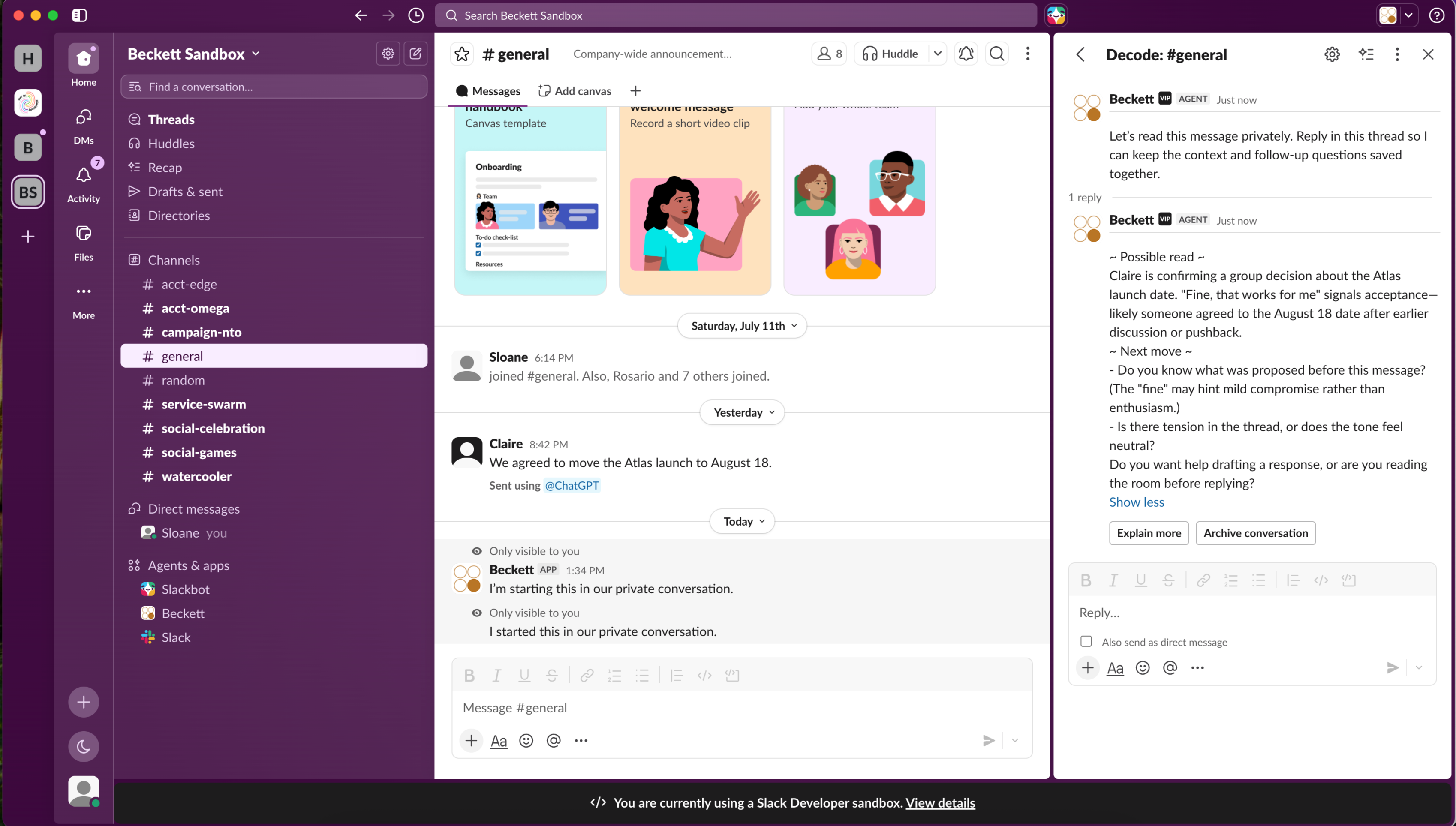
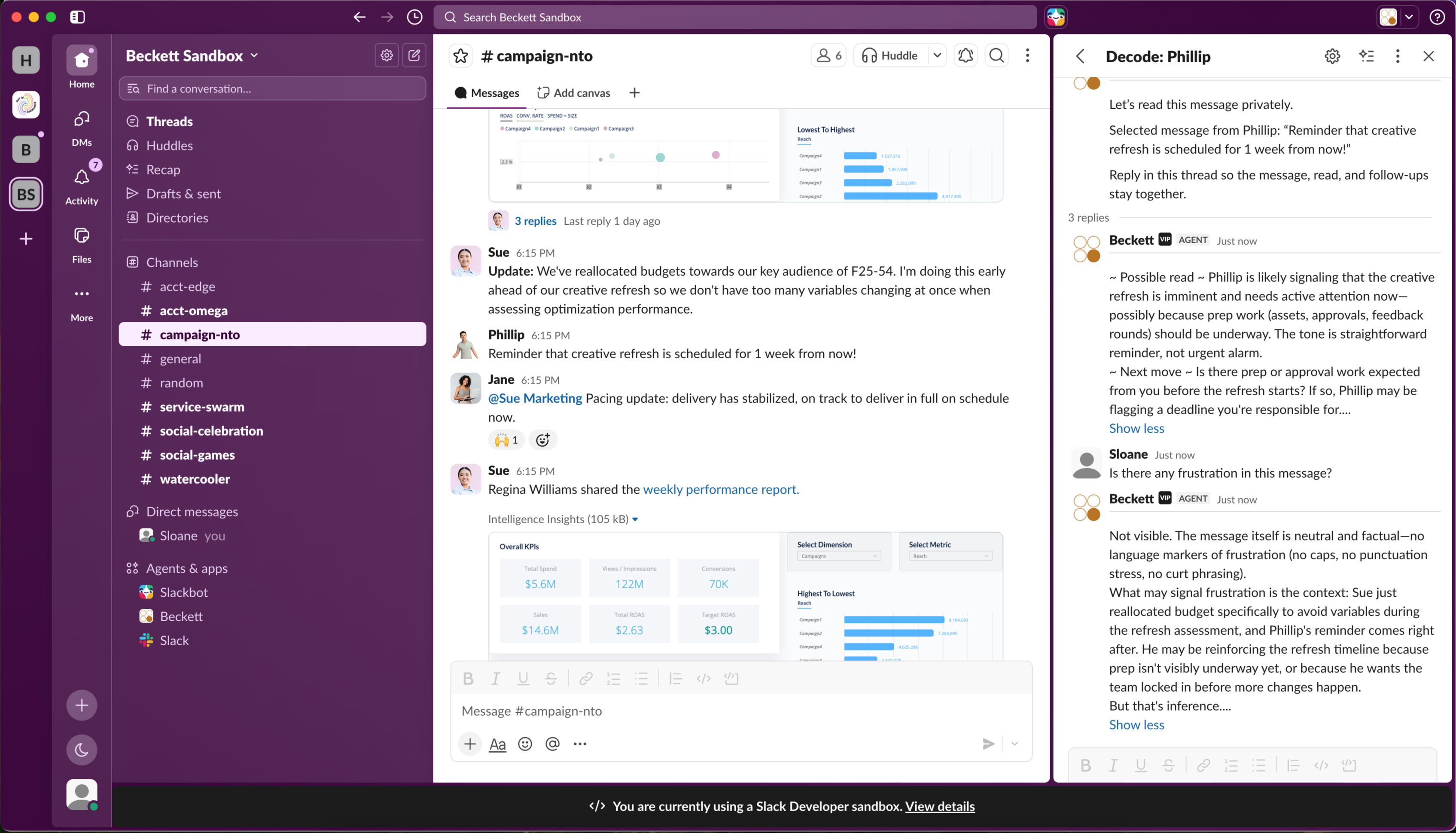
Beckett decodes a selected message, showing the original excerpt and a practical read of its tone, subtext, and ambiguity.
-
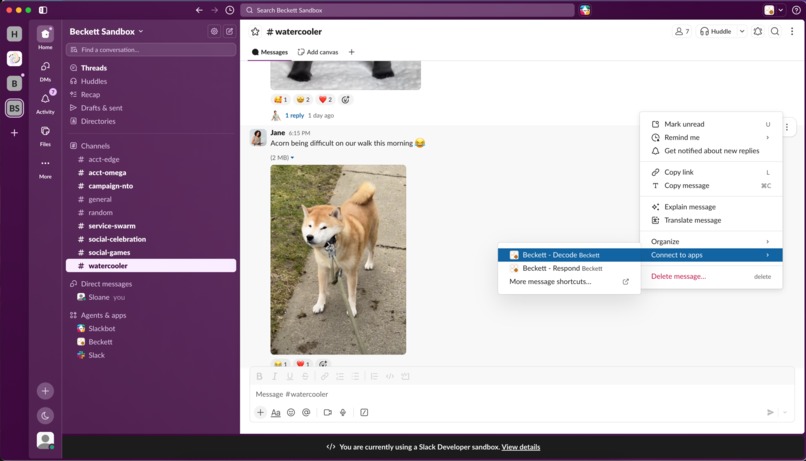
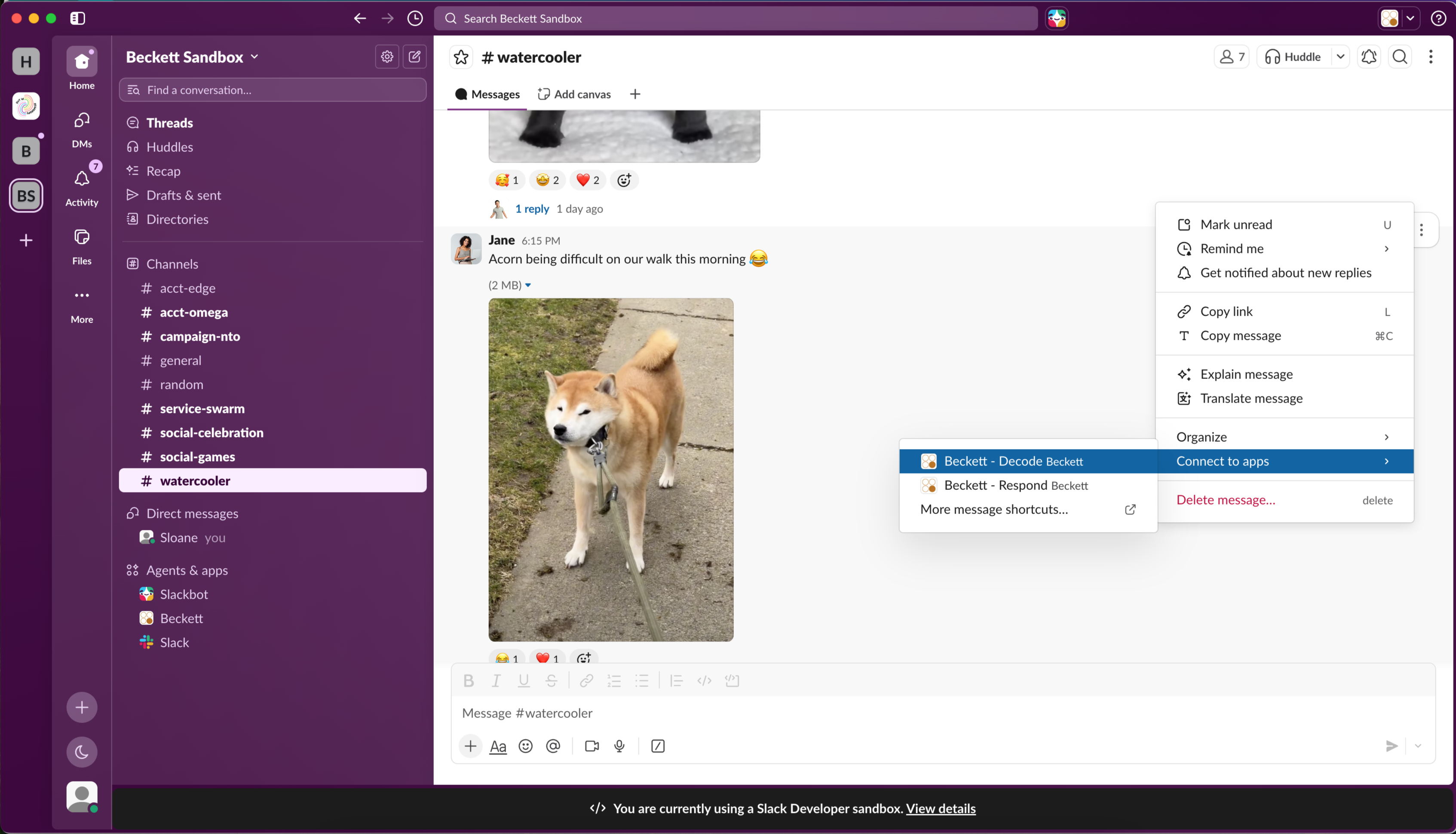
Decode any Slack message in one click to uncover tone, subtext, and the best next move.
-
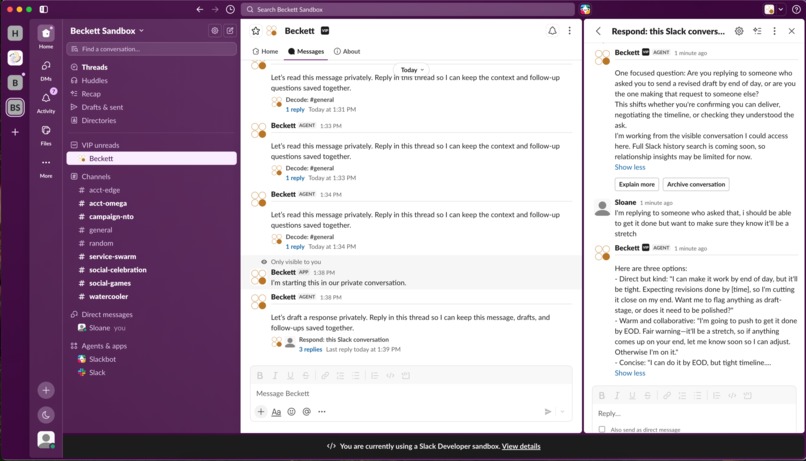
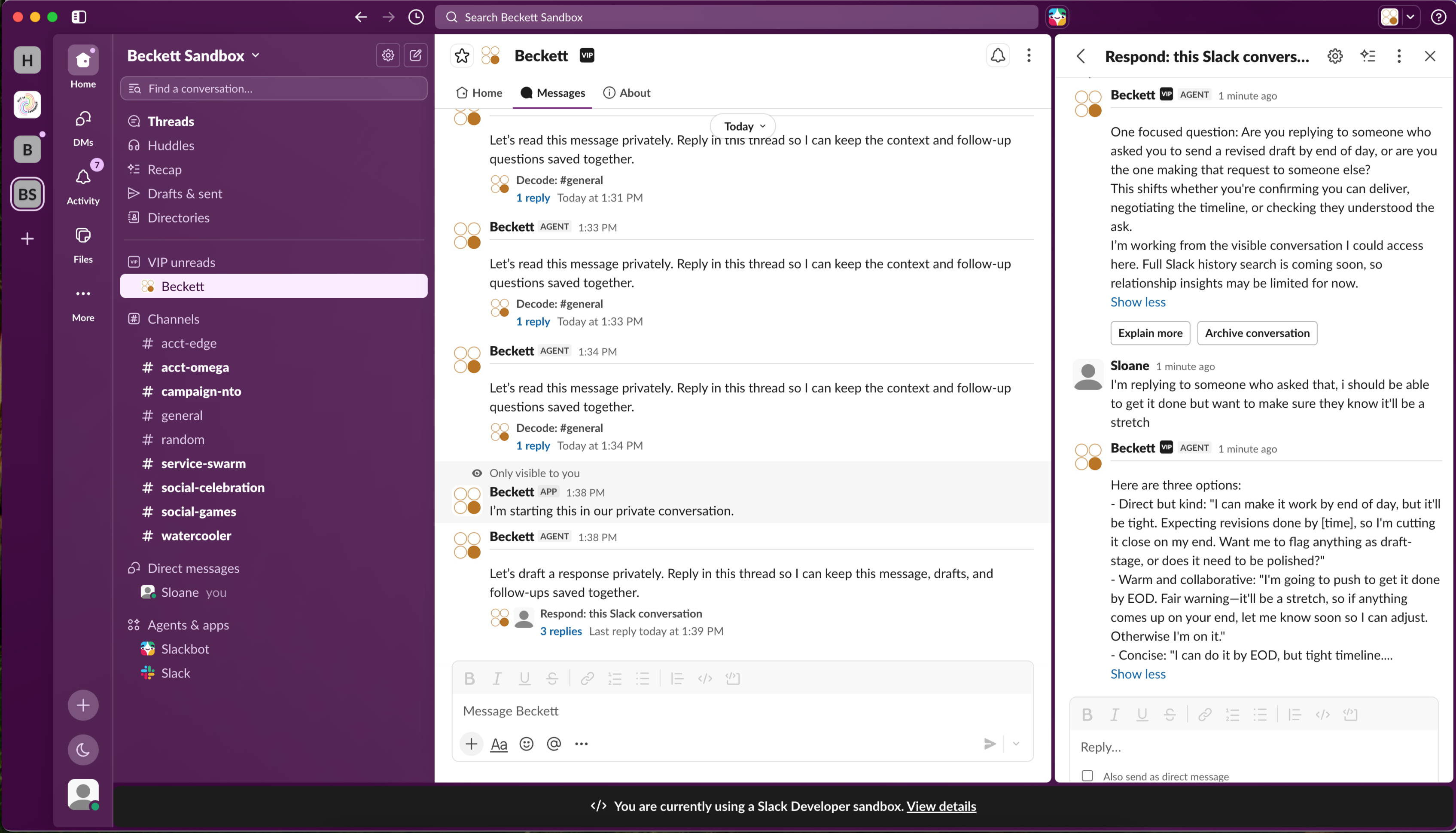
Respond turns a difficult Slack message into clear, ready-to-send reply options tailored to the conversation.
-
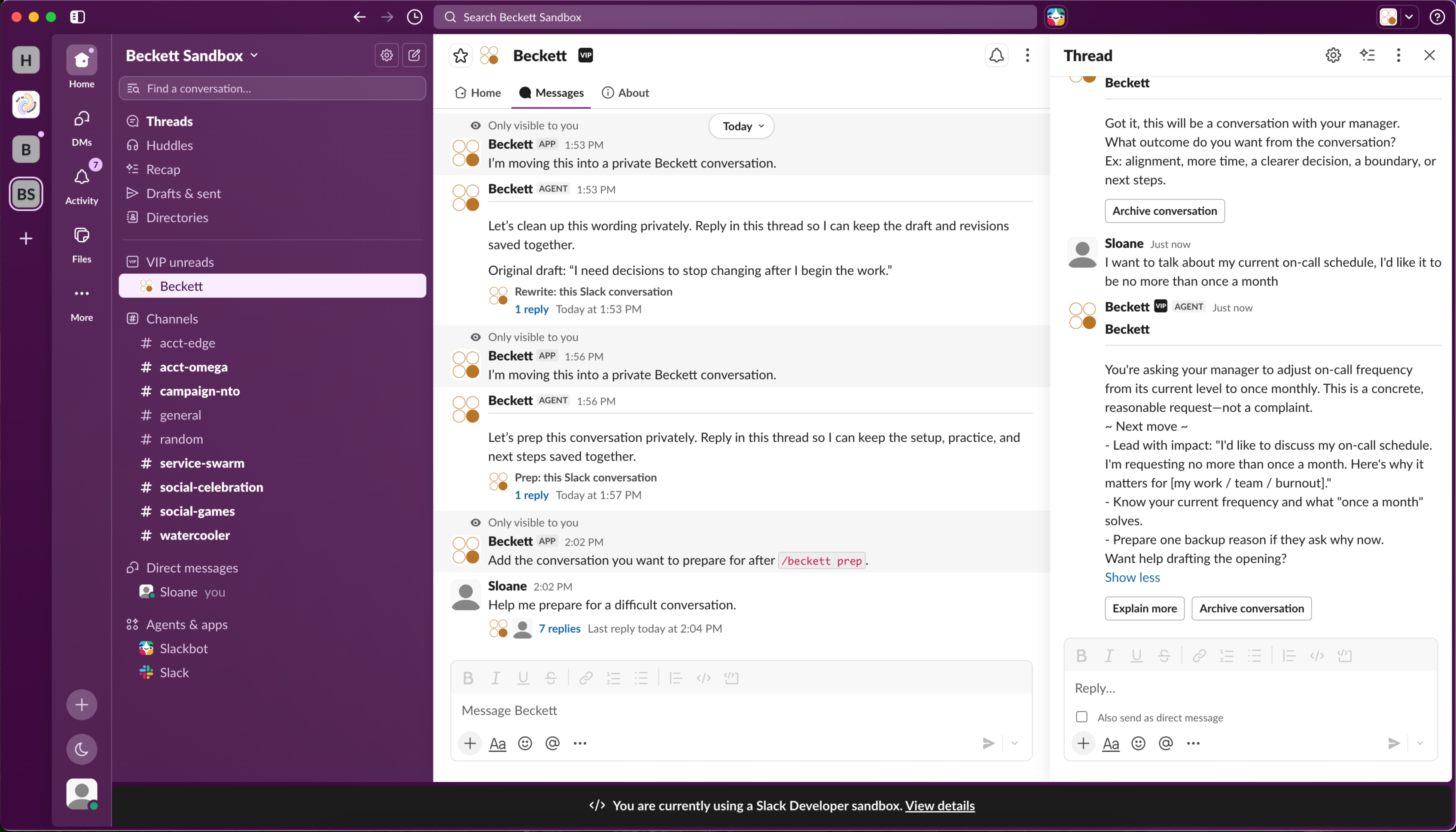
Prep gathers the situation, setting, goal, and concern before creating focused guidance for a difficult conversation.
-
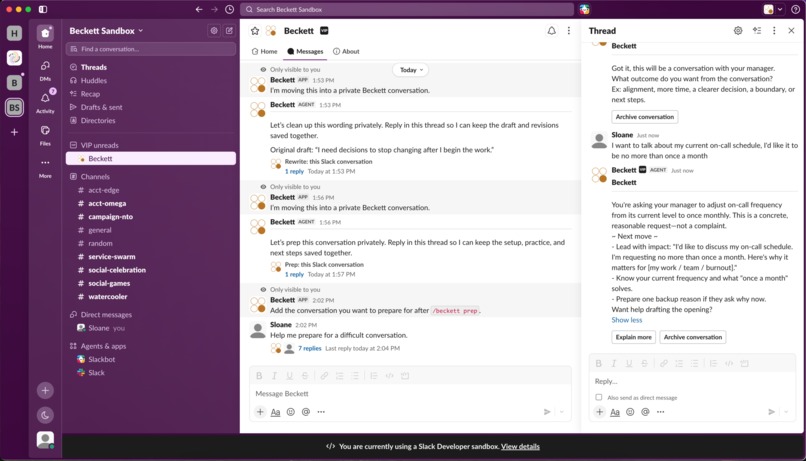
Prep gathers the situation, setting, goal, and concern before creating focused guidance for a difficult conversation.
-
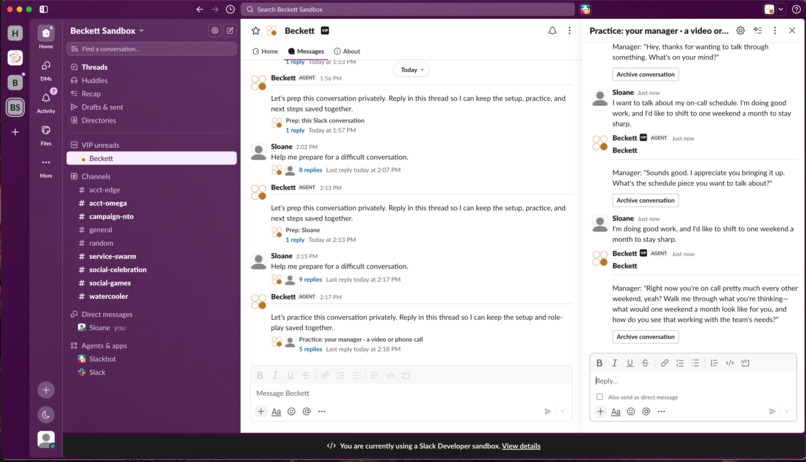
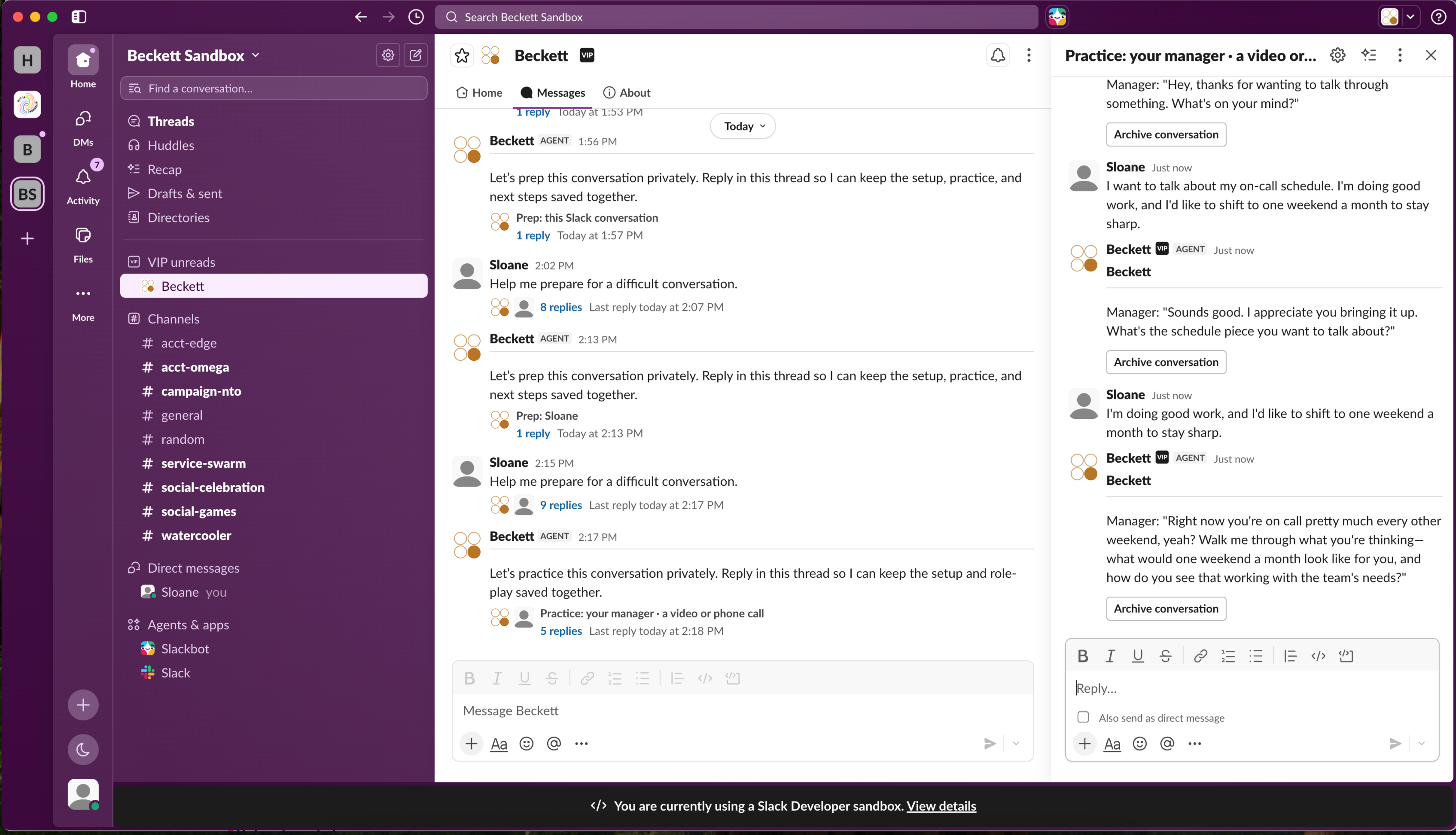
Practice opens a private thread where Beckett role-plays the other person and responds realistically, one message at a time.
-
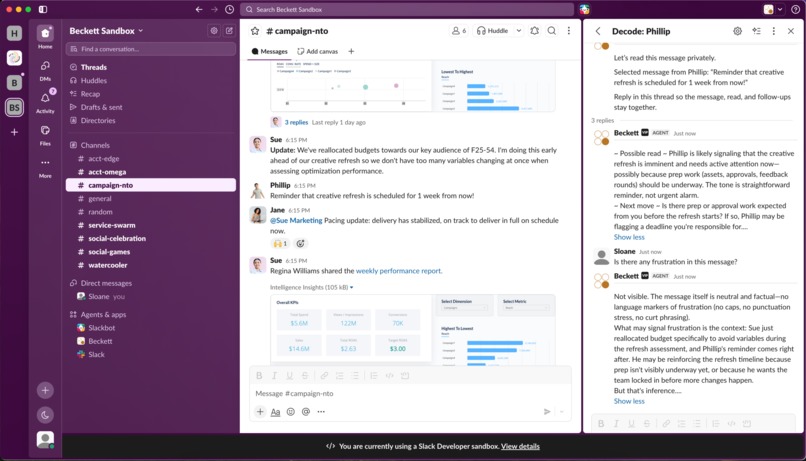
Same-thread follow-ups preserve the original message and Beckett’s earlier advice, keeping coaching consistent and relevant.
-
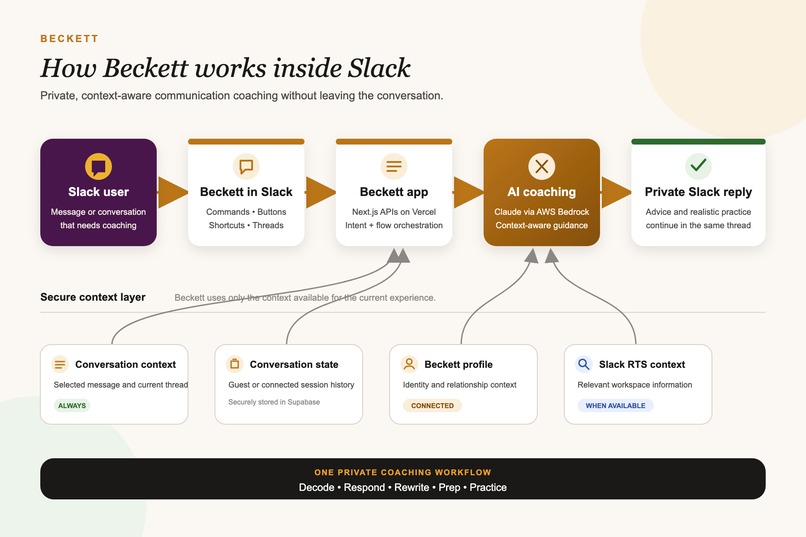
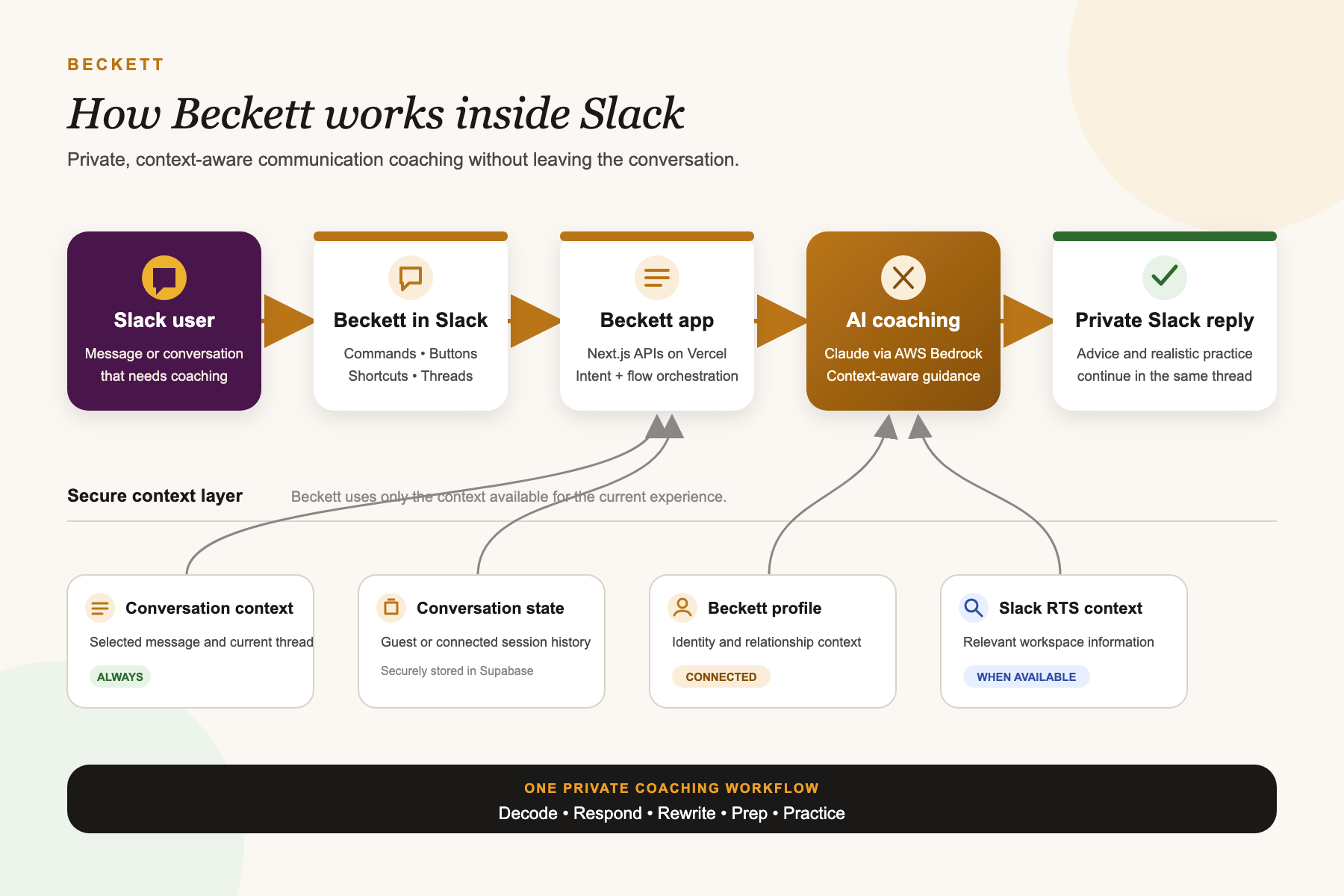
Beckett connects Slack, secure conversation state, AI coaching, and real-time search in one private workflow.
Inspiration
I built Beckett because I am a former special education teacher working to move into edtech. I taught students who were capable, thoughtful, and ready for meaningful work, but who sometimes needed explicit support understanding tone, indirect language, hidden expectations, urgency, and what someone expected them to do next.
In school, that support may come from special education services, direct instruction, structured practice, or trusted adults. After high school, those supports often disappear. Neurodivergent people enter workplaces where communication is higher-stakes, more ambiguous, and increasingly conducted through short written messages.
Beckett is inspired by those students. It brings practical, judgment-free communication support into adult life—inside the tools where communication and work already happen.
What It Does
Beckett for Slack is a private workplace communication coach designed for neurodivergent professionals and anyone who finds workplace communication stressful or unclear.
Inside Slack, users can:
- Select Beckett — Decode on a message to separate what is directly observable from what is uncertain or being inferred.
- Select Beckett — Respond to receive private reply options for a confusing, sensitive, or stressful message.
- Run
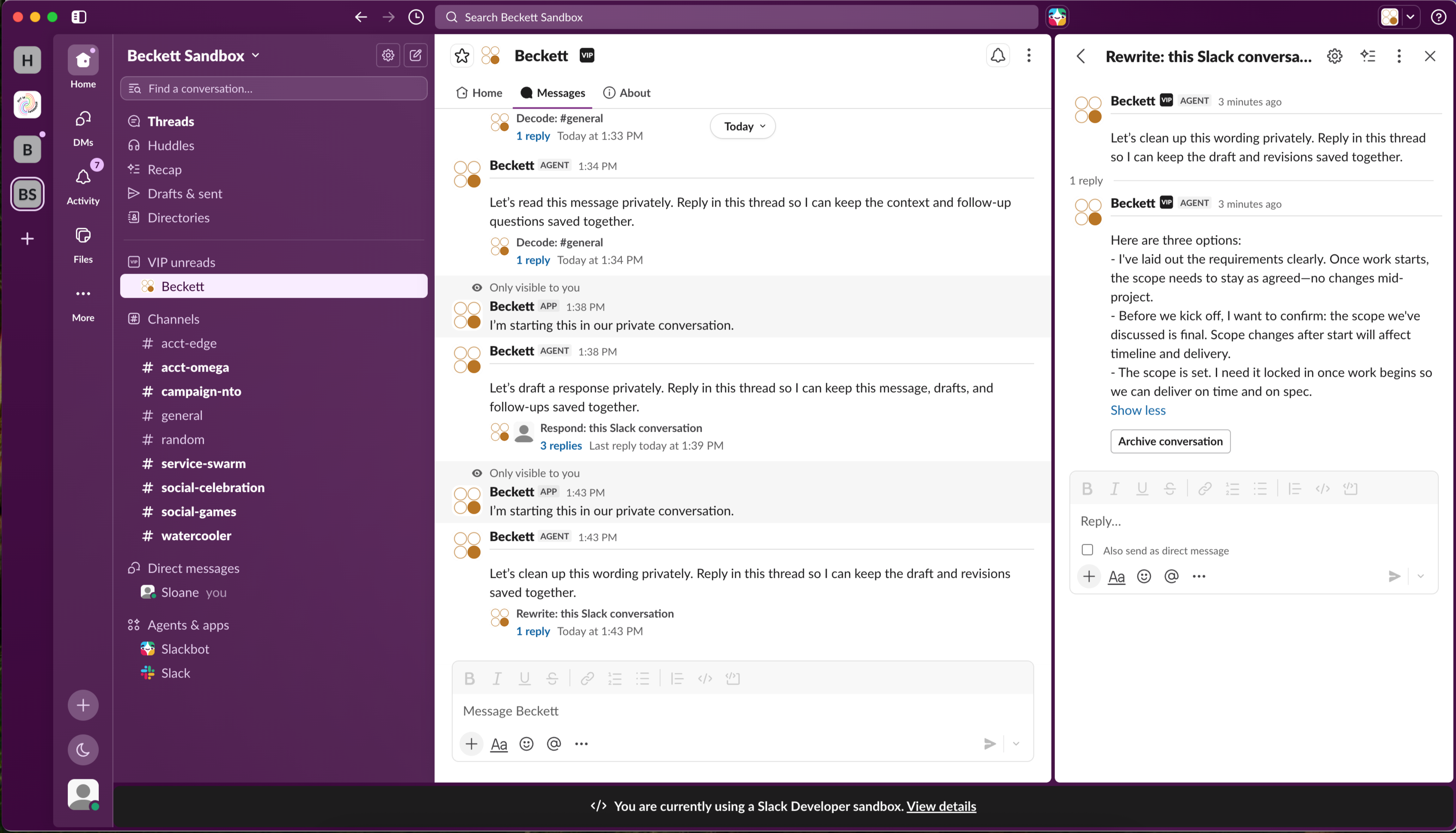
/beckett rewriteto make a draft clearer, calmer, or less defensive while preserving the user’s meaning. - Run
/beckett prepto prepare for a difficult workplace conversation. - Move from Prep into Practice after receiving an assessment and suggested approach.
- Run
/beckett practiceto role-play a conversation, with Beckett staying in character and providing realistic responses or pushback based on the user’s concerns. - Continue asking follow-up questions in the same private Slack thread without losing the original message or Beckett’s earlier advice.
- Use Slack App Home as a hub for recent and archived coaching conversations.
- Try the core coaching experience in Guest Mode without first creating or connecting a Beckett account.
Beckett does not tell users what another person “definitely meant.” It distinguishes evidence from interpretation, communicates uncertainty, and offers grounded next steps, clarifying questions, and possible responses. Users remain in control of what they send or act on.
How I Built It
I built Beckett for Slack with Next.js, TypeScript, Supabase, an AI coaching layer, and Slack’s app and AI agent capabilities.
Beckett uses Slack AI capabilities and Agent View, including private assistant conversations and threaded agent interactions, to deliver coaching directly inside Slack. Message shortcuts and slash commands initiate Decode, Respond, Rewrite, Prep, and Practice workflows. Beckett then keeps the selected message, assessment, follow-up questions, and practice conversation together in a private thread.
The application includes:
- Slack message shortcuts and slash commands
- Slack AI Agent View and private assistant threads
- Guided Prep and Practice workflows
- Same-thread conversation continuity
- Secure Slack request verification
- Slack identity and connected-account matching
- Guest Mode for hackathon testing
- Supabase-backed private conversation state and coaching history
- Slack App Home history and navigation
- Context retrieval designed to support Slack Real-Time Search when it is available to the app
Slack AI capabilities and Agent View are Beckett’s qualifying hackathon technology. Real-Time Search support has also been built into the architecture, but Beckett does not depend on RTS access to deliver its core coaching experience.
The coaching layer includes important safety guardrails. Beckett avoids diagnosing people, presenting hidden intent as fact, or posting coaching publicly by default. It gives users options and context without making decisions for them.
What I Built During the Hackathon
Beckett existed as a broader communication-support concept before the hackathon, but the Slack agent experience was substantially developed and improved during the submission period.
The hackathon work included:
- Building Beckett’s Slack AI Agent View experience
- Creating private assistant-thread workflows
- Adding Decode and Respond message shortcuts
- Building Rewrite, Prep, and Practice slash-command flows
- Creating realistic, message-by-message conversation practice
- Preserving context within the correct Slack thread
- Adding secure guest conversation state
- Creating Guest Mode so judges can test Beckett without an account
- Building App Home conversation history
- Improving selected-message context, response quality, labels, and workflow guidance
- Conducting repeated pressure tests in the Slack developer sandbox and correcting the issues discovered
These updates transformed Beckett from a broader web-based idea into a working Slack communication agent.
Challenges
The biggest challenge was building a real, functional product while still being new to coding. I understood the user need, but I had to learn how to structure the application, debug complex behavior, work with Slack’s platform, and use AI as a coding partner without blindly trusting its output.
Slack had its own learning curve. I had to understand request verification, OAuth, scopes, slash-command acknowledgement timing, message shortcuts, App Home, Agent View, private assistant conversations, thread ownership, and the boundaries between ephemeral messages, channel threads, and private agent threads.
Conversation continuity was especially challenging. Beckett needed to remember the selected message and earlier coaching within the same thread without accidentally carrying information into an unrelated conversation.
I also had to make careful product decisions about safety and privacy. Beckett needed to be useful without becoming overconfident—particularly when interpreting tone, relationships, or someone else’s intentions.
What I Learned
I learned that supportive AI is not simply about generating the “best” message. For this use case, the more important capability is helping someone pause, separate facts from interpretation, understand their options, and select a response that matches their intent.
I also learned how strongly platform design affects the user experience. Message shortcuts work well when a user needs help with a specific Slack message, while private assistant threads work better for follow-up coaching, preparation, and extended practice. Fast acknowledgements, clear thread boundaries, and reliable context are essential to making an agent feel trustworthy.
Most importantly, I learned that communication support after school is a real and often overlooked accessibility gap. People should not lose access to explicit communication support simply because they have entered the workforce.
Impact
Beckett addresses a workplace accessibility challenge experienced by many neurodivergent professionals: being expected to interpret ambiguous tone, indirect requests, hidden expectations, and emotionally charged messages without support.
Misunderstanding these signals can create anxiety, conflict, missed opportunities, and unequal workplace outcomes. Beckett gives users a private place to slow down, examine the available evidence, prepare what they want to say, and practice difficult conversations before responding.
This support can help users advocate for themselves, ask clearer questions, set boundaries, address conflict, and participate more confidently at work. Although Beckett is designed with neurodivergent users in mind, its tools can benefit anyone navigating a difficult or uncertain workplace interaction.
What’s Next
Slack is one part of the larger Beckett ecosystem. Next, I plan to improve personalization, expand conversation practice, refine coaching with feedback from neurodivergent users, and pursue the Slack permissions needed to fully activate Real-Time Search.
Over time, Beckett will support both workplace and personal communication. The goal is to help people understand their emotions and communication habits, build lasting skills, and access practical support in the relationships and moments that matter most.
Built With
- accessibility
- ai
- api
- assistive
- claude
- coaching
- communication
- conversation
- css
- edtech
- neurodiversity
- next.js
- node.js
- oauth
- postgresql
- react
- serverless
- supabase
- tailwind
- typescript
- vercel
- webhooks
- workplace

Log in or sign up for Devpost to join the conversation.