-
-
Main Service
## Inspiration
Students do not usually fail because they lack motivation. They fail because course requirements are spread across messy syllabus text, and planning becomes a last-minute guess. We wanted to build a tool that turns unstructured academic information into a daily execution system, not just another “to-do list” app.
Our goal was simple: from raw syllabus text, produce a realistic plan, explain deadline risk, and give students a clear next action before stress compounds.
## What it does
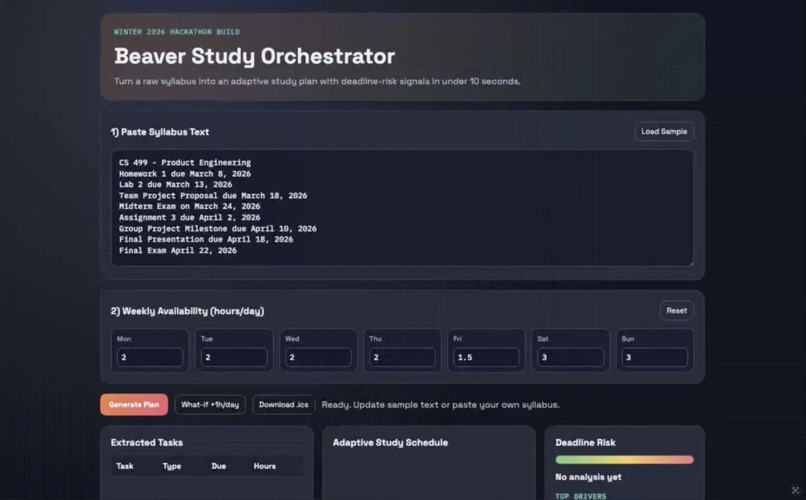
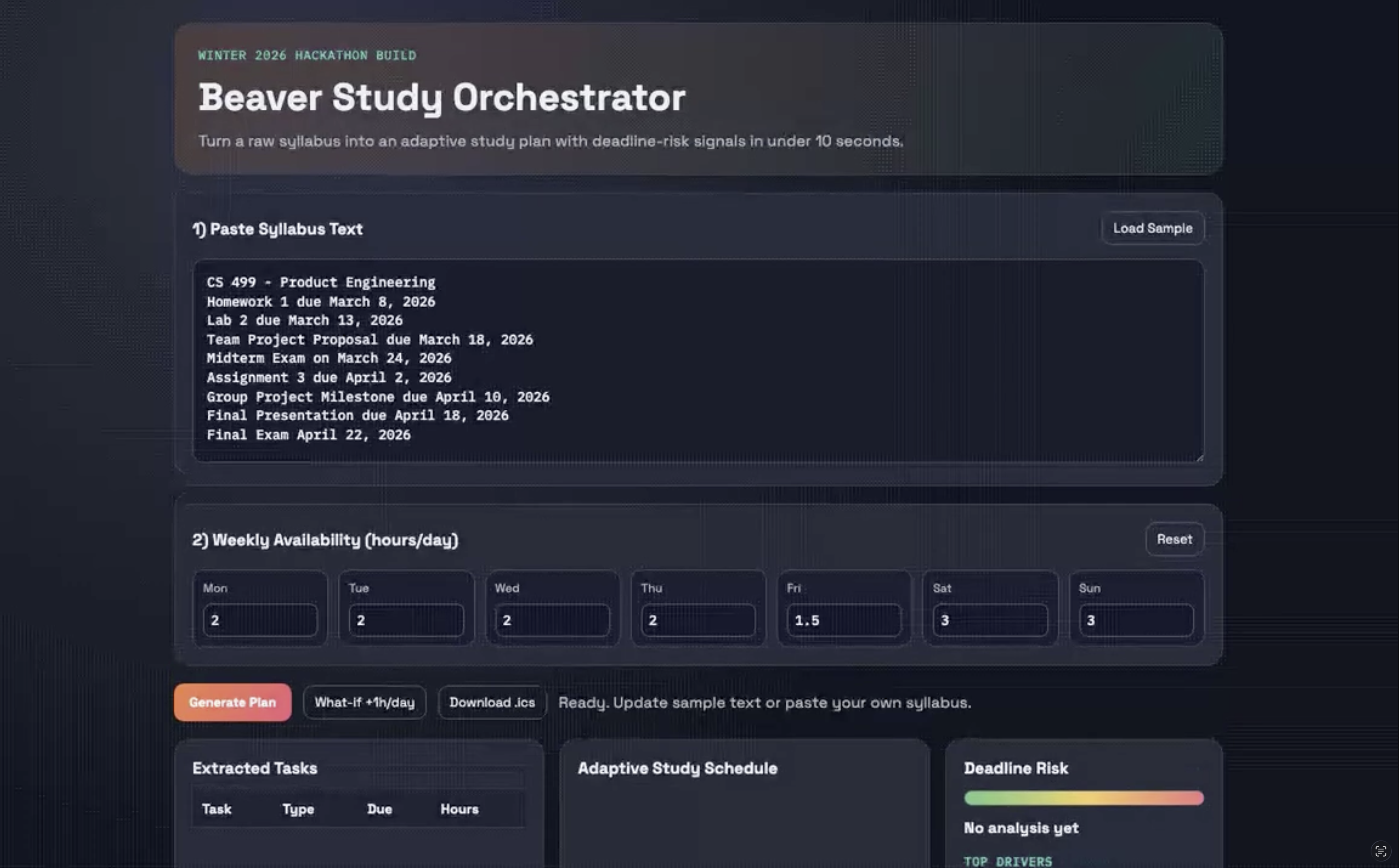
Beaver Study Orchestrator converts free-form syllabus text into an operational study workflow:
- Extracts dated tasks (assignments, labs, projects, exams) from raw text
- Estimates workload and builds an adaptive day-by-day plan from weekly availability
- Calculates an interpretable deadline risk score with top contributing drivers
- Runs a what-if simulation (for example, +1h/day) to show projected risk reduction
- Exports schedule output as .ics so users can execute in Google/Apple Calendar
## How we built it
We built a deterministic full-stack app focused on speed, explainability, and demo reliability:
- Backend: FastAPI with modular core services (syllabus_parser, scheduler, risk_model, calendar_export)
- Frontend: single-page Vanilla JS + HTML/CSS for low-friction demo flow
- Testing: Pytest unit/API tests plus CI on push/PR
Risk modeling is intentionally interpretable rather than black-box. A simplified form is:
[ \text{risk} = \sigma \left( w_1 \cdot \text{coverage_gap} + w_2 \cdot \text{urgency} + w_3 \cdot \text{workload_pressure} + w_4 \cdot \text{capacity_strain} \right) ]
This helped us show why risk is high, not only that it is high.
## Challenges we ran into
- Parsing real-world syllabus language was noisy and inconsistent (mixed formats, partial dates, vague lines)
- Capacity constraints made naive plans look “complete” when they were actually infeasible
- We had to prevent failure states from breaking the demo (for example, no valid due dates found)
- Balancing speed and transparency required careful API/UI design so users could trust the output quickly
## Accomplishments that we're proud of
- Built an end-to-end workflow from text ingestion to calendar export
- Delivered interpretable risk analytics with actionable mitigation guidance
- Added what-if simulation to support decision-making, not just reporting
- Implemented honest spillover reporting when workload exceeds available time
- Shipped with tests and CI, making the project portfolio/interview ready
## What we learned
- In productivity tools, reliability and clarity matter more than model complexity
- Users trust systems that expose constraints and reasoning
- “Execution-ready output” (calendar events, daily workload) creates more value than static analysis
- Deterministic pipelines can be a strong choice when reproducibility and cost control are priorities
## What's next for Beaver Study Orchestrator
- Add Google Calendar and LMS (Canvas) direct integration
- Personalize effort estimates using user completion history
- Support multi-course conflict optimization and priority weighting
- Add reminders and progress feedback loops for long-term habit retention
- Expand parser coverage for broader syllabus styles and multilingual inputs
Built With
- cloudflare
- fastapi
- github-action
- html/css
- icalendar
- javascript
- pages
- pydantic
- pytest
- python
- uvicorn

Log in or sign up for Devpost to join the conversation.