-

Main Registry-Backed Beauty Product Authentication Dashboard
-
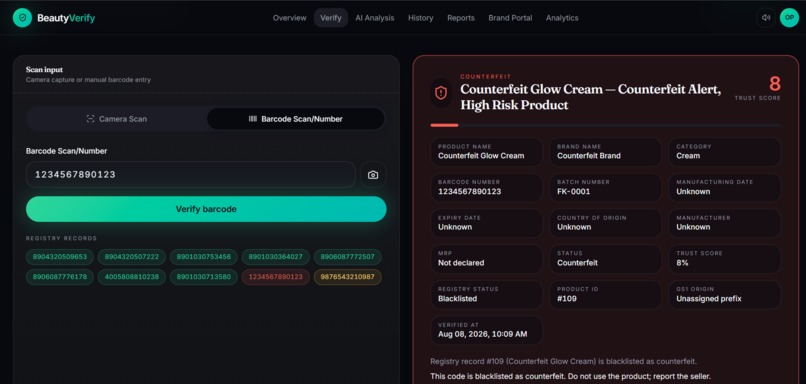
Live Barcode Camera Scanner & Dynamic Trust Score Verification Panel
-
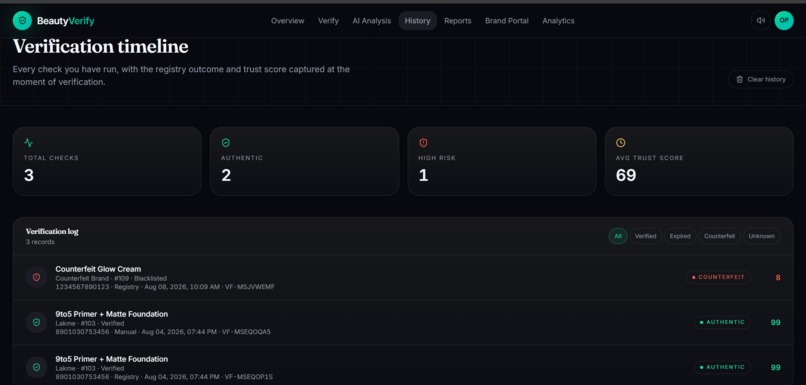
Scan History Log Tracking Authentic vs Fake Barcode Records
-

Real-Time Data Analytics for Brand Protection & Market Insights

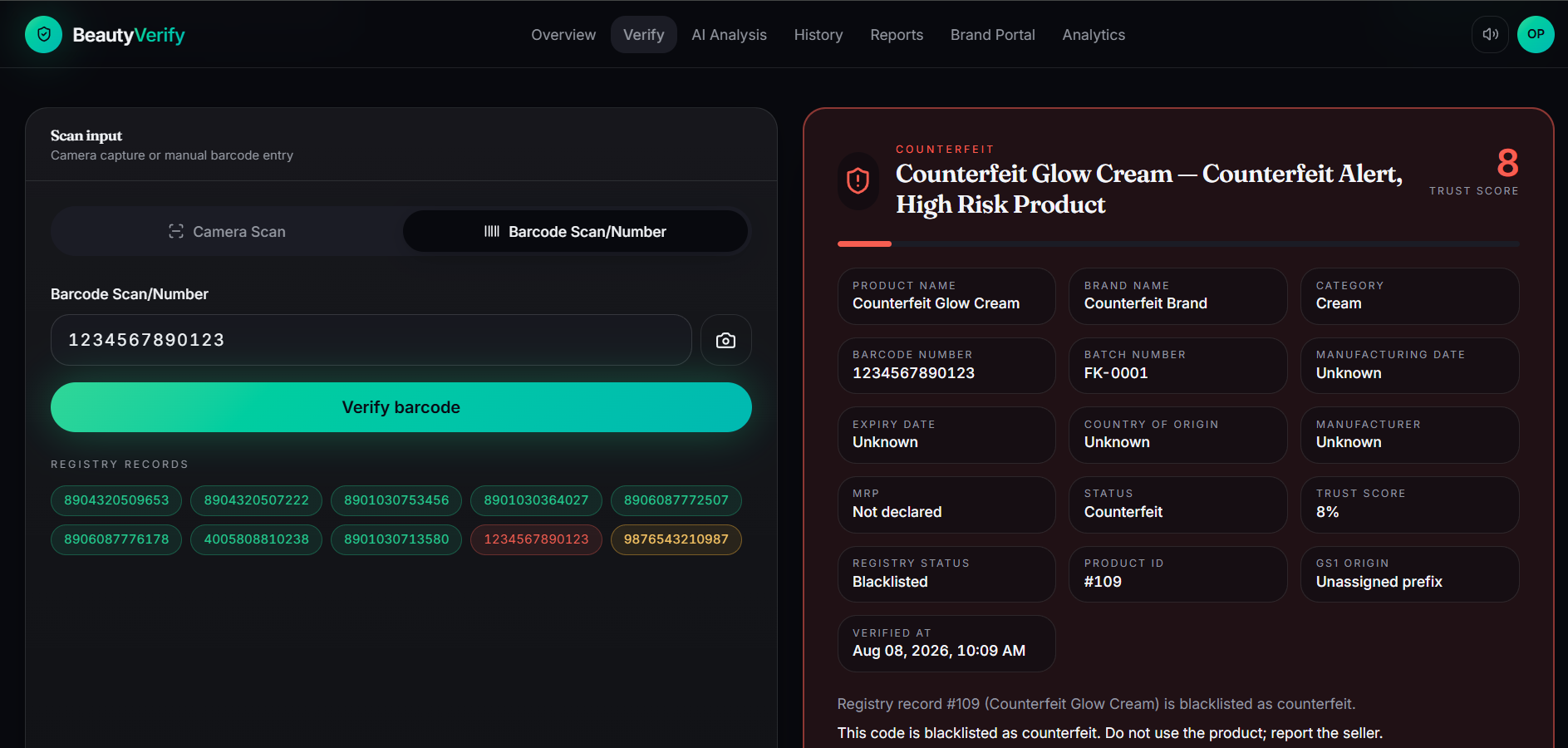
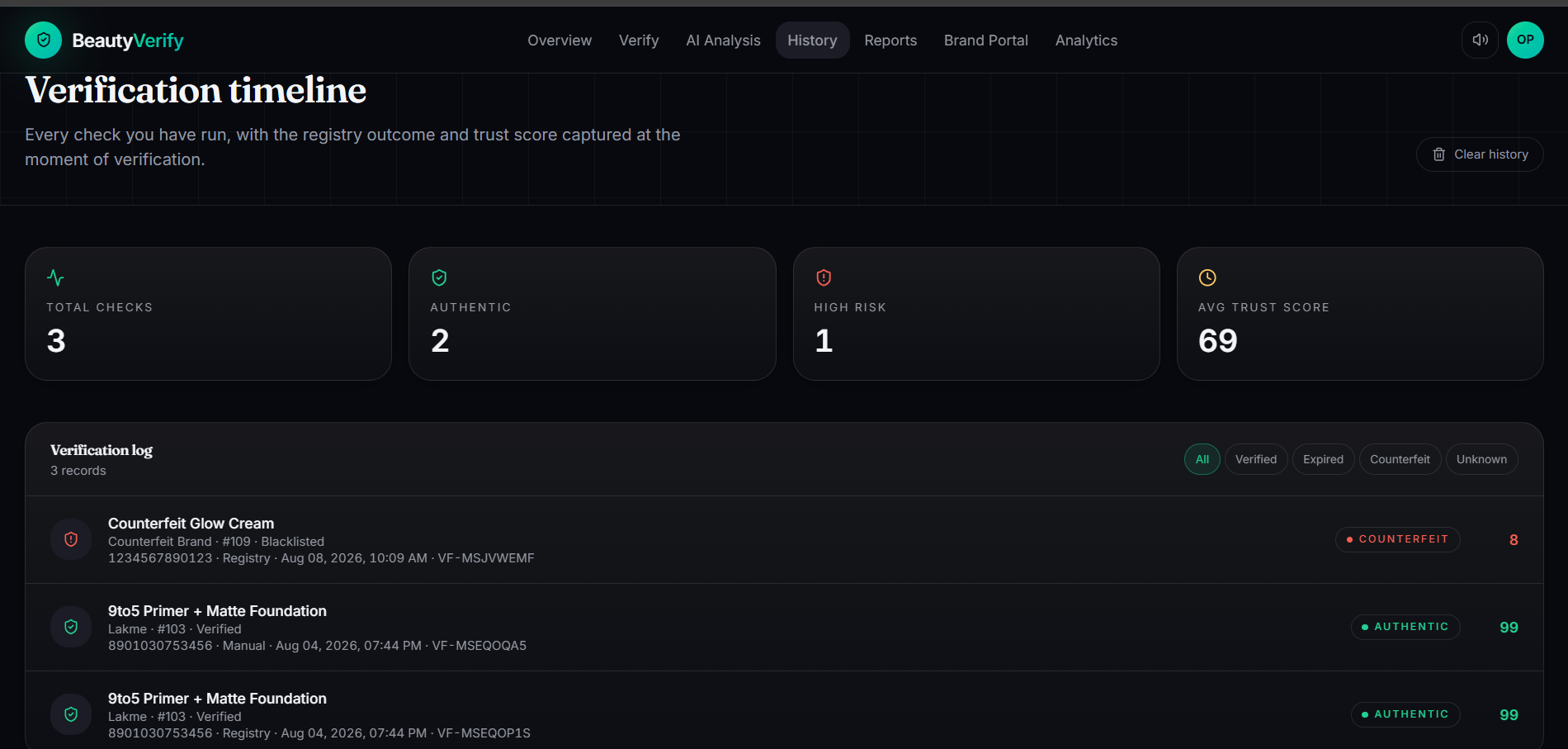

BeautyVerify – AI-Powered Beauty Product Verification
Inspiration
Counterfeit and unauthorized beauty products can be difficult for consumers to identify before purchasing. We wanted to create a simple solution that helps users verify cosmetic products using available product information and provides a clear verification result.
This idea inspired us to build BeautyVerify, a web-based product verification platform designed to help consumers make safer and more informed purchasing decisions.
What We Built
BeautyVerify allows users to verify beauty and cosmetic products using product identifiers such as barcodes and registered product information. The system compares the submitted product details against an authorized product registry and provides a verification result with supporting product information.
The platform is designed around four main capabilities:
- Barcode/Product Verification – checks product identifiers against the authorized registry.
- Product Information – displays details such as brand, product name, batch number, manufacturing/expiry information, and status.
- AI Packaging Analysis – analyzes uploaded product packaging and checks whether the image appears relevant to a cosmetic product.
- Trust-Based Results – provides a verification recommendation based on available registry evidence rather than randomly generating authenticity results.
How We Built It
We developed BeautyVerify as a web application with a focus on a simple and accessible user experience.
The project uses a structured product registry as the source of truth for registered products. The verification workflow normalizes the entered/scanned barcode, searches the registry, and returns the corresponding product information and verification status.
For the AI analysis workflow, the system first checks whether the uploaded image is relevant to a beauty/cosmetic product before providing an analysis result.
The interface was designed to make the verification process easy to understand, even for users without technical knowledge.
What We Learned
While building BeautyVerify, we learned how to:
- Translate a real-world consumer problem into a technology solution.
- Design a verification workflow around structured data.
- Think about AI reliability instead of blindly trusting AI-generated scores.
- Build and test a complete web application.
- Improve user experience through clear verification states and evidence.
- Identify limitations of prototype systems and areas that require real-world integrations.
Challenges We Faced
One of the biggest challenges was making sure the system did not claim that a product was authentic without sufficient evidence.
We therefore focused on making the product registry the source of truth for barcode-based verification and treating unknown products separately instead of guessing their authenticity.
Another challenge was making the camera/barcode verification flow work reliably across different devices and ensuring that the result shown to the user was connected to the correct registered product.
We also had to balance AI functionality with transparency so that the system would not present an unsupported confidence score as a guaranteed authenticity result.
Future Scope
BeautyVerify can be extended by integrating verified manufacturer and regulatory data sources, real-time product databases, stronger image analysis, QR-based verification, and additional anti-counterfeit signals.
Our long-term goal is to make BeautyVerify a practical consumer-facing verification layer that helps people identify suspicious or unauthorized beauty products before making a purchase.
What it does
How we built it
Challenges we ran into
Accomplishments that we're proud of
What we learned
What's next for BeautyVerify
Built With
- ai
- authentication
- base44
- database
- react

Log in or sign up for Devpost to join the conversation.