-
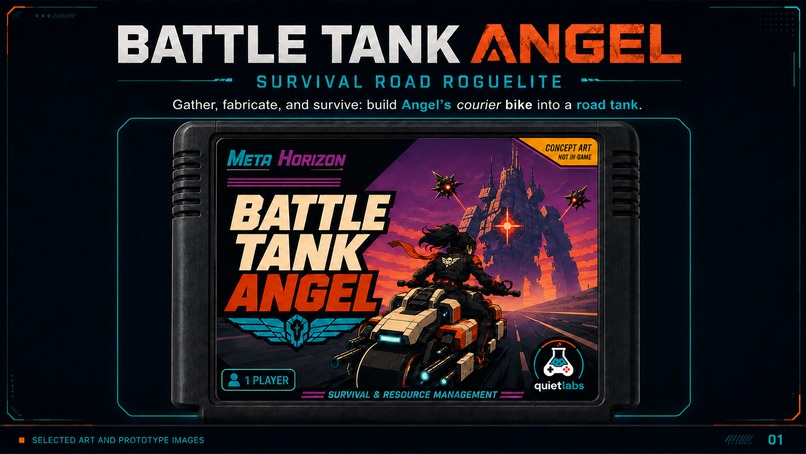
Battle Tank Angel — a five-minute Survival & Resource Management road roguelite.
-
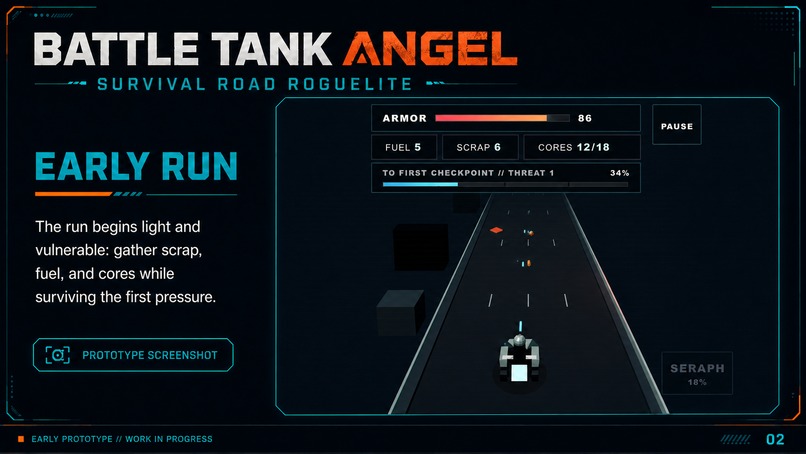
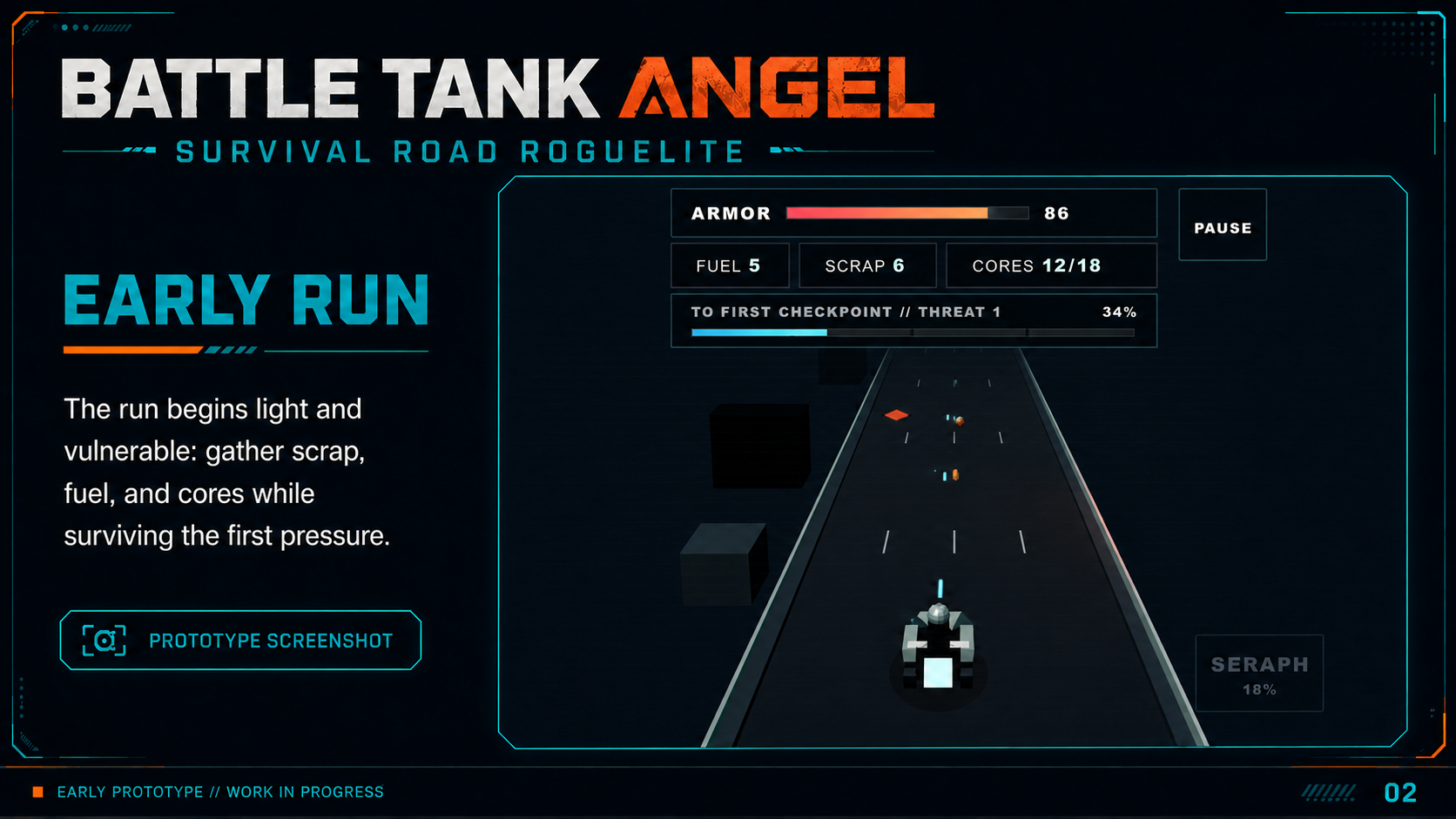
Early run: steer toward scrap, fuel, and machine cores while surviving the sector’s opening pressure.
-
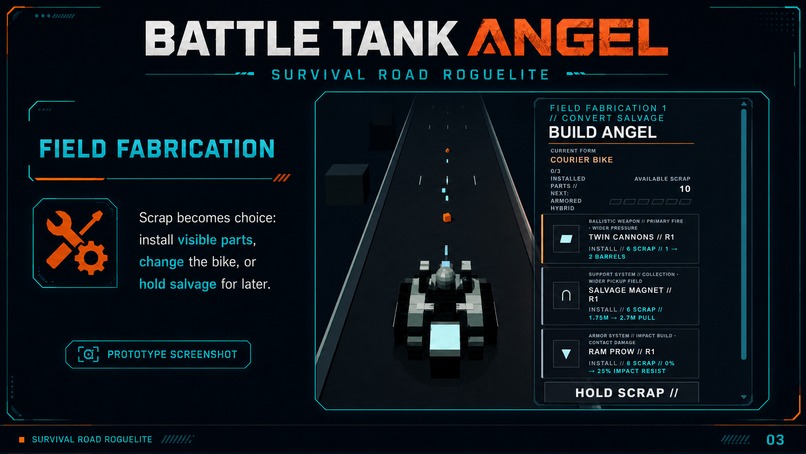
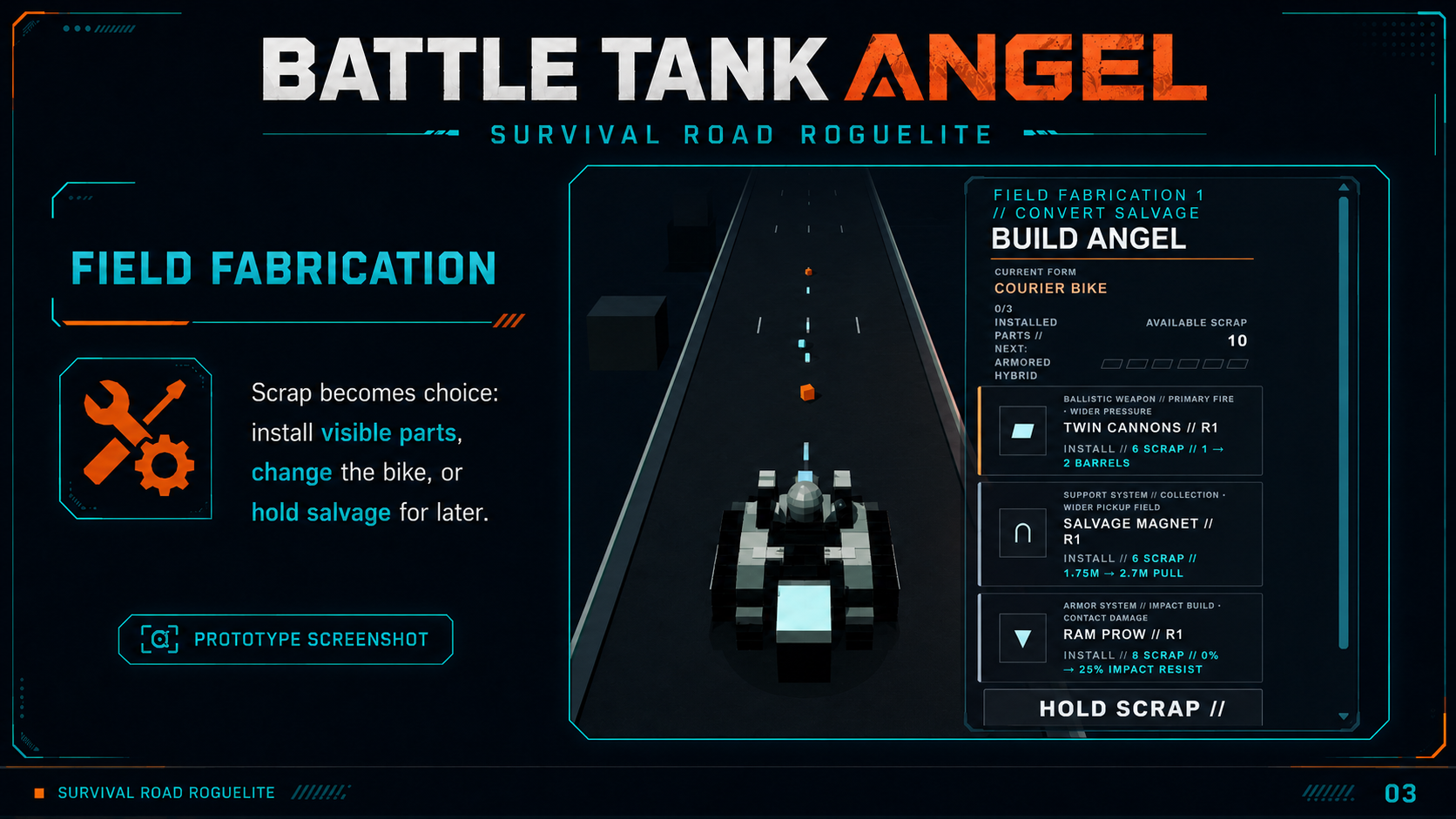
Convert collected scrap into visible weapons, defenses, and support systems—or hold it for stronger upgrades and emergency repairs.
-
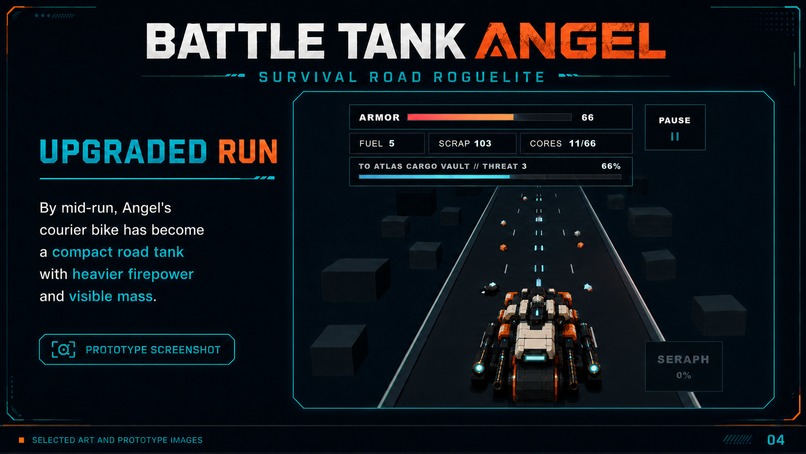
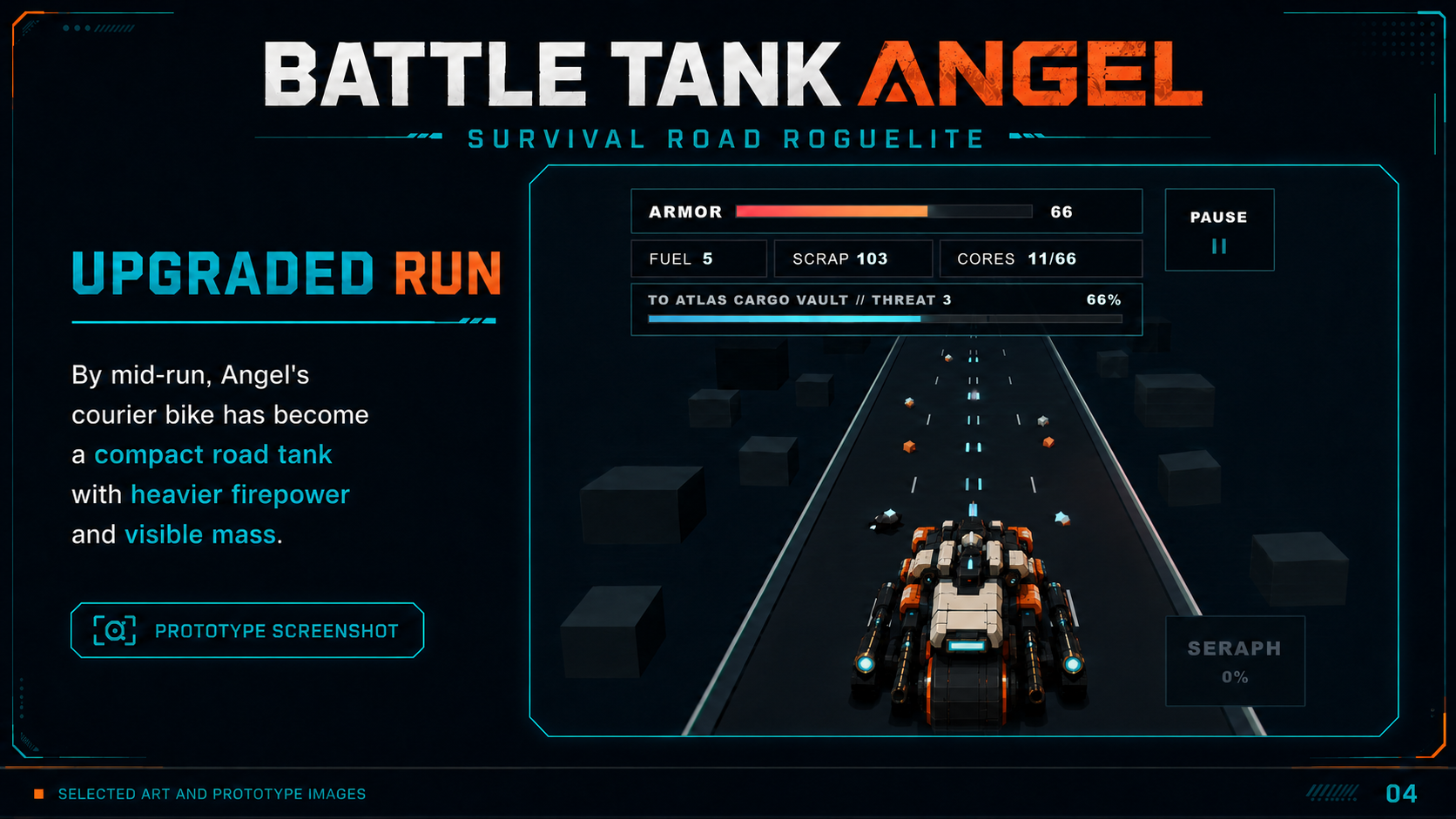
Fabricated parts transform Angel’s vulnerable courier bike into a heavier road tank with greater firepower and survivability.
-
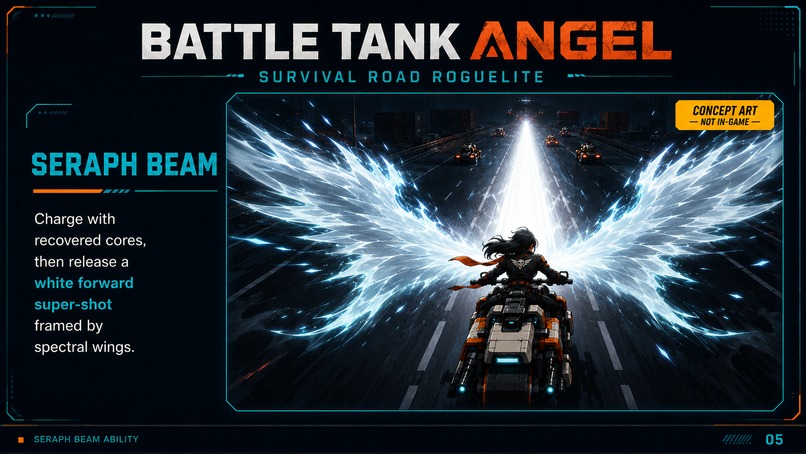
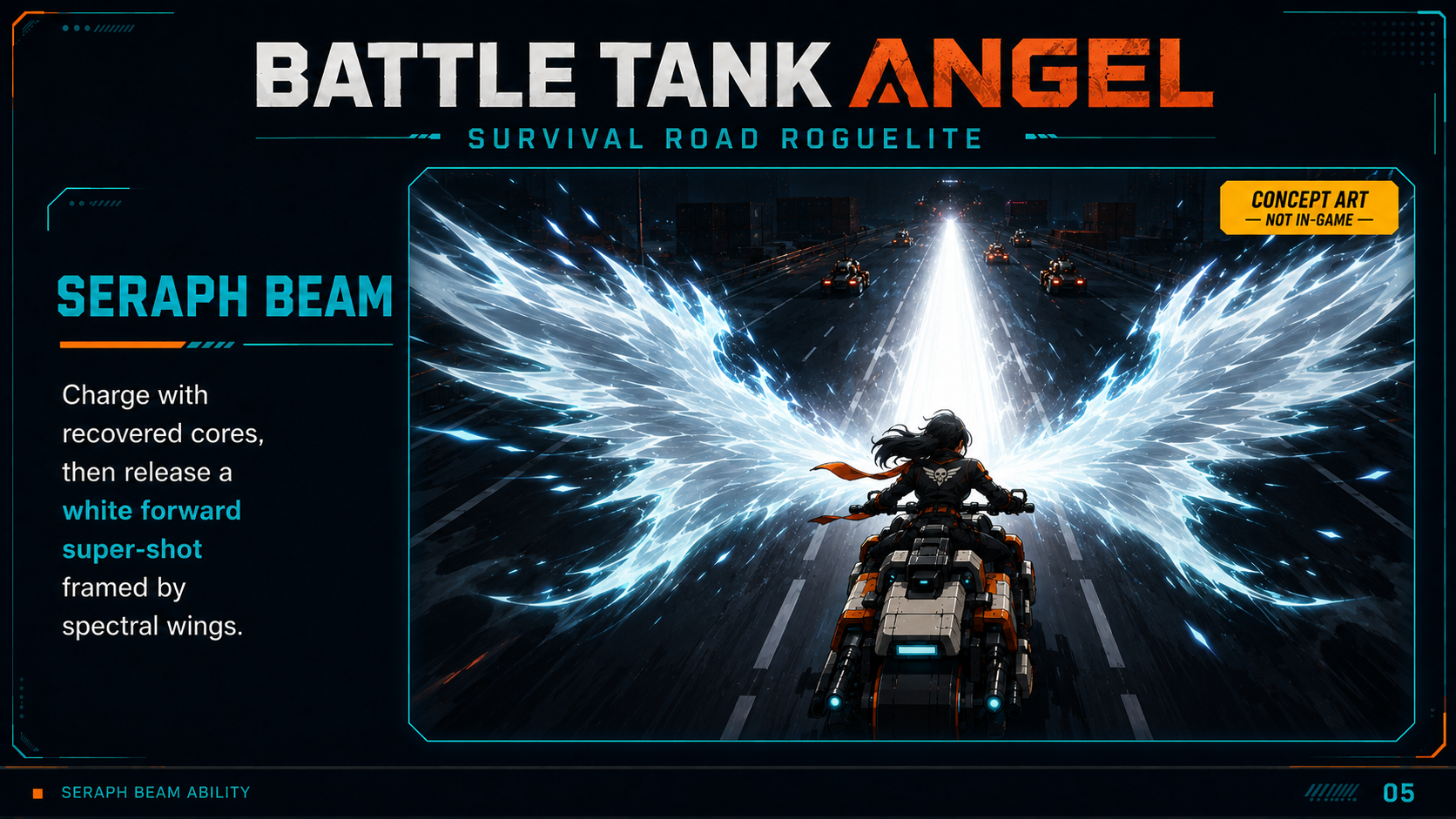
Seraph Beam concept art: recovered cores charge a player-triggered, lane-clearing super weapon. Concept art—not in-game.
-
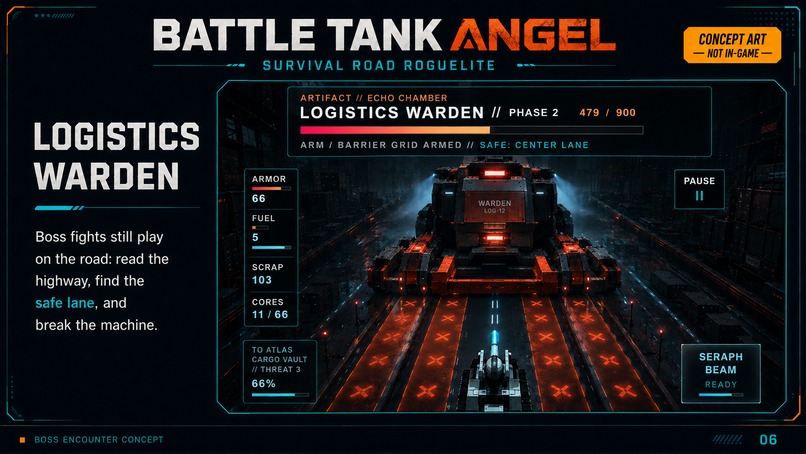
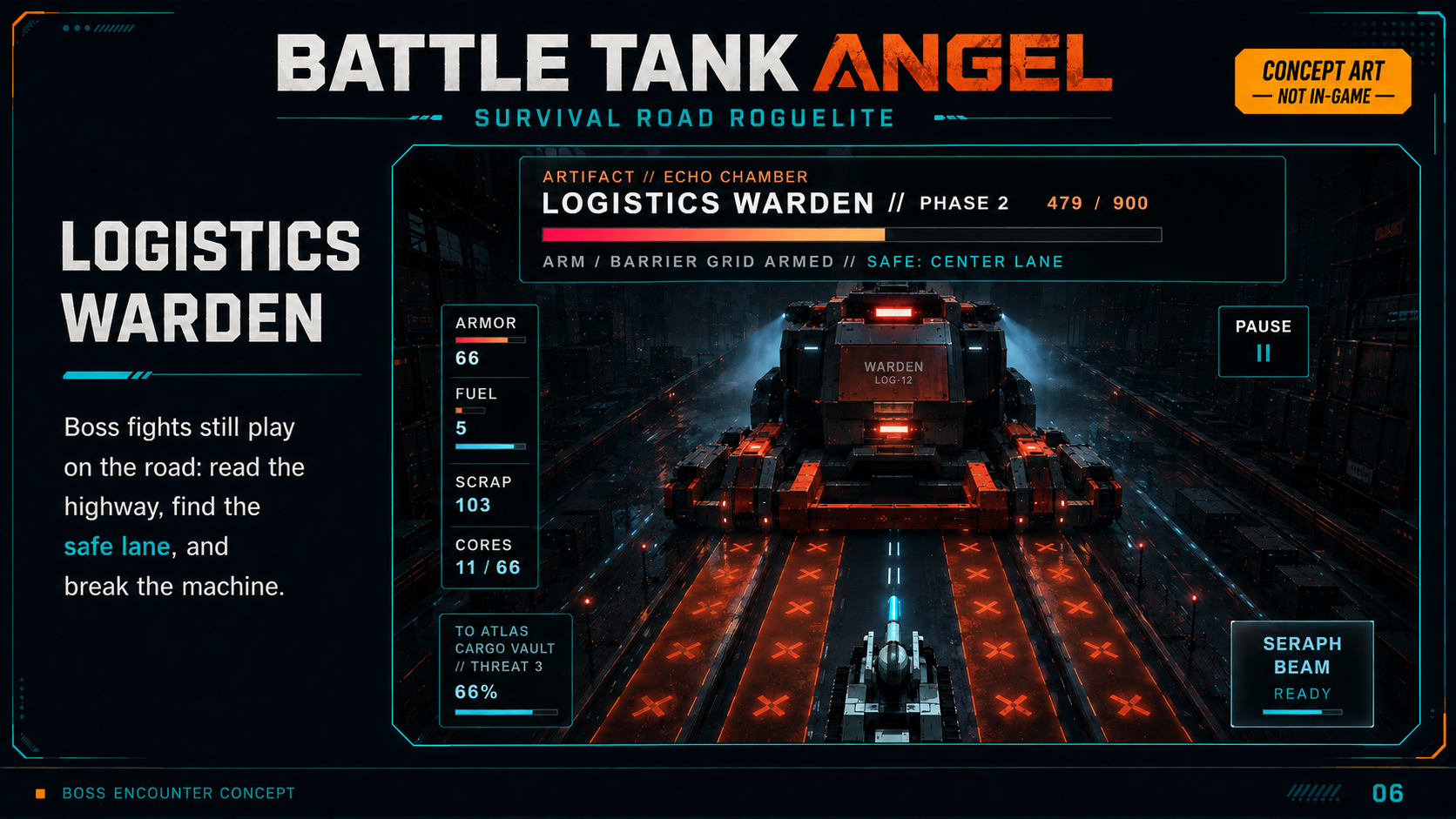
Logistics Warden concept art: escalating threats culminate in a multi-phase boss fight built around reading and surviving the road.
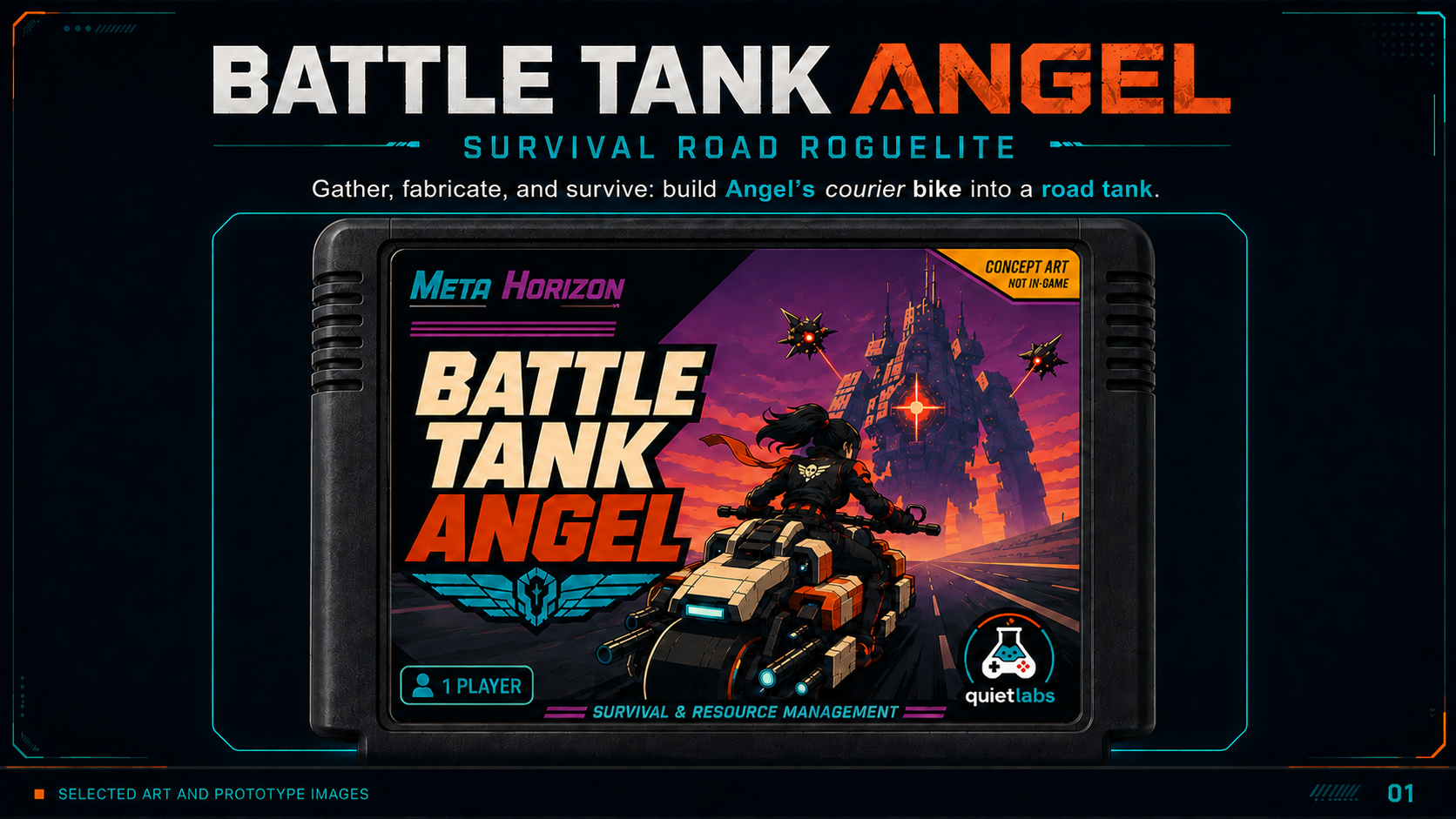
Battle Tank Angel
Battle Tank Angel is an approximately five-minute portrait Survival & Resource Management road-combat roguelite.
You play as Angel, a courier carrying a last-chance device through a freight sector controlled by a machine Kill Order. Her bike fires automatically while you steer through enemies and hazards, collect machine cores, scrap, and fuel, and decide how to turn those limited resources into enough power to survive.
The core loop
Fight and gather → turn scrap into tools and defenses → spend fuel to choose the next road → survive stronger pressure.
Machine cores charge Angel's field fabricator. When it opens, every offered system has a visible scrap cost. You can build a weapon, defense, repair, or support system immediately, or save your scrap for stronger ranks and emergency recovery later.
Every installed part changes both how the bike plays and how it looks. Over the course of a run, Angel's Courier Bike grows into an Armored Hybrid and eventually a compact Road Tank.
At checkpoints, fuel is spent to climb a partially revealed route map. Combat, salvage, repair, event, and vault stops create different risks and rewards while enemy durability, population, and hazards steadily increase. Run out of fuel and Angel can force an Emergency Burn by sacrificing armor. If her armor reaches zero, the run ends.
Core features
- Two-axis portrait steering with automatic forward fire.
- A complete successful run in roughly five minutes.
- Twelve fabricatable system lines with three ranks and visible scrap costs.
- A real save-or-spend tension between upgrades, repairs, and fuel.
- A visible Courier Bike → Armored Hybrid → Road Tank transformation.
- Seraph Drive, a player-triggered super attack charged through kills and near misses.
- Hunter Drones that visibly orbit Angel and automatically strike enemies.
- A climbing route map with rising threat and one-fuel roads.
- An optional Atlas Cargo Vault breach with a persistent Vaultbreaker Cannon reward.
- The Gatekeeper miniboss, three build-changing artifacts, and a three-phase Logistics Warden finale.
- Victory, defeat, recovery, retry, and modest garage progression.
- A fully local Three.js and Web Audio runtime with no external requests.
How AI and Codex were used
The game was built through an iterative workflow with OpenAI Codex and ChatGPT. AI helped shape the original idea, reduce it to one focused Sector One prototype, implement the single-file Three.js game, write interface and narrative copy, and create the required project documents.
Codex was also used as a development partner during playtesting. Hands-on notes were turned into targeted fixes to controls, upgrades, UI clarity, fuel pressure, encounters, bosses, pacing, and reliability.
It also built deterministic browser tests and stress-tested thousands of route and boss seeds.
Generated-art experiments were tested at actual gameplay scale and removed when they made the game harder to read. The final build uses original procedural Three.js visuals and local procedural Web Audio.
Testing
The release candidate passes nine ordered browser test suites covering combat behavior, fabrication costs, fuel failure, saves, bosses, Atlas encounters, controls, five-minute pacing, performance, and a freshly extracted offline ZIP.
Route and boss systems were also stress-tested across thousands of deterministic seeds.
The prototype contains Sector One only. Additional riders, later sectors, and the central-machine finale are future ideas, not shipped features.
Built With
- html5
- javascript
- openai-codex
- playwright
- three.js
- web-audio-api


Log in or sign up for Devpost to join the conversation.