-
-
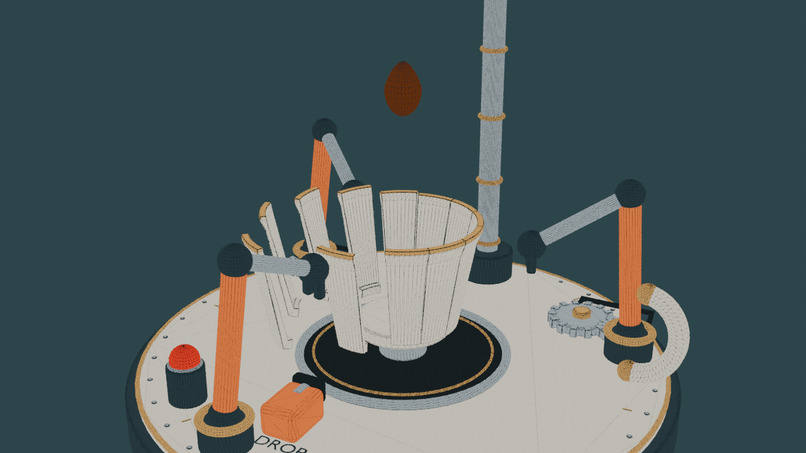
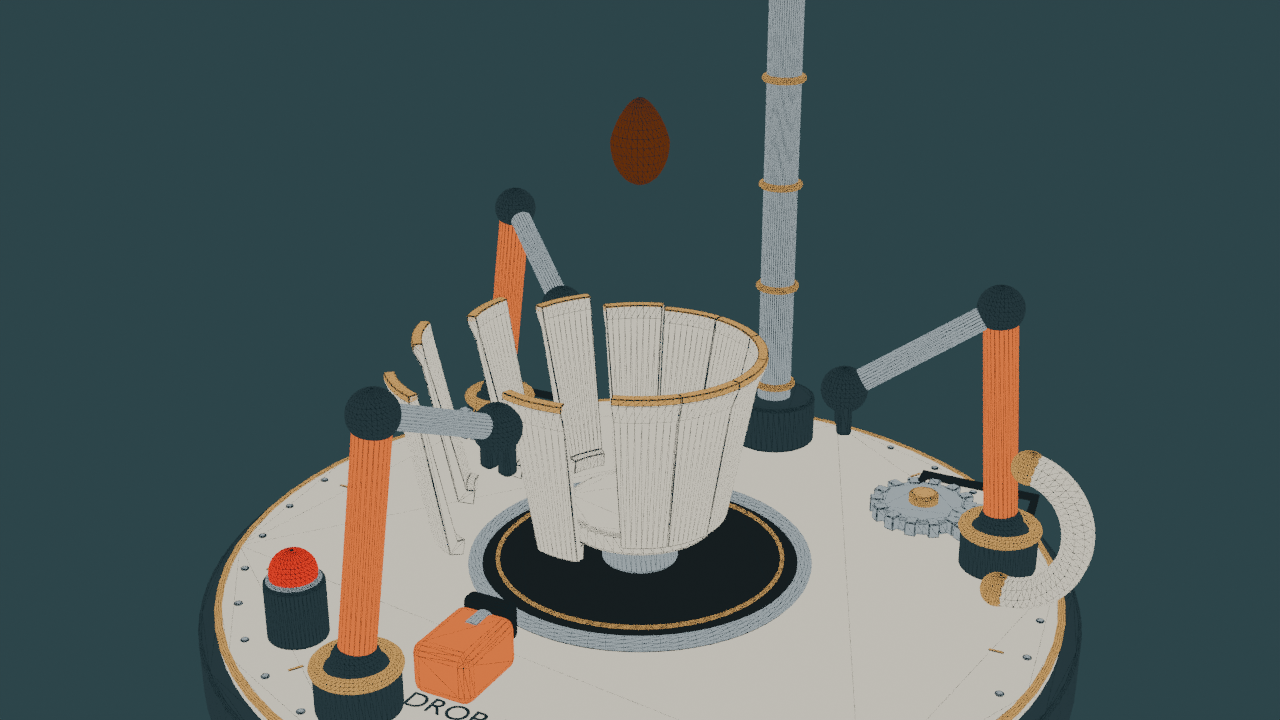
Blender work in progress: wireframe render of the actual procedural cup-assembly scene.
Beat the Drop
A miniature machine has one job: build a cup before a falling coffee drop reaches the table. Twelve ceramic sections rise into position. One jams. A piston pushes it home just in time for the catch. Then a much larger sugar cube arrives.
Created by Kumar Abhinav with ChatGPT assistance.
Interpreting Speed
Speed is a deadline measured by a single falling drop. The coffee moves in stylized slow motion while the machine works through an increasingly urgent assembly sequence. The contrast gives a small event the pressure of a last-second rescue.
How it was built
Blender is the primary creation tool. Python and bpy generate the scene geometry, materials, lights and camera, including twelve curved cup sections, a separate handle, articulated machine arms, hatch leaves, rotating gears and the rescue piston.
The script calculates the movement at each frame and bakes it into ordinary Blender keyframes. It controls the assembly order, the jam and rescue timing, the drop's time ramp, the camera path and the final sugar-cube reveal. The result is a 26-second animation with 624 native frames at 24 fps, rendered with Cycles.
The soundtrack was synthesized in Python with NumPy. It uses motor tones, clicks, a servo squeak, a wet plink and alert sounds. FFmpeg assembles the frames and audio and adds the title cards.
Procedural and programmatic workflow
This entry is intended for consideration for Best Procedural & Programmatic Animation. The automation creates the actual geometry and animation in the film. An editable .blend file and the Python source are retained for verification.
The motion is authored choreography. The coffee impact uses animated geometry and is not a fluid simulation. No RenderJuice API or cloud rendering was used for the current version.
Work in progress and validation
The Blender work-in-progress image is a wireframe render of the actual scene during assembly. It exposes the modeled geometry; it is not a screenshot of Blender's interface.
All 624 rendered PNG frames were checked for integrity. The exported MP4 was decoded successfully and checked for a 26-second duration, 24 fps and stereo audio.
AI and third-party disclosure
ChatGPT assisted with concept development, Python scripting and iteration. The scene geometry and soundtrack were created programmatically for this project. No generative-video footage, stock 3D models, sampled music or stock sound effects were used. Blender's bundled Bfont appears in the scene; the video titles use DejaVu Sans.
Current version
The available video is a complete 640 x 360 review render with sound. The editable project is configured for a higher-resolution render. A camera transition near 20 seconds remains a planned refinement before a final render.