Inspiration
The best tabletop puzzles are the ones you can fiddle with: you pick a piece up, turn it over, try it somewhere else. Hand tracking should make that feel better in VR than on any screen, yet most hand-tracked games still ask you to point at things from across a room. Beamwright starts from the opposite idea: a puzzle the size of a chessboard, floating at your fingertips, that you play sitting down.
What it does
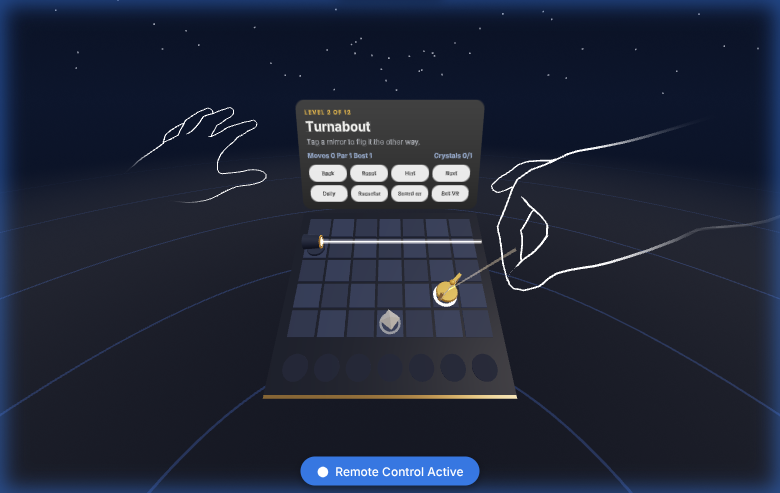
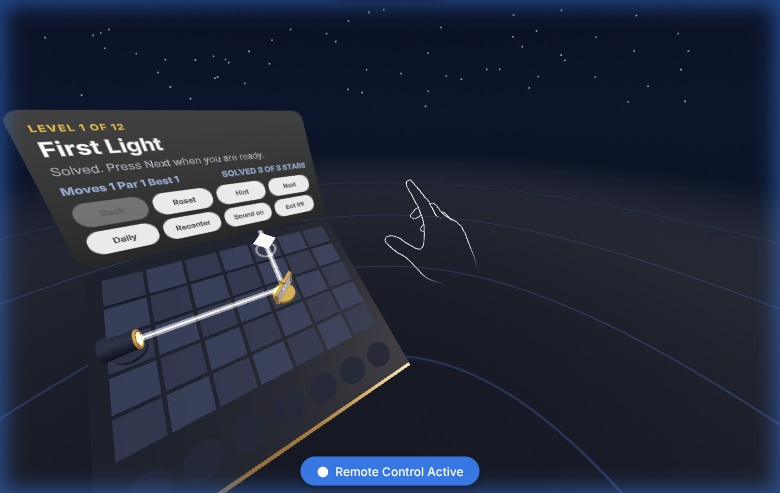
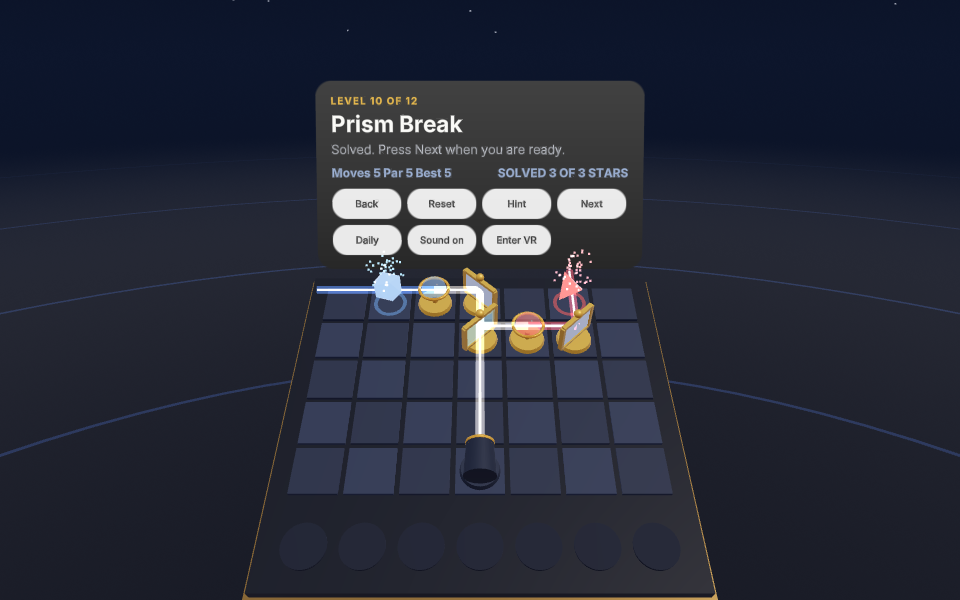
A beam of light crosses a small board. You pinch brass mirrors out of a tray and set them down to bend the beam into crystals. A quick pinch flips a mirror; so does twisting your wrist while you carry it. The beam re-traces live as the piece moves, so you see the answer forming in your hand.
Later levels add splitters, colour filters and colour mixing: red and green beams must cross to light a yellow crystal. There are 12 handcrafted levels and a Daily Beam, a freshly generated puzzle each day with a streak counter.
How I built it
Beamwright is a WebXR app built with Meta's Immersive Web SDK, TypeScript and Three.js. Three decisions shaped it:
- The pinch point is between your fingertips. The pick-up point is the midpoint of the thumb and index tips, read from the hand joints, because that is where you are looking when you pinch something small.
- Letting go must not move the piece. A carried piece rides the palm, not the fingers, and the drop tile only counts once your hand has rested on it for a moment.
- Near and far are one gesture. A hand close to the board manipulates directly; hold it back and it becomes a pointing ray. Nobody has to lean.
Every level is checked by a brute-force solver that proves it is solvable and finds the true minimum number of moves, and the daily generator is validated two years ahead. All models are procedural and all sound is synthesised at runtime, so the whole game is a 3.6 MB download with no loading screens.
Challenges
The hardest problem was the moment of release. Opening a pinch shifts your fingertips by a centimetre or two, which was enough to hop a piece onto the neighbouring tile, and enough to turn a quick tap into an accidental drag. Fixing it meant tracking the palm instead of the fingertips while carrying, adding a short dwell before a drop target counts, and separating "tap" from "carry" by time as well as distance.
What I learned
Hand input is mostly about forgiveness. The interactions that feel precise are the ones that quietly ignore the noise in what your fingers are doing.
Designed for the brief
The board spawns within forearm reach, tilted toward a seated player, and fits in a two-foot radius. A level takes about a minute. Every action, menus included, works with bare hands; controllers are optional. Crystals differ by shape as well as colour, and either hand can play alone.
What's next
More tuning on Quest 3 and 3S across different hands and lighting, a passthrough mode that anchors the board to a real table, a level editor with shareable codes, and packaging for the Horizon Store.
Built With
- github
- immersive-web-sdk
- meta-quest
- three.js
- typescript
- vite
- web-audio-api
- webxr


