-
-
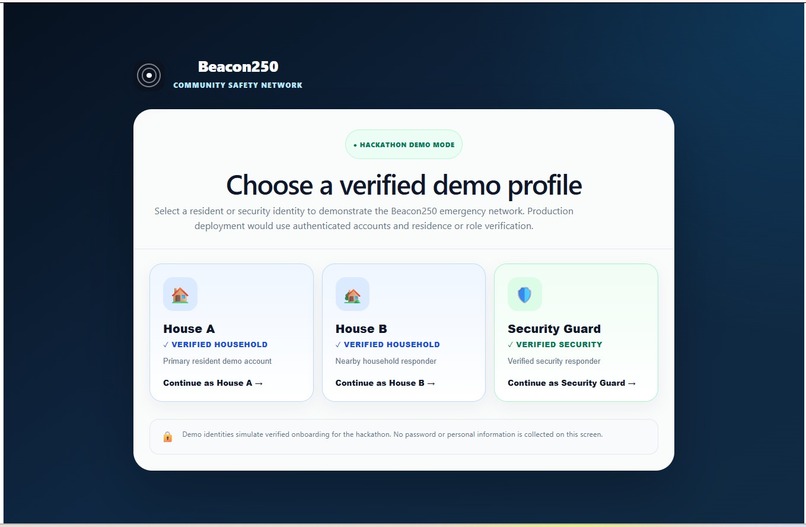
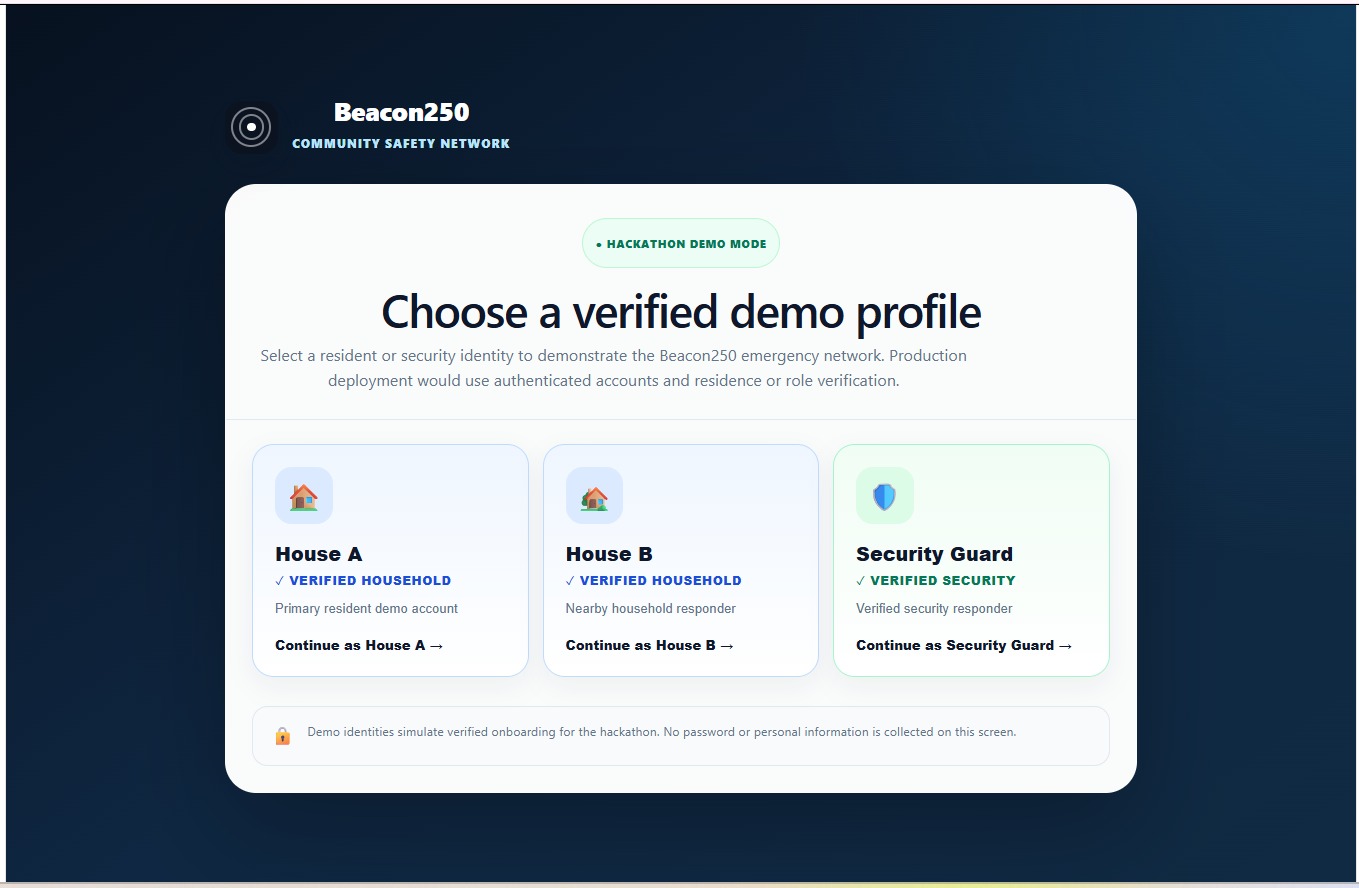
Demo Profiles Simulated verified profiles for House A, House B, and Security Guard demonstrate the complete Beacon250 response network.
-
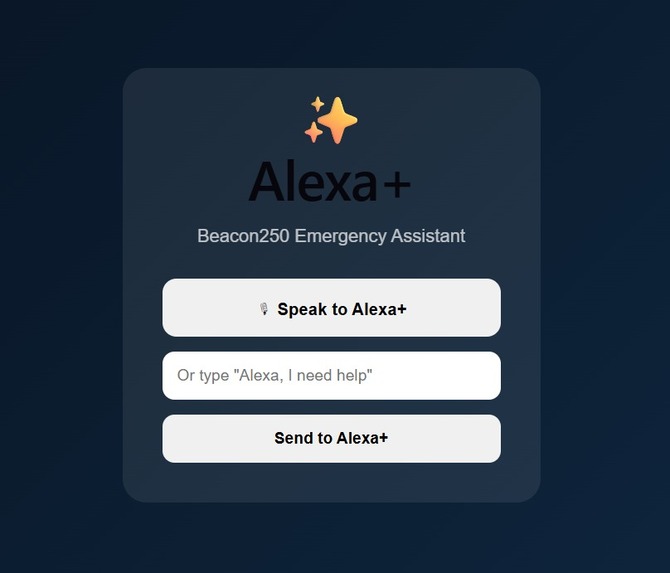
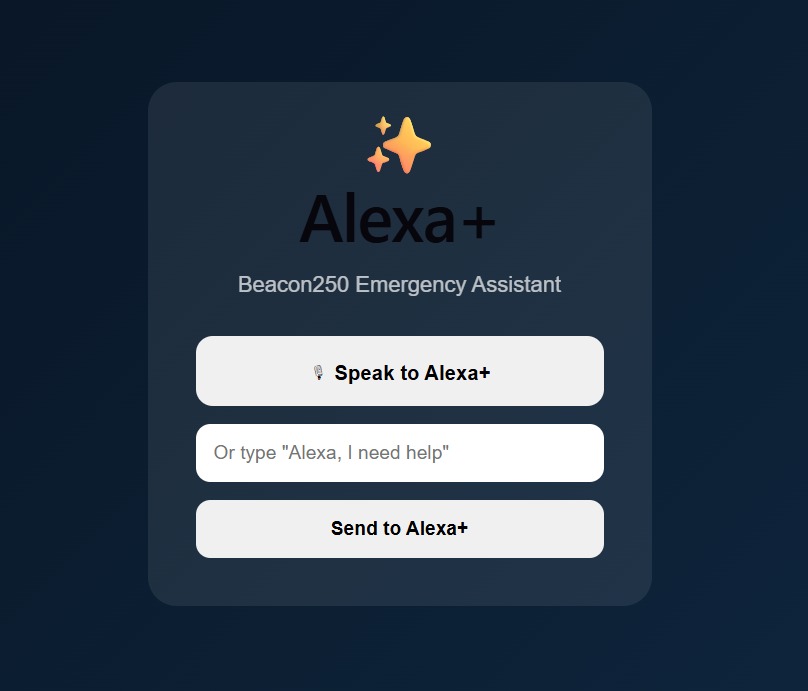
Alexa+ Simulated Alexa+ emergency assistant enables hands-free or typed SOS activation through Beacon250's MCP workflow.
-
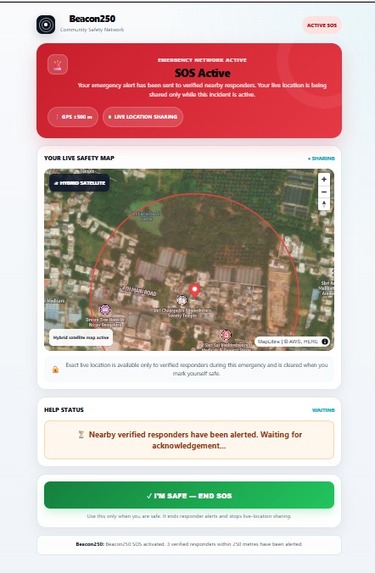
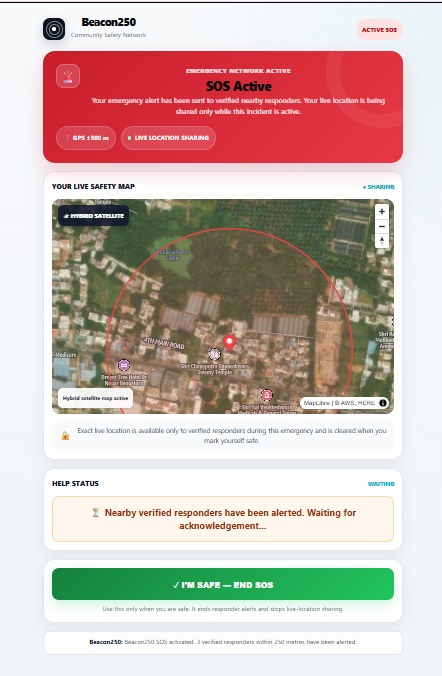
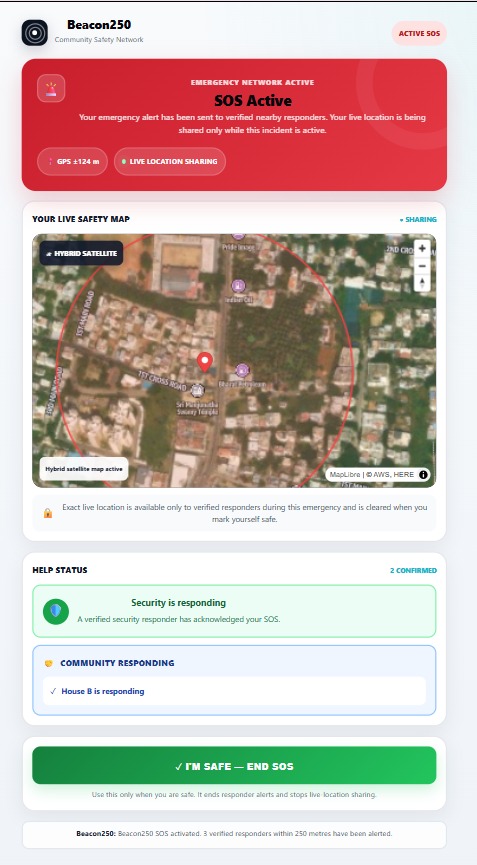
Victim Map Live SOS view with hybrid satellite mapping, approximately 250 m response zone, and temporary live-location sharing.
-
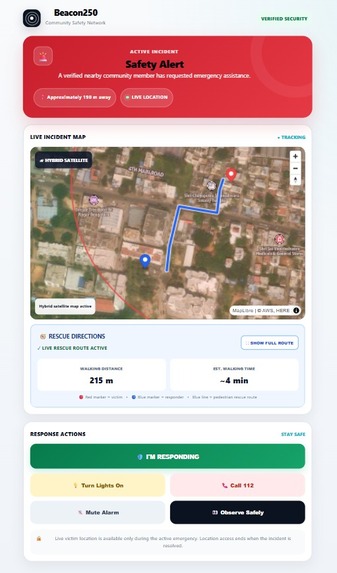
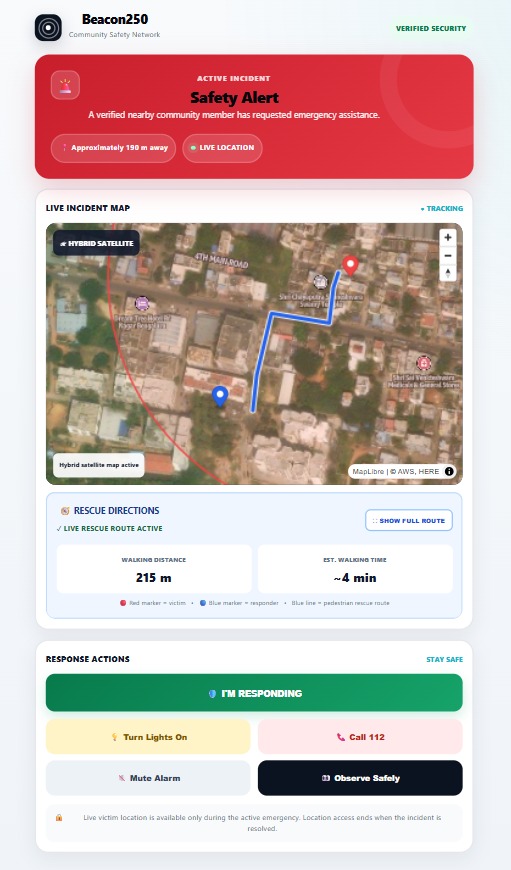
Responder Route Amazon Location Service provides responders with a pedestrian rescue route, walking distance, and estimated travel time.
-
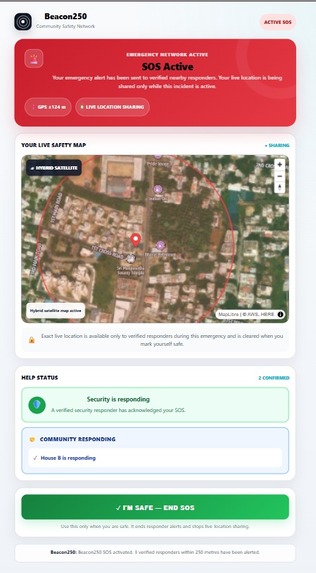
Responder Confirmation Beacon250 gives the victim real-time confirmation when nearby household and security responders acknowledge the SOS.
Inspiration
Inspiration
During an emergency, professional help may take several minutes to arrive, while trusted households or security personnel may already be only a few hundred metres away. Beacon250 was inspired by the idea of using this nearby community as an immediate first layer of assistance during the critical minutes before professional help arrives.
What it does
Beacon250 is a hyper-local community safety network that connects a person in danger with nearby verified demo households and security responders within approximately 250 metres.
An emergency can be activated using the in-app SOS button or through our simulated Alexa+ emergency assistant.
Once activated, Beacon250:
- obtains the victim's live location
- identifies eligible nearby responders
- excludes the requesting household itself
- alerts nearby households and security in real time
- shares the victim's live incident location during the active emergency
- displays a hybrid satellite map
- calculates a pedestrian rescue route using Amazon Location Service
- shows walking distance and estimated travel time
- allows responders to select “I'M RESPONDING”
- immediately sends responder acknowledgements back to the victim
- allows the victim to end the incident using “I'M SAFE — END SOS”
For the hackathon prototype, House A represents the person requesting help, House B represents a nearby household responder, and the Security Guard represents a verified security responder.
How we built it
The Beacon250 frontend was built with React and Vite, while Node.js and Express power the backend services.
The simulated Alexa+ interface communicates with a gateway that connects to our self-hosted Model Context Protocol server. The MCP server exposes the emergency SOS action and connects the conversational interaction with the Beacon250 emergency workflow.
Socket.IO provides real-time communication for emergency alerts, victim-location updates, responder acknowledgements, and incident resolution.
Amazon Location Service provides the hybrid satellite mapping experience and pedestrian routing between responders and the incident location.
MapLibre is used to render the interactive map, while Turf.js supports the approximately 250-metre safety-zone visualization and geospatial logic.
Browser Geolocation provides the victim's current location and live updates during an active incident.
Challenges we ran into
One of the biggest challenges was connecting the simulated Alexa+ experience, gateway, self-hosted MCP server, and Beacon250 backend into one reliable emergency workflow.
Browser voice recognition also behaved differently across environments and worked more reliably in standard Chrome and Edge than in embedded development browsers.
Another challenge was distinguishing straight-line responder eligibility from actual pedestrian route distance. A responder may be geographically within approximately 250 metres while the real walking route is longer because roads and paths must be followed.
Live browser geolocation can also vary in accuracy depending on the device and network, so Beacon250 displays GPS accuracy where appropriate.
Accomplishments that we're proud of
We built a working end-to-end prototype that demonstrates:
- SOS activation through Alexa+ and the application interface
- a self-hosted MCP emergency tool
- real-time household and security alerts
- live emergency-location sharing
- hybrid satellite mapping
- pedestrian rescue routing
- walking distance and estimated travel time
- real-time responder acknowledgements
- coordinated incident resolution
We are especially proud that the system does not leave the victim wondering whether anyone received the emergency. The victim can see when nearby responders have actually acknowledged the SOS.
What we learned
Building Beacon250 helped us understand how conversational interfaces, MCP, real-time communication, browser geolocation, mapping, and routing can work together in a single safety workflow.
We also learned the importance of keeping emergency actions deterministic. When a user explicitly activates SOS, Beacon250 treats that action as intentional rather than asking an AI model to decide whether the emergency is genuine.
What's next
Future versions of Beacon250 could include authenticated household and security accounts, stronger identity verification, native mobile applications, broader emergency-service integration, and improved accessibility.
For low-connectivity areas, Beacon250 could also extend through offline safety poles with physical emergency switches and long-range alerts. This is a future concept and is not part of the current working prototype. \
Built With
- alexa+
- amazon-location-service
- amazon-web-services
- css
- express.js
- geolocation-api
- html
- javascript
- maplibre
- mcp
- model-context-protocol
- node.js
- react
- socket.io
- turf.js
- vite
- web-speech-api


Log in or sign up for Devpost to join the conversation.